India to Build World’s Largest Solar Plant

Madhya Pradesh government has inked a pact with IFC, member of the World Bank Group, to set up the world’s largest solar energy plant with a capacity of 750 MW.

The Rewa Ultra-Mega Solar Power Project will be set up in Gurh tehsil of Rewa district over an area of 1,500 hectares at an estimated cost of Rs 4,500 crore.

The project will be the largest single-site solar power project in the world, a release said.

The Memorandum of Understanding (MoU) was signed between Madhya Pradesh Renewable Energy Development Corporation and IFC.

“Successful implementation of the Rewa Ultra-Mega Power project will be a key milestone for Madhya Pradesh’s outstanding efforts and leadership in renewable energy and the Centre’s remarkable vision on solar power,” the state’s Energy Minister Rajendra Shukla said.

IFC, which is working with the Union government to assist in meeting its large-scale solar energy generation goals, is also supporting the state government for the project.

Moreover, IFC will extend its global expertise to structure and implement the transaction to help attract private investments of about USD 750 million.

Madhya Pradesh Urja Vika Nigam Limited (MPUVN) and the Solar Energy Corporation of India have created a joint venture company — Rewa Ultra-Mega Solar Power Limited — to implement the project.

“With this project, India can demonstrate to the world that innovative business models and partnerships to build scale can help achieve challenging goals.

“IFC is privileged to be part of India’s and Madhya Pradesh’s determined approach to build a sustainable future,” IFC’s Regional Director for South Asia Mengistu Alemayehu said.

Solar Power

Hollande Declares Economic Emergency in France

French President Francois Hollande pledged Monday to redefine France’s business model and declared what he called “a state of economic and social emergency,” unveiling a 2-billion-euro ($2.2 billion) plan to revive hiring and catch up with a fast-moving world economy.

The measures he proposed, however, are relatively modest, and he said they would not “put into question” the 35-hour workweek. With his country under a state of emergency since extremist attacks in November, Hollande did not seek to assume any new emergency powers over the economy.

In an annual speech to business leaders, Hollande laid out plans for training half a million jobless workers, greater use of apprenticeships, and aid for companies that hire young workers.

Hollande’s Socialist government has struggled to boost long-stagnant French growth or reduce chronic unemployment, which has been around 10 percent for years. His chances of winning a potential second term may hinge on whether jobs pick up before next year’s presidential vote.

Hollande stressed the urgency of updating France’s labor-friendly business model in an increasingly border-free, online economy. The measures included a loosening of France’s rigid working time rules, and a bonus of 2,000 euros to small businesses that hire young people.

He stressed the need to integrate youth from France’s troubled suburbs, including minorities who face job discrimination, into the global economy. High unemployment in France’s North African and African communities is seen as one of the factors driving some youths to violent extremism or the drug trade.

Some measures will be included in draft economic reform laws the government is presenting to parliament in the coming weeks.

Hollande


IMF Looks at Subdued Global Growth

The IMF reports:  In 2015, global economic activity remained subdued. Growth in emerging market and developing economies – while still accounting for over 70 percent of global growth – declined for the fifth consecutive year, while a modest recovery continued in advanced economies. Three key transitions continue to influence the global outlook: (1) the gradual slowdown and rebalancing of economic activity in China away from investment and manufacturing toward consumption and services, (2) lower prices for energy and other commodities, and (3) a gradual tightening in monetary policy in the United States in the context of a resilient U.S. recovery as several other major advanced economy central banks continue to ease monetary policy.

Global Prospects

Davos Sober in Face of Global Slowdown and Political Unrest

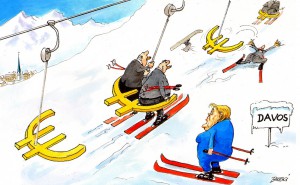
Simon Kennedy and Matthew Simon write:  As the chattering chieftains of the global economy gather this week in Davos, Switzerland, they’re facing the darkest outlook since the financial crisis tipped the world into recession seven years ago.

The Chinese slowdown and accompanying slide in the yuan are imperiling already sluggish international growth, oil is trading at its lowest level in more than a decade, stocks have suffered their worst January ever, and the prospects for corporate earnings are the most pessimistic in years.

Economic frustrations have driven the rise of populists in the U.S. and France while sowing doubts about the longevity of German Chancellor Angela Merkel and Britain’s membership in the European Union.

China has confirmed its weakest quarter since 2009 and its slowest annual growth since 1990. The International Monetary Fund, meanwhile, cut its estimate for expansion in the world economy this year to 3.4 percent from 3.6 percent.

Meantime, the International Labor Organization predicted that global unemployment will climb this year by almost 2.3 million to 199.4 million, led by emerging markets. PriceWaterhouseCoopers LLC said only about a third of chief executive officers it polled were “very confident” about their companies’ growth prospects.

Also causing some concern is the Federal Reserve’s decision to raise interest rates last month for the first time in nine years even with tame inflation. That’s pushed up the dollar, hurting those emerging markets that boosted borrowing in greenbacks when rates were at rock-bottom.

In developed countries, there is a sense of frustration as once-robust middle classes fall ever further behind the have-lots. The charity Oxfam said on Monday that the richest 1 percent of people on Earth now control more wealth than the rest of the world’s population combined.

Political activity  in the US, the world’s largest economy, which large companies and investors have relied on to drive growth as Europe stagnates and emerging markets underperform is unnerving.

Davos


Children Working in Congo Cobalt Mines

Human rights organisation Amnesty has accused Apple, Samsung and Sony, among others, of failing to do basic checks to ensure minerals used in their products are not mined by children.  In a report into cobalt mining in the Democratic Republic of the Congo, it found children as young as seven working in dangerous conditions.

Cobalt is a a vital component of lithium-ion batteries.  The firms said that they had a zero tolerance policy towards child labour.

The DRC produces at least 50% of the world’s cobalt. Miners working in the area face long-term health problems and the risk of fatal accidents, according to Amnesty.

It claimed that at least 80 miners had died underground in southern DRC between September 2014 and December 2015.

It also collected the testimonies of children who allegedly work in the mines.

Paul, a 14-year-old orphan, started mining when he was 12 and told researchers: “I would spend 24 hours down in the tunnels. I arrived in the morning and would leave the following morning … I had to relieve myself down in the tunnels … My foster mother planned to send me to school, but my foster father was against it, he exploited me by making me work in the mine.”

 UNICEF estimates that there are approximately 40,000 children working in mines across southern DRC.

In response to the report, Apple said: “Underage labour is never tolerated in our supply chain and we are proud to have led the industry in pioneering new safeguards.”

It said that it conducts rigorous audits on its supply chain and any supplier found hiring underage workers is forced to:

  • fund the worker’s safe return home
  • finance the worker’s education at a school chosen by the worker or his/her family
  • continue to pay the worker’s wages
  • offer him or her a job when he or she reaches legal age to work.

On cobalt specifically it added: “We are currently evaluating dozens of different materials, including cobalt, in order to identify labour and environmental risks as well as opportunities for Apple to bring about effective, scalable and sustainable change.”

Samsung said that it had a “zero tolerance policy” towards child labour and that, it too, conducted regular and rigorous audits of its supply chain.

“If a violation of child labour is found, contracts with suppliers who use child labour will be immediately terminated,” it said.

Sony commented: “We are working with the suppliers to address issues related to human rights and labour conditions at the production sites, as well as in the procurement of minerals and other raw materials.”

Child Labor in Cobalt Mines


Entrepreneur Alert: Alternate Energy Sources

Developing energy alternatives an entrepreneurial opportunity, but financing remains elusive.

The need for more innovation in energy was one of the strongest points of agreement at the Paris talks. Some have suggested that the most important news to come out of the conference was not the final accord, signed with great fanfare by the governments of 195 countries, but the commitments made by governments and wealthy individuals to research and develop technologies that can help the climate.  Energy innovation is a concept that has become almost universally popular — among all from the most traditional of oil companies to the most radical of environmental groups.  For all the rising enthusiasm, though, investing in innovation remains a hazardous and uncertain business in energy, as in other industries.  

Alternative Energy


Entrepreneur Alert: PC Sales

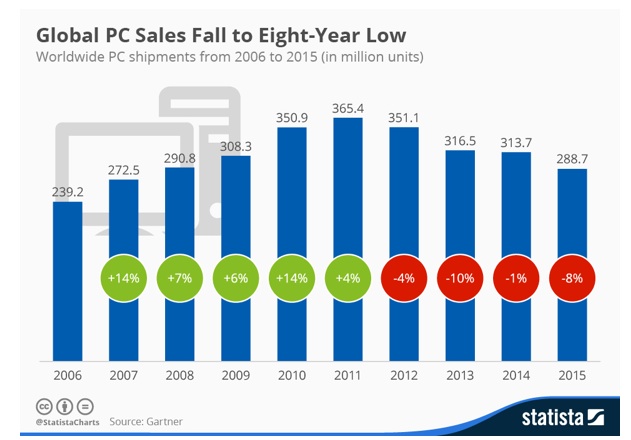
Felix Richter writes:  Worldwide PC shipments hit an eight-year low in 2015 after declining for the fourth consecutive year.

Global shipments dropped by 8 percent to 289 million in 2015, the lowest it’s been since 2007.

The decline of the PC industry started in 2012, around the time when tablet sales really took off. After a brief respite in 2014, when PC sales were virtually flat thanks to the end of official support for the popular WIndows XP and the subsequent upgrade cycle, the market’s decline re-accelerated in 2015 despite the release of Windows 10 in July.

Gartner attributes the weak market performance at least partially to currency effects, which negatively affected sales in EMEA, Japan and Latin America. However, the analysts also see a structural change happening that will lead to fewer people using PCs over the next few years.

Global PC Sales?


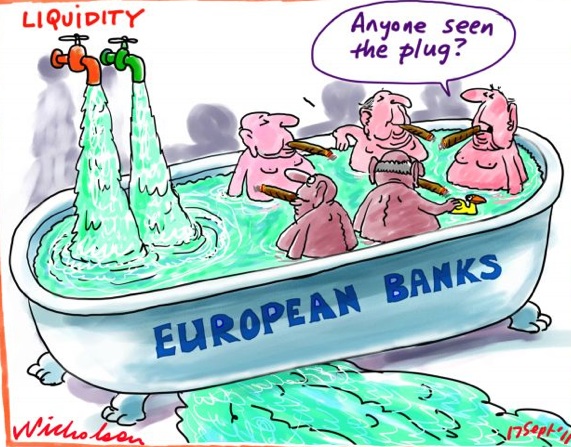
Bank Liquidity Crucial?

Taking the risk out of banking: Liquidity requirements versus equity requirements

Richmond Federal Reserve writes:  The financial crisis of 2007 – 08 revealed the dangers of banks’ underinvestment in liquid assets or overreliance on high-risk funding sources. At some level, however, liquidity risk is part of a core function performed by banks: maturity transformation. In traditional banking, this means accepting deposits and making loans.

This leads to “maturity mismatch” between banks’ liabilities and assets – many of a bank’s liabilities are short-term and payable on demand to depositors and other creditors, while many of its assets are long-term and illiquid. A bank without enough liquid assets to meet a sudden increase in demand on its liability side may be forced to sell assets quickly at reduced prices or suspend operations. And since some banks act as sources of funding for other banks or financial firms, strain at one institution could cause broader disruptions to the financial system.

While large nonbank financial institutions rely on funding sources other than deposits, the maturity mismatch principle is still the same. Shortterm funding sources, such as commercial paper and repurchase agreement (repos), are rolled over very frequently – sometimes even daily. But if creditors suspect weakness on the part of the bank or the securities underlying a repo, they may choose not to roll over the debt in favor of extending that credit to another institution. This sudden loss of funding could create a scenario similar to a classic bank run.  Report

Bank Liquidity

Should We Use a Social Progress Index?

Laura Levis writes:  What are the ingredients of a  healthy, inclusive society—one that offers its citizens opportunity, happiness, and a positive quality of life? According to Lawrence University Professor Michael E. Porter, models of human development based on economic growth alone are incomplete; nations that thrive provide personal rights, nutrition and basic medical care, ecosystem sustainability, and access to advanced education, among other goods—and it is possible to measure progress toward providing these social benefits.

Porter’s 2015 Social Progress Index (SPI)—released in April and developed in collaboration with Sarnoff professor Scott Stern of MIT’s Sloan School and the nonprofit Social Progress Imperative—ranks 133 countries on multiple dimensions of social and environmental performance in three main categories: Basic Human Needs (food, water, shelter, safety); Foundations of Wellbeing (basic education, information, health, and a sustainable environment); and Opportunity (freedom of choice, freedom from discrimination, and access to higher education). Porter considers the index “the most comprehensive framework developed for measuring social progress, and the first to measure social progress independently of gross domestic product (GDP).”

The index, he explains, is in some sense “a measure of inclusiveness,” developed based on discussions with stakeholders around the world about what is missed when policymakers concentrate on GDP (which tallies the value of all the goods and services produced by a country each year) to the exclusion of social performance.

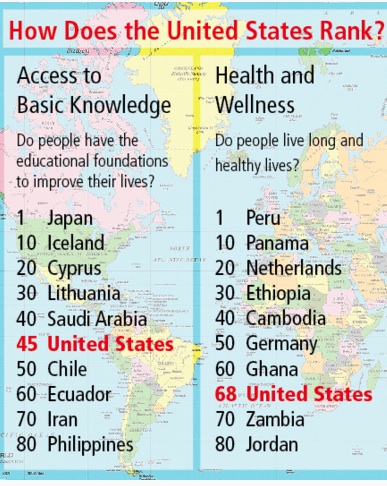
The United States may rank sixth among countries in terms of GDP per capita, but its results on the Social Progress Index are lackluster. It is sixteenth overall in social progress: well below Canada, the United Kingdom, Germany, and Japan in several key areas, including citizens’ quality of life and provision of basic human needs.

About 20 or 30 years ago, for reasons Porter says he cannot completely explain, the rate of progress in America began to slow down. As a society, he points out, Americans slowly became more divided, and important priorities such as healthcare, education, and politics suffered.

Meanwhile, he notes that even though other fast-growing nations such as India and China haven’t been able to attain a level of social progress commensurate with their economic progress either, certain countries such as Rwanda have “knocked the cover off the ball” in terms of social progress. “They went through a genocide, were devastated, and, to bring the society together, there was a consensus, led by the president, that their first job was to re-energize and restock the society and the capacity of their citizens,” he says. For example, the country achieved a 61 percent reduction in child mortality in a single decade, and today, primary-school enrollment stands at 95 percent. Rwanda also ranks high for gender equity, as women constitute a majority of the parliament—partly he says, because a lot of men were killed, but also because the country set out to be a place where women are not just equals, but leaders.

Porter hopes his continuing work on the index will help explain why the United States is “doing poorly” relative to other countries that are doing well.

In terms of progress for the average citizen, Porter warns, the United States is more threatened now, globally and economically, than it has been in generations.
Wellness?