Thailand Facing Trade Sanctions Over Human Tracking

In a few weeks, Thai diplomats and officials will be hard pressed to explain the kind of progress, if any, the country has made in addressing the issue of human trafficking.  A United States government report, on the Trafficking In Persons (TIP), could potentially affect bilateral relations between Thailand and the US and will be released next month.

US law requires that its State Department rate nations across the world with regard to human trafficking. Countries rated in tier one fully meet minimum standards while tier two nations do not meet the minimum standards but are making an effort.

Tier three countries, on the other hand, do not meet the standards and are not showing any signs of trying to make a meaningful effort. What concerns many Thai officials is that tier three countries, which could very well include Thailand, face the threat of sanctions by the US government.

At the discretion of the US president, Thailand has received a waiver from such punishment and allowed to remain in tier two for past two years. But time is up and Thailand is hard pressed to show that progress has been made.  Judging from the previous report, in which Thailand was accused of slow progress in prosecuting trafficking-related cases, there is a real chance that the country could be rated down.

A few days ago, a US Congressional panel reminded us how bad Thailand’s performance and image is with respect to poor treatment of the Rohingya. The hearing in Washington DC was on “Effective Accountability: Tier Rankings in the Fight against Human Trafficking Lessons”.

Representative Chris Smith, chairman of the House Subcommittee on Africa, Global Health, Global Human Rights, and International Organisa-tions, listened to testimonies about how Thai government officials were involved in the trafficking of Rohingya.  Smith is not just another lawmaker. He is the author of the landmark law, the Trafficking Victims Protection Act of 2000, that created this three-tier system of reward and punishment for countries that do not comply with the requirements.

Human Trafficking


An Indian State Proposes to Sell Iron Ore Mines

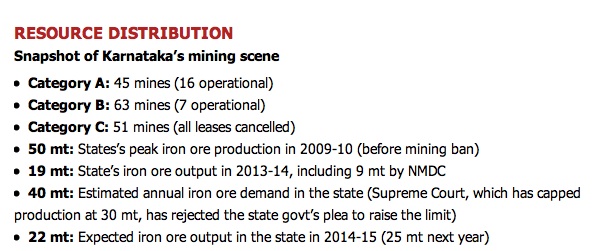
Malash Kulkarni writes:  In a court order on April 18, 2013, iron ore mines in the state of Karnataka south of Mumbai were classified in three categories. “C” signified large scale violations of the mining rules.  Fifty-one mines in this category had their leases cancelled and are up for sale to end-users.  End-users have the capacity to make use of the ore by breaking it through chemical reduction processes to final products which include pig iron, sponge iron and steel, but exclude pellets and the extraction of minerals and gangue.

The auction of mines is likely to benefit ‘end-users’ like JSW Steel, Kalyani Steel and BMM Ispat, which do not have captive iron ore mines and depend on e-auction of iron ore for their raw material requirements. As new mining leases are unlikely to be given out in the state in the near future, auction of mines could give steel mills a big opportunity to acquire the natural resource.

Karnatake Mines

A New Asset Class for Infrastructure Repair and Development

Justin Yifu Lin and Kevin Lu argue the importance of private financing for infrastructure, which contributes to growth in China and many sub Saharan countries.

Infrastructure projects should have a new definition, considering: a link between the internal rate of return and the economic rate of return.  Private-sector sponsors should be given space of initiate valuable projects.  The political risks of public-sector involvement and the lower return from infrastructure relative to private equity.

Infrastructure projects demand special technical expertise.  To make their projects more efficient and cost-effective, specially-trained overseers will have to be deployed.

Certainly in China, private investment is vital.  Maybe it is in the US too?

Infrastructure in China


A Technologically-Driven Revolution in Finance?

Mohamed A. El-Erian writes suggestively about the impact of technological innovation on finance.  Noting that journalism, the media and entertainment have been revolutionized by technology, he looks at some areas that may be dramatically changed by technology.

Bitcoins have “attracted attention from specialists, regulators, and, slowly but surely, the public. But the crypto-currency phenomenon is far from the only example, and it is certainly not the most consequential one. Its impact, both actual and potential, is relatively limited when compared to ongoing attempts to enhance and democratize lending, borrowing, investing, and payments and settlements.”

El-Erian points to technology entrepreneurs who understand the power of online/social media innovation to disrupt components of traditional finance, and are now leading efforts that include behavioral scientists and finance experts.

Think:  Internet driven lending clubs,  peer-to-peer initiatives in consuer financial services, digital wallets and mobile transfers.

Mobile transfers


Lawsky Gets Tough

The New York State Financial Services chief understands that even fines that seem humungous to the ordinary citizen are for financial institutions just “the cost of doing business.”  Unless some of these financial officers go to jail, business is going to continue as usual.   But Lawsky has his eyes wide open.

  • At the center of New York Department of Financial Services chief Ben Lawsky’s concerns are Ocwen’s relationship with Altisource Portfolio Solutions and its home-auction website subsidiary Hubzu.
  • “Hubzu appears to be charging auction fees on Ocwen-serviced properties that are up to three times the fees charged to non-Ocwen customers,” writes Lawsky’s office. In other words, when Ocwen chooses Hubzu to market a property, the fee is 4.5%, but when Hubzu competes for business in the open market, it’s 1.5%.
  • “The relationship between Ocwen, Altisource Portfolio, and Hubzu raises significant concerns regarding self-dealing. In particular, it creates questions about whether those companies are charging inflated fees through conflicted business relationships, and thereby negatively impacting homeowners and mortgage investors.
  • Speaking Thursday on the Home Loan Servicing Solutions earnings call, Ocwen boss Bill Erbey says Lawsky’s hold on the purchase of $2.7B in MSRs from Wells Fargo has put a freeze on all MSR deals in the market.      Lawsky

IMF Suggests Bank Deposit Insurance in China?

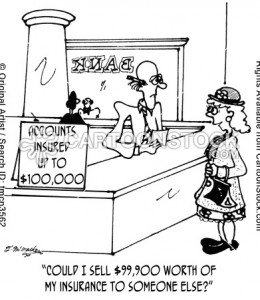
James A. Dorn reports:  The International Monetary Fund (IMF) has recommended that China institute deposit insurance before embarking on interest rate liberalization and opening its capital markets. Higher rates on deposits may encourage more risk taking by banks and some of the lending/investments may go sour. The IMF sees deposit insurance as a way to prevent bank runs.

That logic may be true, but deposit insurance also encourages banks to take more risk, because ultimately taxpayers will have to make depositors whole if a bank fails. Most banks in China are already state owned and have an implicit guarantee that the government will not let them go bankrupt. Deposit insurance may help smaller private banks compete against the giant state banks. But the real problem is not the lack of deposit insurance; it is the lack of private ownership and responsibility that permeates China’s financial sector.

Introducing deposit insurance is a double-edged sword: it may help protect depositors but it also increases risk taking and could be costly to taxpayers. China’s move toward liberalizing interest rates does not require government deposit insurance; it requires a genuine rule of law that safeguards personal and economic freedom, and holds those who make unwise investment/lending decisions responsible.

W-T-W.org notes: In the US, insuring depositors (among other protections)  has led bankers to take unreasonable risks and caused the expenditure of a great deal of taxpayer money.  Bankers go scot free.

Deposit Insurance

Saudi Arabian Women, A Step Back

From Susie Khalil’s blog banned in Saudi Arabia:

Earlier this week, it was reported in the news here that women are no longer permitted to go out with girlfriends to enjoy smoking shisha, unless she is accompanied by her legal male guardian who must order it for her.
The ramifications of this are really confusing, as many hasty decisions here in KSA are.  If every woman who wishes to smoke shisha has to drag her husband, brother or son with her, the result will be scores of men and women mingling together in public!   Didn’t they think of that?
The message here is that women are not capable of making their own decisions and that men are more intelligent and superior in every way and must decide what is best for their wives, daughters, and sisters, regardless of the women’s wishes.  I don’t buy into the BS that a man needs to decide what is best for me.
By now we all know the harm that smoking can cause to humans.  But as long as there is no law against smoking, adults should have the right to decide for themselves whether to smoke or not.  I am an adult and I am perfectly capable of making my own decisions regarding my life, my image, and my health.  Ahmed Al-Shamman tweeted,  “I am totally supporting this idea because it is sad when I see young women smoking shisha in public.  It makes them look cheap and easy.”   It’s okay for men to smoke shisha because it makes them look cool, or what?  Sadly this is the mentality of so many ignorant and backward men in Saudi Arabia.
Double standards for men and women.
Smoking Shisha Only by Male Permission

Credit Suisse’s 1st Quarter Report

We have been following the bank and the US interest in stopping the outflow of taxable income to protected offshore countries.  Switzerland and Credit Suisse is in the cross hairs of the US Senate, Department of Justice, Internal Revenue and The New York State Department of Financial Services.  Interestingly, although the decline in profits is attributed to Credit Suisse’s investment-banking unit which fell 13% and pretax income slide 36%. Credit Suisse has trimmed its investment-banking operations recently, pulling back from its interest-rate swaps and options businesses. But the bank maintains a relatively large fixed-income trading operation, a business that singed results at J.P.Morgan Chase and Citigroup during the quarter.  Credit Suisse said revenue from fixed-income sales and trading fell 21% from the same period a year earlier.

The drop in investment-banking revenue was coupled with an unexpected bump in the bank’s risk-weighted assets that crimped its CET 1 capital ratio, a key international measure of bank stability.

However high income individual’s deposits are up by 8%.  We do not know how many American citizens this includes, and why they continue to bank in Switzerland instead of at home.   Credit Suisse Earnings Report

Swiss Banks


Luci for Solar Justice

About 1.7 billion people around the world live off the grid, most of them not by choice.  Children doing their studies at home at night are disproportionately impacted by not having light.

MPOWERD, a New York based company committed to ending poverty and to solar justice, is creating products to make living off the grid comfortable and affordable.

They lauched with Luci in 2012. A response to the earthquake in Haiti, which left so much of the population in the dark, MPOWERD brings light to places electricity does not reach.

Solar Justice day is April 15th.  Join the movement as an Ambassador.  Give the give of light.  Buy

Enlightened Functionality

Unlike other solar lamps, Luci offers the benefits of a task light, flashlight and diffused lantern in one attractive design. Never reliant on the power grid, she shines brightest where light is inaccessible or unaffordable. To light up life with clean energy, Luci is your girl.

Luci, an Inflatable Solar Lantern


Capital Requirements Raised for US Banks

New rules do not go into effect until 2018.  The real question is, is this the answer for banks that are too big too fail.  They are still too big.  Some economists think that capital requirements mask the real problem.  Anat Admati’s “The Bankers’ New Clothes” is out in paper, and makes another argument.

Janet Yellin. chairman of the Federal Reserve says,  “The financial crisis showed that some financial companies had grown so large, leveraged and interconnected that their failure could pose a threat to overall financial stability. Today’s action is another step in the Federal Reserve’s efforts to address those risks.”

Capital Requirements