When Capitalists Went on the Public Dole

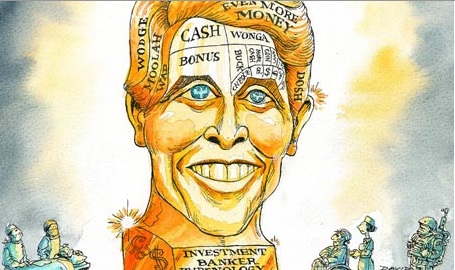
If you had to pick a city on earth where the American investment banker did not belong, London would have been on any shortlist. In London, circa 1980, the American investment banker had going against him not just widespread commercial lassitude but the locals’ near-constant state of irony. Wherever it traveled, American high finance required an irony-free zone, in which otherwise intelligent people might take seriously inherently absurd events: young people with no experience in finance being paid fortunes to give financial advice, bankers who had never run a business orchestrating takeovers of entire industries, and so on. It was hard to see how the English, with their instinct to not take anything very seriously, could make possible such a space.

Yet they did. And a brand-new social type was born: the highly educated middle-class Brit who was more crassly American than any American. In the early years this new hybrid was so obviously not an indigenous species that he had a certain charm about him, like, say, kudzu in the American South at the end of the nineteenth century, or a pet Burmese python near the Florida Everglades at the end of the twentieth. But then he completely overran the place. Within a decade half the graduates of Oxford and Cambridge were trying to forget whatever they’d been taught about how to live their lives and were remaking themselves in the image of Wall Street. Monty Python was able to survive many things, but Goldman Sachs wasn’t one of them.  Review of Capital by John Lancaster   Capital

Banker

Investing in the Time of Taper

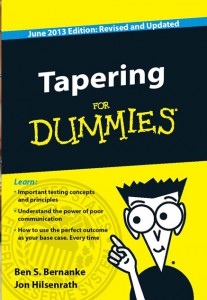
There are few sure bets in investing.  But here is one sure bet: The Fed will reduce it monthly purchases of securities and US interest rates will rise. The question then becomes what this means for investors. The McKinsey Global Institute has published an excellent report on the subject in which they attempted to quantify many of the effects. This article summarizes the McKinsey findings and goes on to spell out the investment implications.  Investments in the Time of Taper

Tapering for Not so Dummies

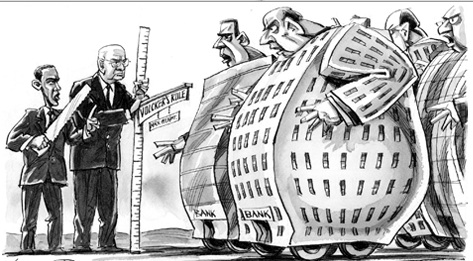
Volker Rule Ties Banks’ Hands When They Hold Depositors’ Insured Money

UPDATE  William Grieder:

Behind Paul Volker’s back, they called him “Tall Paul” in the 1980s and Volcker was indeed awesome then as Federal Reserve chairman alongside Ronald Reagan as president. Together they refashioned government—shifting everything rightward and setting up the triumph of the financial sector that has reigned ever since with its destructive qualities.

The Gipper did the fun part—cutting taxes from the top down—but Volcker did the heavy lifting. He presided over a long, brutal recession that broke inflation and labor wages and lots more. It was a decisive injury to organized labor He was a civil service giant, brave and also scary. At six-foot-seven, Volcker towered over the pedestrian ranks of Washington politics. Also important bankers and the US Senate. Reagan’s White House staff tried to push him around (though not Reagan himself) and Volcker brushed them off like gnats.

For all those reasons, I see his triumph—finally getting federal regulators to adopt his “Volcker amendment” to limit proprietary investing by the mega-banks—as a melancholy moment. It took three years for regulatory agencies to fend off the thousands of bank lobbyists and approve something. That’s better perhaps than a hollow victory but still far short of the reforms that are needed to get control over the out-of-control mega-banks.

I haven’t read the bill, but the financial press and Wall Street talkers are not impressed. It is something like 850 pages and so dense with loopholes and clever snares it will probably take another three years for bank examiners to understand what they are supposed to do with it.

Meanwhile, the too-big-to-fail banks will go on about their business, getting sweet on America’s troubles and pretty much ignoring prudent restraints. The real solution will not come until another Congress or a new president find the courage to break them up, cut them down to size and restore the old Glass-Steagall division of commercial banking from investment banking. A few years of experience with the Volcker Rule will probably be enough to demonstrate that it’s insufficient to change the behavior of JP Morgan and the banker gang. The risk is that the bankers will go wild again in the meantime.


Paul Volcker must be feeling a sense of personal regret if not guilt. He was present at the creation, after all. As Fed chairman. He blessed the first rounds of serious deregulation that repealed the caps on interest rates and doomed the savings and loan industry that financed housing. However reluctantly, Volcker also engineered the first big rescue of a too-big-to-fail bank—Continental Illinois in Chicago. He could have hung tough but he caved to the bankers. The Fed has lived off that precedent many times since.

The Federal Reserve and Treasury Secretary want us to believe they won’t do it again. I judge from his body language and muted comments that Paul Volcker doesn’t believe them.

While the Volcker Rule has been moderated since its inception, these limitations would have a significant impact on the ability of U.S. banking organizations to provide investment management products and services that are competitive with nonbanking firms generally and with non-U.S. banking organizations in overseas markets. It would also effectively prohibit short-term trading strategies by any U.S. banking organization, regardless of the location of its trading business, if those strategies involve instruments other than those specifically permitted for trading.  Analysis by a Prominent US Law Firm
The Volcker Rule

VolckerpreambleFinal Rule
Volker Rule

Mary Barra First Woman to Head General Motors

She worked her way, step by step, up the corporate ladder from the time she started working at General Motors as age 18.  Now she has reached the top.

In the statement announcing her new role as CEO, GM credited Barra with “revitalizing GM’s product development process,” saying that her efforts resulted in higher product quality ratings and increased customer satisfaction.

“With an amazing portfolio of cars and trucks and the strongest financial performance in our recent history, this is an exciting time at today’s GM,” Barra said in a statement Tuesday morning. “I’m honored to lead the best team in the business and to keep our momentum at full speed.”   Mary Barra Named First woman CEO at General Motors
Mary Barra to Head General Motors

OECD Assesses Education Worldwide: Asian Countries are Doing the Best Job

The OECD’s PISA 2012 tested more than 510,000 students in 65 countries and economies on maths, reading and science. The main focus was on maths. Math proficiency is a strong predictor of positive outcomes for young adults. It influences their ability to participate in post-secondary education and their expected future earnings. Shanghai-China, and Singapore were top in maths, with students in Shanghai scoring the equivalent of nearly three years of schooling above most OECD countries. Hong Kong-China, Chinese Taipei, Korea, Macao-China, Japan, Liechtenstein, Switzerland and the Netherlands were also in the group of top-performing countries.   Asian countries top OECD’s latest PISA survey on state of global education

 School Children

Music Entrepreneurs in Iceland

The annual Icelandic Airwaves Festival has come and gone.  Iceland now seems a brisk and bustling economy after the 2008 collapse.  Angry at the EU for their treatment of EU countries’ debts, Iceland has stalled on its application and now seems focused on the Arctic Council and the Far East.  Will this impact the country’s vibrant music culture. Iceland Music Entrepreneurs

Icelandic Airwaves

How Important Are Investment Managers?

Regulators are beginning to look at the impact, not of assets gone sour, but of the sheer volume of trades one institution makes.

Regulators want not merely to prevent a repeat of the last blow-up but also to identify the sources of future systemic perils, BlackRock investment managers raises a subtle issue concerning not the ownership of assets but the way buying and selling decisions are made. The $US15 trillion of assets managed on its Aladdin platform amount to around 7% of all the shares, bonds and loans in the world. As a result, those who oversee many of the world’s biggest pools of money are looking at the financial world, at least in part, through a lens crafted by BlackRock. Some 17,000 traders in banks, insurance companies, sovereign-wealth funds and others rely in part on BlackRock’s analytical models to guide their investing. A dangerous skew?

The Economist reports:  Black Rock Rocks the Financial World

Investment Advisors

Back to Basics Like Infrastructure Important Investments

Kenneth Rogoff, a former chief economist of the IMF, is professor of economics and public policy at Harvard University writes:  Is today’s slow growth in advanced economies a continuation of long-term secular decline, or does it reflect the normal aftermath of a deep systemic financial crisis? More important, do we need to answer that question definitively in order to boost the pace of economic recovery?   Should We Be Focusing on Fundamental Investments

Infrastructure Invetment?