
How Financial Advisors Approach Women Clients


M. P.Dunleavey writre:  Imagine that you work for a financial company. You’ve plowed through stacks of research showing that women — who are increasingly educated and affluent — could be a big source of revenue for you. Now what?  Do you paint the reception area a nice shade of coral? Put handbag hooks on the bathroom doors? Provide sensitivity training to your staff?

If you’re thinking that it can’t be that hard to bring female customers in the door, let me bring you up to speed: Women control trillions of dollars of wealth in the United States, yet as clients, they pose a challenge to Wall Street’s traditional way of doing business.

Every year at its national conference, for example, TD Ameritrade offers a seminar for advisers on working with women as clients, and it’s always jam-packed.  This session is attended mostly by men, and they’re struggling.  Some are thrown by women’s high question-asking quotient, she said; many male advisers wonder whether they should just stay out of the way and have women deal with women.

Research shows that women as clients don’t necessarily prefer to work with female advisers — any more than they want pink-themed websites.  Women don’t need different products or services.  Mutual funds and that work for men ought to be fine for women, too. But women need to be approached differently than men do.

Companies know this, yet there’s a frustrating lack of agreement about how to go about it. Companies like Merrill Lynch and Vanguard lean toward what I’ll call a more gender-agnostic approach, focusing more on a client’s individual situation. TD Ameritrade, Ameriprise, Barclays and Pax World Investments are among those that seem to be trying to embrace a financial style that is more overtly friendly to women, like companies that focus on women as leaders.

Vanguard learned through a two-year study, many women prefer advisers to focus on life goals, and not just on mutual funds and other investments.  Likewise at Merrill Lynch, there’s a conviction that gender “can be a distraction in financial planning,” said Michael Liersch, head of behavioral finance at Merrill Lynch Wealth Management. To that end, the company is training advisers to use a proprietary tool called the Investor Personality Assessment to give advisers a more objective way to evaluate each client’s goals..

A survey of 6,000 people in the United States, Britain China, India, Singapore and Hong Kong, suggests that women don’t necessarily lack moxie, skill or interest in money. But they’re often turned off by how money is handled in a mostly male world of finance.

Many women today prefer companies and advisers with gender smarts. That means being able to field questions on virtually all aspects of a woman’s life, understanding how time-constrained most women feel, and not taking a one-size-fits-all-women approach to planning.

So what approach is best for women — and how can Wall Street accelerate its efforts to adjust to their needs? Finance has a long and hidebound history, and it may well be necessary to take a traditional approach to get the ball rolling faster.

How about giving advisers a bonus when they bring in more women as clients?  If coral-colored reception areas do the trick, great. But for the sake of creating financial parity at long last, I’m inclined to think there’s nothing like a carrot to get people moving.

Women and Money


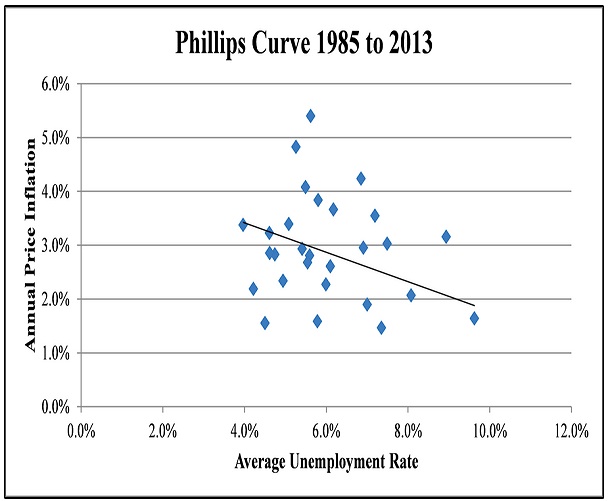
The Relationship Between Prices and Employment Rates

Chris Casey writes:  Due to its unjustified acceptance of the Phillips curve and its related misconceptions about price inflation and business cycles, the Federal Reserve will never be able to trade higher price inflation for lower unemployment. Nor can it sacrifice higher unemployment for lower price inflation. But it can, and likely will, generate high levels of both. If the Federal Reserve’s economic controls appear broken, it is because they never really worked in the first place.  Inflation and Unemploymnet

Phillips Curve

Economics 101 in a Graduation Speech


Nobel Laureate Thomas Sargent  began with a simple promise. “I will economize on words,” he said. And he did.

Economics is organized common sense. Here is a short list of valuable lessons that our beautiful subject teaches.

1. Many things that are desirable are not feasible.

2. Individuals and communities face trade-offs.

3. Other people have more information about their abilities, their efforts,
and their preferences than you do.

4. Everyone responds to incentives, including people you want to help. That
is why social safety nets don’t always end up working as intended.

5. There are tradeoffs between equality and efficiency.

6. In an equilibrium of a game or an economy, people are satisfied with their
choices. That is why it is difficult for well meaning outsiders to change
things for better or worse.

7. In the future, you too will respond to incentives. That is why there are
some promises that you’d like to make but can’t. No one will believe those
promises because they know that later it will not be in your interest to
deliver. The lesson here is this: before you make a promise, think about
whether you will want to keep it if and when your circumstances change.
This is how you earn a reputation.

8. Governments and voters respond to incentives too. That is why governments sometimes default on loans and other promises that they have made.

9. It is feasible for one generation to shift costs to subsequent ones. That is
what national government debts and the U.S. social security system do
(but not the social security system of Singapore).

10. When a government spends, its citizens eventually pay, either today or
tomorrow, either through explicit taxes or implicit ones like inflation.

11. Most people want other people to pay for public goods and government
transfers (especially transfers to themselves).

12. Because market prices aggregate traders’ information, it is difficult to forecast stock prices and interest rates and exchange rates.


Economics 101


Women on Boards

Dr. Morten Huse, who holds the Reinhard Mohn Endowed Chair for Corporate Governance, Business Ethics and Social Evolution at Witten/Herdecke University (UW/H), write in the Journal of Business Ethics about some of the issues surrounding women on boards as well as employee-elected board members. We focus on women in the following synopsis:

In recent years, there has been increasing pressure from society and investors to appoint women directors on corporate boards. The number of women in top management and board positions has slowly increased. How does gender diversity contribute to variations in board tasks. Some have argued that there are greater differences among men and women than there are between men and women.

Conventional wisdom suggests that men focus more on quantitative issues and that women are more concerned with qualitative issues. How the bottom line is affected by this difference is still debated. If women are more concerned with corporate governance and social issues, how does this impact shareholder value? Does the adding of women to boards increase diversity of thought in the boardroom? And if it does, increasing studies show that decision-making is improved.

Some recent studies have re-directed the questions about if women make contributions to how women make contributions. When women are in the boardroom, discussions appear to be more open and creative. Are they?

In showing the need to go beyond board composition and corporate financial performances Huse suggests 1. Going beyond demographic descriptions of women, 2. Exploring differences related to various boards takes to include open discussions in the boardroom as a mediating variable between board member characteristics and boardroom tasks.

1. Huse’s research results emphasize that backgrounds and experiences go beyond gender and external demographics and that the personalities of the individual board members should be considered when researching the implications of diversity.

2. While women are expected to have a more questioning attitude than men and contribute to more open discussions in the boardroom, Huse has found that the contribution of women to creative discussions only existed when the women had a different background from the men. However, this relationship was weak. A possible reason for the lack of strong findings may be that women directors tend to adopt the ideas of the conventional board members.

3. Other research has found that minority board members make a contribution to their boards dependent on (1) their own previous experience in a minority position of other corporate boards and (2) previous experience by other board members in a minority position. Hence, while women directors may bring alternative back- grounds and knowledge to the boardroom, they may lack the experience of how to actually present and bring through such knowledge.

4. There appears to be correlation between women board members and concerns of Corporate Social Responsibility (CSR).

5. In the case of women directors, Huse found that esteem was positively related to budget controls, but not to the other types of control. However, the esteem of the women directors was generally found to be high and the lack of variations in the data might have caused the lack of findings.  Women on Boards

Women On Boards

Google to Teach High School Girls to Code


Google’s diversity report last month revealed just how white and male the company — and the tech industry as a whole — really is. But in a first step to correct the disparity, the company has launched a new initiative to help get school-age girls interested in coding.  Made with Code.

By the numbers, women make up half of the economy’s workforce but are seldom represented in science, technology, engineering and mathematics (STEM) fields. Women only make up about 25 percent of STEM jobs and have even lower representation in tech alone.

Google reported they employ only three women for every seven men, and just 17 percent of their tech workers are women. Yahoo introduced its own diversity program.  Both companies also reported low rates of women in leadership positions. Yahoo only had 15 percent women in tech supervisory roles, compared to 21 percent at Google, which has no female executives and only one woman on its senior leadership team.

But the lack of women in the tech workforce goes beyond 24/7 jobs and pizza rinds.  Less than 20 percent of high school girls take the advanced placement (AP) computer science test, or go on to earn a college degree in the subject. While AP computer science courses aren’t available at most schools, two states didn’t have a single female student take the test in 2013.

Girls also tend to be steered away from STEM, and many develop negative views of the field early on.  While 80 percent of high school students are clueless as to what computer science majors learn, female students unfamiliar with the subject often associated it with words such as “boring” and “hard.”

Made With Code aims to close the gap by showing girls that there’s more to coding than it seems. Girls will be able to design 3-D printed bracelets or create songs using Blockly coding technology, which lets users build programs with blocks of code rather than typing it in manually. The program spotlights women who are dancers, music producers, cinematographers and humanitarians and shows how they all use coding to do their jobs. Google is also sponsoring and partnering with similar initiatives nationwide such as Girls Who Code, Black Girls Code and Technovation.

Computer Programming


Continuing Education by Reading Books

The Australian Businesswomen’s Network invites their community to review books that have been helpful.  Since we have so little time, following someone else’s lead narrows the field.  Here are some titles that are suggested:
Launch by Michael Stelzner:  A whole new way of thinking about marketing.

The Male Factor: The Unwritten Rules, Misperceptions and Secret Beliefs of Men in the Workplace by Shaunti Feldhahn.   She interviewed hundreds of men in corporations and asked them: What’s it really like to work with women? What she found out was eye-opening.

The Intention Economy: When Customers Take Charge by Doc Searls.
This book is for anyone who wants to understand the future around the Internet and the customer.

All these books are available from Barnes and Noble.  BN.com.

The Male Factor

Class Action Lawsuit Awards Parents for Apps Their Kids Charge

Time Online reports that for fifteen minutes after a parent has signed off from their Itunes account, anyone can go online and charge to that account.  Kids have been doing this the world over.  In January Apple agree to reimburse over 24 million dollars to parents whose children, unattended, shopped in the Apple Store.

Time notes that children should gain experience with money in the real world, so that they can grasp the issues of charging to their parents’ account.

Computer Shopping


Women Staying Away From Jobs in the Finance Sector

A new report by YouGuv prepared for Bank of American finds that only one in three women even consider working in the “male dominated”  financial world. 1000 girls aged 16-20

A “lack of information from teachers” (21 per cent) and a perceived “sexist culture” (19 per cent) came second and third. The survey was carried out by YouGov for Bank of America Merrill Lynch and North London Collegiate School.

Almost half believed work-life balance would be better in industries other than finance, compared with just 22 per cent who disagreed. This is despite efforts by financial institutions to provide a supportive working environment, including mentoring programmes aimed at women, workshops for those returning from maternity leave and various diversity and inclusion policies.
In 2013, girls’ schools dominated GCSE and A-level league tables but just 19 per cent of applications for financial services graduate jobs came from women. Employers are trying to increase the percentage by recruiting young women before they go to university.
The report urges the financial services sector and education establishments to work together to encourage more young women to consider a career in the field. Just three out of 10 young women said financial careers had been discussed with them at school.

Young Women in Banking

Teaching Computer Code in Kindergarten

The Israelis led the way.  The New Zealand, some German states and Australia.  The UK is coming on now, and the US, maybe.

Digital technology is now so ubiquitous that many think a rounded education requires a grounding in this subject just as much as in biology, chemistry or physics. That is one reason that the pendulum is swinging back towards teaching coding. Employers’ moans are another. The shortage of skilled programmers is clear from the high salaries they command. The shallower the pool of people who know the basics, the smaller the number of potential tech entrepreneurs. According to Judith Gal-Ezer of the Open University of Israel, who was part of the team that put computer science on the country’s high-school curriculum, a growing share of jobs in developed countries require “computational thinking”: the ability to formulate problems in such a way that they can be tackled by computers. But bosses complain that workers lack such skills—and politicians are listening. Mr Schmidt’s public criticism is credited with prodding Britain’s government into action.

Computer Coding for Elementary School Students

Italian High School Students Learn to Identify Corruption in Society

Students investigated crimes in their municipalities and were able to understand how the illegalities are addressed and experienced by ordinary citizens.  This “Laboratory of legality and corruption ” was not just a study, but also data collection and analysis that starts from their home towns. people they meet or with whom they will deal as they grow up.  The field study consisted of the questionnaires , and through qualitative analysis, and also conversations with the interviewees.
Throughout the initiative , students were tracked by experts.  Alberto Vannucci , a political scientist and professor at the University of Pisa, Mario Palazzi deputy public prosecutor at the Prosecutor’s Office of Rome and the colleague the Attorney Latin Daria Monsurrrò , the lawyer Guido Lombardi and the journalist of La Repubblica, Federica Angeli showed how corruption and bribery are presented by the press.

Five small Atlases of Corruption were prepared and will be distributed and stored as archive material.  This is because the students prepared such accurate and precise material.  These students know how to fight corruption, because they know how to amass the facts.  The corrupt few cannot thrive in a society where everyone understands what’s at stake.

 Bribery and Corruption