No Bridge Loans for Greece

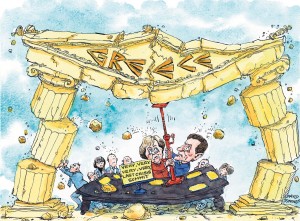
Prime Minister Alexis Tsipras will chart a path forward for Greece in parliament on Sunday, two days after the head of the euro-area finance ministers’ group shot down his proposal to avoid being shut off from funding at the end of the month.

The new government’s request for a debt writedown has already been rejected, and Eurogroup chief Jeroen Dijsselbloem on Friday rejected a request for a short-term financing agreement to keep the country afloat while it renegotiates the terms of its bailout program.

“We don’t do” bridge loans, Dijsselbloem told reporters in The Hague, when asked about Greece’s request. “A simple extension is possible as long as they fully take over the program.”

 The European Union’s latest rebuff raises the stakes for Greece’s new government. The next showdown is scheduled for Feb. 11 in Brussels, when Greek Finance Minister Yanis Varoufakis faces his 18 euro-area counterparts in an emergency meeting after Tsipras delivers his major policy address to lawmakers.

Standard & Poor’s lowered Greece’s long-term credit rating one level to B- and kept the ratings on CreditWatch negative.

“Liquidity constraints have narrowed the timeframe during which Greece’s new government can reach an agreement with its official creditors on a financing program, in our view,” S&P said in a statement.

Greece’s goal remains to achieve a bridge program that would give it time to negotiate with its creditors and devise a three- to four-year fiscal plan.

Varoufakis has said his government won’t accept any more cash under the terms of Greece’s existing bailout, leaving 7 billion euros of potential aid on the table, rather than complying with demands for more austerity attached to the country’s international bailout agreement.

The standoff risks leaving Europe’s most-indebted state without any funding as of the end of this month, following the Jan. 25 election victory of Tsipras’s Syriza party.

While there’s little doubt Tsipras will win the confidence vote — his coalition has 162 seats in the 300-seat chamber — attempts to persuade the rest of the euro-region to endorse his plan to restructure the country’s debt and boost spending have so far drawn a blank. Tsipras and Varoufakis, have been recalibrating their rhetoric this week after markets plunged during their first days in office.


No Bridge Loans

Alibaba Does More Than Phone In India

Ant Financial Services Group, an affiliate of China’s Alibaba Group Holding Ltd, has agreed to buy 25 percent of Indian payment services provider One97 Communications, tapping into the country’s smartphone and online industry boom.

The companies did not provide the value of the deal, but a person with knowledge of the matter called the investment a precursor to One97 listing on the stock exchange, and said the stake was worth more than $500 million.

The deal values One97 at more than $2 billion, making it one of the most-valuable start ups in the country. One97 runs Paytm, an online platform through which users can shop or pay utility bills, whereas Ant runs Paytm’s Chinese peer Alipay.

Paytm has benefited from the spread of affordable handsets and internet connectivity which has turned India into the fastest-growing smartphone market in the Asia-Pacific region, according to researcher IDC.

“This partnership between Ant Financial Services Group and Paytm will foster the growth of India’s digital payment ecosystem,” the companies said in a joint statement.

Ant, investing in an Indian company for the first time, will provide Paytm “with strategic and technical support for its business”, the companies said.

One97 plans to use the proceeds to grow its mobile payment business and increase the scale of its services, they said.

“With over one billion people, India’s payments market has vast untapped potential,” Ant Vice President Cyril Han said in the statement.

Paytm has about 23 million users, the companies said. The $2 billion valuation of operator One97 compares with the $11 billion of Flipkart Online Services Pvt Ltd, India’s biggest e-commerce company.

Ant to India

Should Obama Mind his own Business?

Ashoka Mody writes: President Barack Obama’s recent call to ease the austerity imposed on Greece is remarkable – and not only for his endorsement of the newly elected Greek government’s negotiating position in the face of its official creditors. Obama’s comments represent a break with the long-standing tradition of official American silence on European monetary affairs. (Note: It is unfortunate that the American who speaks up knows so little of his own country’s finances).

German Chancellor Angela Merkel said that Greece should not expect more debt relief and must maintain austerity. Meanwhile, after days of not-so-veiled threats, the European Central Bank is on the verge of cutting funding to Greek banks. The guardians of financial stability are amplifying a destabilizing bank run.

The International Monetary Fund has acquiesced in German-imposed orthodoxy. As IMF Managing Director Christine Lagarde told the Irish Times: “A debt is a debt, and it is a contract. Defaulting, restructuring, changing the terms has consequences.”

Delays and errors in managing the Greek crisis started early. In July 2010, Lagarde, who was France’s finance minister at the time, recognized the damage incurred by those initial delays.  Even the IMF acknowledged that it had been a mistake not to impose losses on private creditors preemptively; it finally did so only in June 2013, when the damage had already been done.

There is plenty of blame to go around. Former US Treasury Secretary Timothy Geithner championed a hardline stance against debt restructuring during a crisis.

Lee Buchheit, a leading sovereign-debt attorney  was harshly critical of the authorities’ failure to face up to reality.

Obama may have arrived late to the right conclusion, but he expressed what should be an obvious truth: “You cannot keep on squeezing countries that are in the midst of depression.”

Recent analysis shows that forgiveness of Greece’s official debt is unambiguously desirable.. If European sensitivities must be assuaged, Greece’s debt repayment could be drawn out over 100 years.

At the end of the day, debt forgiveness benefits creditors as much as it helps debtors. Creditors have known this since Spain’s King Philip II became the world’s first known serial sovereign defaulter.

European authorities must come to understand that the next act of the Greek tragedy will not be confined to Greece. If relief fails to materialize, political discontent will spread, extremist forces will gain strength, and the survival of the European Union itself could be endangered.

 End of Austerity in Greece

Win Win Gender Diversity in Silicon Valley?

Kristin V. Brown writes:  As criticisms of Silicon Valley’s largely white male ranks came to a boil last spring, Nicole Sanchez was in the midst of launching a company of her own — a consultancy to help companies’ diversity.

The timing couldn’t have been better. The month Vaya Consulting opened, Google released its lackluster employee diversity data to the public. At Vaya, the calls came pouring in. One company’s public relations nightmare, it turns out, is another woman’s startup.

Vaya is one of a host of upstarts seeking to turn Silicon Valley’s diversity problem into profit — helping tech companies find, recruit and retain a diverse workforce, usually for a hefty fee. Still other companies have recently added diversity services to those already offered.

In tech, diversity is now for sale.

Sanchez and her team helps clients like Pinterest with tasks such as restructuring recruitment and organizing bias training.

At Pinterest, a scrapbooking social network that has a majority of female users, the numbers are a bit better than elsewhere in tech. Overall, 92 percent of its staff is either white or Asian, but 40 percent of the more than 300 employees are women.

But Pinterest suspected that lurking in its hiring and recruiting strategies might be practices that made it harder for female, black, Latino and Native American candidates to make the cut. The company signed deals last week with Vaya, and another startup, Paradigm, to revamp the way it phrases job postings and interview questions.

Gap Jumpers, another diversity startup, sells software that helps tech companies evaluate job candidates based on talent alone.

Sound company Dolby Labs, one of Gap Jumpers’ clients, said it recently hired an engineering intern who probably would have otherwise been passed over due to a lack of experience and academic pedigree.

Gap Jumpers was started in June, and already has eight paying clients and six more testing its product. Its customers pay an annual fee of $2,000 for each hiring manager using the software.

Textio is a new company whose software detects patterns in job postings that might turn off candidates who aren’t white and male.

Entelo, a recruiting software company, added a feature in May that allows hiring managers to run searches for diverse job candidates with specific skills, such as a female software developer with expertise in JavaScript. Annual subscriptions start at $10,000.

Piazza, which makes software that college students use to communicate with professors, introduced a product last fall that lets technology companies find women taking computer science classes. The cost of that service starts at $100,000 a year.

Likewise, Sanchez, of Vaya Consulting, said she has been turning business away — too many companies seem to think hiring her will be a quick solution to a complicated problem.

Gender Diversity in Silicon Valley

Nigeria’s Bonds?

Nigeria having a tough time as oil prices plummet. Yet  Nigeria will probably remain in JPMorgan Chase & Co.’s local-currency emerging-market bond indexes tracked by over $200 billion of funds, according to the central bank governor.

“The main issue was liquidity and we are convinced that liquidity has come up to the level they desire,” Governor Godwin Emefiele said by phone from Abuja. “It’s gone to a range of about $250 million to $300 million a day.”

JPMorgan placed Africa’s largest economy and oil producer on “index watch negative’’ for its GBI-EM indexes on Jan. 16, saying central bank measures in December had reduced foreign exchange and bond trading and made it difficult for investors to replicate the gauge. The New-York based lender said it would make a decision within five months.
Nigeria, which derives 90 percent of export earnings and 70 percent of government revenue from oil, has been battered by crude prices that have fallen by half since June.
The central bank increased interest rates to a record 13 percent in November in a bid to stem outflows and stabilize the naira, which has weakened 17 percent against the dollar in the past six months,

Nigeria's Bonds

Whistleblowers of the World Unite?

In the original case against UBS there was one indispensible person:  Bradley Birkenfeld.  He had to do time, in jail and then at home with an electronic bracelet.  But he also received $104 million from the Internal Revenue Service for making possible the collection of billions of dollars in unpaid taxes.

Why haven’t more people become whistleblowers?  They are often the difference between prosecuting a case and not starting an action.  They are certainly instrumental in winning cases.  And people who blow the whistle can make huge sums of money.

It is a frightening action to take.  You are going up against big companies and often ending your chance of being employed in your business of choice.  The prospect of prison is also a deterrent.

Should governments consider amnesty for people who are willing to step up and expose the criminal cultures of the institutions in which they work?  Transparency International writes: Whistleblowers are invaluable in exposing corruption, fraud and mismanagement. Early disclosure of wrongdoing or the risk of wrongdoing can protect human rights, help to save lives and preserve the rule of law.

Safeguards also protect and encourage people willing to take the risk of speaking out about corruption. We must push countries to introduce comprehensive whistleblower legislation to protect those that speak out and ensure that their claims are properly investigated. Companies, public bodies and non-profit organisations should introduce mechanisms for internal reporting. And workplace reprisals against whistleblowers should be seen as another form of corruption.

Public education is also essential to de-stigmatise whistleblowing, so that citizens understand how disclosing wrongdoing benefits the public good. When witnesses of corruption are confident about their ability to report it, corrupt individuals cannot hide behind the wall of silence.

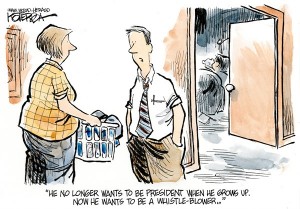
Jeff Koterba cartoon for June 18, 2013 "Whistle Blower"

Russia Update

Alexander Winning and Oksana Kobzeva write:  Russian banks’ capital could “quickly melt” if the economy significantly weakens, but banks won’t experience significant difficulties if the situation develops in line with official forecasts, a deputy central bank governor said.

Mikhail Sukhov said banks’ loan quality could deteriorate sharply if two of the following take place: gross domestic product (GDP) falls by over 6 percent in 2015, real wages fall by over 10 percent, or if unemployment goes over 10 percent.  “I’m categorically against calling it a banking crisis,” he said. “But difficulties could emerge if economic development is significantly different from the forecasts that we have.”

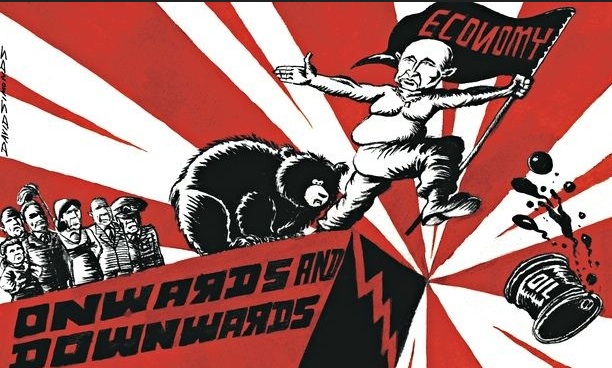
The Economy Ministry last week said it expects Russia’s GDP to contract by 3 percent this year, if oil prices average $50 a barrel. Many analysts are less optimistic, predicting the economy could shrink by 5 percent or more.

Russian banks’ cost of financing and loan-loss provisioning jumped last year, hurting their profits and eroding their capital as their access to Western markets was restricted due to sanctions linked to the Ukraine crisis.  Sukhov said on Thursday that he expected Russia’s top five banks to increase their share of total banking assets to around 60 percent next year. Most of them are state-controlled, including Sberbank (SBER.MM: Quote, Profile, Research) and VTB (VTBR.MM: Quote, Profile, Research).  “The process of consolidation is going very quickly,” he said. “The concentration of business in the banking sector will strengthen.”

Russian banks’ open foreign-currency position had fallen from $14 billion to $10 billion in December, meaning their exposure to potential forex losses had reduced, Sukhov said.

The Central Bank has relaxed accounting rules and credit ratings of lenders to pre-date Russias incursion into Crimea. This means they are pretending that the economy is better than it is.

Russian Economy?

Oppenheimer, a Little Guilty?

What one hand takes away, the other hand gives.  The Securities and Exchange Commission (SEC) has voted to give Oppenheimer Holdings Inc. (NYSE:OPY) & Company a break from further enforcement action after a “bad actor” ban was triggered and then subsequently waived by an SEC commissioner’s vote.

Two of five SEC commissioners, however, are speaking out against the waiver for what they see as repeated offenses, placing law and order credentials of SEC Chairwoman Mary Jo White, a Democrat and former prosecutor, into question.   White cast the deciding vote with two Republican commissioners in favor of Oppenheimer.

Here’s the problem:  We have rules and when they are ignored, we wink and let the offending party continue doing buisness as was and is.  We are following the US Department of Labor’s decision on whether or not to waive the criminal charges levied against Credit Suisse so they can continue with their 2 billion dollar pension business in the US, despite admitting to aiding and abetting US tax evaders.

The Securities and Exchange Commission charged Oppenheimer & Co. with violating federal securities laws while improperly selling penny stocks in unregistered offerings on behalf of customers.  Oppenheimer agreed to admit wrongdoing and pay $10 million to settle the SEC’s charges. Oppenheimer will pay an additional $10 million to settle a parallel action by the Treasury Department’s Financial Crimes Enforcement Network (FinCEN).

According to the SEC’s order instituting a settled administrative proceeding, Oppenheimer engaged in two courses of misconduct. The first involved aiding and abetting illegal activity by a customer and ignoring red flags that business was being conducted without an applicable exemption from the broker-dealer registration requirements of the federal securities laws. The customer was Gibraltar Global Securities, a brokerage firm in the Bahamas that is not registered to do business in the U.S. Oppenheimer executed sales of billions of shares of penny stocks for a supposed proprietary account in Gibraltar’s name while knowing or being reckless in not knowing that Gibraltar was actually executing transactions and providing brokerage services for its underlying customers, including many in the U.S. The SEC separately charged Gibraltar in 2013 for its alleged misconduct.

The SEC’s order finds that Oppenheimer failed to file Suspicious Activity Reports (SARs) as required under the Bank Secrecy Act to report potential misconduct by Gibraltar and its customers, and the firm failed to properly report, withhold, and remit more than $3 million in backup withholding taxes from sales proceeds in Gibraltar’s account. Oppenheimer also failed to recognize the resulting liabilities and expenses in violation of the books-and-records requirements, and improperly recorded transactions for Gibraltar’s customers in Oppenheimer’s books and records.

SEC Press Release:  According to the SEC’s order, the second course of misconduct involved Oppenheimer again engaging on behalf of another customer in unregistered sales of billions of shares of penny stocks. The SEC’s investigation, which is continuing, found that the sales generated approximately $12 million in profits of which Oppenheimer was paid $588,400 in commissions. The firm’s liability stems from its failure to respond to red flags and conduct a searching inquiry into whether the sales were exempt from registration requirements of the federal securities laws, and its failure reasonably to supervise with a view toward detecting and preventing violations of the registration provisions.

The SEC’s order requires Oppenheimer to cease and desist from committing or causing any violations and any future violations of Section 15(a) and 17(a) of the Securities Exchange Act of 1934 and Rules 17a-3 and 17a-8, and of Section 5 of the Securities Act of 1933. In addition to the monetary remedies, Oppenheimer agreed to be censured and undertake such remedial measures as retaining an independent consultant to review its policies and procedures over a five-year period.  Oppenheimer Case

Design Rachel Gold

Design Rachel Gold


UBS Still Aids and Abets US Tax Evaders

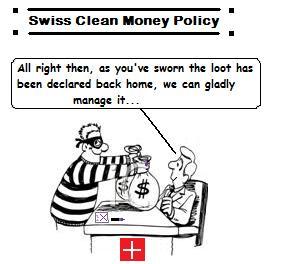
U.S. federal prosecutors have launched a new probe into whether Swiss bank UBS AG helped Americans evade taxes through investments banned in the United States.  UBS, which paid $780 million in 2009 to settle a separate Justice Department tax-evasion probe, is now under investigation for allegedly helping wealthy clients hide assets through so-called bearer securities.

Corruption in Indonesia?

Banyan writes:  In October Joko Widodo was inaugurated as Indonesia’s president, with parliament controlled by an opposition of bad losers threatening to thwart all his plans. Yet by this week, when Jokowi, as he is known, marked 100 days in office, his biggest headaches were caused by his own party, the PDI-P. It has stoked a confrontation between the notoriously corrupt police force and a popular anti-corruption body. The row risks blunting the great political weapon Jokowi has so far wielded to cow friend and foe alike: his personal popularity.

At the centre of it is Budi Gunawan. The policeman had been under a cloud since 2010 because his bank balance bulged suspiciously for a humble cop’s.  On January 23rd, the police arrested a KPK commissioner, Bambang Widjojanto, on flimsy-looking charges of encouraging perjury in 2010, when he was a campaigning private lawyer. He has resigned. To many, the arrest seemed like retaliation by the police. The three other KPK commissioners are also under investigation. The KPK needs a quorum of three to function, so it risks paralysis.

The affair undermines faith in his commitment to wiping out corruption. Like his predecessor, Susilo Bambang Yudhoyono, in other ways his polar opposite, Jokowi is respected as honest and a doughty fighter against graft. Many Indonesians know from personal experience that the police cannot be trusted.

Mr Budi’s appointment also mocked hopes that Jokowi would make promotions on merit. A businessman from a humble background, Jokowi worked his way to power through winning direct elections, first as mayor of his Javanese hometown, Solo, then as governor of the capital, Jakarta.

Perhaps Jokowi is not his own boss, and Ms Megawati still calls the important shots.

At home, these hardline policies are popular. Mr Jokowi appealed to voters not as a soft-centred liberal but as a no-nonsense small-town mayor who gets things done. And that is another reason why his deliberate, letter-of-the-law handling of the crisis over the KPK is so damaging.

It is also distracting attention from his rapid achievement of some economic-policy goals: starting the distribution of smartcards to poor Indonesians, entitling them to free health care and education, and removing fuel subsidies. Greatly helped by the plunge in the oil price, this last measure has freed billions of dollars for investment in infrastructure and social welfare. Environmentalists also give the president grudging credit for making a start on another crying need: affording better protection to Indonesia’s forests.