Can You Do Business in Cuba?

Bradley Klapper writes:  The Obama administration is putting a large dent in the U.S. embargo against Cuba as of Friday, significantly loosening restrictions on American trade and investment.

The new rules also open up the islland to greater American travel and allow U.S. citizens to start bringing home small amounts of Cuban cigars after more than a half-century ban.

Thursday’s announcement of new Treasury and Commerce Department regulations are the next step in President Barack Obama’s plan to re-establish diplomatic relations with Cuba. They come three days after U.S. officials confirmed the release of 53 political prisoners Cuba had promised to free.

Only Congress can end the five-decade embargo. But the measures give permission for Americans to use credit cards in Cuba and U.S. companies to export telephone, computer and Internet technologies. Investments in some small business are permitted. General tourist travel is still prohibited, but Americans authorized to visit Cuba need no longer apply for special licenses.

With the new regulations public, the focus shifts to American businesses and the Cuban government. Some changes could take months as U.S. firms analyze the risks and benefits of moving into a complicated new market. And the Cuban government has said nothing publicly about how it will regulate new trade with the United States. Foreign companies currently deal almost entirely with state-owned firms that are notoriously slow, inefficient and short on cash.

Cuba will likely be more open to a surge in new travelers than to other potential effects of the loosened rules.

But Cuban hotels generally fall short of international standards and those with better food and service are almost always fully booked during the winter high season.

Casting a shadow on potential deals is the possibility of litigation by Cuban-Americans and U.S. firms whose property was confiscated in Fidel Castro’s 1959 revolution and may try to sue companies entering into business with the Cuban government. In Washington, Congress may also seek to erect barriers to new investment.

Thomas Donohue, the head of the U.S. Chamber of Commerce  said it was better for the U.S. to sell computers, smartphones and cars to Cuba than to cede such business to countries like Russia and China. Still, the embargo as a whole appears unlikely to fall anytime soon.

Starting Friday, U.S. companies will be able to export mobile phones, televisions, memory devices, recording devices, computers and software to a country with notoriously poor Internet and telecommunications infrastructure. Internet-based communications will fall under a general license. The new rules “immediately enable the American people to provide more resources to empower the Cuban population to become less dependent upon the state-driven economy,” White House spokesman Josh Earnest said Thursday.

The U.S. is now “one step closer to replacing out of date policies,” Treasury Secretary Jacob Lew said Thursday.

Other changes include:

—The elimination of limits on how much money Americans spend in Cuba each day or what they spend it on.

—Permissible use of U.S. credit and debit cards.

—Travel agents and airlines can fly to Cuba without a special license.

—Insurance companies can provide coverage for health, life and travel insurance policies for individuals residing in or visiting Cuba.

—Financial institutions may open accounts at Cuban banks to facilitate authorized transactions.

—Investments can be made in some small businesses and agricultural operations.

—Companies may ship building materials and equipment to private Cuban companies to renovate private buildings.

Further down the road, Washington envisions reopening the U.S. Embassy in Havana and carrying out high-level exchanges and visits between the governments. Secretary of State John Kerry could travel to the island later this year.

Doing Business in Cuba

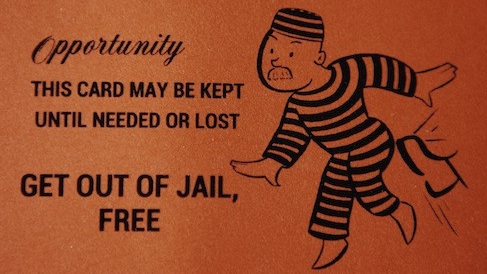
Credit Suisse Gets Out of Jail Free?

Neil Weinberg writes: Credit Suisse Group AG (CSGN)’s bid to continue managing U.S. pensions after its conviction for helping American clients evade taxes should be rejected by the Labor Department unless the bank improves controls against wrongdoing, according to Representative Maxine Waters.

Waters, the top Democrat on the House Financial Services panel, sent a letter to Labor Secretary Thomas Perez today ahead of an agency hearing in Washington on Credit Suisse’s status as a pension manager, which Waters and two colleagues had pressed the department to hold.

“I believe that at this point, the waiver should be denied given the lack of important public facts and the insufficient proposed conditions,” Waters wrote. If regulators continue to routinely approve waivers, they will be “throwing away valuable enforcement tools and enshrining a policy of too-big-to-bar.”

Unless Labor grants a waiver, the Swiss bank will be disqualified from handling U.S. pension funds following its guilty plea last year to helping thousands of Americans evade U.S. taxes. Credit Suisse oversees billions of dollars of assets for more than 100 U.S. pension plans, according to a July court filing.

Credit Suisse has three asset management units seeking waivers to continue managing U.S. pension funds, Roger Machlis, head of Credit Suisse Asset Management’s legal and compliance unit, said at the hearing. John Popp, managing director of the asset management unit, who also spoke at the hearing, estimated more than 1 million individuals are in the pension plans it manages.

Credit Suisse Get out of Jail

Reform Iran’s Banks?

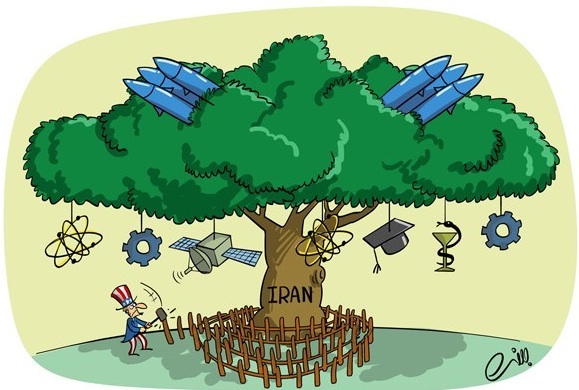
At the beginning of January, Tehran hosted the most significant economic conference held in Iran since 1979, with President Hassan Rouhani, his economic team and 1,500 economists focusing on economic hardships that have surfaced in recent years.

The need for restructuring the banking system was among major issues discussed in the two-day event, while top monetary officials on the second day of the conference called on the commercial banks to be selective when offering loans.

Akbar Komijan, the deputy governor of the central bank, implied that if the commercial banks do not provide enterprises with loans, the reason would be lack of eligibility of loan seekers, and not a lack of finances.

In the eight months ending Dec. 21, more than 60% of the granted loans were made to address cash flow issues.  The banks have been faced with a massive number of non-performing loans due to the combination of government’s lending directives to support failing enterprises and harsh depreciation of the rial in 2013 against major foreign currencies.

The commercial banks, troubled with a lack of cash, are now left with few options to meet their daily needs. The central bank is complaining that the banks have been borrowing to much from the treasury.   Komijani said at the conference that the banks’ overdraft from the central bank is “inconveniencing” and called on them to find other ways to meet their needs for cash.

A monetary expert in Tehran said the banks usually fail to pay off their debt, given the high interest rate of 32% for such loans. The banks have no choice but to borrow from either the central bank or one another.

Some struggling banks are even given one-day loans by other financial institutions. These loans would let the banks meet their immediate needs for cash. Monetary officials are fearful that they would soon face a desperate situation as the non performing loans cannot be recovered.

Another option the banks could consider to boost their lending ability is to use the money held by the public in the form of gold and foreign currency, which is estimated to be around $21.5 billion.  The amount is more than five times the estimated gold reserves of the central bank, which is nearly $3.9 billion.

Many believe that the lifting of sanctions is a shortcut to prosperity as they have so far blocked the Iranian government from tapping into the reduced oil income.

The lifting of sanctions would let Iran access $100 billion in foreign assets blocked in international banks in one go and resume economic relations with world nations, a move that would give a boost to the economy and the private sector in particular, which is heavily indebted to the banking system. But for now the negotiations are unlikely to result in a swift deal and the government can do little to shore up the stressed banks.

Among the few measures the regulator may take to help recover the sizable NPLs is create a specialized team or entity to address problems of bad debt. If a list of top defaultors connected t politicians were published, this might also improve matters.

Iran

Colombia, for Entrepreneurs?

Columbia’s turnaround.   A quarter century ago, the Latin American nation was nearly a failed state, overrun by drug lords. Even today, after the drug cartels have been largely suppressed, a war with leftist guerrillas has become the longest armed conflict in the world – lasting more than a half century. More than 220,000 people have been killed and more than a tenth of the population remains displaced.

Such troubles, which include high corruption and a big gap between rich and poor, might have left an entire people feeling down. Not so in Colombia.

In 2012, the United Nations ranked it third on a “happiness” index. A Gallup poll last year put Colombia in the top 10 of countries in which people like what they do each day and have supportive relationships. And Forbes magazine cites it as one of “10 coolest places to visit in 2015.”

Yet coolness, love, and happiness might not be enough to explain Colombia’s recent successes and reform efforts. A 2014 survey by the Pew Research Center ranks it the highest country on a few key character traits. Colombians stand out in believing that “getting ahead” takes a combination of hard work and education.  Even more telling is that Colombians rank very high compared to other emerging economies in not believing that “success is determined by outside forces.”

These traits of resilience may help explain why Mark Schneider of the International Crisis Group predicted last week that “the only good news” on the world state in 2015 may be a peace agreement in Colombia’s long war.

Talks between President Juan Manuel Santos and the Colombian Revolutionary Armed Forces, known as FARC, began in 2012. The two sides have reached a couple key agreements. But the hardest parts – how to reintegrate militias and provide reparations to some 6 million victims – are not yet resolved. Even after an agreement, it might take years to reduce the poverty and injustices that first drove the rebellion.

Still, much of Colombia, especially the former drug-addled city of Medellín, is thriving despite the war. Instead of being home to drug barons like Pablo Escobar, Medellín now sports impressive infrastructure, such as a long escalator and cable cars up hillside slums to help connect the poor and rich. The city’s culture of entrepreneurship is creating a Silicon Valley of Latin America.

Colombia has long stood out in Latin America. It was the region’s first democracy. Bogotá was once the “Athens of South America.” Now it has the strongest and fastest-growing economy, ranking in size behind Brazil and Mexico. With aid from the United States, it has curbed much of its major drug trafficking.

It still needs land reform and a better human rights record to uplift its most marginalized people. During his reelection campaign last year, Santos promised to move his country from a “culture of fear” toward a “culture of fair play, of decency, of respect towards institutions.”

A nation that has been at war for 50 years, he says, has to start early to heal the wounds of war. The victims of the conflict have a seat at the peace talks, as Santos has insisted, because they are more willing to forgive and more willing to be generous.

Colombia


Jamie Dimon Whines

Hugh Son writes: Jamie Dimon, grappling with multibillion-dollar legal costs and rising capital requirements at JP Morgan Chase  said overlapping efforts by U.S. regulators place banks “under assault.”

“We have five or six regulators or people coming after us on every different issue,” Dimon, 58, said today on a call with reporters after New York-based JPMorgan reported fourth-quarter results. “It’s a hard thing to deal with.”

JPMorgan, the largest U.S. bank, posted a drop in fourth-quarter profit amid $990 million of legal expenses, about double what some analysts predicted. The legal costs, mostly tied to probes into currency rate-rigging, follow even bigger payments in 2013 related to mortgage bonds sold before the 2008 crisis by JPMorgan and firms it acquired.

Dimon, who previously blamed regulators for stifling economic growth, struck a more conciliatory tone last year. The bank had a “tin ear” when dealing with overseers before settling probes into mortgage lapses and trading losses, he said in an April letter to shareholders.

New Federal Reserve rules that exceed the global standard also could mean JPMorgan needs more than $20 billion in additional capital by 2019.

“The regulators clearly want even more capital,” Dimon said today. “We’ll meet those requirements. But those measures aren’t a measure of risk at all. It is simply a measure of size. This company is as sound as it gets.”

Dimon, who was lauded during the crisis for JPMorgan’s role in buying Bear Stearns Cos. and Washington Mutual Inc.’s banking operations, has criticized the government for penalizing JPMorgan for those firms’ actions.

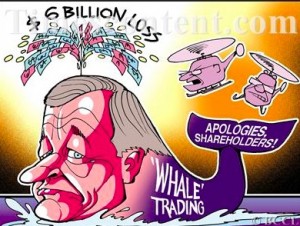
In 2013, Dimon settled a litany of disputes, including government probes of mortgage-bond sales, energy trading, oversight of a trader known as the London Whale, and scrutiny of services provided to Ponzi-scheme operator Bernard Madoff.

The bank settled foreign-exchange investigations with three regulators in November, paying about $1 billion, and still faces a Justice Department probe.

“In the old days, you dealt with one regulator when you had an issue, maybe two,” said Dimon, 58. “Now it’s five or six. It makes it very difficult and very complicated. You all should ask the question about how American that is. And how fair that is. And how complex that is for companies.”

Dimon’s bank, of course, does only 20% of its business as a conventional commercial bank.  It is in the derivatives market, the commodities market and has already gotten spanked for its involvement in LIBOR.  Maybe Dimon should listen to Goldman Sachs, who has suggested the company should be divided up.  Then each section could deal with its own regulators.

Jamie Dimon

Has Tsipras Lost Already?

Faced with a popular Greek opposition party, Syriza, which demands that Europe either reduce Greece’s debts or watch Greece walk out of the eurozone, German Chancellor Angela Merkel has not blinked and therefore has neutralized the bargaining position Syriza hoped for.

Greece’s creditors – in the main, the governments of northern European Union countries, the IMF and the World Bank – are unfazed by Greek threats.

There are still creditors tied to Greece, but they have changed. Greece’s creditors are governments and international organizations, and not banks and pension funds, nor companies whose downfall would immediately affect millions of citizens in predominantly northern European countries,

The original rescue operation was a huge bailout – but in the form of quick money that was used to pay off Greek debts to German, French, and Dutch financial institutions.

At the beginning of the crisis, a Greek default would have seen banks and pension funds in the tank, resulting in renewed panic on financial markets still reeling from the credit crisis. Now the risk of contagion – with banks in Italy, Spain, and Ireland crashing like dominoes stones as investors flee – has largely subsided.

Instead, Greece now owes billions of euros to EU countries, the IMF, and the World Bank, among others. These creditors do not easily default. The hit they would take would be one they could bear. Meanwhile, a default and an exit from the European Union wouldn’t help Greece at all..

The first thing Greece would have to do it it exited the euro and the EU is organize stringent capital controls to prevent Greeks from moving their euros to other countries, which would effectively end any economic activity still going on in the country.

Second, Athens would have to quickly introduce a new currency,  which would immediately crash against the other main currencies.

For  Greek bonds, a new level below junk status would have to be invented. Within 24 hours Greece would be a financial pariah, paying huge interest rates and risk premiums, while its existing loans would balloon, as most loans outstanding to its foreign creditors would still have to be paid in euros. Greece would be Europe’s Zimbabwe, with the local economy in tatters; rampant inflation; and mass unemployment.

So Syriza leader Alexis Tsipras stood on the ledge,  Merkel folded her arms, smiled told him to go ahead and jump.  And now Merkel wonders whether Tsipras understands that he may call himself Greece’s new prime minister after Jan. 25, but he still won’t be the one holding any power.

Merkel and Tsipras

China Needs New Math

William Pesek:  As goes the US go go China’s exports.

The improving U.S. economy has brought some welcome cheer to officials in Beijing, which reported an unexpectedly high 9.7 percent jump in December exports.  If those numbers continued in months ahead, they’d also be good news for a global economy that’s running short on viable growth engines.

China will probably have to loosen monetary policy soon in order to ensure that GDP growth stays above last year’s target of 7.5 percent (it’s currently around 7.3 percent).

Already worryingly high compared to where Japan was 25 years ago when its own bubble burst, China’s GDP ratio  will only rise further with additional stimulus. The more China gins up growth in 2015, the more irresponsible lending it will have to service in the decade ahead.

The math simply doesn’t work out. Even if China could somehow return to the heady days of 10 percent-plus GDP growth, its debt mountain would by then be nearly unmanageable.

From Japan to Argentina to Greece, recent decades offer many examples of governments thinking 1 + 1 = 3. It took Japan more than a decade after its bubble burst in 1990 to create the Resolution and Collection Corporation, modeled after America’s Resolution Trust Corporation, to dispose of bad loans. China can’t afford to wait that long to head off a full-blown crisis. It’s one thing for a $24 billion economy like Argentina to blow up; it would be quite another if the world’s second-biggest plunged into turmoil.

Yet for all the official talk about curbing borrowing and adjusting to a new normal of lower growth, Xi’s government still hasn’t shown the stomach necessary to bring China’s debt problems out into the open and deal with them. Even one of the first defaults on an offshore bond by a Chinese developer last week ended happily. Kaisa Group missed a $23 million interest payment, but quickly received a waiver from HSBC.

What should China be doing? First, clamp down more firmly on new borrowing, particularly to the state sector. While that would roil credit markets and crimp growth, it’s vital to gaining control of the financial system. Next, conduct a truly transparent audit of public debt and the shadow banking system.

Finally, China needs to create a mechanism to collect and write down bad assets. Only by doing so can Beijing prod wobbly banks to act openly and quickly to repair balance sheets. There are many ways China could go — a Japan or a Sweden-like purge and bank recapitalization. The point is to address its math problem frontally. However cheery, trade and GDP figures are the wrong numbers to focus on.

Xi's Purge?

Hun Sen’s Rule of Cambodia?

Sebastian Strangio writes:  In late November, Cambodia’s government offered the opposition Cambodia National Rescue Party (CNRP) some concessions. One was that the parliament would formally recognize the CNRP’s president, Sam Rainsy, as leader of the opposition, with a “rank equal to the prime minister.”

Most Cambodians know only Hun Sen who marks his 30th anniversary in power. In that time, the Cambodian leader has been one of the world’s great political Houdinis, passing unscathed through repeated cycles of his country’s turbulent history.

Hun Sen now faces perhaps the greatest challenge of his career: to win back Cambodian voters without undermining the tycoons who have bankrolled his long reign. Does an aging strongman have the energy for another rebranding before elections due in 2018? Whatever happens, Cambodia’s singular leader has made it clear he isn’t going anywhere. After the January 2014 garment protest crackdown, Hun Sen showed no remorse for those killed, warning that he would meet further protests with even bigger demonstrations of his own. “If Hun Sen comes out to do something,” he said, “it’s not going to be small.”

Hun Sen’s remarkable career has tracked the tumults of modern Cambodia. Throughout the 1970s Hun Sen fought for those “Khmers Rouges,” or Red Khmers, as Sihanouk dubbed them. After taking power in April 1975, the Khmer Rouge established a network of brutal labor camps in the Cambodian countryside, which led to the death of an estimated 1.7 million Cambodians — nearly a quarter of the population.

After 2013’s election, Hun Sen promised change. Ministries have been reshuffled; reforms have been launched in education and environmental policy. At the same time, the government has ruled out any possibility of a new administration. After opposition supporters and unions took to the streets in December 2013 calling for Hun Sen’s resignation, security forces fired at striking garment workers on Phnom Penh’s outskirts on Jan. 3, 2014, leaving five dead. Politicians and protesters have since been hauled into court on spurious charges.   Hun Sen of Cambodia

Hun Sen of Cambodia

Guilty Credit Suisse Exempt?

Since the repeal of Glass Steagall in 1999, the US  government has been of the big banks, for the big banks and yes, by the big banks.  Vast sums of money have been obtained by the very few. Many citizens have been hurt. More importantly, instead of helping businesses, small and large, which drive the US economy, these banks now spend most of their time on high risk derivative plays which include owning warehouses to store commodities until their price goes up and manipulating markets.

The tide is slowly turning with the alliance in the Senate of Elizabeth Warren, Sherrod Brown and Jeff Merkley.

While US regulators and the Department of Justice have been reluctant to take American-owned banks to task, propelled by the climate of the times, they have begun to go after foreign banks.

Last spring, after a dramatic session before the Senate Subcommittee on Investigations where Senators McCain and Levin let loose on the top manamagement of Swiss-based Credit Suisse, the Department of Justice followed with the announcement of a plea bargain that at last included the acceptance of a criminal charge of aiding and abetting tax evasion in addition to a large fine.  Most observers had noted up until this point that banks were being fined, but the fines  were ‘the cost of doing business.”  Only criminal indictments would deter their behavior, it was thought.

Criminal indictments have serious consequences.  Credit Suisse managed billions of dollars in pension funds in the US. Under law, a convicted felon can not manage these funds.  Credit Suisse is a convicted felon.  But they quickly applied for an  exemption.

While it is true that the Department of Labor has regularly granted exemptions to banks over the past fifteen years, this time the route to exemption was not going to be smooth.  Congresswoman Maxine Waters, and two other representatives called for a hearing.

Waters said:”Every commenter urged the DOL to enforce the law, and not grant Credit Suisse an exemption, with one exception: Credit Suisse. The Credit Suisse letter actually asks for even greater latitude in pension management. In the face of this comment record, bolstered by letters from senior members of Congress , from committees responsible for banking and pension fund oversight, it will be a miscarriage of the regulatory process if the DOL grants Credit Suisse a pass from this penalty without a hearing. Unfortunately, the DOL habitually grants such exemptions — 23 straight times in previous cases. We hope the comment record changes this streak.”

The hearing is to be held in Washington on January 15th.  The question is: Will the bank lobby or the American people win?  Let us hope that the DOL focuses on what Credit Suisse can do that no other bank can do. (Nothing.)  Why a guilty plea to criminal activity should be over looked?  How pension funds can be protected when the administrator is not governed by American law?  When are we going to scratch firms from the “Too Big To Ban” list?

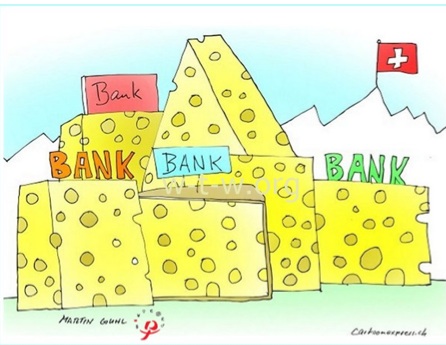
Credit Suisse by Martin Guhl


Piketty’s Ripples and Waves?

Jusstin Fox writes:  CEO of Aetna Life Insurance  Mark T. Bertolini asked executives at his company to read Thomas Piketty’s “Capital in the 21st Century.” Then he announced that the company will raise the wages of its lowest-paid workers to at least $16 an hour and cut their health-care bills

One way to look at this is as a reaction to the improving economy — and a sign that serious upward wage pressure may finally start showing up in employment statistics.  Aetna’s business is becoming more dependent on selling coverage to individuals, meaning customer service has to improve. But there’s also that Piketty thing:

It’s not just about paying people, it’s about the whole social compact. Why can’t private industry step forward and make the innovative decisions on how to do this?

Yeah, why can’t it? The standard answer for quite a while now has been that in a competitive global economy, companies can’t afford to pay workers more than they’re worth.

Earlier economists such as Adam Smith and David Ricardo depicted the setting of wages as a social decision as much as an economic one. Ricardo believed that the income distribution depended on the “habits and customs of the people.”

Most likely it’s a mix. Productivity plays an undeniable role, but so do those habits and customs, which can change. The minimum wage research of the past few years indicates ndicate that there’s at least some room on the margin for using non-market means to push incomes upward.

Then there’s the matter of whether higher wages themselves do economic good. Henry Ford’s 1914 announcement that he was going to double the wages of his assembly line workers is an oft-cited case study. The story goes that he did this so his employees could afford to buy the cars they were making.

Mainstream economists were never entirely comfortable with this reasoning, but some came up with another justification for what Ford did: the “efficiency wage.” As Daniel Raff and Larry Summers this:

These theories have in common that over some range a firm can increase its profits by raising the wage it pays its workers to some level above the market-clearing one. A variety of mechanisms, turning on the role wage increases might play in eliciting effort, reducing turnover, attracting better workers, and in improving morale, have been suggested to explain why profits might be an increasing function of wages.

The financial crisis and subsequent Great Recession have changed the tone of the discussion somewhat. As CEOs of major corporations go, Bertolini is a little different. He does yoga and believes in alternative medicine. He was the first straight board member of the National Gay and Lesbian Chamber of Commerce. He says things like, “I have enough narcotics in my cabinet at home to put families through college.” Just because he’s going in this direction doesn’t mean his CEO peers will follow. Still, it is out of steps like these that big societal shifts are made.

Piketty's Waves