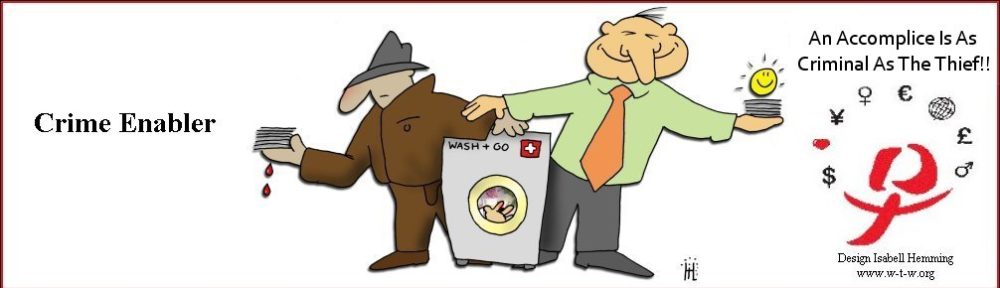
Egypt: Business Permissible, Reform Not

Michelle Dunne, a diplomat and scholar, was recently barred from Egypt.  She writes: “In my many trips in researching Egyptian politics and economics, I met with officials, politicians, activists and business leaders. The country has fascinated me since I studied there in the 1980s and later served at the U.S. Embassy in Cairo. Increasingly troubled by its stagnation under President Hosni Mubarak, in early 2010 I helped form the Working Group on Egypt. This bipartisan group of scholars urged the Obama administration to take Egyptians’ popular demands for political and economic reform into account. The group recommended U.S. political and economic carrots to support the democratic transition that was promised after Mubarak’s 2011 ouster, as well as sticks after President Mohamed Morsi from the Muslim Brotherhood took anti-democratic steps in 2012. After popular disaffection with Morsi paved the way for a military coup in July 2013 that ended the democratic transition, followed by a bloody crackdown, the group called for application of the U.S. law that required suspending military assistance in such cases, a step the administration later took.

In my own research, I looked into the unprecedented human rights abuses, domestic terrorism and startling politicization of the once-respected judiciary that ensued.

My deportation provoked a flurry of debate in the Cairo media. While many Egyptian commentators accepted the foreign ministry’s line that I had tried to force my way into the country without proper documentation, a few prominent voices highlighted what the incident said about Egypt’s political trajectory.  Can Egypt be considered a law-respecting state if it varies its visa rules depending on whether the government likes or dislikes the visitor? And what does it mean if Egypt excludes foreign visitors whose views the government dislikes?

Egypt is not North Korea, but my deportation is just the latest and least important of many steps toward an authoritarianism much nastier than that of the Mubarak era. I am safely at home, but there are an increasing number of Egyptian rights activists, journalists and politicians who have been forced into exile in the past several months.

On the very day I left for Cairo, I had met with businesspeople from the American Chamber of Commerce in Egypt, several of them old friends, who had come to Washington to proclaim that Egypt was stabilizing and open for business. They were hoping to drum up interest from foreign investors in a high-profile economic conference planned for March.

The question is whether Egypt can stabilize the country and attract foreign investment needed to enliven the economy, while repressing all criticism of government policies from inside or outside and abandoning any semblance of the rule of law. Some Egyptians point to Russia or China as models, but Egypt has neither Russia’s mineral wealth nor China’s more qualified labor force. It must ultimately unshackle the potential of its young and undereducated population, which will require opening the space to allow individual initiatives and ideas.
Business as Usual, No Reform


Modi’s Scorecard

Pankaj Mishra writes: In May, Narendra Modi’s Hindu nationalist government swept to power on his promise to revive investment, boost manufacturing and create jobs. Many influential commentators vigorously endorsed Modi’s credentials as an economic modernizer or Vikas Purush, “Development Man.

Six months on, Modi’s scorecard on the development front is mixed. India’s GDP slowed from 5.7 percent to 5.3 percent in the first full quarter of his prime ministership. Industrial output is down, and Modi’s plan to imitate East Asia’s export-oriented economies with a government-directed push to “Make in India” looks anachronistic at a time of increasing automation and slow global growth. Fixed investment has barely budged in recent months.

Critics of “Development Man” are arguably being unfair, or at least hasty. India’s economic problems are structural and deep-rooted; they stem from, among other things, poor investments in education and infrastructure, and excessive reliance on crony capitalism.

However, Modi’s extended family of Hindu nationalists assesses his six months as prime minister differently. It measures progress by the steps India has taken towards purging foreign influences and becoming a “Hindu nation.”

The Rashtriya Swayamsevak Sangh (RSS), the parent outfit of Hindu nationalists (Modi is a lifelong member), has long wanted India’s religious minorities to call themselves Hindu.

A senior minister in Modi’s cabinet claimed recently that there are two kinds of Indians: children of Lord Rama (Hindus) and bastards (Muslims and Christians).

Rajnath Singh, the home minister, claimed recently that Werner Heisenberg (whom Singh called “Eisenhower”) had derived his uncertainty principle from the ancient Vedas. Leaders of Modi’s Bharatiya Janata Party now routinely propose revisions in modern science as well as history.

How to reconcile this eruption of know-nothing chauvinism and sectarian lusts with the great expectations from Modi’s Development Man? Modi as prime minister has actually toned down the demand that he focus on economic modernization and suppress his followers’ retrograde cultural politics.  But it betrays a perilous naivete about Modi’s past as a missionary of the RSS, as well as disregard for the organization’s openly-avowed long-term project: the Hindu nationalization of Indian society.

In the minds of many politicians, think-tankers and journalists, pragmatic interests (narrowly defined as economic) trump ideological beliefs. But such quasi-rationalistic assumptions have led to a consistent failure to appreciate the potency of ideological zeal in the world today.

It should not be surprising at all that Modi has failed to deplore wholeheartedly his supporters’ statements, let alone to make them firing offenses. A politician called Giriraj Singh who earlier this year advocated banishing Modi’s critics to Pakistan has been given a ministerial position. Banned briefly during the elections for hate speech, and still facing trial for murder and kidnapping, Amit Shah, Modi’s closest aide, is now president of his party.

For these implacable culture warriors who have spent their lives fighting for a Hindu nation, “acche din” — good days — have been here since May. And regardless of what the GDP figures say and investors think, they are getting better all the time.

Modi

Social Networks and Authority

Leonid Bershidsky writes:  U.S.-based social networks have been credited with helping protesters in many countries topple oppressive regimes, or at least try.  Governments have learned a lot from the Arab Spring and other such protests, and social networks have turned into mature companies that must, by definition, maintain good relations with the authorities.

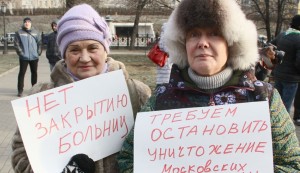
Facebook proved it Saturday by blocking an announcement inviting Muscovites to attend a January rally in support of anti-corruption activist Alexei Navalny, who is about to be sentenced to a long prison term on trumped-up charges.

Ever since Navalny emerged as the most credible leader of Moscow’s failed “Snow Revolution” of 2011 and 2012, he has been hounded by Russia’s law enforcement agencies.

Last year, when he was sentenced on trmped on charges in a lumber case, between 5,000 and 10,000 Muscovites assembled opposite Red Square to demand his release. This time, Navalny’s supporters are taking no chances and trying to organize a rally for Jan. 15, when the sentence is due to be announced.  About 12,500 people indicated they would attend before Facebook blocked the announcement for Russia-based accounts and, as users later reported, even for some people based overseas if they listed a Russian city as their birthplace.

The move was a godsend to Volkov and other Navalny sympathizers. The rally became a kind of international cause celebre after Michael McFaul, former U.S. ambassador to Moscow, tweeted about the blockage:

Twitter refused to block tweets announcing the Jan. 15 rally. It merely forwarded the authorities’ complaints to the posters. It would not do for Facebook to appear more pliable than its competitor. Second, both Twitter and Facebook have audiences of a little more than 10 million in Russia, a tiny share of their worldwide user base, and their revenues from the Russian market hardly even register on the corporate ledgers.

None of these three considerations would even have come up if Facebook hadn’t blocked the original event announcement. What if Facebook is doing significant business in a country, its authorities have not fallen foul of Washington, and Twitter is, for reasons of its own, complying with requests for the removal of certain content? Then will it be possible to organize a protest using the platform?

Opposition activists everywhere must now assume that they need more reliable ways to organize online.

As for the U.S.-based Internet companies, after Edward Snowden’s reports of their cooperation with U.S. intelligence, they are already widely mistrusted.

Facebook Blocks Protest News in Russia

How Will Putin Fight Back?

Russia’s immediate first task is to stabilize the value of its currency, ease pressures on its international reserves and restore normal functioning of its banking system. The Russian government, together with its central bank, has made progress on this score by substantially raising interest rates, injecting liquid assets into its banking system and working to persuade Russian exporters to surrender more of their dollar proceeds.

Yet measures are only temporary stabilizers, not long-term solutions. They need to be quickly supplemented by cuts in the government budget and the adoption of pro-growth measures that alleviate the dangers of what is already an ugly outlook.

The second issue relates to Russian’s operating environment. Oil prices will not rebound quickly from their stunning decline. Russia will suffer a meaningful fall in foreign earnings and also see less direct outside investment to support its energy sector. Meanwhile, President Vladimir Putin is giving the West no reason to lift sanctions that have gradually and effectively put pressure on the Russian economy.

The third task relates to Russia’s access to an “external balance sheet” that is, a large source of outside funding.

Most emerging economies in crisis — be they in Africa, Asia, Eastern Europe or Latin America — have required either the reality or the perception of sizable external financing to support adjustments in domestic policies. This has normally come in large part from an International Monetary Fund program that, in addition to providing direct financial support, brings in other official funding and private capital.

Russia is unlikely to secure help from the IMF or other credible outside sources. Instead, it has no choice but to rely on its own $400 billion buffer in international reserves to meet multiple objectives: stabilizing the currency, securing payments on its foreign debts, restoring liquidity to its banking system, alleviating the effects of a huge contraction in imports, slowing capital flight, and securing refinancings and new loans.

The experience of prior emerging-market crises suggests that to restore durable economic and financial calm, Russia needs to do a lot more.  It would need to change course on Ukraine, open the way for constructive re-engagement with the West, and secure external funding.

We can expect alternating periods of financial dislocation and temporary calm. They will be accompanied by credit-rating downgrades, a worsening economy, higher inflation, controls on imports and capital flows, and shortages. In other words, Russia faces an especially dark winter.  (But never underestimate Putin, who will make every effort not to go down in history as a loser.)

Russia Under Pressure


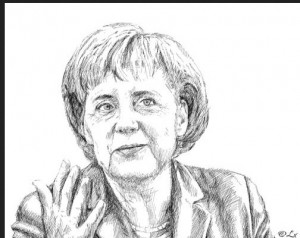
Angela Merkel, Statesperson of the Year

n 2014, the battle for Europe’s future has been fought between two leaders: Russian president Vladimir Putin and German chancellor Angela Merkel. The contrast between them could not be sharper. There the Russian man: macho, militarist, practitioner of the Soviet-style big lie.

The German woman: gradualist, quietly plain-speaking, consensus-building, strongest on economic power, patiently steering a slow-moving, sovereignty-sharing, multinational European tortoise.

Merkel has long been recognised as Europe’s leading politician, but this year, during the crisis over Ukraine, she became its leading stateswoman.

At the beginning of this year, German president Joachim Gauck, an east German Protestant, appealed for Merkel to assume more leadership responsibility in Europe.  She has. As a schoolgirl, Mrekel won East Germany’s Russian-language Olympiad. On her office wall, she has a portrait of the Pomeranian princess who became Empress Catherine the Great of Russia. She can speak to Putin in Russian, as he can to her in German.

Both were in east Germany in 1989 – he as a KGB officer, she as a young scientist – and the lessons they drew were diametrically opposed. in this European crisis, two profound, personal commitments  of her generation have come to the fore: to peace and to freedom.

Recently Merkel excoriated what Putin has done in Ukraine: “Who would have thought it possible that 25 years after the fall of the Berlin Wall … something like this could happen in the middle of Europe?”  International law can not be trampled underfoot

Merkel has talked to Putin more than any other world leader has: 35 phone calls in the first eight months of this year.  She is also the world leader to whom the American president has spoken most often.

As she never tires of repeating, her strategy has three prongs: support for Ukraine, diplomacy with Russia and sanctions to bring Putin to the negotiating table. She has led rather than followed German public opinion. She has faced down the so-called Putinversteher – those who show such “understanding” for Putin’s actions that they come close to excusing them. She has made the larger arguments, from history, about Europe, and they have resonated.

What is more, she has made the case for sanctions powerfully to more reluctant members of the EU. The battle of Europe is far from over. In Russia, deepening economic crisis will not necessarily translate into more accommodating policy.. Russian military planes have flown into the air space of Baltic Nato members.

Yet as 2014 draws to a close, it is clear that Angela Merkel has been the stateswoman of the year.

Merkel


Should the US Join the ITU?

Randoph J. May writes:  In a coauthored essay in Re/code titled “Protecting the Internet from Government Control,” Reps. Fred Upton (R-Mich.), Henry Waxman (D-Calif.), Ed Royce (R-Calif.) and Eliot Engel (D-N.Y.) argue that the United States must not hand over Internet governance to the International Telecommunications Union (ITU), controlled by 193 nations, or a similar international organization.

In no uncertain terms, the essay’s authors, a foursome of committee chairs and ranking members, assert: Handing over the reins of Internet governance to a body like the ITU would imperil the Internet at a time when its dynamism and innovation are benefitting more people around the globe than ever before. It is critical that, on issues of Internet governance, the ITU-member states refrain from changing the current, well-functioning system. For continued advancement of the Internet, the world must maintain multi-stakeholder governance and reject efforts to recast the ITU or any other similar intergovernmental entity as an international Internet regulator

There are a few lines buried in the essay well worth highlighting, especially in light of President Obama’s recent statement explicitly asking the supposedly independent Federal Communications Commission (FCC) to adopt burdensome new net neutrality mandates by classifying Internet service providers as “telecommunications” providers under Title II of the Communications Act.

What the ITU regulates, by the very terms of its operative agreement, is “telecommunications,” and the agreement recognizes the right of each country to regulate telecommunications as it sees fit.

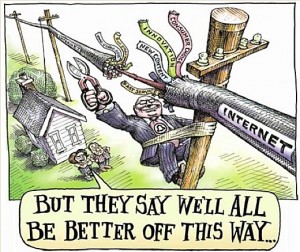
Title II telecommunications designation by the FCC will have real-world impacts far more consequential than merely ironical.  The effect of the FCC’s regulation of Internet providers as telecommunications providers is likely to be just what Messrs. Upton, Waxman, Royce and Engel claim they wish to avoid — that is, the action will make it more likely that other countries will succeed in their quest to put Internet governance under government control.

Net Neutrality


The Gulf Countries Become Gas Guzzlers

Over the years, the monarchies’ of Saudi Arabia and Kuwait provided steady stewardship over their oil fields and kept markets supplied with sufficient energy to fuel the world during a period of unprecedented economic and population growth. Back home, the ruling families harvested the proceeds to improve the lives of their people, who had, until then, lived in nearly primeval deprivation, with little access to electricity, clean water, medicine, or education. Ruling sheikhs made their subjects wealthy and complacent; oil production was a virtuous cycle.

That old story is beginning to change. The Gulf monarchies have developed a growing taste for their chief export, which, if left unaddressed, could undermine both of their long-held roles: as global suppliers and as stable polities in an otherwise fractious Middle East. For the rest of the world, meanwhile, the potential loss of a key Gulf asset—spare oil production—foreshadows a period of greater market volatility and uncertainty.

It took an astonishing increase in demand to get to this point. Energy consumption in exporting countries, just a rounding error on global demand a few decades ago, has grown by eight percent annually since 1972, compared to two percent for the world. Together, four of the six monarchies (Kuwait, Qatar, Saudi Arabia, and the United Arab Emirates) have less than one percent of the world’s population, but account for more than five percent of global oil consumption. Saudi Arabia, which consumes roughly a quarter of its own production, is now the world’s number-six oil consumer, guzzling nearly as much of the stuff as Russia and more than either Brazil or Germany, countries with far larger economies and populations.

How is this going to be handled is the question?  Gas Guzzling in the MIddle East

Gas Guzzling in the MIddle East?

Spanish Royal to Trial for Tax Fraud

Cristina de Borbon, sister of Spain’s King Felipe VI, will stand trial on charges of tax fraud, the first Spanish royal to face prosecution in court.  Princess Cristina’s husband, former Olympic handball player Inaki Urdangarin, is accused of embezzling public funds.

Princess Cristina, 49, and Urdangarin are among 17 people ordered to stand trial in the case involving his Noos Foundation charity, the High Court of the Balearic Islands said on Monday.

Cristina and her husband have both denied any wrongdoing.

Urdangarin has been charged with breach of legal duty, embezzling public funds, fraud, influence-peddling and money-laundering. The princess is accused of two tax crimes.

The couple have been ordered to deposit funds with the court to cover possible liabilities – 2.6 million euros ($3.2 million) in the case of Cristina, and nearly 15 million for Urdanganrin.

They have 20 days to deposit the money, according to a written court ruling, or face having assets seized.

King Felipe is riding high in opinion polls and has tried to modernise the monarchy, including taking rights and duties away from his two sisters, who are no longer formally part of the royal family.

Tax Fraud


Illegal Trade in Tiger and Cat Skins up on China Border

The illegal trade in Tigers and other wild cat parts from Burma into China has grown in the border town of Mong La in the past decade, while the same trade into Thailand through the border town of Tachilek has diminished, a new survey has found.

The report, issued by wildlife trade monitoring group Traffic on Monday, analyzed data from 19 separate surveys of wild cat trade in Tachilek between 1991 and 2013, and seven surveys between 2001 and 2014 in Mong La.

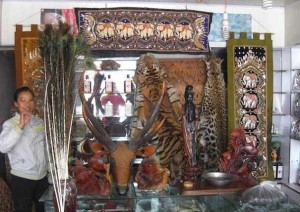
In Tachilek on the Myanmar-Thailand border, shops selling wild cat parts including Tiger and Leopard skins and skulls, fell from 35 in 2000, to just six in 2013.  In Mong La, at the China border, such shops more than trebled from six in 2006, to 21 in 2014. Mong La caters almost entirely to customers from China.

Parts of the Clouded Leopard were found most frequently, representing some 482 individuals, while other cat species included Tiger, Leopard, Leopard Cat and the Asiatic Golden Cat, according to Traffic, which said that traders claimed most animals were sourced from Burma and India.

All wild cat species are protected under the Convention on International Trade in Endangered Species of Wild Fauna and Flora (CITES) and by national laws.

“[T]he decrease in Tachilek could be due to greater enforcement action in Thailand while the increase in Mong La may be linked to the rising buying power of China’s consumers, and the apparent ease in smuggling illegal wildlife parts into China from Mong La,” the Traffic report said.

“It’s time for the relevant enforcement authorities to live up to their international commitments to address wildlife crime,” said Vincent Nijman, a professor of anthropology at Oxford Brookes University and one of the report’s authors.

Tachilek is located in eastern Shan State and forms Burma’s main border crossing with northern Thailand. Mong La is located on the Burma-China border and administered by the National Democracy Alliance Army, a 2,000-men-strong armed group that is a remnant of the now-defunct Communist Party of Burma. It signed a ceasefire with the central government in 1989 and gained a range of concessions to run the area.

All manner of illegal trade, from prostitution and gambling to narcotics, arms and wildlife trafficking, have long flourished in the rebel-run town, which is part of a wider swathe of territory known as Special Region 4.

 Tiger and Leopard Skins for Sale

Is Norway Moving to a Post-Oil Economy?

Nick Cunningham writes:  New oil projects are being scrapped in Norway amid falling production and low oil prices. Long held up as the model for managing oil abundance, Norway has painstakingly sought to prevent the problems that occur with other natural-resource-based economies, such as corruption, slow economic growth, currency appreciation and deindustrialization.

Since 1990, Norway has diverted much of its oil earnings to a sovereign wealth fund, which has become the world’s largest. The money, reaching $890 billion as of June 2014, amounts to $178,000 for every Norwegian citizen. The sovereign wealth fund helps Norway avoid some of the problems associated with the “resource curse” by investing capital abroad. But more importantly, the money is set aside to be saved and invested to help the country plan for the eventual decline of oil production and the transfer to a more diversified economy.

The early cracks in Norway’s petrol-based economy are beginning to show more quckly than many predicted. Statoil, the mostly government-owned oil company, has  seen its share price cut in half since July 2014.  Several offshore rigs have stopped drilling.  To make matters worse, costs of developing new fields have been steadily rising.  Since oil prices have tumbled. Norway may see a steep decline in investment.

Lower oil prices could force more than $150 billion worth of investments to be put on hold worldwide.  Statoil is deferring a decision on investing $5.74 billion in the Snorre field, an offshore oil project in the Norwegian Sea. Also, Statoil’s Johan Castberg field, an estimated $16 billion to $19 billion oil field in the Barents Sea, will be tabled.

Even with high oil prices Norway was facing a tougher future due to years of waning oil production. Since 2001, Norway’s oil production has fallen by almost half, from around 3.5 million barrels per day down to about 1.8 or 1.9 million barrels per day in 2014.

The decline in investment is already pinching the labor market. About 10,000 Norwegian oil workers have been laid off as the industry pares back spending, accounting for 10 percent of the sector’s total workforce. Oil workers are threatening to strike unless the government steps in to stem further losses.

Despite its best efforts, Norway’s economy is overwhelmingly dependent on oil, which accounts for more than half of the country’s exports. Other export industries have struggled to develop, as costs are too high.  It doesn’t make sense for many companies in Norway to invest in new projects. Spending could drop by another 18 percent next year, as project economics look poor.  Without investment, new production will not materialize in the coming years, leading to further deterioration for the sector as existing fields age and decline.

Norway has its almost $1 trillion sovereign wealth fund to fall back on, so it is not as if its citizenry will be thrust into poverty anytime soon. Still, Norway may need to begin building a post-oil economy sooner than it thought.

Norway's Oil?