China’s Sputtering Housing Market Poses Threat to Economy

The Dallas Federal Reserve report suggests that China’s economic slowdown and changing demographics cloud its housing market’s long-term prospects. While urbanization and a lack of alternative investment opportunities provide short-run support, the housing sector’s difficulties imperil China’s financial sector and the global recovery.

China’s Housing Market

China's Housing Market


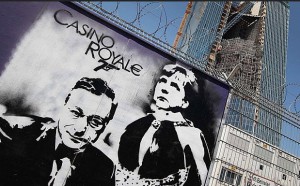
Draghi Performs QE with ABS

The ECB (European Central Bank) action announced today is not QE (quantitative easing) in the form it has been customarily used. Instead of boosting weakened banks with expanded reserves with the expectation that lending will then be increased, the ECB is injecting money directly into the real (non-financial) economy by purchasing ABS (asset backed securities) and covered bonds. More ‘behind the wall’.

The ECB “will purchase a broad portfolio of simple and transparent securities,” Draghi said at a press conference in Frankfurt today. “Some of our council were in favor of doing more than presented.”

Big step toward QE, although Germany is not quite on board.  People have expected this, but not quite yet.

Draghi Starts QE

Getting More Women in the CEO Supply Chain

Caroline Fairchild writes:  Just 5% of top-level supply chain positions at Fortune 500 companies are filled by women, lagging behind figures in other senior executive roles.

Before taking over as chief executive of General Motors, Mary Barra served as the automaker’s executive vice president of global product development, purchasing, and supply chain. The leap to the top job seems logical, but compared to her peers, Barra stands relatively alone. There just aren’t that many women at the top of the supply chain heap to begin with.

Women account for 37% of students enrolled in university supply chain courses, but only 5% of top-level supply chain positions at Fortune 500 companies are filled by women, according to SCM World, a research firm that studies corporate supply chains. In comparison, women hold 15% of all executive officer positions at Fortune 500 companies.

Getting more women atop supply chain management is a major part of getting more women into the C-suite, says Beth Ford, executive vice president and chief supply chain and operations officer at Land O’Lakes. The role provides an ambitious executive with a window into every business unit, and is increasingly becoming important for innovation and strategy, she added.

“This field has transformed. It is a critical role in the C-suite of any business,” Ford says. “The representation of women in this area is not where it needs to be. At the same time, it could be viewed as tremendously exciting. The opportunities are there for women.”

The dearth of women atop the supply chain may be rooted in the particular demands of the job. Supply chain managers are responsible for planning, purchasing, production, transportation, storage, and distribution of particular products. This results in a work schedule that can require a lot of travel and time in the field, making it a challenging lifestyle choice for women who may be interested in building a family. Still, more and more women are studying the supply chain because of its importance to most businesses, Ford says.

“We will often times see candidates for jobs that are great, but they only want to work in a particular area or city,” she says. “I have a couple sites and regional offices and in order to get the right level of experience you have to be willing to travel.”

Some female executives believe quota policies could be an effective tool to get more women into supply chain roles. Though the tactic is controversial, some women in the field feel that specific targets will help get more women into the industry.

“If you’re going to be measured on something, you tend to deliver on it,” said Sandra Kinmont, head of supply chain academy at Unilever, in a recent SCM World webinar.

To Ford, the number of women working in supply chain jobs will grow if more women take control of their careers. The mother of three joined Land O’Lakes in 2012 after working in a variety of operating and senior leadership positions at companies like PepsiCo and Mobil Oil, now Exxon Mobil. She chalks up a lot of success to her taking an active role in shaping her own career. Too often the conversation is about women being on the receiving end of their accomplishments, Ford says. Instead, she advocates for women to be aggressive and push for the right experiences in their careers.

“Be mindful and own your decisions,” Ford says. “Don’t think of yourself as a receiver of what happens in your life. Be an active steward of your career and make decisions accordingly.”

 Supply Chain


Is Vice President at Goldman Just a Title to Impress Clients?

Matt Levine writes on a recent court case involving a vice president who ‘stole’ or ‘took’ Goldman’s ‘proprietary’ or ‘generic’ code from the office.  The banker says he thought the code was generic.  Goldman says that a Vice President’s legal problems are not their concern.  The title is just “too be police.”

From the opinion:  ”


Over a six year period, fifty-three people associated with GSCo were considered for advancement and/or indemnification. Of these fifty-three, Goldman paid the attorney’s fees for fifty-one. Aside from Aleynikov, Goldman refused to pay indemnification and/or advancement for one other person who sought it, also a GSCo vice president. However, of the fifty-one whose fees Goldman paid, fifteen were GSCo vice presidents.

Now the case will go before a jury of twelve people who are to determine:

A jury must determine the interpretive value of Goldman’s extrinsic evidence in resolving the ambiguity in the By-Laws.

Because that is what 12 randomly selected laypeople are particularly good at: determining the interpretive value of extrinsic evidence in resolving ambiguity in corporate documents.

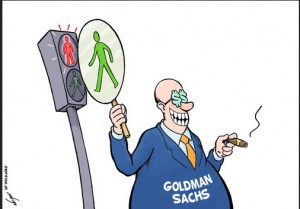
Goldman Sachs, To VP or Not?


Modi and Rajan Push the Indian Economy

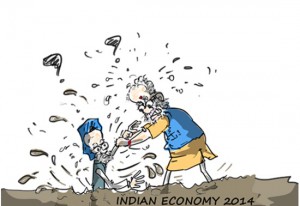
Dhiraj Nayyar writes:  This week Indian Prime Minister Narenda Modi and India’s central banker central banker Raghuram Rajan reached symbolically important milestones: Modi has been in office over a hundred days while Rajan has finished his first year as governor of the Reserve Bank of India. Together they bear the burden of huge expectations for a turnaround in India’s moribund economy. Their reputations alone have prompted an early uptick in sentiment. To maintain momentum, though, they need to start acting more like the bold reformers everyone expects them to be.

Reputation can go a long way, of course. In a country where nepotism and connections usually determine who occupies high public office, Modi and Rajan represent a refreshing change. Neither of them are insiders in New Delhi, whose halls of power are as clubby and claustrophobic as Washington’s Beltway. Both are high achievers with undeniably successful track records. Modi won three elections as chief minister of Gujarat, India’s most industrialized state, because of his economic stewardship. Rajan is a prescient academic who became the International Monetary Fund’s chief economist at the tender age of 40. To Indian businessmen, they exude a credibility and competence that is rare at the highest levels of India’s government.

To this point, both men have benefited from improving economic conditions globally and locally. In the months before Rajan took office, emerging market currencies including India’s were battered by hints that the U.S. Federal Reserve would begin to taper its massive quantitative-easing program. By the time Rajan arrived, that fear had largely receded.

The RBI governor can take credit for projecting a sense of confidence and placing his faith in a tight money policy, despite opposition from the incumbent, Congress-led government. The rupee, which had lost 20 percent of its value in six months before he took over, is now stable. Inflation, which had reached double digits, is three percentage points lower.

For his part, Modi benefited from a late rearguard action by the previous government, which in its last year in office tried belatedly to correct skewed macroeconomic indicators, including the fiscal deficit and the current account deficit. That helped drive gross domestic product growth from below 5 percent to 5.7 percent — the highest rate in nine quarters — between April and June. (Modi was inaugurated at the end of May.) Anecdotal evidence suggests that investors, both domestic and foreign, are now slowly loosening their purse strings.

 Indian Economy

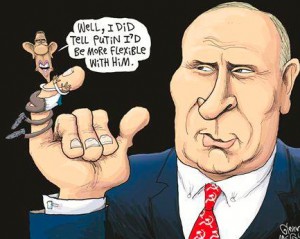
Is the EU Facing Facts on the Economy and Putin?

Clive Crook writes:  The EU’s current economic policy is indefensible: The EU has chosen to extend the recession by rejecting available remedies. As far as its foreign and security policy goes, this can barely be said to exist. Europe didn’t make Putin the ruthless outlaw he is, but it provoked him while knowing it was unwilling or unable to deal with the consequences.

Germany’s input to these mistakes has been disproportionate. It isn’t just that the size and strength of Germany’s economy have made Berlin the de facto capital of Europe. It’s also that the errors are characteristically German — postwar German, that is. Germany’s mortal dread of inflation and what can follow has paralyzed Europe’s economic policy; and its overweening desire for commerce with Russia and reluctance to confront threats with force has defanged the EU’s security policy.

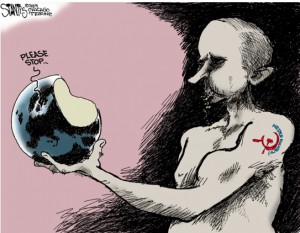
Putin Threat to Europe


Does Putin Care About the Impact of Western Sanctions?

“The West needs to realize that economic and financial measures imposed to date haven’t been effective in deterring Putin’s ambitions in Ukraine — and that even a maximalist financial isolation campaign alone may not be enough to stop Russian adventurism,” Juan Zarate, a former senior Treasury Department official charged with overseeing sanctions for George W. Bush’s administration, said in an email.  Russian Sanctions

Putin

China Investing Big in Berlin

Chinese companies are making big investments in Germany, eyeing the country’s advanced technology and management, a senior Chinese commerce official said.
“The value and the amount of Chinese investment in Germany are both rising quickly,” said Meng Fanzhuang, minister counselor for commerce at the Chinese embassy in Germany.  Embassy figures show that about 2,300 Chinese companies are investing in German industries – such as finance, aviation, telecommunication and machinery – with a total investment of more than $4 billion.

Apart from setting up traditional trading firms, manufacturing bases and service companies, more Chinese investors are building research and development centers, bolstered by Germany’s outstanding talent reserve and technologies, Meng said.
More Chinese investors are trying to make their ventures fit better into the local business environment. For instance, they dispatch a handful of executives to Germany for decision-making, financial management and other essential tasks, and employ local workers to prime the pump, he said.

Meng said the financial crisis that began in 2008 forced some German companies into difficulties – such as financing or finding the company’s successor – to sell out to or team up with foreign companies, including Chinese ones.  Cao Yi, a media officer with Germany Trade and Invest, a promotional agency set up by the German government, said the Chinese government’s support for companies’ outbound investment is an important catalyst for the steadily increasing Chinese investment in Germany.
Chinese enterprises are also eager to expand their turf and create brand-names in the international market, she said.
“Made-in-Germany is a good label for them,” Cao said, adding that Chinese investors also covet the well-trained German workforce.

China Invests

China Lays Cross Border Rails

Zhong Nan writes:  China is negotiating with the governments of Mongolia, Uzbekistan, Kyrgyzstan and Pakistan to build three connective railroads to improve regional trade on the Silk Road economic belt. Huang Shengqiang, head of the China Port Management Office, said China has already opened 25 international airports and land ports as well as 12 special trade areas along the economic belt within the country.
It will continue to build regional freight stations and create more trading platforms with Kyrgyzstan, Pakistan, Mongolia and Nepal, Huang said.

Because of the greater number of cross-border rail lines that have cut down on transport times and freight costs, more Chinese cities have discovered that these links to Central Asia and Europe can help improve regional connectivity and trade on the Silk Road economic belt.  “China will seek diversified trade methods by establishing new international procurement centers, centralized shipment control centers and transfer and import distribution centers. It will also develop a cross-border economic cooperation zone in the Xinjiang Uygur autonomous region to further promote border trade with neighboring markets,” Huang said.

Since 2010, major Chinese cities, including Chengdu, Chongqing, Xi’an, Zhengzhou, Wuhan and Yiwu have began weekly or monthly train services to European and Central Asian destinations, part of China’s efforts to turn its inland resources and labor-rich cities into international trade hubs.  Eighty-six cargo trains carrying 7,450 containers passed through the Alataw Pass railway station on the China-Kazakhstan border between January and July of this year, with trade volume reaching $1 billion, according to customs.

Transport Minister Yang Chuantang said regional connectivity is in the interests of all countries on the Silk Road Economic Belt. Yang added that China is following the Asian Highway Network deal signed in 2004 and the Trans-Asian Railway agreement penned in 2006 to continue its railway investment and develop major entry-exit rail and road projects.  “Countries in Central Asia and Eastern Europe, including Kazakhstan, Turkmenistan, Poland and Belarus, are eager to build new platforms for broader trade and for cultural and technological cooperation with China and other countries along the belt,” said Wang Ming at the National Development and Reform Commission.

Transport of the Future

The End of Secret Corporate Ownership in Delaware?


For years, Senator Carl Levin (D-Michigan) and Senator Charles Grassley (R-Iowa) have sponsored a bi-partisan bill to eliminate anonymous shell corporations only to see their measure go nowhere. This year, their annual Sisyphean effort is getting support from the unlikeliest of places: Delaware.

Pretty odd because Delaware has long been criticized for its welcome embrace of corporate secrecy and, in fact, is one of the targets of the Levin-Grassley bill. The tiny state is perennially at the top of the list of global tax havens and has gained a reputation as place where those with something to hide – embezzlers, arms merchants, money launders, drug dealers and the like – can set up shop, no questions asked. This is thanks to Delaware laws that allow the true owners of a corporate entity to remain a secret.    The End of Shell Corporations in Delaware

The End of the Shell?