China Buying Assets

Beijing-based Hony Capital has bought PizzaExpress, the British restaurant chain, for about £900m in the latest example of China’s growing appetite for overseas investments.

The sale comes after PizzaExpress owner Cinven, the London-based buyout group, explored plans last year to sell Gondola Group, the parent company that owns the pizza chain along with other restaurant assets, including Zizzi.

Cinven has moved to dispose of individual chains within the group after reckoning it would be difficult to find a private buyer for the entire business. It sold Byron, the gourmet burger chain, in October for £100m. Cinven declined to comment.
A string of UK brands have been sold to buyers based in China. Outbound mergers and acquisitions in the food and beverage industries accounted for 17 per cent of total M&A in China in the year to June, almost on a par with the 20 per cent from the energy and power sector – traditionally the biggest deal generator, according to Thomson Reuters.

Chinese property and entertainment conglomerate Wanda paid more than £300m for almost 92 per cent of Dorset luxury yachtmaker Sunseeker International, and Weetabix was bought by Bright Food in a deal that valued the breakfast cereal at £1.2bn.  Hony Capital is a China-focused middle-market private equity firm backed by Legend Holdings. It has more than $6.8bn in assets under management across seven funds, according to its website.
The firm is also exploring a bid for United Biscuits, the maker of Jaffa Cakes, said people familiar with the situation.

The PizzaExpress bidding process also attracted Chinese rival Citic, said people familiar with the matter.  Cinven, which manages a €5.3bn buyout fund, took Gondola private in a €1.3bn deal in 2006.  Asia is a key part of our future growth strategy and Hony’s expertise in this region will be invaluable.

Gondola employs more than 15,000 people, serving 40m meals a year in more than 690 restaurants, according to Cinven’s website.  PizzaExpress has focused on international expansion in recent years. It will open its first Beijing outlet this summer. The group has restaurants in Shanghai and Hong Kong. The chain also expanded its Middle East business, with a new outlet in Saudi Arabia. The expansion means that PizzaExpress now operates in 14 countries.

Pizza Worldwide

Renminbi Clearing Banks

Barry Eichengreen writes:

European and Chinese officials have made two notable announcements in recent weeks. On June 18, China’s second largest financial institution, China Construction Bank, was designated as the official renminbi clearing bank for London. The next day, the Frankfurt branch of the Bank of China, the country’s largest commercial bank, received the same designation for the eurozone.
Both announcements were greeted with great acclaim. British Chancellor George Osborne hailed the creation of a London clearing bank as “hugely important” for the financial future of the City. Joachim Nagel of the German Bundesbank lauded the Bank of China announcement as a “milestone on the road toward creating a renminbi trading center in Frankfurt.”
We should expect these kinds of enthusiastic pronouncements from European officials, who are desperate for good news, whatever its source. But should the rest of us care? After all, banks, firms, and even individuals already can buy renminbi for their pounds and euros. A range of financial institutions, both locally and in Hong Kong, have long stood ready to provide this service.
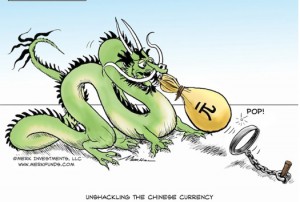
The only difference is that the two big Chinese banks, when doing business in London and Frankfurt, will be permitted to purchase renminbi in China itself when their foreign customers demand it. The People’s Bank of China (PBOC) will give them a quota for this purpose. Other banks, when seeking to provide renminbi to their clients, are limited to bidding for the fixed supplies that circulate offshore. This raises their costs and limits demand for their services.
Thus, by permitting two clearing banks to access renminbi onshore, Chinese officials are effectively subsidizing their London and Frankfurt operations and encouraging direct sterling and euro trades.
But London and Frankfurt would be reckless to bank on rapid growth in their renminbi transactions. In its most recent survey of foreign-exchange markets, in April 2013, the Bank for International Settlements found that renminbi-dollar trades averaged $113 billion a day, whereas direct renminbi-euro trades totaled a mere $1 billion, while direct renminbi-sterling trades amounted to even less.
In practice, when Europeans want China’s currency, they use their euros and pounds to buy dollars, and then use those dollars to buy renminbi. This reflects the fact that the market in dollar-denominated assets is exceptionally deep and liquid, which limits transaction costs. In other words, European practice reflects the dollar’s “exorbitant privilege” as the only true global currency, freely accepted by currency traders and investors in China and around the world.
Chinese officials presumably believe that this situation will change over time. Once banks offer new assets denominated in renminbi, more customers will be drawn into the market, thereby adding liquidity and reducing transaction costs for purchases of renminbi in European currencies. The dollar’s asymmetric role will be superseded. At that point, the renminbi, the euro, and sterling will all play consequential international roles.
Thus, the decision to designate renminbi clearing banks in London and Frankfurt is, in effect, one more step by China to foster the emergence of an international monetary system with several global currencies, not just one. It is a step toward creating a better match between our multipolar global economy and its monetary and financial system – and thus a step toward ending the world economy’s dependence on the dollar, which European and Chinese policymakers have complained about since the global financial crisis erupted in 2008.
But it is only a step. Deep and liquid markets are not built in a day. In June 2013, when the PBOC unexpectedly tightened monetary policy, domestic interbank interest rates shot up to 25%. Thus, even a quota that permits an offshore clearing bank to tap funding in China does not guarantee that it can obtain that funding at a reasonable price.
Moreover, if China develops financial problems, capital outflows may accelerate. The Chinese authorities may then be forced to tighten the quotas made available to the clearing banks. Market liquidity would be a casualty.
One can also question how much appetite European investors will display for renminbi-denominated financial assets. In the past, demand for such assets has been fed by the expectation that the renminbi will continue to appreciate. If Chinese growth slows, such expectations might well dissolve.
There is no doubt that, with time, the renminbi will acquire a more consequential international role. Twenty-first-century financial technology will facilitate direct trading in a variety of different currencies, eliminating the need and custom of routing virtually all international transactions through the dollar. Ultimately this will spell the end of America’s “exorbitant privilege.” Just not yet. And not anytime soon.

Renminbi


Diversity in Tech?

Evan Charles writes:  Our technology and innovation economy isn’t doing a great job of recruiting, hiring or promoting women. And by ‘not doing a great a job,’ I mean it’s failing.

By most estimates, fewer than 30 percent of all tech and computer jobs are held by women as of 2014. The further up the management and leadership ladder you look, the more it resembles an old boys’ club. That’s an especially troubling reality for an industry, which believes that decisions such as hiring should be analytically driven, and merit-based.

The business world is chock full of studies and data which show that diversity in hiring and management is profitable. Diverse teams are more creative, more energetic and productive.  Not only is diversity better for business, it’s morally correct.

But for various reasons, diversity hasn’t yet fully taken real root in tech companies. Sewing diversity into small technology startups is especially important because small startups become large global players more quickly than ever. And corporate cultures endure.

Companies that start with a real commitment to diversity are likely to stay that way. Companies that grow without those principles, by contrast, are far less likely to be course-corrected – even by savvy management.

And let’s be clear. Since most – and some economists would say all – new jobs in the United States are created by new startups, it’s simply not good enough to have a strongly worded diversity statement, or to simply blog about it.

Startups – and especially those which see themselves as future business and economic leaders – have to model best behavior. They must recruit, pay to train, reach in hiring and promote qualified women.  Because such commitment may cost extra hours and dollars, the venture capital investors who fund tech startups have an obligation too. If early funders insist on diversity in coding teams and boardrooms, entrepreneurs will have to do it. Investors are often too lax on technology wunderkinds because they want to ‘win the deal’ and the results, in diversity at least, are evident.

Once entrepreneurial leaders and early investors insist on gender and other diverse backgrounds, demand for talent will increase supply. More women will take computer science classes and enroll in coding camps when they know businesses want, need and value what they offer. Confidence will follow.  So what can a tech startup do to increase gender equity in their own offices and industry-wide? Here are four suggestions:

1. Establish a scholarship for a promising woman at a coding camp or sponsor a student directly.  Amanda Cheung was a designer at Dockyard, an agency that builds mobile and Web applications. The company sponsored her tuition-in-full to attend Launch Academy, the coding school which I co-founded. Following graduation, Amanda was able to transition into a developer role, where she still works.  Tuition at coding camps varies but investing in diversity at the building-block level speaks directly to commitment and will have tangible results – fostering more trained women developers in the talent pool.

2. Set company hiring goals and attach accountability.  Making it a company mandate to hire, retain and promote a workforce that is just 5 percent higher than the industry average of 30 percent would be great progress. Linking those goals to leadership and Board reviews – and bonuses, for example – would be even more impressive.

3. If your investors don’t have a diversity policy for their investments, ask them why.  Showing investors that diversity and equality are important to your company is a great idea. More diverse companies tend to make more money.  Just as investors can influence the companies they back, the reverse is likewise true.

4. Get involved  Don’t just lament that local colleges’ computer science programs or coding camps aren’t graduating enough women. Go ask these programs what your startup can do to get more women in the classrooms. Then ask for resumes of female graduates – interview them, get their perspective.

If tech-savvy entrepreneurs are smart and resourceful enough to disrupt entire industries, they are smart enough to fix the gender equity problems in their offices. The fact that they haven’t yet may say more about their motivation than their ability.

Women in High Tech

Should Australia Follow the US

Joseph Stiglitz writes:  

For better or worse, economic-policy debates in the United States are often echoed elsewhere, regardless of whether they are relevant. Australian Prime Minister Tony Abbott’s recently elected government provides a case in point.

As in many other countries, conservative governments are arguing for cutbacks in government spending, on the grounds that fiscal deficits imperil their future. In the case of Australia, however, such assertions ring particularly hollow – though that has not stopped Abbott’s government from trafficking in them.   Should Australia Copy the US


Australian Education

Illegal Bank Transactions Rampant in Italy


Last year, the Financial Intelligence Unit of the Bank of Italy received nearly 65,000 reports of suspicious transactions, worth approximately 84 billion Euros, relating almost exclusively (99.7%) to the recycling of money.  This is reported by the FIU, the national intelligence unit established in 2007 to fight money laundering and financing of terrorism.  Numerous reports have focused on the laundering of proceeds of crime “attributable to politically exposed persons”.

They have detected, in particular, the inappropriate use of public funds, defaults in the application of rules on traceability of financial flows in the area of ​​public procurement, embezzlement of funds pertaining to political parties, corrupt situations.”

From 2007 to 2013, the transactions reported to the FIU increased five-fold, from 12,500 to 64,601 (with a peak of over 67,000 in 2012), 10% of which are classified as “high risk.”

In the first half of this year, reports were received over 38,000, an increase of 23% compared to the same period of 2013.

On more than 50% of the reports received, the report said, there have been findings of investigation. Whereas in general – according to FIU – half of the cases on which they are carried out further investigations end up in court, 25% of reports gives rise to legal proceedings.

“This shows an ability of obligated parties to identify at-risk behaviors. Even in the difficulty of making accurate comparisons with the reality of other countries, these are definitely values ​​that place us in the most virtuous,” says the report by the Director of FIU Claudio Clemente.  As indicated by a recent study of the European Central Bank, in Italy, the volume of retail transactions settled in cash is significantly higher than the EU average.”

The analysis indicates that the use of cash is more concentrated in areas of southern Italy where it is a strong presence of organized crime, although there are “points of care” in some areas of Central and North-West, especially near the border.

Mafia Cash


The Relationship Between Prices and Employment Rates

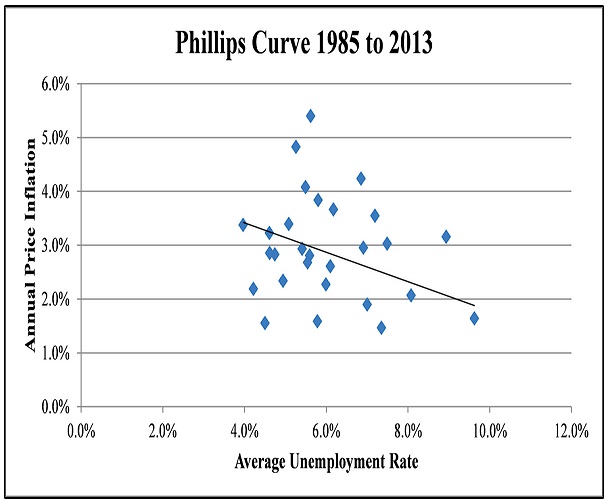
Chris Casey writes:  Due to its unjustified acceptance of the Phillips curve and its related misconceptions about price inflation and business cycles, the Federal Reserve will never be able to trade higher price inflation for lower unemployment. Nor can it sacrifice higher unemployment for lower price inflation. But it can, and likely will, generate high levels of both. If the Federal Reserve’s economic controls appear broken, it is because they never really worked in the first place.  Inflation and Unemploymnet

Phillips Curve

Using a State as an Economic Laboratory in the US


Steven Hansen writes: Economic theory is interesting. There never has been “scientific” proof documenting how any theory performs against the wide range of economic dynamics because there is no experimental control sample for comparison. Like most of us, I have opinions (based on theory) but I do not confuse opinions with data or facts.

This past week, everyone’s “love him or hate him” economist Paul Krugman wrote:

Two years ago Kansas embarked on a remarkable fiscal experiment: It sharply slashed income taxes without any clear idea of what would replace the lost revenue. Sam Brownback, the governor, proposed the legislation — in percentage terms, the largest tax cut in one year any state has ever enacted — in close consultation with the economist Arthur Laffer. And Mr. Brownback predicted that the cuts would jump-start an economic boom — “Look out, Texas,” he proclaimed.

But Kansas isn’t booming — in fact, its economy is lagging both neighboring states and America as a whole. Meanwhile, the state’s budget has plunged deep into deficit, provoking a Moody’s downgrade of its debt.

Yah, Kansas is not booming but consider the following and let’s see where these items might take us:

  • the debt in Kansas is not much worse than any other states.
  • more than two states bordered Kansas;
  • how fast does any economic theory work? Should it be judged in the short, medium or long term?
  • raising income taxes removes money from consumers.

There is no question that based on employment, Kansas is doing worse than its neighbors (about the same as Missouri) and the average for Kansas and all its neighbors looks to be slightly below the national average. Remember that employment is a lagging indicator of economic growth.

GDP growth for Kansas appears also be very near the national average – but GDP growth is less than 3 of its 4 neighbors.

If raising taxes were an answer – the USA economy should be flying. You cannot condemn a single element of an economy without examining all elements. I am not for or against raising taxes per se on a state level. My opinion would be conditional when judged against all the other economic dynamics.

Consider also that the Federal Government has different monetary dynamics than the states (being a sovereign monetary issuer) – and the examples given in Professor Krugman’s oped were based on Federal Government experience.

The individual states in America, like countries in the EU,  are potential economic laboratories. States should be encouraged to leave the trodden trail and experiment. Most experiments end in failure, but without failures – our understanding of economic dynamics is not enriched. Professor Krugman is the mouthpiece for liberal partisan politics, and partisan politics have no place in “factual” economic discussions.


Piketty’s Statistics Can Be Questioned, But…

his conclusions can not be, write Dan Lieberman.  Capitalism is doomed if the spread between the very, very wealthy and the rest of us is too great.

Questioning the statistics in Thomas Piketty’s best selling book with intent to undermine his thesis, is futile. Even if Piketty’s alert to the economics community that returns on investment have exceeded the real growth of wages and output, which means that the stock of capital is rising faster than overall output, may not be exact, the criticism has neglected to upset the conclusion – severe income inequality and inequitable wealth distribution doom the capitalist system to an eventual collapse, and a more narrow distribution keeps it going.    Piketty’s Statistics

Income Inequality


Evaluating Oil and Gas Reserves

Factors to watch in evaluating oil and gas reserves.

  • Price changes can increase or decrease reserves
  • Improved technologies can increase the reserves
  • New discoveries can increase the reserves. Elsewhere there are studies that predict what is left to be discovered.
  • Political realities can increase but more frequently decrease reserves.

So reserves is an economic concept unlike the size of the total resource which is a geological concept and the technically recoverable portion of the total resource which is an engineering concept. These three concepts and the quantification that corresponds to each concept has a relationship which is not always as clear as it should be and ofttimes controversial especially when things are changing rapidly.

BP-statistical-review-of-world-energy-2014-full-report

Oil Reserves


European Debt

Kenneth Rogoff writes:

Eurozone leaders continue to debate how best to reinvigorate economic growth, with French and Italian leaders now arguing that the eurozone’s rigid “fiscal compact” should be loosened. Meanwhile, the leaders of the eurozone’s northern member countries continue to push for more serious implementation of structural reform.

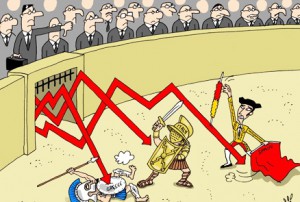
Ideally, both sides will get their way, but it is difficult to see an endgame that does not involve significant debt restructuring or rescheduling. The inability of Europe’s politicians to contemplate this scenario is placing a huge burden on the European Central Bank.

In general, neither pure austerity nor crude Keynesian stimulus can help countries escape high-debt traps. Throughout history, other measures, including debt rescheduling, inflation, and various forms of wealth taxation (such as financial repression), have typically played a significant role.

It is hard to see how European countries can indefinitely avoid recourse to the full debt toolkit, especially to repair the fragile economies of the eurozone’s periphery. The ECB’s expansive “whatever it takes” guarantee may indeed be enough to help finance greater short-term stimulus than is currently being allowed; but the ECB’s guarantee will not solve long-run sustainability problems.  European Debt

European Debt