SEC Lets Lehman Looters Off the Hook

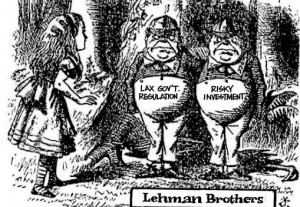
The Department of Justice (DOJ) and the SEC focused their “investigations” solely on Lehman’s quarter-end “Repo 105” transactions that were entered into for the sole purpose of deceiving investors and the SEC about Lehman’s liquidity, earnings, and leverage crises – crises that would soon cause it to collapse.

A “repurchase obligation” (REPO) is a short-term borrowing that is nominally structured as a “sale” with a “repurchase obligation.” Lehman improperly treated these short-term borrowings as if they were a true sale with no repurchase obligation, which caused Lehman to report lower debt levels.

It is not normal for a U.S. investment bank to go to a UK firm to obtain a legal opinion on U.S. law. Nevertheless, the cynical act by Lehman’s leaders of legal dumpster diving to obtain a legal opinion blessing an obvious fraud was not treated by the Department of Justice (DOJ) as it should have been as an aggravating factor, but rather as a “get out of jail free card.”

“They discovered that Repo 105 had nothing to do with Lehman’s failure and was technically allowed under an obscure accounting rule. Noting that London lawyers had approved Repo 105, prosecutors in Manhattan also worried they could not prove that executives intended to mislead investors.”

Enforcement attorney George Cannelos arrogated the client’s right to define its interpretation of its rules. It was a perfectly reasonable and normal “suggest[ion]” by Cannelos’ boss that Cannelos’ team prepare a draft of potential charges against Lehman’s officers. When your boss makes a “suggest[ion]” of this nature you prepare the document. There is no “ethical” issue in providing your superior with the strongest notice of charges you believe is supported by the evidence.  

Cannelos’ real problem was that had he drafted such a notice of charges it would have been obvious that the evidence did support a finding of materiality under the agency’s interpretation of materiality. The limited nature of his draft would also reveal how little about Lehman’s far larger frauds Cannelos’ team had actually investigated.   The SEC and Lehman BrothersLehman Brothers
Why is the Finance Industry so Sexist?

A Financial Times survey of the fund industry (subscription required) has found that sexual harassment in finance is “rife,” with 28 percent of women saying they had experienced harassment and an additional 54 percent saying they had faced inappropriate behavior.
More powerful than the numbers were the descriptions of attitudes women in finance say must contend with. One survey respondent said that whenever her team failed to win business, she was blamed for not wearing a shorter skirt. Another said that they only way she could be taken seriously was by dressing down — wearing glasses, a cardigan and tying her hair back. “Certain asset classes are very male dominated, which results in behaviours and cultures that may alienate female colleagues,” one woman told the FT.
Why is the finance industry so sexist?Do you think theres still a problem


Tougher Sanctions For Financial Markets Manipulation??

New rules imposing tougher sanctions for manipulating financial markets, insider dealing or abuse of inside information were voted on Tuesday. These rules will also cover a wider range of trading venues and financial instruments than today’s rules and they will apply directly in all member states, which should ensure a high level of investor protection in the EU.
Sanctions for financial markets manipulation


Tougher sanctions for financial markets manipulation

The Thriving Car Industry and Jobs in America

The US needs growth, and we’re getting more of it from cars than perhaps another other industry.

But unpacking this story reveals a more frightening picture of American industry and productivity. In the mid-20th century, a strange and wonderful blip of good fortune for the American middle class, unions concentrated in the manufacturing sector helped millions of American families achieve healthy and rising wages, thanks to collective bargaining and a burgeoning industry that wasn’t yet automated or globalized. But that story is over. It has been replaced by a new American story where one of the country’s most iconic industries scarcely needs more American workers to do all the work it needs.   Does the Car Industry Explain the US Economy_

Jobs USA

Has Quantitative Easing Worked?

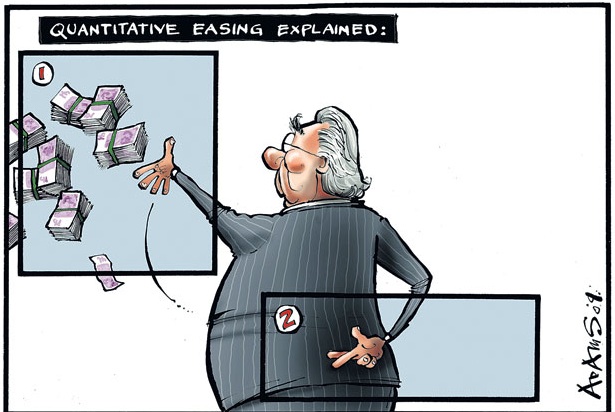
It is nearly five years since the U.S. Federal Reserve slid into quantitative easing, the deployment of artificially created money into the bond market. QE and a prolonged period of near-zero interest rates have been the highlights of post-crisis monetary policy. That era is far from over, but it has lasted long enough for a preliminary judgment of monetary policy – especially as the Fed says it is now preparing to “taper” its bond purchases. My verdict: QE could have been worse, and it should have been better.  Quantitative Easing

Quantitative Easing

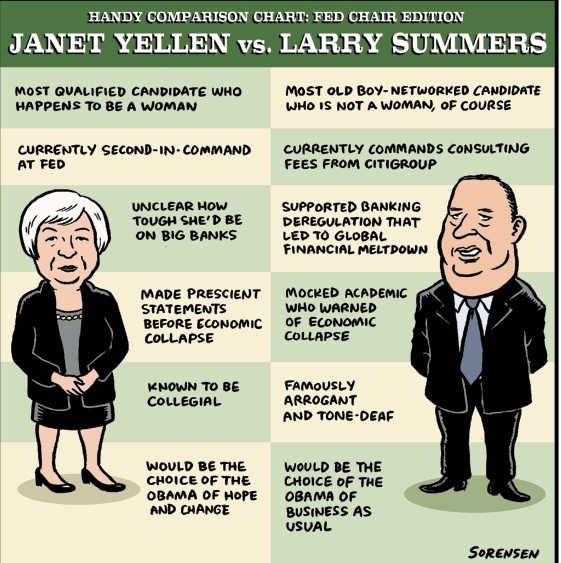
Why Stiglitz Supports Yellen for the Fed

Nobel prize winning economist Joseph Stiglitz has worked with both Janet Yellen and Lawrence Summers.  Attention must be paid to his advice.  Always a frank speaker, he said after advising Obama that the administration’s bank rescue plan is “either in the pocket of the banks or they’re incompetent.”

Now he tackles Yellen v Summers.  Stiglitz Supports Janet Yellen for the Fed

Yellen v Larry Summers