GSK and the China Market

A China-born scientist was the first of 18 authors on the 2010 paper, which included graphs later shown to have incorrectly labeled healthy human cells as being those from multiple sclerosis patients. Liu says he opposes a retraction of the paper.  “It was an honest mistake, and it doesn’t affect the findings,” he said, sipping a cappuccino. “I can confidently say that I can recreate the result in any laboratory.”

The disputed research isn’t part of the investigation of Glaxo China announced in late June by the nation’s Public Security Ministry of alleged economic crimes involving 3 billion yuan  ($489 million) of spurious travel and meeting expenses, and trade in sexual favors. Glaxo’s head of emerging markets of Abbas Hussain said on July 22 after meeting with government officials in Beijing that some of its employees may have broken China’s laws. The drugmaker has said it’s cooperating with the government’s investigation.

Race to Publish Shows Glaxo Zeal to Get Leg Up in China

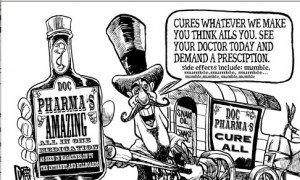
Big Pharma


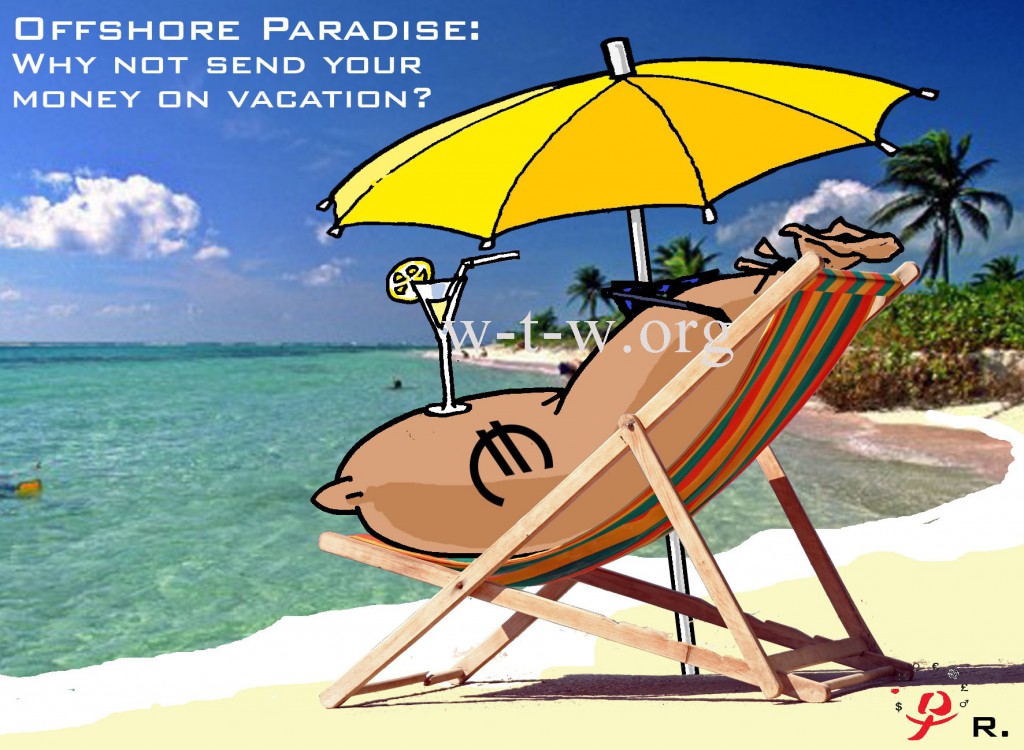
Tax Heavens: How to loot a country (and get away with it)

Secretive offshore tax havens help funnel billion of dollars out of the poorest countries and into the bank accounts of their corrupt officials. This video shows a how a dodgy politician could hypothetically abuse this shadowy financial network to enrich himself, and explains why we need greater financial transparency in the fight against international corruption.


More on Thomson Reuters Foundation 

Money laundering allows gangsters, terrorists and corrupt politicians to profit from their crimes.

The offshore financial system makes it too easy for these criminals to hide their wealth and too difficult for the police to catch them.

Here is an example of how a politician could use the secrecy of tax havens to steal from a developing country rich in natural resources.

If you want to move dirty money then you need a shell company in a tax haven. Our politician chooses the Seychelles, where you can register a new firm online in under 10 minutes for just 690 euros.

This company needs directors, so he pays residents in another tax haven, such as the British Virgin Islands, to use their names on all official documents.

This practice is completely legal in the UK and its overseas territories. A recent investigation into these nominee directors found a group of 28 individuals who collectively controlled more than 21,500 companies worldwide.

The next step is to set up a corporate bank account somewhere with strict secrecy laws.

The crooked politician picks Panama, where the authorities makes life very difficult for anyone requesting information.

This creates another valuable layer of secrecy, letting money launderers stay one step ahead of the authorities.

The politician can then use the shell company to open a high street bank account, buy a fleet of supercars or invest in the prime real estate markets of London, Paris and New York.

Even if his bank questioned how a civil servant could afford a Bugatti Veyron, it would be next to impossible to prove he had stolen the money.

Offshore tax havens have made sure his name never appeared on a public register.

Until these secret jurisdictions become more transparent, corrupt politicians will be able to loot developing countries with little risk of being caught.
Design Rachel Gold @wtwfinance
Design Rachel Gold
@wtwfinance

China is Making Business Easier for International Small Businesses

Research studies usually identify three key success factors behind the internationalization of small firms: effective networking, management motivation and low psychological distance. In my experience, spanning some 20 years, with China’s smaller business contingent, it is the latter of these three that represents the greatest obstacle to international success.  Small Firms Should Think Global

Small Think Global

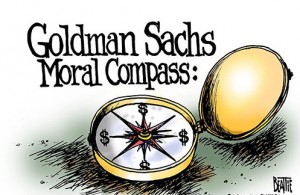
Has the Financial Community Lost Its Moral Compass?

A recent report by Labaton Sucharow suggests that many young people coming into finance regard corporate wrongdoing as the cost of doing business.  Here are the main points of the report.

• Despite the many reforms put in place in the wake of the financial crisis, only 36% of respondents felt that Wall Street has changed for the better since Dodd-Frank’s passage in 2010.

• More than half of respondents–52%–felt it was likely that their competitors have engaged in unethical or illegal activity to gain an edge in the market; 24% felt employees at their own company likely have engaged in misconduct to get ahead.

• Misconduct is still widespread in the financial services industry; 23% of respondents indicated that they had observed or had firsthand knowledge of wrongdoing in the workplace.

• 29% of respondents believed that financial services professionals may need to engage in unethical or illegal activity in order to be successful.

• More than one-quarter of all financial services professionals–26%–believed the compensation plans or bonus structures in place at their companies incentivize employees to compromise ethical standards or violate the law.

• An alarming number of financial services professionals, 24% of respondents, likely would engage in insider trading to make $10 million if they could get away with it.

• Shockingly, and consistent with recent and high-profile criticism of the culture within the financial services industry, a full 28% of respondents felt that the financial services industry does not put the interests of clients first.

• Building on this seemingly endemic culture problem, a concerning number of financial services professionals indicated that their leadership may put profits above ethics; 17% felt their leaders were likely to look the other way if they suspected a top performer engaged in insider trading. Equally concerning, 15% doubted that their leadership,upon learning of a top performer’s crime, would report it to the authorities.

• As enforcement actions are on the rise and new reforms have strengthened financial regulators and law enforcement authorities, the court of public opinion is following suit; 62% of financial services professionals felt the SEC is an effective watchdog and 57% felt that FINRA is effective.

• Despite the encouraging 89% of financial services professionals who indicated a willingness to report wrongdoing given the protections and incentives such as those offered by the SEC Whistleblower Program, 40% of respondents were still unaware of the SEC’s Whistleblower Program. Financial Services Survey July 2013

Moral Compass

Audette Exel Profits and Philanthropy

While Exel downplays her sacrifices, they won her a standing ovation when Lazard Asset Management invited her to give a presentation on Isis’s business and foundation work to its young analysts in Sydney last year, says Rob Prugue, a Singapore-based Lazard senior managing director. “Audette shows that you can be passionate about what you do in finance yet maintain an equal integrity and compassion behind that,” Prugue says.  Audette Exel Profits and Philanthropy

Audette Exel