Russia Welcomes Deal with Competitor Iran?

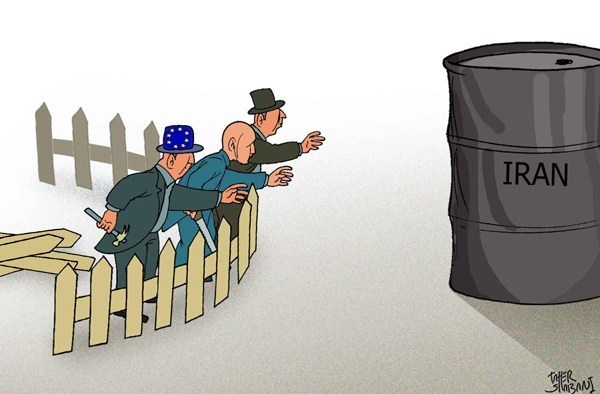
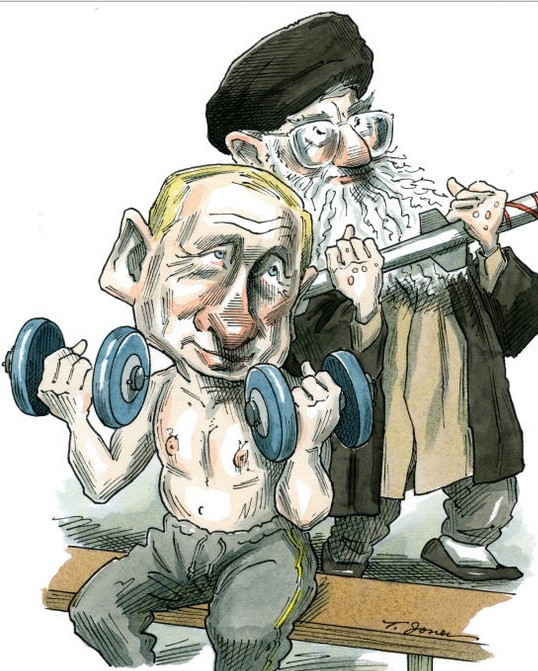
Moscow wants the Iran deal.   One of the reasons why sanctions against Iran will be lifted whether or not America pulls out of the nuclear deal is that the other signatories (Russia, China, and the EU) have an economic interest in lifting those sanctions. This economic interest includes natural gas.  On the face of it, there was no reason for Russia to let Iran re-renter the natural gas market.  The two countries, after all, are competitors.

Yet a closer look at the complicated geopolitics of energy makes sense of Russia’s endgame.  The EU imports about one third of its natural gas from Russia. This relative dependency limits the EU’s leverage over Russia and, therefore, Europe’s ability to rein in Vladimir Putin’s rampant annexation of eastern Ukraine. Since Iran has one of the world’s largest natural gas reserves, it could potentially help diversify Europe’s imports. Yet it might take a decade for Iran to turn into a major natural gas supplier (not least because Iran has a high domestic demand that is likely to increase). Putin, of course, understands that Iran might become a major competitor in this field, but he appears to assess that bringing back Iran into the natural gas market may help Russia create a cartel that will artificially inflate the price of natural gas. Doing so would serve Russia’s economic interests.
Russia and Iran

Does Greece Deserve more Lending?

Kenneth Rogoff writes: The International Monetary Fund’s acknowledgement that Greece’s debt is unsustainable could prove to be a watershed moment for the global financial system. Clearly, heterodox policies to deal with high debt burdens need to be taken more seriously, even in some advanced countries.

Ever since the onset of the Greek crisis, there have been basically three schools of thought. First, there is the view of the so-called troika (the European Commission, the European Central Bank, and the IMF), which holds that the eurozone’s debt-distressed periphery (Greece, Ireland, Portugal, and Spain) requires strong policy discipline to prevent a short-term liquidity crisis from morphing into a long-term insolvency problem.

The orthodox policy prescription was to extend conventional bridge loans to these countries, thereby giving them time to fix their budget problems and undertake structural reforms aimed at enhancing their long-term growth potential. 

A second school of thought also portrays the crisis as a pure liquidity problem, but views long-term insolvency as an outside risk at worst.

A third point of view is that, given the massive financial crisis, Europe’s debt problem should have been diagnosed as an insolvency problem from the start, and treated with debt restructuring and forgiveness.

Europe’s experience ought to spur a full rethink of the global system for administering sovereign bankruptcies. That could mean bringing back older IMF proposals for a sovereign bankruptcy mechanism, or finding ways to institutionalize the Fund’s recent stance on Greek debt. There is no free lunch in Europe, and there never was; but there are much better ways to deal with unsustainable debt. Greece’s Debt Solution

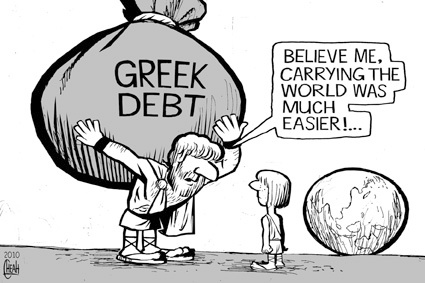
Greek Debt Relief

German Centrality?

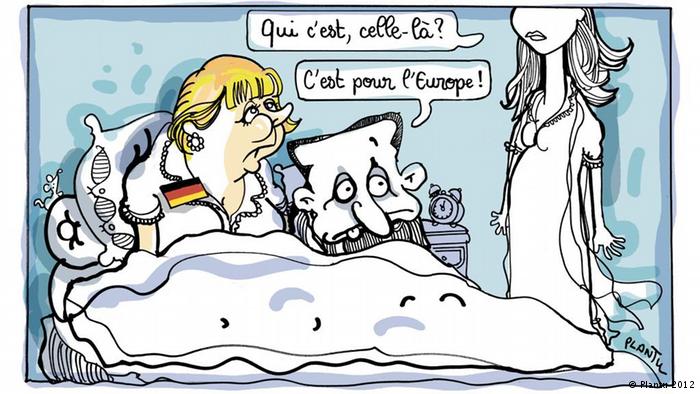
The Greek saga has gnawed at the foundations of the eurozone and distressed European unity for quite some years now. One of the greatest risks it poses is in the further erosion it causes to Franco-German relations.

The European project was built along the Paris-Berlin axis from the start. France’s political and military might and the German economic miracle created an equilibrium of sorts. Together, the countries formed a twin engine that drove the European integration process. German reunification threw the relationship off-balance to some degree, and that bond has since continued to deteriorate. For starters, France does not have a patch on Germany when it comes to economic performance. Further, the eastward expansion of the European Union has put Berlin at the Union’s geographical heart, replacing Paris as Europe’s crossroads. The credit crisis and its many ramifications have definitively put Germany on the map (not always voluntarily) as Europe’s dominant power. It is almost regarded as a hegemon.   The Price of German Power

Germany and Europe

Iran’s Oil

Anthony Cordesman writes on Iran’s potential energy exports.  A comprehensive agreement with Iran could result in the lifting of oil-related sanctions against Iran and a subsequent increase in Iran’s crude oil production and exports, although the timing and details of any suspension of sanctions are uncertain. EIA has not changed its short-term projection for Iranian crude oil production, which assumes that production will stay close to the current level.

  • Iran is believed to hold at least 30 million barrels in storage. It is possible that Iran will attempt to move oil out of storage more quickly sometime during the second half of 2015 in preparation to increase production if discussions on sanctions show progress. As a result, the global market may see incremental increases in Iran’s crude oil exports before seeing a substantial increase to Iran’s production, but the pace at which oil in storage could be withdrawn is uncertain.
  • EIA believes that Iran has the technical capability to ramp up crude oil production by at least 700,000 bbl/d by at least the end of 2016, of which 600,000 bbl/d represents capacity that was previously shut in and 100,000 bbl/d is new capacity.
  • EIA’s current STEO projects that growth in global inventories declines from 1 million bbl/d in 2015 to 100,000 bbl/d in 2016. If Iran ramps up production by 700,000 bbl/d by at least the end of 2016, then this could result in an annual average growth of about 500,000 bbl/d in global inventories in 2016, which would stress storage capacity limits and put downward pressure on prices… OPEC nontrade liquids production, which averaged 6.3 million b/d in 2014, is expected to increase by 0.1 million b/d in 2015 and by 0.2 million b/d in 2016, led by production increases in Qatar, Iran, and Kuwait.    Iran’s Potential Energy Exports

Iran's oil

Chinese Laundering in Vancouver

Sam Cooper writes:  Vancouver International Airport is the major port of entry for millions in hidden cash being smuggled into North America by mostly Chinese citizens, a federal document investigation by The Province reveals.

And according to money laundering investigators, the amounts identified in Canada Border Service Agency cash seizure data, obtained by The Province under freedom of information law, is only the tip of the iceberg.

Experts said Vancouver appears to be targeted  by Chinese citizens because Canada’s forgiving border laws allow seized cash to be returned for minimal fines. As well, permissive property investment rules and loose reporting compliance in the real estate industry make Vancouver homes the perfect vehicle for illicit offshore investment.

“A lot of the illicit money coming into Canada from Chinese citizens is laundered through real estate in Vancouver,” Hayley Labbé, a senior forensic investigator with the firm MNP LLP, told The Province.

The Province obtained CBSA data months after undertaking a wide-ranging federal document search to learn more about China’s anti-graft initiatives such as Operation Fox Hunt and SkyNet — the aggressive crackdowns by the Communist Party of China on political corruption suspects.

Co-operation between China and Canada in the hunt for numerous suspects who have allegedly fled to Canada with ill-gotten gains is controversial, because of many differences between the two countries’ legal systems.  Chinese Buy Vancouver Real Estate

Chinese in Vancouver

Women Rangers in US Army?

Two Army soldiers are still in the running to become the first women ever to earn a Ranger tab.

On Friday, the Army announced that these women, along with 125 men, successfully passed the second phase of Ranger school – the mountain phase – in the north Georgia mountains. 

Coming into the mountain phase, three of the 19 women who originally began Ranger School back in April were still at Ranger School. One of these women and 60 men will now be offered the opportunity to recycle, or repeat, the mountain phase of the training.

For the rest of the students, their next stop, starting Sunday, will be Camp Rudder at Eglin Air Force Base in Florida, where they will begin jungle training, the final step in their efforts to earn a Ranger tab. 

The soldiers are part of a pilot program this year to allow women to participate in Ranger School. Army Chief of Staff Gen. Ray Odierno has said that he expects the pilot program to be extended for at least a couple more rounds of Ranger School. The move is another step toward erasing historic discrepancies within the military that have contributed to a perception that women were second-class soldiers, advocates of the change say. If they pass, the women would not serve as Rangers, but would instead earn the tab, which could offer them additional credibility with fellow soldiers.

All of these students have demonstrated “grit, refusal to quit, tactical competence, and perhaps most importantly, teamwork while under extreme individual conditions,” said Maj. Gen. Scott Miller, commander of the Army’s Maneuver Center of Excellence at Fort Benning, Ga..

The swamp training, as with all phases of Ranger School, is intense. In February 1995, four soldiers died during swamp training, due to “severely lowered body temperatures” after conducting military exercises, including building rope bridges, in chest-deep water for an extended period of time. Four others, suffering from hypothermia, were sent to the hospital. Though this is unlikely to be a problem in the summer, the swamp phase will test the Ranger students in a number of ways. 

It will include 17 days of “extended platoon level operations” in the “costal swamp environment” near Valparaiso, Fla. During this time, there will be two jumps for those soldiers who are airborne-qualified. The training also will feature four days of “waterborne operations,” including small boat movements and stream crossings, as well as 10 days of field training with student-led patrols. All of this training is meant to simulate warfighting in the jungle. 

Ranger 

Puerto Rico Defaults

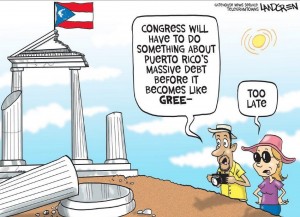
Puerto Rico just went into default for the first time.  The commonwealth didn’t pay $58 million in debt due today to creditors of its Public Finance Corporation. The debt is mostly owned by ordinary Puerto Ricans through credit unions.  The island is struggling with about $70 billion in total outstanding debt, and its economy is in recession.
For 25 years, Puerto Rico has been caught in a debilitating economic spiral. Decades of recession and slow economic growth forced a succession of governments to take out loans to cover budget deficits.

“What we have been doing is basically borrowing to survive today,” Marxuach says. “Unfortunately, our debt levels have gotten to a point where the rating agencies have downgraded our credit to below investment grade.”

With a junk status rating, Puerto Rico is trying to negotiate a new bond sale with Wall Street investors.

Puerto Rican Debt

Banks Need to be Regulated

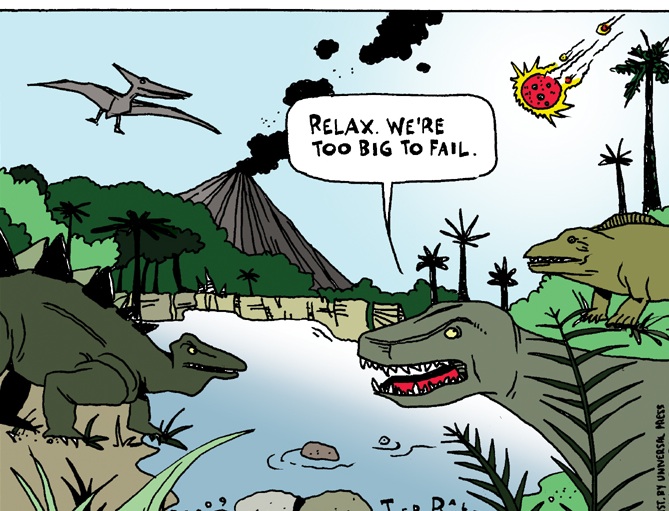
Simon Johnson writes: Nearly seven years after the global financial crisis erupted, and more than five years after the passage of the Dodd-Frank financial-reform legislation in the United States, the cause of the crisis – the existence of banks that are “too big to fail” – has yet to be uprooted. As long as that remains the case, another disaster is only a matter of time.

The term “too big to fail” dates back several decades, but it entered wide usage in the aftermath of the collapse of Lehman Brothers in September 2008. As problems spread throughout the financial system, the US authorities decided that some banks and other financial companies were so large relative to the economy that they were “systemically important” and could not be allowed to go bankrupt. Lehman failed, but AIG, Goldman Sachs, Morgan Stanley, Citigroup, Bank of America, and others were all rescued through various forms of massive – and unprecedented – government support.

The official line at the time was “never again,” which made sense in political and economic terms. These large financial firms were provided a scale of assistance that was not generally available to the nonfinancial corporate sector – and certainly not to families who found that the value of their assets (their homes) was below the value of their liabilities (their mortgages).

If large, complex financial institutions continue to have an implicit government guarantee, many people – on both the right and the left – would agree that this is both unfair to other parts of the private sector and an inducement for big banks to engage again in excessive risk-taking. In the jargon of economics, this is “moral hazard.” But no special training is needed to know that it is unwise and dangerous when bank executives get the upside (huge bonuses) when things go well and everyone else bears the downside risks (bailouts and recession).   Regulate Banks for Success

Too Big to Fail

EU: Focus on Cooperation?

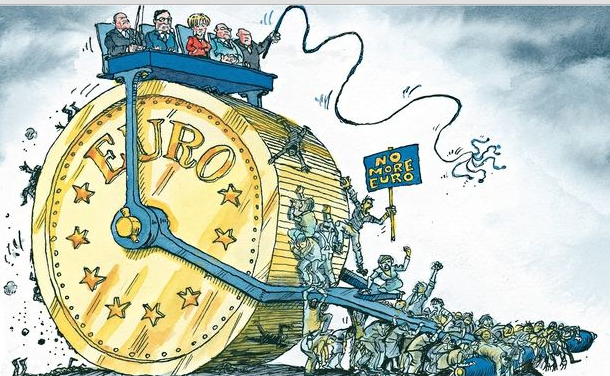
Jean Pisani Ferry writes.  When Wolfgang Schäuble, Germany’s finance minister, recently tabled the option of a Greek exit from the euro, he wanted to signal that no member could abstain from the monetary union’s strict disciplines. In fact, his initiative triggered a much broader discussion of the principles underpinning the euro, its governance, and the very rationale for its existence.

The new dispute over Greece has convinced many policymakers of the necessity to return to the drawing board. Meanwhile, citizens wonder why they share this currency, whether it makes sense, and if agreement can be reached on its future.

For currencies, as for countries, founding myths matter. The conventional wisdom is that the euro was the political price Germany paid for French acquiescence to its reunification. In fact, German reunification only provided the final impetus for a project conceived in the 1980s to resolve a longstanding dilemma. European governments were both strongly averse to floating exchange rates, which they assumed would be incompatible with a single market, and unwilling to perpetuate a Bundesbank-dominated monetary regime. A truly European currency built on German principles appeared to be the best way forward.

In retrospect, German reunification was more a curse than a blessing. When exchange rates were locked in 1999, Germany’s was overvalued, and its economy was struggling; France’s was undervalued, and its economy was booming. During the ensuing decade, imbalances slowly grew between a resurgent Germany and countries where low interest rates had triggered credit booms. And when the global financial crisis erupted in 2008, conditions were ripe for a perfect storm.

No one can say how Europe would have evolved without the euro. Would the fixed-exchange-rate system have endured or collapsed? Would the Deutschemark have been overvalued? Would states have reintroduced trade barriers, ending the single market? Would a real-estate bubble have developed in Spain? Would governments have reformed more or less?

Establishing a counterfactual baseline against which the euro’s impact could be assessed is impossible. But that is no excuse for complacency. Over the last 15 years, the eurozone’s economic performance has been disappointing, and its policy system must answer for this.

What really matters is whether a common European currency still makes sense for the future. This question is often evaded, because the cost of exiting is deemed too high to consider .How the EU Can Survive
Euro Repair

Sovereignty and the EU

The Rocky Road to Globalization

Siv O’Neall writes: The Greek crisis is very much the work of the so-called ‘free market’ where anything goes. Big banks, led by Goldman Sachs and other vicious speculators pounced on unhappy Greece already in crisis situation due to slack governments, tax evasion and a high level of corruption. The unscrupulous vultures had now secretly stored away booties at the expense of the Greek people.

After all this and five years of austerity suffered by the largely innocent Greek people the EU is now firmly requesting that jobless and hungry Greeks tighten their belts even more. How can you be more jobless than jobless and how can you be hungrier than hungry, unless you are dead. Greece is now a dying nation.

One point is important to mention in the context of the Greek disaster. I doubt if the IMF should even be included any more in this now so popular term ‘Troika’. Very recently, before and after the July 5 referendum, Christine Lagarde, the managing director of the IMF has been saying more and more openly that Greece must get significant debt relief. What is this – the IMF with a human face? It has actually come to an open war between Lagarde and the German chancellor Angela Merkel, the new iron lady.

Why are the members of Eurogroup (whoever they are… Big question.) all saying that no other viable basis exists for a solution to the Greek crisis? Austerity, more austerity is all the EU can come up with. The billions in the past two bailouts went to the lenders, the banks, and the Greek government got a nickel to throw to its hungry people.

The Troika screaming and the media picking it up and repeating: “Blame the Greeks” (some of them were indeed to blame and slack governments were also guilty) – but above all don’t blame the banks and speculators who were responsible for the shenanigans that took place before 2010. Hide it all under the rug and let’s just go on pretending we believe in what we are screaming so loud – so say the leading members of the EU, with Angela Merkel and Jean-Claude Juncker screaming the loudest.

The European Commission (the EC, the EU, or call it the Troika if you like) is completely set on removing all sovereign power from the individual European countries.  The national governments do not have clean hands, but at least we voted for them and we have to take part of the blame if there is something rotten in our nation.

We, the real left in France and all over Europe, have known from the beginning that Europe was as undemocratic as the U.S. wanted it to be. It was a U.S. dream to make Europe a united vassal. Their dream came true. With a bang. Only the unelected officers of the European Commission have any say whatsoever. The only elected body in the EU is the Parliament, which has no power at all, a symbolic right to utter a word here and there is all. The Parliament is the carnation in the buttonhole.

Merkel and all the dictator-presidents of the European Commission didn’t think we would ever discover the hidden truth about this Europe of the very very few. Be they Barroso or Juncker, they melt into one as far as taking all power away from the individual countries and from the people.

Greece and the EU