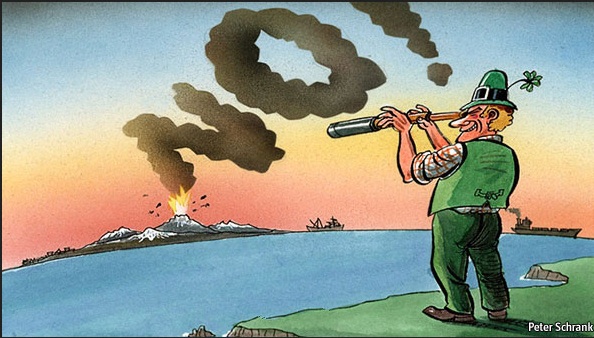
Work Transformed by Technology?

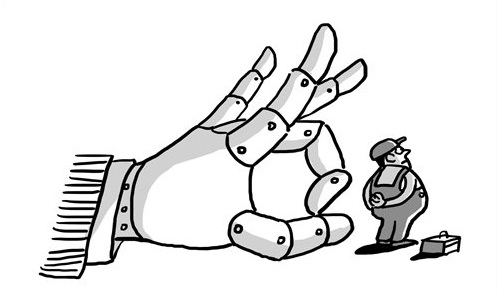
Jean Pisani-Ferry writes:  In 1983, the American economist and Nobel laureate Wassily Leontief made what was then a startling prediction. Machines, he said, are likely to replace human labor much in the same way that the tractor replaced the horse. Today, with some 200 million people worldwide out of work – 30 million more than in 2008 – Leontief’s words no longer seem as outlandish as they once did. Indeed, there can be little doubt that technology is in the process of completely transforming the global labor market.

To be sure, predictions like Leontief’s leave many economists skeptical, and for good reason. Historically, increases in productivity have rarely destroyed jobs. Each time that machines yielded gains in efficiency (including when tractors took over from horses), old jobs disappeared, but new jobs were created. Furthermore, economists are number crunchers, and recent data show a slowdown – rather than an acceleration – in productivity gains. When it comes to the actual number of jobs available, there are reasons to question the doomsayers’ dire predictions. Yet there are also reasons to think that the nature of work is changing.

Rather than try to stop the unstoppable, we should think about how to put this new reality at the service of our values and welfare. In addition to rethinking institutions and practices predicated on traditional employment contracts – such as social security contributions – we will need to begin to invent new institutions that harness this technology-driven transformation for our collective benefit. The backbone of tomorrow’s societies, after all, will be built not by robots or digital platforms, but by their citizens. Laborers’ Future

The Nature of Work

Making TPP Palatable

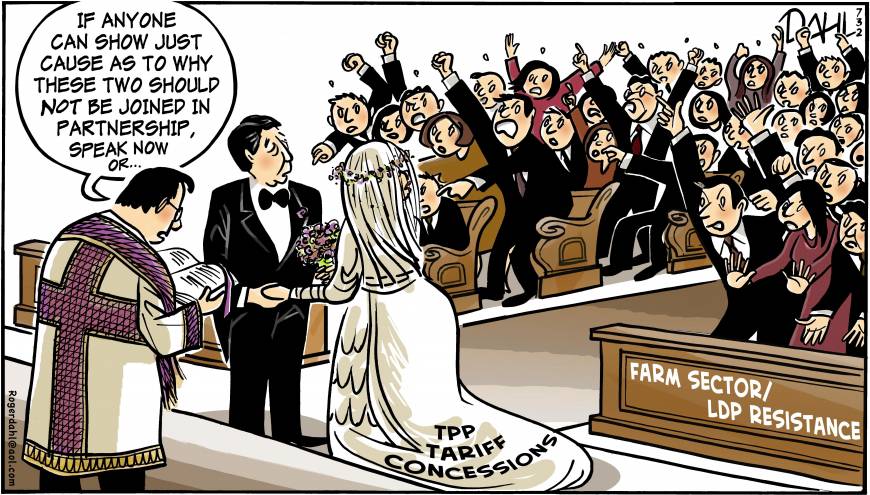
Simon Roe writes:The United States Congress has now given President Barack Obama so-called fast-track negotiating authority to conclude the Trans-Pacific Partnership (TPP), the proposed mega-regional free-trade agreement among the US and 11 other countries. But Obama’s victory was not an easy one.

But the Democrats have a point. They want the Obama administration to ensure that the TPP includes core international labor standards for all participants, a high level of environmental protection, and access to affordable medicines, among other measures.

Though Obama has promised that the TPP will be the most progressive trade agreement in history, which is achievable, the shroud of secrecy that surrounds almost all details of the negotiations has made it difficult to evaluate claims and counterclaims on this point.

In 2005, only 15 House Democrats voted for the Central American Free Trade Agreement, precisely because its terms on labor standards and the environment were so weak. In 2007, by contrast, 109 House Democrats voted in favor of the US-Peru Trade Promotion Agreement, precisely because its terms had been adjusted as requested and in line with the May agreement. And, in October 2011, the House approved the much-debated US-Korea Free Trade Agreement with 59 Democrats in favor. The extent of congressional Democratic support depends directly on what exactly is in any trade agreement.

The main principles in the May 2007 agreement are straightforward and difficult to oppose. Workers should be allowed to form trade unions. Child labor should be abolished. All forms of forced or compulsory labor – including human trafficking – should be prohibited.

Moreover, the agreement calls for the inclusion of existing international environmental standards in free-trade agreements, including rules concerning pollution and endangered animals. Likewise, such agreements should support fair access to pharmaceutical patents and to the data used to prove the safety of medical treatments. And the May 2007 agreement makes it clear that “foreign investors in the US will not be accorded greater substantive rights with respect to investment protections than US investors in the US.”

It would not be difficult for the administration to give Levin and his colleagues what they want.

The most difficult challenge for the Obama administration may be the issue of currency manipulation. Democrats are pushing for provisions to prohibit or limit currency-market intervention by central banks that is intended to give a country’s exporters a competitive edge. This is also a huge potential problem with the TPP, because competitive devaluations can swamp any other gains from trade by an order of magnitude, with substantial negative effects on US jobs. The administration urgently needs to take this point on board.

The TPP represents an important opportunity to write better rules for international trade and investment. But we are not there yet.

TPP?

Do Greece and the Eurozone Need Each Other?

Mark Roe writes:  A deal between Greece and its creditors might not happen. Several factors are in flux; Greek and northern European interests are not aligned; and personal animosities are in play. For Greece, an exit from the euro would not be easy, but if the alternative is endless austerity without debt forgiveness, its government may conclude that leaving the eurozone is the better choice.

Germany, for its part, would prefer to avoid a Greek exit – a position that Greek Finance Minister seems to have been banking on. But the German public largely wants to punish Greece, and German Chancellor Angela Merkel does not want to set a precedent for recurring bailouts of the European Union’s weaker members.

Failure to reach an agreement would be painful for Greece, which would face chaotic economic conditions. But an exit from the euro would also provide its government with new options – most notably, the ability devalue its currency to make its exports more competitive. For the rest of Europe, however, the risk is mostly on the downside, because beyond the obvious losses that would be incurred if Greece does not pay its debt to European governments and international institutions, there is the wider worry that the crisis could reverberate through the continent’s real economy.

There are three important risk channels through which Greece’s troubles could hit the European economy. The first is by destabilizing its financial institutions. The second is by disrupting the other EU member states in situations similar to Greece’s. And the third is by bringing about unexpected political outcomes.

It is important to recall that the 2008 financial crisis started in the United States, prosaically enough, with the bursting of a housing bubble.

The real trouble came when those losses hit the American financial system. At first, many authorities and observers thought that the crisis – beginning with the collapse of the US investment bank Lehman Brothers – could be contained.

Optimists will point out that the European institutions most exposed to the turmoil in Greece have had years to prepare themselves. And, indeed, a significant share of Greece’s government debt has migrated from banks to robust public institutions like the European Central Bank and the International Monetary Fund.

But the risks have not been eliminated. Risk and loss can spread from Greece to other heavily indebted countries, like Spain and Italy.

A Greek default and exit from the eurozone could unleash unpredictable political forces with a knock-on effect on the European economy.

Further hardship and economic turmoil could produce governments even further out on the political spectrum (the neo-fascist Golden Dawn party is another beneficiary of Greece’s economic troubles) or generate considerable instability, with governments becoming unable to provide basic security, let alone encourage an economic recovery. Add to that Greek Prime Minister Alexis Tsipras’s overtures to Russian President Vladimir Putin.

Greece has yet officially to default or leave the eurozone. There is still time for one side or the other to concede or for the various parties to find a face-saving compromise.

Many in Greece desperately want to retain the euro. As for the rest of Europe, its decision-makers may not want to risk finding out whether the repercussions of a Greek exit really can be contained.

Greece and the Eurozone

Goldman Wins Round Against Libya

Sarah Townsend writes:The Libyan Investment Authority has failed in an attempt to sue struggling British real estate mogul Glenn Maud for more than £20 million ($31 million), but it has been granted permission to appeal the court’s decision.

The UK bankruptcy court ruled last month that Maud – who amassed a $7 billion global property portfolio before he went bust as a result of the financial crash – does not have to repay a loan he received from the LIA to help finance his acquisition of 50 percent of Banco Santander’s global headquarters in Madrid in 2008.

The loan was granted to Maud before the imposition of United Nations sanctions against Libya in March 2011.

The sanctions regime effectively prevents the turbulent North African country from seeking to recover unpaid debt, and freezes all assets held outside the state.

Although the judge did not dispute that Maud owed the money, she ruled that its repayment to Libya would amount to a breach of sanctions.

According to court documents seen by Arabian Business, Maud’s now defunct real estate company Propinvest received the first tranche of what was originally intended to be a bigger loan from Libya at a time when it was common for the country to seek inward investment from other nations.

This payment amounted to £17.6 million. Maud claimed he did not receive the rest of the agreed loan because of the collapse of the Libyan regime. The total size of that loan is not revealed in the court documents.

The documents state that Propinvest defaulted on the loan repayment from March 2010 (it went into administration in 2011). The unpaid debt stood at around £20 million including interest.

The LIA served a statutory demand on Maud but he challenged it on the grounds that to pay would amount to a breach of sanctions.

The court ruled in Maud’s favour, deciding that anyone making payment to the LIA in breach of the sanctions would be subject to criminal penalties and it would be unjust to require a debtor to make repayments in such circumstances.

The LIA had argued Maud should have applied for a licence from the UK Treasury that might have allowed him to make the repayment regardless of the sanctions.

But the court held that Maud, as a debtor, was not responsible for doing this – especially since there was no certainty that a licence would be granted.

The lawyers involved in the case declined to comment. The judgment is a coup for Maud, who retains his 50 percent stake in Banco Santander’s headquarters at a time when he is still recovering from the financial crash that caused Propinvest to collapse in 2011.

The Financial Times reported in 2012 that Maud was subject to a Channel Islands court order that prevented him from living on more than £500 ($782) a week. He also had his worldwide assets frozen.

However, the flipside of the decision is that the LIA stands to lose out on valuable sources of funding that could help it to rebuild the country.

A spokesperson for the LIA revealed that the LIA has been given leave to appeal the decision. The spokesperson said: “This was a highly technical and complex public law case concerning the interpretation of economic sanctions. The sanctions are there to protect the interest of the Libyan people.

“Rather oddly in this ruling, the existence of sanctions has been turned on its head for the benefit of a debtor who is liable to those very same people. This cannot be right.  The [LIA’s] Board of Directors is intent on clarifying this point of law and pursuing a substantial and undisputed debt due to the people of Libya.

“The LIA is taking the case to the Court of Appeal and hopes this court will recognise that Maud is seeking to protect his own interests by using a sanctions regime designed to protect funds designated for investment in the building of a safe country with a vibrant, well-educated and healthy population.”

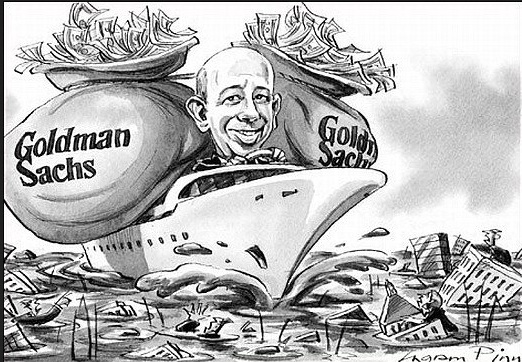
The outcome will have implications for Libya’s other creditors – among them the banks Goldman Sachs and Société Générale, both of whom are embroiled in similar, separate, court cases to quash the LIA’s demands to pay outstanding funds.

One well placed lawyer told Arabian Business that, should the LIA win or the sanctions be lifted, questions will arise over where to direct repayments given that it is unclear which of Libya’s two warring governments are in charge of the investment body.

Surprise- Goldman Prevails


Iceland Says No to EU

Iceland has announced it is dropping its bid to join the European Union in line with pledges made two years ago by its then-new eurosceptic government.

Iceland first applied for EU membership under a leftist government in 2009, when the country was badly shaken by an economic crisis that saw the Icelandic krona lose almost half its value, making eurozone membership an attractive prospect.

But the thorny issue of fishing quotas was seen as a key obstacle to joining the bloc, although it was never brought up in the accession talks.

Fishing represents an important part of the Icelandic economy, and it was never made clear how differences between Brussels and Reykjavik could be patched over on the subject.

Thousands of protesters had thronged the streets of Reykjavik last year to demand a referendum after the government said it was dropping its EU membership bid without a popular vote.

But opinion polls more recently began to show growing resistance among Icelanders to EU membership.

The north Atlantic island is a member of Europe’s visa-free Schengen area and the European Economic Area.

That allows it to export seafood to the mainland tariff-free and helps boost tourism, which is crucial to the country’s foreign exchange earnings.
Advertisement

Iceland has clawed its way back from the demise of its bloated financial sector in 2008, with official figures showing this week that GDP reached record levels last year.

At constant prices, Iceland’s GDP grew by 1.9% in 2014 to beat a GDP record dating back to pre-crisis levels, according to Statistics Iceland.

However, “GDP per capita remains lower than in 2008, and while there is no shortage of jobs, we lack jobs that pay well, especially for young graduates,” University of Iceland economics professor Asgeir Jonsson told AFP.

For many Icelanders, joining the EU has not been a major priority, with concern instead over how to pay back loans taken on when the economy seemed to be booming before the crash.

The small Nordic country was hit hard as the crash of US investment bank Lehman Brothers caused the collapse of its three largest banks.

Without effective oversight, Iceland’s banks had taken out massive cheap loans abroad, scooping up assets worth several times the island’s annual output.

Iceland then became the first western European nation in 25 years to appeal to the International Monetary Fund to save its battered economy.Iceland Says No to EU

Entrepreneur Alert: A New Niche in Baking?

Michal Muskal writes:  he former owners of an Oregon bakery have been ordered to pay $135,000 to a lesbian couple who were refused a wedding cake, in the latest front in the battle between religious liberty and individual rights.

Oregon Labor Commissioner Brad Avakian ordered Aaron and Melissa Klein, who owned the Sweet Cakes by Melissa bakery in Gresham, Ore., to compensate the couple for emotional and mental suffering that resulted from the denial of service.

The Kleins had cited their Christian beliefs against same-sex marriage in refusing to make the wedding cake for Rachel and Laurel Bowman-Cryer.

Avakian’s final order, issued Thursday, had been expected in the dispute that dates from 2013, one of several around the nation involving bakers, florists and photographers who have refused to provide services to same-sex couples on religious grounds.

Oregon law bars businesses from discriminating or refusing service based on sexual orientation, just as they cannot turn away customers because of race, sex, disability, age or religion.

If we take unclesmrgol’s thinking to its logical conclusion, then we are all slaves, and we are all owners. We all have the right to walk into a for-profit establishment or government office and “force” the workers to provide goods and services that are available to all customers…

According to the state Bureau of Labor and Industries’ report, Rachel Bowman-Cryer and her mother attended a bridal show in Portland where the Kleins had a booth advertising their wedding cakes. Bowman-Cryer and her mother went to a cake-tasting at the bakery in 2013.

When Aaron Klein was told there would be two brides, Rachel and Laurel, he responded that he was sorry, but the bakery did not do wedding cakes for same-sex couples because of his and his wife’s religious convictions, according to the report.

The Bowman-Cryers held a commitment ceremony in June 2013 and were married in May 2014, shortly after a federal judge struck down Oregon’s ban on same-sex marriage.

In August 2013, the brides filed a complaint with the state Bureau of Labor and Industries, and the agency brought charges against the Kleins in January 2014.

Aaron Klein said his family had suffered because of the case and the glare of media attention.

The bakery’s car was vandalized and broken into twice, he said. Photographers and florists severed ties with the company, eventually forcing the Kleins to close their storefront shop in September 2013.

Growing the Marriage Market?


The Greeks Say No

Greeks overwhelmingly rejected conditions of a rescue package from creditors on Sunday, throwing the future of the country’s euro zone membership into further doubt and deepening a standoff with lenders.

As the euro slid more than 1 percent against the dollar and European stock and bond markets were poised to take a sharp hit with the resumption of trade on Monday, stunned European leaders called a summit for Tuesday to discuss their next move.

Thousands of jubilant Greeks waving flags and bursting fire crackers poured into Athens’ central square as official figures showed 61 percent of Greeks had rejected a deal that would have imposed more austerity measures on an already ravaged economy.

The surprisingly strong victory by the ‘No’ camp defied opinion polls that had predicted a tight contest after a week of rising desperation as banks shut and cash machines ran dry.

The vote leaves Greece in uncharted waters: risking a banking collapse that could force it out of the euro. Without more emergency funding from the European Central Bank, Greece’s banks could run out of cash within days. That might force the government to issue another currency to pay pensions and wages.

For millions of Greeks the outcome was an angry message to creditors that Greece can no longer accept repeated rounds of austerity that, in five years, had left one in four without a job and that shrank the economy by a quarter. Tsipras has denounced the price paid for aid as “blackmail”, a national “humiliation”.

Officials from the Greek government, which had argued that a ‘No’ vote would strengthen its hand to secure a better deal from international creditors after months of wrangling, immediately said they would try to restart talks with European partners.

But euro zone officials shot down any prospect of a quick resumption of talks, even though finance ministers were planning to meet during the week to discuss the fallout from the vote.

Many of Athens’ partners have warned over the past week that a ‘No’ vote would mean cutting bridges with Europe and driving Greece’s crippled financial system into outright bankruptcy.

The result delivers a hammer blow to the European Union’s grand single currency project. Intended to be permanent and unbreakable when it was created 15 years ago, the euro zone could now be on the point of losing its first member with the risk of further unraveling to come.
Greeks Say No for Now

A Greek Deal in the Offing?

The ultimate goal is to keep Greece within the eurozone, according to German spokesman Martin Jaeger.

A Greek exit from the euro would be hugely painful for the country.

Talks over the Greek debt issue have been in deadlock for five months.

The proposals put forward by Athens aim to raise €8bn, mostly through new taxes on the wealthy and businesses, early retirement restrictions, VAT increases and a cut in defence spending.

We should also be very cautious of rumours today as these can cause significant turbulence in the markets and if denied – which they usually are – can cause a sizeable swing in the opposite direction. The official spoke only on condition of anonymity because the talks were ongoing.

Greece should not limit its proposals to promises of more tax revenue and must present “credible” reform plans, said International Monetary Fund chief Christine Lagarde in an interview published by French magazine Challenges on Wednesday.

In spite of the standoff, many analysts and economists think a deal that would release €7.2-billion in loans left over from the current bailout, which expires on Tuesday, is still likely.

Greek prime minister Alexis Tsipras was under pressure to seal a deal before facing other European Union leaders at the summit.

But the International Monetary Fund was cautious about the mix of reforms Greece proposed, saying they rely too heavily on tax increases that can hurt the economy.

Talk of a default is “all speculation, because we’re expecting the payment to be made on June 30th and that’s what the Greek authorities have said publicly”, fund spokesman Gerry Rice said.

Penions and taxes remain the sticking points. Nowhere! This odd stance may be due to two reasons. “Are they doing this for growth or (to serve) interests?”

For its part, the ECB’s governing council is holding daily conference calls to decide whether to increase the emergency liquidity assistance (ELA) available to the Greek banking sector. Greece is in talks with creditors this week to get more bailout loans to avoid bankruptcy next week.

But Greece was still not on board, and wanted to stick to a previous plan it has offered.

The key European Union policymakers including German Chancellor Angela Merkel said they hope a final deal would be reached at Saturday’s meeting of the eurozone finance ministers that are scheduled to start at 15:00 GMT.

Merkel and Tsipras

US Minimum Wages Impact Puerto Rico

Nick Timiraos writes: With the Puerto Rican economy in decline, Luis Acevedo, a 31-year-old chemist, decided to get a degree in chemical engineering to give him a better chance at boosting his earnings. Even with the degree, he has had no luck finding a job after five months, and he said competition is fierce given a high unemployment rate, about 12%. “The way things are going I’m starting to apply abroad,” Mr. Acevedo said.

Weak job prospects have prompted Puerto Ricans, who are U.S. citizens, to seek employment in places like Florida, New York and New Jersey. Since 2000, total employment is down 11% in Puerto Rico, while it is 7% higher in the U.S. The island was projected to post one of the largest population declines in the world last year, according to U.S. government figures.

More than 27% of Puerto Ricans between 15 and 24 years old who were in the labor force were unemployed in 2013, compared to nearly 16% in the U.S.
Andrew Bary of Barron’s tells Jack Otter what just happened in San Juan, and what it means for municipal bond investors.

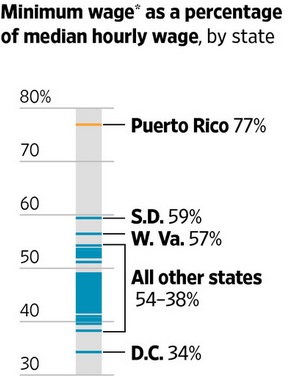
Labor unions on the mainland pushed for the federal minimum wage to cover Puerto Rico in the 1970s amid concerns that the island would create low-wage competition for mainland jobs. The move eliminated a comparative economic advantage for the island, while tax breaks designed to lure multinationals did little to establish permanent job growth, said Barry Bosworth, an economist at the Brookings Institution in Washington.

Congress mandated two U.S. territories in the Pacific, American Samoa and the Commonwealth of the Northern Mariana Islands, to increase their minimum wages in 2007 by 50 cents annually until meeting the federal level this year, but it delayed those increases in 2010 amid concerns about economic growth.

“They are begging the government to stop the onwards march of raising the minimum wage,” said Mr. Porzecanski. “It’s better to be hired at $5 than not to be hired at $7.25.” Minimum wages in American Samoa, which range from $4.18 to $4.76 an hour, are set to rise by 50 cents at the end of September.

Labor dynamics are only part of the problem with Puerto Rico’s economy, which also faces poor business investment, high tax evasion, and unusually expensive electricity and other costs of living.

The Jones Act, a law that requires most shipping between U.S. ports to rely on a small and specific fleet of U.S.-flagged vessels, means that just a handful of ships serve Puerto Rico, limiting competition and increasing costs of basic goods. The Krueger Report recommends that Congress exempt Puerto Rico from the Jones Act, following similar exemptions for the U.S. Virgin Islands.

In Puerto Rico, broad use of government benefit programs have further damped workforce participation. Transfer payments, such as food stamps and disability benefits, account for roughly 40% of personal income in Puerto Rico, double the share on the U.S. mainland, according to the New York Fed.

Those payments tend to be generous relative to local incomes because payments are indexed to conditions on the mainland. Moreover, because they decline as wages rise, they can create a disincentive to work. The Krueger report recommends providing lower benefit payments to a larger number of people, which would maintain the social safety net while encouraging more labor-force participation.

At the same time, economists say other local labor laws, including more generous overtime pay and vacation rules, plus laws that make it harder to fire workers, have made employers reluctant to hire.

While it would make sense to exempt Puerto Rico from future increases in the federal minimum wage, cutting wages “will just accelerate the exit from the island,” Mr. Bosworth said. “The fundamental problem in Puerto Rico is the lack of jobs.
Minimum Wages