Greek Crisis Impacts the EU

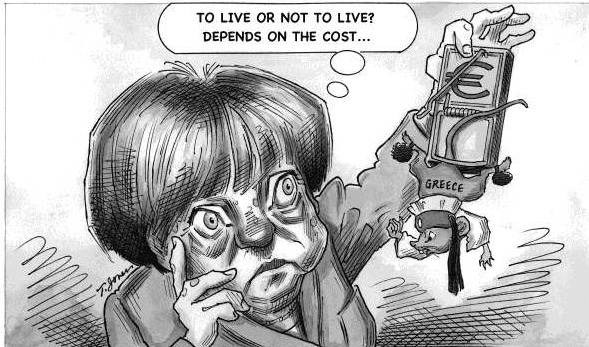
The Econmist editorializes:   European Union has never seen the like of the past eight days in Greece: barred banks, capital controls, the first IMF default by a developed country, the collapse of a multi-billion-euro bail-out, plans for a referendum that may hasten Greece’s ejection from the single currency, and the beggary of the people. Were the stakes not so high, all those emergency summits and last-minute demands would count as farce.

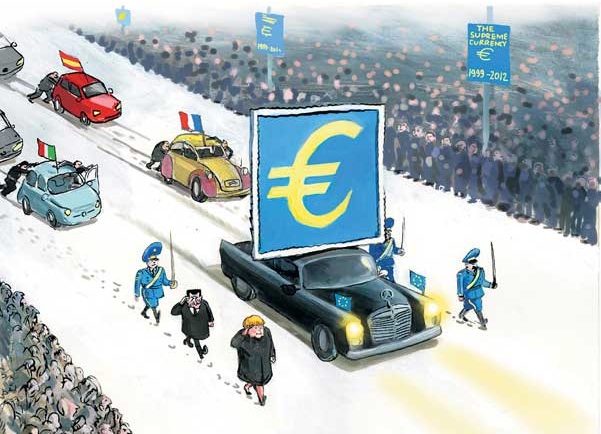
Instead it is a tragedy, where an outcome that all sides say they do not want—Greece’s exit from the euro—seems increasingly likely. The chaos is evidence that leaving the euro would be disastrous for Greece, not least because modest gains from default and devaluation would be overwhelmed by political and economic instability. For the rest of Europe, too, “Grexit” has well-rehearsed risks, notably that of a failing state on the continent’s south-eastern flank. But as the drama has become more desperate, so Europeans seem less worried. They take comfort from the fact that Greece is uniquely dysfunctional. Game-playing and repeated miscalculation have poisoned the negotiations (see article). Without Greece, many now conclude, the euro zone might actually be more stable.    Facing up to the Euros Contradictions
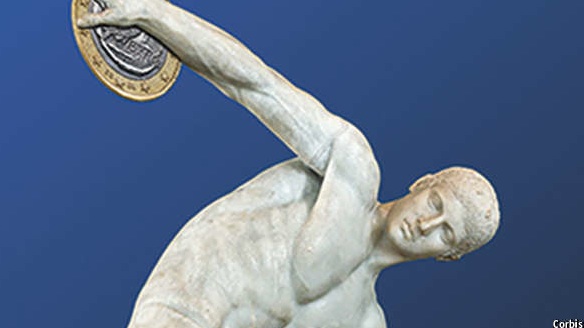
How the Greek Crisis Impacts the EU

China or Russia to Aid Greece?

Joshua Keating writes:  If you want some perspective on Europe’s current debt crisis, consider the fact that Chinese stocks have fallen by a value 10 times Greece’s entire GDP, with nary a peep from the Greek-obsessed international media..

But even if the scale of Greece’s woes seem small by Chinese standards, Beijing is still concerned with what happens this weekend, particularly due to concerns that if the situation isn’t resolved, it could drag down economies throughout the EU, China’s largest trading partner. By coincidence, Prime Minister Le Keqiang was in Brussels this week for an annual China-EU summit and said that China is hoping for a resolution that keeps Greece within the eurozone, saying it concerns not just Europe but “world financial stability and economic recovery.”

Still, the prospect of a Greek exit from Europe and a collapse of the bailout has led to some speculation about whether China could turn the situation to its advantage. China has leant money to countries that have defaulted on their debts before, notably in Latin America, and it may see a political advantage in stepping in when Europe failed to.

If history is a guide, China would be less interested than the EU in reforming Greece’s governance and domestic economic policies, so long as Greece committed to policies that provide advantages for Chinese trade and, perhaps, a reliably pro-China foreign policy.

There’s been even more speculation about the prospect of Russia stepping in to bail Greece out. The Kremlin has helped out debt-addled the Mediterranean before, granting a 2.5 billion euro emergency loan to Cyprus in 2011.

Greece’s ruling Syriza party is fairly pro-Russian, opposing EU sanctions against Vladimir Putin’s government.

The Russians have left open the possibility of further economic cooperation in exchange for concessions to Russian business. Finance Minister Anton Siluanov said back in January that Russia would “definitely consider” a Greek request for aid.

Despite these hints, a Russian lifeline for Greece is probably still unlikely. Battered by both low oil prices and western economic sanctions, Russia is burning through its reserves fast without much relief in sight.

It would be a mistake for Greece’s government to count on help from Russia (or China for that matter) if things take a turn for the worse with Europe. But it’s probably still advantageous for Greece and Russia if the lenders in Brussels think it’s a possibility.

Aid to Greece?


After the Greek Crisis

George Friedman writes: The Greek situation – having perhaps outlived the term “crisis,” now that it has taken so long to unfold – appears to have finally reached its terminal point. This is, of course, an illusion: It has been at its terminal point for a long time.

The terminal point is the juncture where neither the Greeks nor the Germans can make any more concessions. In Greece itself, the terminal point is long past. Unemployment is at 26 percent, and more than 50 percent of youths under 25 are unemployed. Slashed wages, particularly in the state sector, affecting professions including physicians and engineers, have led to massive underemployment. Meanwhile, most new economic activity is occurring in the untaxable illegal markets. The Greeks owe money to EU institutions and the International Monetary Fund, all of which acquired bad Greek debts from banks that initially lent funds to Greece in order to stabilize its banking sector. No one ever really thought the Greeks could pay back these loans.

The problem is simple. The core institutions of the European Union have functioned not as adjudicators but as collection agents, and the Greeks have learned how ruthless those agents can be when aided by collaborative governments like Cyprus. The rest of the Europeans have also realized as much, which is why Euroskeptic parties are on the rise across the union. Germany, the country most threatened by growing anti-EU sentiment, wants to make clear that debtors face a high price for defiance. And if resistance is confined to Greece, the Germans will have succeeded. But if resistance spreads to other countries, the revolt of the debtor states against the union will cause major problems for Germany, threatening the economic powerhouse’s relationship with the rest of Europe.  After the Greek Crisis

Greek Default

Time for Democracy in Africa

James Kellman writes: For the first time in the history of Africa’s largest country, a challenger defeated a sitting Nigerian president via the ballot box. The losing incumbent in the March 28 election, Goodluck Jonathan, graciously conceded defeat to Muhammadu Buhari, offered his best wishes, and urged supporters to follow due process. Nigeria’s accomplishment is all the more remarkable in the face of terrorist threats from Boko Haram.

Yet in much of Africa, democracy remains an empty word. The phrase that U.S. diplomat Edward Djerejian coined in 1992 — “one person, one vote, one time” – is the more established rule. Leaders, once elected, to contrive to stick around for decades, defying term limits, and rigging elections. For example, the president of Burundi, Pierre Nkrunziza, is standing for election to a third term on July 15, in defiance of constitutional limits. The European Union has withheld funds to conduct the election, and, already, violence has broken out at polling stations.

In Togo recently, President Faure Gnassingbe won a third term. He and his late father have been running the country now for 48 years. Indeed, nine African countries have a leader who has been in power for 21 years or more.

Only one African country, Mauritius, qualifies as a “full democracy.” Some 27 sub-Saharan nations are “ruled by an authoritarian regime or nominal democracy,” and 13 countries have no presidential term limits.  Time for Democracy in Africa

Entrepreneur Alert: Elizabeth Warren’s Boosts

Senator Elizabeth Warren told an audience of Worcester entrepreneurs  that they are the future of the United States and more must be done to promote small business start-ups when policies are being pass down from Washington, D.C.

In Worcester, Warren visited the robotics technology incubator Technocopia and its Prescott Street neighbor, the co-working space Running Start.

“There are a lot of opportunities if you are already big to get bigger,” Warren said. “But, where the real innovation in this country comes from is the folks who have a good idea, but they have to start right down at the base. You’re creating that here.

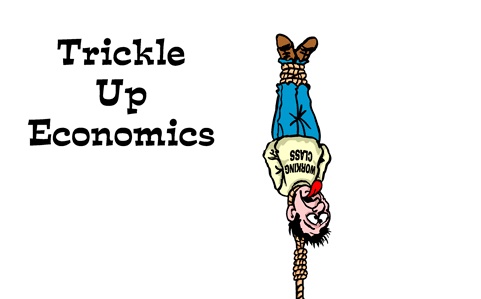
Warren said much of the country’s current woes date back to 1980 and the start of trickle-down economics. Those policies have favored large corporations, and created an atmosphere where college graduates are buried in so much debt that they cannot afford to start small businesses, she said.

Kevin Harrington, of Technocopia, asked about the possibility for a small business deferment on student loans.

For her part, Warren said it was a good idea that needs to be considered among many others to help promote start-ups.

The visit to Worcester incubators highlights Worcester’s recent successes.

Making Trickle Up Economics Work

Lagarde Opposed Greek Loans; Now Stuck with Default

As French Finance Minister in 2010, Christine Lagarde opposed the involvement of the International Monetary Fund in Greece.

Now Lagarde’s tenure at the head of the IMF since 2011 will be shaped by Greece, which holds a referendum on Sunday that could pave the way to its exit from the euro.

By its own admission the Washington-based institution broke many of its rules in lending to Greece. It ended up endorsing austerity measures proposed by the European Commission and European Central Bank, its partners in the troika of Greece’s lenders.

That the IMF lent to Greece at the behest of Europe, which has nominated every IMF Managing Director since the inception of the Fund in 1946, may expose the institution to greater scrutiny, especially as it has $24 billion in loans outstanding to Greece in its largest-ever program.

The involvement of the Fund in Greece and its continued support for decisions driven by eurozone governments caused a deep split in the institution.

Some IMF economists had misgivings about lending to Greece in 2010 within the constraints of the so-called “troika” of lenders, where the Fund would be the junior partner to the European Central Bank and the European Commission.

IMF board members also protested the “exceptional” size of the program, as Athens did not meet the Fund’s criteria for debt sustainability, meaning it would have trouble repaying.

Yet swayed by the fear that contagion in Athens could spread to French and German banks, the IMF agreed to participate in a joint 110-billion-euro bailout of Greece with the Europeans.

Later, the Fund admitted that its projections for the Greek economy had been overly optimistic. Instead of growing after a year of austerity, Greece’s economy plunged into one of the worst recessions to ever hit a country in peacetime, with output falling 22 percent from 2008 to 2012.

While the eurozone’s insistence on drawing a direct link between euro membership and Greece’s debt sustainability and the negotiating tactics of the Greek government have exposed both to questions of credibility, the Fund stands charged as well.

Greek default on all $24 billion it owes to the IMF dwarfs previous delinquincies from countries like Sudan, Zimbabwe and Somalia.

While the IMF was worried about contagion when it made the loans, it also had institutional incentives for wanting to bail out troubled countries.

The IMF’s heavy involvement in large bailouts for euro zone countries, which included Ireland and Portugal, have enabled it to build up its reserve buffers in recent years. It is now aiming to store away some $28 billion by 2018.

From interest and charges on the Greek program alone, the IMF has earned some $3.9 billion since 2010.

Greek Default

Leading Shock Absorbers

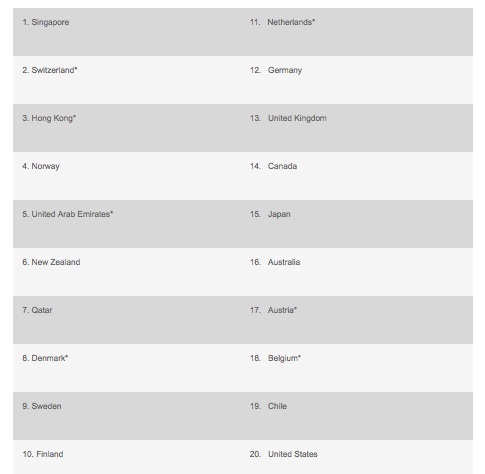
Top five countries prepared for economic and political charts are: Singapore, Switzerland, Hong Kong, Norway and the UAE.

When it comes to dealing with change brought about by everything, from economic and political shocks, to long term trends such as technologies and demographics, the UAE is the most prepared in the Arab world.

It is the only Arab country that made it to the top five. Qatar, however, is trailing behind in the seventh place.

Produced in partnership with Oxford Economics, the index rated 127 countries for their capability to prepare for or respond to change caused by financial crises, political shocks and natural disasters.

It looked at the business environment, technology access, as well as fiscal, regulatory and security capabilities, among several other indicators, of 127 countries.

Global Readiness Index

Alibaba’s Ma Takes Over the Rockefeller’s Adirondacks

Brandon Park, the 28,100-acre former estate of William A. Rockefeller, Jr. (a co-founder of Standard Oil with his brother John D. Rockefeller), has been purchased by Alibaba co-founder Jack Ma of China for $23 million according to the Wall Street Journal.

Alibaba is the world’s largest e-commerce company. He reportedly bought the property principally for conservation purposes, but may also use it as a personal retreat.  Ma is chairman of the China board of the Nature Conservancy and is a member of the global board. The Nature Conservancy introduced Ma to the property, according to The Wall Street Journal.  Ma has extensive experience in conservation projects in China, including co-founding the Sichuan Nature Conservation Foundation and the Laohegou Nature Reserve in Sichuan, which protects giant panda habitat and is the first protected area managed by a non-governmental organization in China.  This is his first conservation project outside of China.

Ma Conserves the Adirondacks


Have Press Leaks Killed the Euro?

Frances Coppola writes:  The creditors have once more rejected Greece’s proposal and put forward their own version including tax and pension changes that Greece had already said it would not accept.

In the early hours of Saturday morning, June 27th, the Greek Prime Minister Alexis Tsipras announced that the people of Greece would be asked to decide whether they wished to accept the creditors’ proposal. A referendum will be held on July 5th.

The question that will be put to the Greek people is only about the creditors’ proposal, not about Greece’s membership of the Euro. But this referendum has huge historical and emotional resonances, deliberately created by the Greek government in a manner reminiscent of Alex Salmond’s linking of the Scottish independence referendum to the historic victory of the Scots over the English in 1314.   Similarly, Tsipras’s subtle attempt to link this referendum to Greece’s rejection of Benito Mussolini’s ultimatum in October 1940 may not be enough to overcome Greek fears.

But the creditor side and the world’s media quickly decided that the referendum was actually about Euro membership. A “No” vote would result in Greek exit from the Eurozone. A “Yes” vote would mean the fall of the Syriza government. Not surprisingly, the Greek opposition parties called for a “Yes” vote.

A press release says that this proposal was under discussion until the Greeks walked out:

Discussions on this text were ongoing with the Greek authorities on Friday night in view of the Eurogroup of 27 June 2015. The understanding of all parties involved was that this Eurogroup meeting should achieve a comprehensive deal for Greece, one that would have included not just the measures to be jointly agreed, but would also have addressed future financing needs and the sustainability of the Greek debt. It also included support for a Commission-led package for a new start for jobs and growth in Greece, boosting recovery of and investment in the real economy, which was discussed and endorsed by the College of Commissioners on Wednesday 24 June 2015.

However, neither this latest version of the document, nor an outline of a comprehensive deal could be formally finalised and presented to the Eurogroup due to the unilateral decision of the Greek authorities to abandon the process on the evening of 26 June 2015.

The Greek people are being asked to vote on the proposal put to the Eurogroup. The release of a new version of the proposal, and the suggestion that debt relief would have been up for discussion too, is thus clearly intended to invalidate the referendum.

The world’s media, supported by a succession of leaks from “unnamed sources”, was speculating that the imminent expiry of the existing bailout program would force the ECB to end ELA funding of Greece’s banks, resulting in closure of the banks and capital controls. Unsurprisingly, withdrawals from Greek ATMs increased.   Frances Coppola on the Euro

Death of the Euro

European Markets Plunge

European stocks started the day with losses of 4% or more as investors reflected on the weekend news from Greece: of the planned referendum, bank closures and capital controls. The Portuguese stockmarket was one of the worst affected, falling almost 6% at the open on fears that the economy would be dragged into the crisis (the Athens stock exchange is closed).

Contagion was seen in the bond markets too, with Spanish and Italian 10-year bond yields rising around 18 basis points, while the German equivalent fell 15 points; a spread widening of around a third of a percentage point. The euro was slighly lower on the news, falling less than 1% against the dollar. While uncertainty over Greece’s future is bad news for the European economy, traders had been using the euro as the basis for a “carry trade”; borrowing euros and investing the proceeds in higher-yielding risky assets. As those traders pulled back from their risky bets, they would have paid back the euros they borrowed, limiting the currency’s fall.

Traders had three other factors to consider, which might limit losses as the day proceeds. The European Central Bank could step into the market to buy bonds, particularly in places like Portugal, Spain and Italy, and limit the contagion. In addition, a yes vote in the Greek referendum might lead to a deal with creditors, and might see the departure of a Syriza-led government. And then there is the sheer chaos in Greece, which has ended up in the situation all other governments bent over backwards to avoid in 2008—its ATMs running out of money. Some commentators believe the referendum, which asks voters to approve a deal which will not even be on the table by July 5th, may yet be called off.

Greek Default?