What’s Draghi Up To?

Mohamed El-Erian writes: European Central Bank President Mario Draghi painted a dovish and hopeful picture and was also realistic about what euro zone governments need to do to enable the ECB’s full success.

Draghi left no doubt the ECB is committed to the implementation of its “non-standard” monetary policy. He reiterated that the central bank “intends” to intervene in markets until the end of September 2016, regardless of concerns about negative nominal yields and a possible shortage in securities to purchase. And it would continue beyond that date if the bank doesn’t obtain the macroeconomic outcome the quantitative easing program is designed to achieve.

To make this point even more forcefully, Draghi dismissed concerns about QE’s inadvertent collateral damage. These include accentuating the future risks of financial instability and enabling governments to be less responsible.

Turning to the impact of QE, Draghi was optimistic about the initial results. He pointed to the improvement in credit flows and other monetary indicators; and he took comfort from the stronger momentum of the euro zone economy, notwithstanding substantial variations among countries. In doing so, he played down concerns that ECB policy was encouraging financial bubbles, though he only seemed focused on bank leverage.

What Draghi didn’t make clear is that the euro zone’s experience of QE closely resembles those of other countries that had previously undertaken such efforts, particularly Japan and the U.S.

As was the case elsewhere, the first stages of the ECB’s program were immediately met with a helpful response in financial markets, including higher equity prices, lower bond yields and a depreciated currency. This response boosted sentiment more broadly and partially spilled over into economic activity. That was the easy part, which I previously described as the first third of the QE journey.

The remaining two-thirds will be much harder. Success requires sustaining economic progress while, simultaneously, containing the “costs and risks” associated with artificially boosted asset prices and possible resource misallocations. To navigate that artfully, the ECB will need a lot of help from other institutions.

As noted by Draghi, the ultimate success of the ECB’s unconventional policy approach will require governments to implement deeper structural reforms — including in labor and product markets — as well as encourage business investment and expansion. It will need much more pronounced balance-sheet healing, including overcoming increasingly entrenched debt overhangs. And, in my opinion, it also needs aggregate demand within Europe to be higher and more evenly spread across countries.

Europe is still quite a distance from achieving any of this. The celebration of the encouraging start of the euro zone’s QE should be tempered by the lessons of similar policies elsewhere.
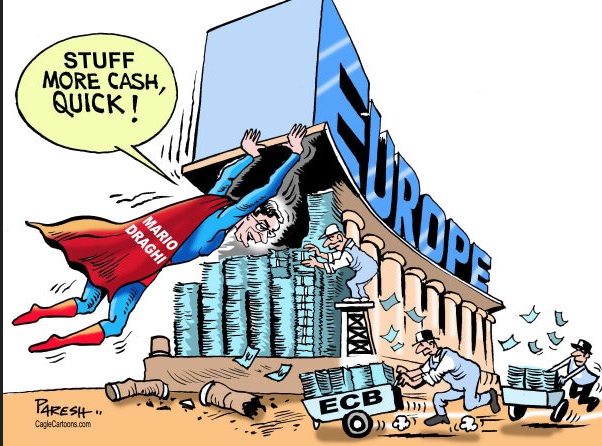
Draghi

Wolfgang Schäuble on Sensible Finance Policy

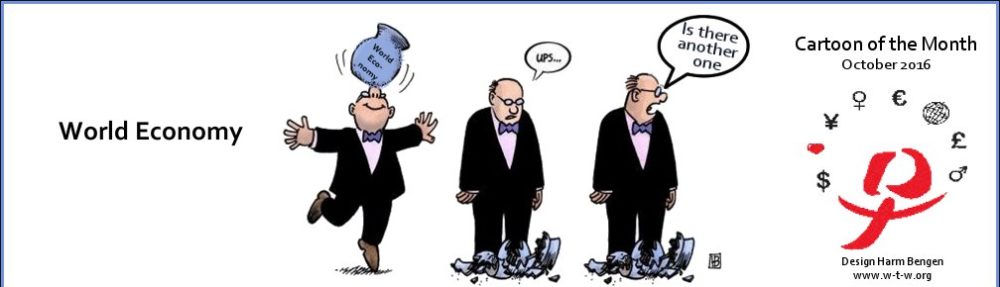
he immediate sting of the global financial crisis has faded in much of the world.  Unfortunately, however, the world economy is not yet out of the woods. It still faces very concrete challenges. We are as badly as ever in need of a common understanding of what needs to be done

Complaints that the European response to the crisis has been ineffective at best, or even counterproductive — are simply not accurate. There is strong evidence that Europe is indeed on the right track in addressing the impact, and, most importantly, the causes of the crisis.

First, it has often been said that German insistence on fiscal austerity meant that Germany, the largest economy in the European Union, has “punched below its weight” — and thereby pushed the eurozone more deeply into crisis — by not stimulating more demand. This misses the point. The crisis in Europe was first and foremost a crisis of confidence, rooted in structural shortcomings. Investors started to realize that the member countries of the eurozone were not as economically competitive or financially reliable as the uniform bond yields of the pre-crisis years had suggested. These investors began to treat the bonds of certain countries with much more caution, causing interest rates for those bonds to rise.

Germany has consistently advocated an approach of structural reforms and reducing public debt without throttling growth. This is not blind “austerity.” It is about setting a reliable framework for private-sector activity, preparing aging societies for the future and improving the quality of public budgets.

In Germany, this approach has shown tangible success: The economic recovery since 2009 has been broad-based, with domestic demand as the main driver of growth. Investment — both public and private — is increasing. We are speeding up debt reduction, in line with the I.M.F.’s recent call for “symmetric stabilization” (reducing deficits in good times, to offset deficits in bad times).

Many European countries are reaping the rewards of reform and consolidation efforts. Countries like Ireland and Spain, which put far-reaching reforms into effect when they hit financial trouble a few years ago, now boast some of the highest growth rates in Europe.

Some make the absurd claim that Germany — being a creditor nation— is actually profiting from the crisis.  It is true that the German government now enjoys historically low borrowing costs. But so do almost all other eurozone members. Unconventional monetary policies pursued by the independent European Central Bank seem to have fulfilled their part there. Low interest rates help all borrowers — but they come at ever-increasing costs to savers and pension funds.

Some say the answer to the crisis in Europe has been ever-greater liquidity and ever-lower interest rates. Now that we have both, we are finding that these policy tools are no panacea, but create problems of their own. More and more experts on both sides of the Atlantic warn of dangerous bubbles in asset prices and risks to financial stability from ever-increasing leverage (financing by borrowing). And it is clear that the debt burden in many countries cannot be solved by incentives to take on even more debt.

On the fiscal side, we need to prepare government budgets for an eventual normalization of monetary policy and capital markets.

The European Central Bank has warned many times that monetary policy cannot substitute for fiscal and structural reforms in member countries. Christine Lagarde, the managing director of the I.M.F., has also called for further structural reforms.

The priorities for Germany, as the current president of the Group of 7 nations, are modernization and regulatory improvements. Stimulus — both in fiscal and monetary policy — is not part of the plan. When my fellow finance ministers and the central bank governors of the G-7 countries gather in Dresden at the end of next month we will have an opportunity to discuss these questions in depth, joined — for the first time in the G-7’s history — by some of the world’s leading economists.

Wolfgang Schäuble


Reform the IMF?

Paolo Noguiera Batista and Hector R. Torres write:   More than four years have passed since an overwhelming majority of the membership of the International Monetary Fund agreed to a package of reforms that would double the organization’s resources and reorganize its governing structure in favor of developing countries. But adopting the reforms requires approval by the IMF’s member countries; and, though the United States was among those that voted in favor of the measure, President Barack Obama has been unable to secure Congressional approval.

The delay by the US represents a huge setback for the IMF. It stands in the way of a restructuring of its decision-making process that would better reflect developing countries’ growing importance and dynamism.

In our view, the best way forward would be to decouple the part of the reforms that requires ratification by the US Congress from the rest of the package. Only one major element – the decision to move toward an all-elected Executive Board – requires an amendment to the IMF’s Articles of Agreement and thus congressional approval.

The other major element of the reform package is an increase and rebalancing of the quotas that determine each country’s voting power and financial obligation. This change would double the IMF’s resources and provide greater voting power to developing countries. Congress would still need to ratify the measure before the US’s own quota increased, but its approval would not be required for this part of the reform package to take effect for other countries.

The connection between the two parts of the reforms has always been unnecessary; the measures are independent, require different approval processes, and can be delivered separately. Removing the link between them would require the support of the US administration, but not ratification by Congress.

This separation could be implemented smoothly. A simple majority of the IMF’s Executive Board would recommend it to the Board of Governors, where a resolution separating the reforms into two parts would require 85% of the votes.

The changes to the quotas could then quickly become effective.

The key obstacle to this proposal is the requirement of congressional approval to increase America’s quota share. This opens the possibility that the US’s voting power could temporarily fall below the 15% threshold needed to veto decisions that require the support of 85% of IMF members’ votes.

In order to secure US support, the Board of Governors could commit not to consider any draft decision requiring 85% backing without America’s consent. This guarantee could be included in the resolution dividing the reform package into two parts. It would remain valid until the US was in a position to increase its quota and recover its voting share.

The agreement could also act as an incentive for ratifying the reforms. The power to reinstate the US’s formal veto power would lie entirely in the hands of Congress – making it unlikely that another four years would pass before the matter is finally resolved.

Criminals on Trial and at Large

Matt Levine deliciously balances his take on financial matters.  One story he tells is of an information security director at the Multi-State Lottery Association who won a $14.3 million jackpot after he allegedly accessed the secure room housing the computer and infected the random number generator with software that allowed him to control the number generated. He goes on trial next week.

For your edification, Mr. Tipton changed the settings of the cameras so that they only filmed one second of every minute, so he had 59 seconds to break in, insert his thumb drive and watch the progress bar crawl across the screen as the klaxons rang in the distance.

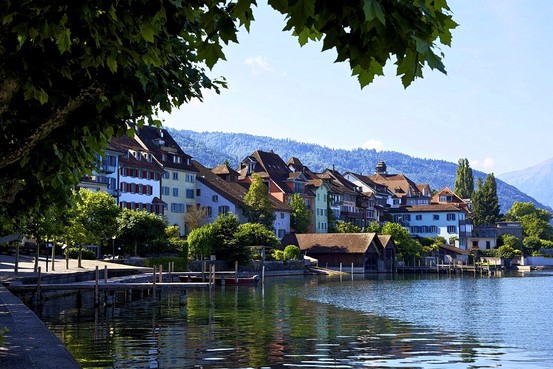
image015Mr. Levine also notes that Jesse Drucker went to Switzerland to visit with 21 financial advisors who remain under US indictment and are at large.  He reports they have adapted well to fugitive life.

P1-BC212_ZUG2_G_20110828171044


Xi Jinping Spreads His Wings

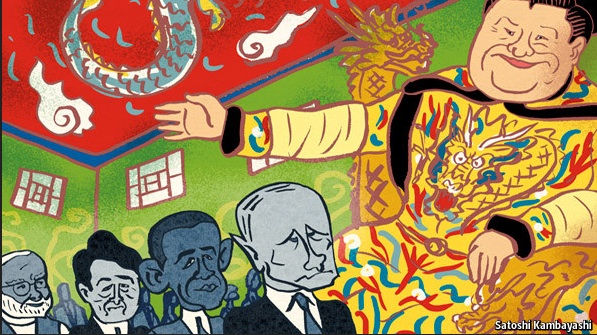
Chinese President Xi Jinping will launch energy and infrastructure projects worth $46 billion on a visit to Pakistan next week as China cements links with its old ally and generates opportunities for firms hit by slack growth at home.

Also being finalised is a long-discussed plan to sell Pakistan eight Chinese submarines. The deal, worth between $4 billion and $5 billion, according to media reports, may be among those signed on the trip.

Commercial and defense ties are drawing together the two countries, which share a remote border and long-standing mistrust of their increasingly powerful neighbor, India, and many Western nations.

“China treats us as a friend, an ally, a partner and above all an equal – not how the Americans and others do,” said Mushahid Hussain Sayed, chairman of the Pakistan parliament’s defense committee.

Pakistan and China often boast of being “iron brothers” and two-way trade grew to $10 billion last year from $4 billion in 2007, Pakistani data shows.

Xi’s trip is expected to focus on a Pakistan-China Economic Corridor, a planned $46-billion network of roads, railways and energy projects linking Pakistan’s deepwater Gwadar port on the Arabian Sea with China’s far-western Xinjiang region.

It would shorten the route for China’s energy imports, bypassing the Straits of Malacca between Malaysia and Indonesia, a bottleneck at risk of blockade in wartime.  If the submarine deal is signed, China may also offer Pakistan concessions on building a refueling and mechanical station in Gwadar, a defense analyst said.

China’s own submarines could use the station to extend their range in the Indian Ocean.  “China is thinking in terms of a maritime silk road now, something to connect the Indian Ocean and Pacific Ocean,” said a Pakistani defense official, who declined to be identified.

For Pakistan, the corridor is a cheap way to develop its violence-plagued and poverty-stricken Baluchistan province, home to Gwadar.

China has promised to invest about $34 billion in energy projects and nearly $12 billion in infrastructure.

Xi is also likely to raise fears that Muslim separatists from Xinjiang are linking up with Pakistani militants, and he could also push for closer efforts for a more stable Afghanistan.  “One of China’s top priorities on this trip will be to discuss Xinjiang,” said a Western diplomat in Beijing. “China is very worried about the security situation there.”

Xi Jinping Spreads his Wings

S&P Gives Greece Close to “D”

Ratings agency S&P has downgraded Greece’s credit rating again, saying it expects its debt and other financial commitments will be “unsustainable”.

It has dropped long and short-term sovereign credit ratings to CCC+/C from B-/B and says its outlook is negative. Markets use sovereign ratings to work out the interest rate at which investors should lend to a country.

The budget deficit – the difference between its revenue and spending – was 3.5% of GDP, compared with the prediction of 0.8%. The worsening finances of the government could see Greece’s creditors pushing for further austerity, experts said.

German Finance Minister Wolfgang Schaeuble warned that an agreement between Athens and its creditors was unlikely to happen any time soon.

The Syriza government is negotiating with the International Monetary Fund (IMF) and its eurozone partners in an attempt to lessen the burden of its debt repayments. A €750m ($800m; £540m) payment is due on 12 May, but the government will struggle to make it.

Athens faces a “choice between paying the IMF or paying the wages and pensions of its employees”, Raoul Ruparel, head of economic research at Open Europe, told the BBC.

“For a radical left-wing government such as Syriza, that is a very poisonous choice.”

The Greek economy has shrunk by 1% in six months, despite the twin benefits of a lower oil price and a weak euro..

Government finances, which appeared to be improving slightly last year, have now been dented by weaker economic activity and rising arrears on taxes.

Since the end of November 2014, Greek banks have lost about 14% of their deposit base to customer withdrawals and deposit outflows have continued.

The conditions have been made worse by the uncertainty over the negotiations between Athens and its main creditors – the IMF, the European Commission and the European Central Bank.

S&P said that economic prospects could deteriorate further unless Greece reached a deal over the next €7.2bn tranche of its bailout loan.

But time is running out.

Greek Report Card

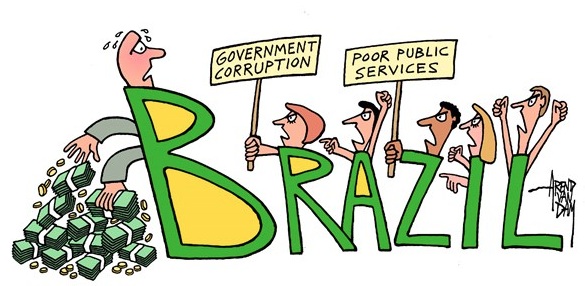
Tentacles of Petrobras Scandal Grab Treasurer

The treasurer of Brazil’s ruling Workers’ Party, Joao Vaccari, has stepped down, after being arrested over corruption at oil giant Petrobras.

Mr Vaccari is  charged with an alleged scheme in which the party received dirty money from inflated deals between oil executives and construction firms.

Party president Rui Falcao said he still had confidence in Mr Vaccari.

He is the closest ally of President Dilma Rousseff to have been arrested in the broadening scandal.

The arrest places further pressure on the president, who has faced street protests, impeachment calls and plummeting opinion ratings since her re-election four months ago.

Ms Rousseff served as the head of Petrobras for much of the period when the corruption took place, but she has not been implicated in the scandal.

More than 40 politicians, including the heads of both houses of congress, are being investigated over the affair.

Prosecutors say Mr Vaccari served as the Workers’ Party’s liaison in a scheme where oil officials colluded with construction firms to artificially inflate billions of dollars worth of contracts.

According to oil officials who are testifying for the prosecution, some of the cash skimmed from the deals was diverted to the party and its allies.  The party remains sure of Mr Vaccari’s innocence, “not only because of his conduct, but because in a democratic state everyone has the fundamental right to be considered innocent until proven guilty”.

When he was first questioned in February Mr Vaccari said in a statement that the Workers’ Party only receives legal contributions and that he would co-operate with investigators.  He said he answered their questions “with transparency”.

Mr Vaccari was charged last month, becoming one of the most powerful political figures to have been named in the scandal.His arrest was reportedly ordered because of concerns that he may influence the investigation or flee the country.Corruption in Brazil

Ruble on the Rebound?

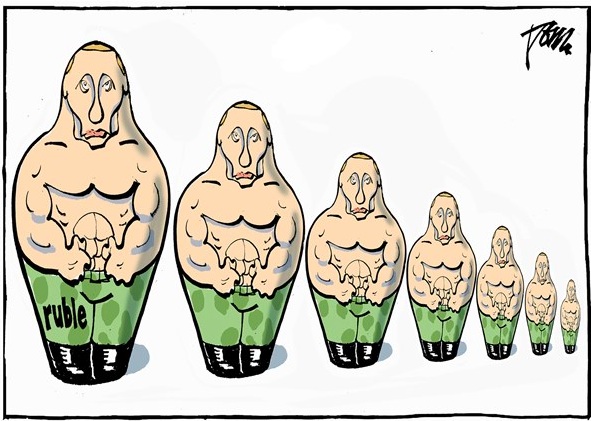
Jamila Trindle writes: The Russian ruble is rebounding, outpacing all other world currencies against the dollar this year. The 20 percent recovery this month alone stands in stark contrast to last year, when U.S. officials smugly pointed to Russia’s plummeting currency as proof that Western sanctions against Moscow for meddling in Ukraine were working.

That doesn’t mean the sanctions no longer have teeth. But it does add another complication to Western leaders’ already difficult task of trying to forge a lasting peace in Ukraine.

Some analysts have ascribed the ruble’s upward march to the tenuous cease-fire agreement reached between Ukraine and Russian-backed separatists in February. Rising oil prices could be giving the ruble a boost, since the Russian government is dependent on money coming in from the country’s state energy giants. And yet another theory is that the ruble is not really strengthening, but just recovering to a reasonable level after plummeting too far last year.

The dramatic turnaround has prompted some investors to scramble to get back in. Bond investors, who had steered clear of Russia, are now returning in droves.

Some cautione against viewing the success of sanctions or Russia’s economy through only its currency.

While the appreciating ruble is welcome news for Russians who want to travel abroad and buy foreign goods, it may not be the sign of brighter days quite yet for the overall economy.

While oil prices have recovered somewhat, they’re still far away from the $100 a barrel that the Russian government budgeted for last year, or even the $70 a barrel Siluanov said they were hoping for this year. Russian oil sells at a slight discount to Brent crude, which traded around $58 a barrell.

European leaders struggle to hold together the fragile consensus on sanctions against Moscow, the ruble surge is giving some parts of the Russian economy a shot in the arm. Companies that borrowed in dollars, for instance, are likely breathing a sigh of relief, as their debts deflated a little bit as the ruble strengthened.

But whether or not it continues, the currency rally is unlikely to be enough to save the Russian economy, or Putin, from another round of sanctions.

Rouble

Meaning of China’s Slowing Growth?

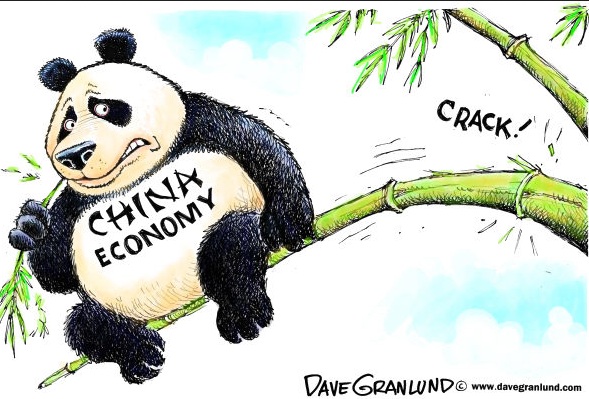
The growth rate in China was lower than the 7.3% posted for the three months to December.  Last year, China’s economy, which is the world’s second largest, grew at its slowest pace since 1990.

It expanded by 7.4% in 2014, missing its annual growth target of 7.5% for the first time in 15 years.  Despite the slowdown, the Chinese economy was still one of the world’s fastest-growing and analysts have said it was proving to be more resilient than expected.

However, they have also said that slower growth, together with the country’s cooling property market – a key economic driver – was likely to mean further easing by China’s central bank this year, including further rate cuts among other measures.

In February the People’s Bank of China unexpectedly cut interest rates for the second time since last November.  Interest rate cuts together with injections of liquidity are some of the tools Beijing uses to fine tune its economic growth.

The latest growth numbers were by no means a hard landing – which some had feared – and were in line with the latest government target, analysts said.  “Still, it represents a slowdown from the previous read of 7.3%,” Nicholas Teo from CMC Markets said.  “And is one of the weakest numbers reported in quite a few years.”

In the first three months of 2009, amid the financial crisis, China’s economy expanded 6.6% from a year earlier.

China also released industrial production (IP) figures on Wednesday which fell to 5.9% month-on-month in March, down from forecasts for an expansion of 6.9% and the lowest since 2008.

Analysts said these figures were more glaring than the growth data. Mr Teo described the latest IP numbers as “unfavourable”.

“Together with the slower trade numbers reported earlier this week, the industrial production number may just set the tone for a quickening pace with regards further easing measures,” he said.

Evan Lucas from IG Markets said the IP numbers highlighted “the real issue facing China” as exports declined “and falls in work done were being felt across the board”.

Markets were lacklustre following the numbers.

China's Economy?

EU’s Competition Commissioner Anti-Trusting Google.

The European Union’s competition commissioner, Margrethe Vestager has filed a complaint against Google that alleged the company violated anti-trust laws. The complaint stated that the company’s promotion of its own shopping links amounted to an abuse of its search dominance. (Google accounts for 90 percent of web searches in the EU.) The company has 10 weeks to respond.

The complaint follows a years-long investigation into Google’s practices. Since 2010, a number of companies, including Microsoft, Tripadvisor, and Streetmap, have leveled anti-trust allegations.

Google rejected the claim that it had acted inappropriately. “While Google may be the most used search engine, people can now find and access information in numerous different ways,” wrote its search chief Amit Singhal. “[A]llegations of harm, for consumers and competitors, have proved to be wide of the mark.”

The legal process could carry on for years and ultimately lead to billions of euros in fines.

Isn’t the point of proviing a useful free service to leverage it into exposure for your other profitable services?

Google?