Monetary Policy and Worldwide Growth

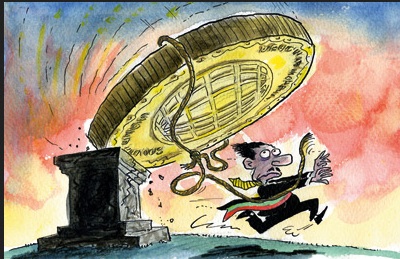
The Dallas Federal Reserve reports:  In 2014, global real gross domestic product (GDP) grew 3 percent year over year, its lowest value since 2009. Growth in emerging markets was sluggish at 4.3 percent, the slowest pace since 2003 (excluding 2009), led by poor growth in Russia and Brazil. Advanced foreign economies also expanded modestly at 1.8 percent. Still, the global economy grew more quickly in fourth quarter 2014 than for the year as a whole at a 3.4 percent annualized rate, reflecting positive growth in the euro area and Japan. Forward-looking indicators such as the Purchasing Managers Index, which tracks the health of the manufacturing sector, ticked up in February for advanced foreign economies, suggesting a possible pickup.

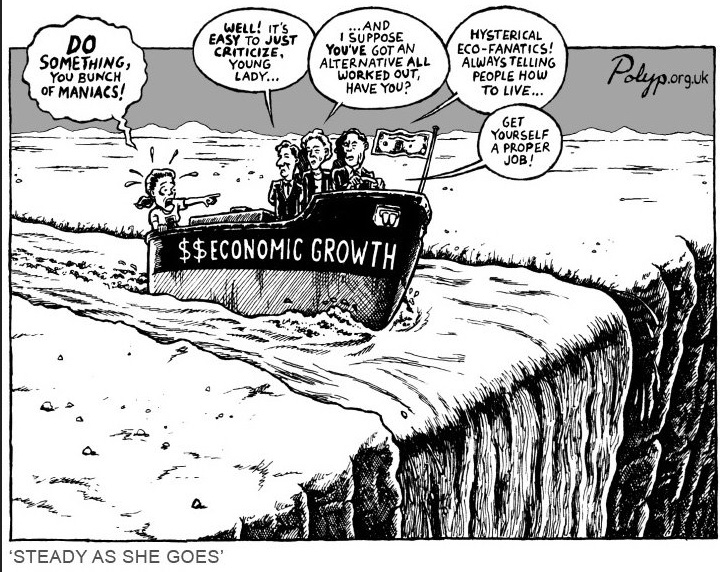
Exceptionally low oil prices have contributed to lower inflation globally. Inflation in advanced foreign economies fell from 2 to 1 percent between June and December 2014. In 2015, accommodative monetary policy and low oil prices may provide a much-needed boost to global growth.  Monetary Policy and Global Growth

Design by POLYP

Design by POLYP

Issues for Hillary Clinton

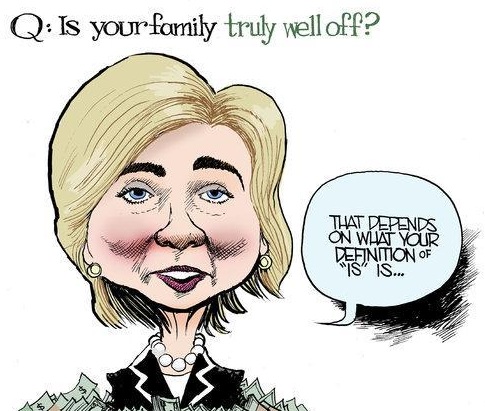
Former Secretary of State Hillary Clinton will announce her run for the presidency tomorrow.   Here are the words we are looking for:

Inequality

End Glass Steagall

Break up of banks

Education reform

Afforable housing for all

Diversion of public funds by corruptioin

Commodities trading

High speed trading

Inclusive foreign policy

Mrs. Clinton AnnouncesAdd to the list on twitter or below.


Turkey’s Erdogan

Stephen Cook writes:  t is eight weeks before Turkey’s general elections, the end of a stretch that has lasted a little more than a year during which Turks will have gone to the polls three times to elect their Mayors, President, and now legislators. The extended electoral season, made difficult by Turkey’s polarization, has not dampened the Istanbul-Ankara elite’s appetite for rank speculation, however. In years past, much of this chatter centered on parties and politicians who were going to save Turkey from whatever crisis of governance had befallen the country. There was the businessman Cem Uzan and his Youth Party in 2002; the dream team of Ismail Cem and Kemal Dervis, who were going to lead the New Turkey Party to victory also in 2002; Kemal Kilicdaroglu, the man to reverse the slide of the Republican People’s Party into the party of Izmir and certain Istanbul neighborhoods; and, of course, Abdullah Gul, the man to wrest control of the ruling Justice and Development Party (AKP) from Recep Tayyip Erdogan. Uzan, however, was convicted of fraud in the United States and now lives in France, the New Turkey Party received a paltry 1.2 percent of the vote, Kilicdaroglu has presided over one defeat after the next, and Gul moved quietly from Ankara’s Cankaya Palace to Istanbul, where he seems to be enjoying retirement. So much for saving Turkey.

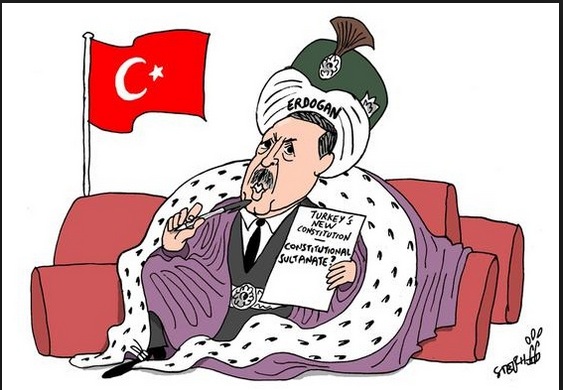
As this year’s vote approaches, speculation has focused not on a would-be charismatic leader riding to the rescue, but rather on the relationship between Prime Minister Ahmet Davutoglu and President Recep Tayyip Erdogan, and what it means for the future of Turkish politics. There seems to be a consensus among Ankara insiders and foreign observers that all is not well between the Prime Minister and the President. The deteriorating relationship between Davutoglu and Erdogan has given life to the idea that there is now a faction within the AKP capable of checking Erdogan and his apparent voracious appetite for power. It seems that the two most powerful figures in Turkish politics barely tolerate each other, but Davutoglu and his emerging faction—if it exists—do not stand a chance. Erdogan is, and will likely remain, the sun around which Turkish politics revolves. Turkey’s Erdogan

Erdogan

Supporting the AIB?

Latin America’s Fit in Global Trade

The Doha Round is at a standstill, the World Trade Organization is increasingly looking weaker, and new initiatives such as the Trans-Atlantic Trade and Investment Partnership (TTIP) and Trans-Pacific Partnership (TPP) appear to be changing the roadmap of global trade negotiations. The two major trading blocks in Latin America—the Pacific Alliance (Chile, Colombia, Mexico and Peru) and Mercosur (Brazil, Argentina, Venezuela, Paraguay and Uruguay)—appear to have different underlying orientations and philosophies towards trade, markets and investment. As a consequence, they are pursuing increasingly separate courses and different strategies towards global trade. What are the implications of this perceived gap as Latin America seeks to position itself in the new dynamics of global trade negotiations?

Latin America

On March 25, the Latin America Initiative at Foreign Policy (LAI) and the Brookings Global-CERES Economic and Social Policy in Latin America Initiative (ESPLA) hosted a discussion on Latin America’s evolving role in the global trade environment. Panelists included Antoni Estevadeordal, manager of Integration and Trade at the Inter-American Development Bank; Joshua Meltzer, fellow in Global Economy and Development at Brookings; and Jeff Schott, senior fellow at the Peterson Institute for International Economics. Brookings Senior Fellow and ESPLA Director Ernesto Talvi provided introductory remarks and Brookings Senior Fellow and LAI Director Harold Trinkunas moderated the discussion.  Global Trade; How Does Latin American Fit In?


Inflation in China Mirrors World

John Loundsbery writes:  The March inflation numbers continue in the same pattern that has continued for over three years now:  CPI (Consumer Price Index) inflation is low but hanging on to a positive level, +1.4% year-over-year and essentially the same as the six-month average 1.35%.  The report was slightly higher than the consensus expectation of 1.3% reported by Reuters.  The PPI (Producer Price Index) which has been in deflation for more than three years, also continues in a downtrend with a March reading of – 4.6%, slightly more positive than the February reading of -4.8 which was also the expectation quoted by

arrow.down.361x190

While both CPI and PPI have been in a similarly sloped down trend for three years, PPI has been negative for the entire time and the three readings in 2015 have all been below –4%.  This bears watching because PPI may be seeing an acceleration of the rate of deflation.  If readings in this new domain below –4.0% continue for a number of months more, there may be a drag lower for CPI.

It is important to note that CPI covers goods and services while PPI is derived from the input prices for manufacturing which is dominated by goods and raw materials.  The service sector of the Chinese economy has been much stronger than manufacturing in the most recent couple of years which explains why PPI has not yet dragged CPI into deflation.  But it will be difficult for CPI to remain at current levels if PPI degrades further and becomes entrenched in the new range below –4%.

Estonia: Europe’s Largest Drug Problem?

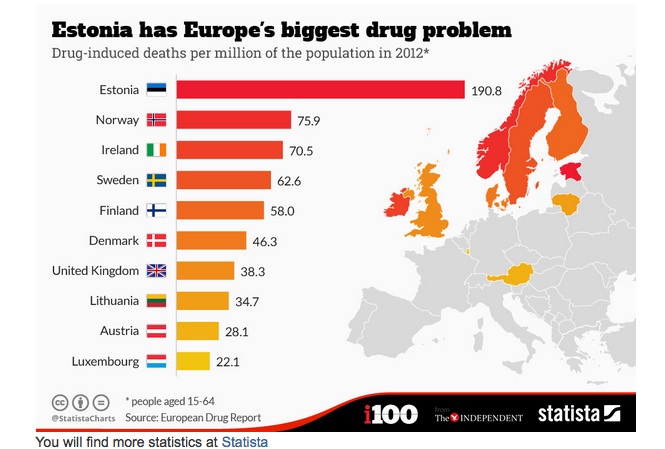
The small baltic state had 190.8 drug-induced deaths per million of the population in 2012, more than double second placed Norway. The reason for Estonia’s high death rate is an overdose boom caused by fentanyl, a synthetic form of heroin produced clandestinely in neighbouring Russia. For more infographics about Europe, read more in Statista’s latest Independent feature.

This chart shows drug-induced deaths per million of the population in 2012.

Estonia- Europe's Biggest Drug Problem

GE Leaves Banking. A Dodd Frank Success Story?

For decades, General Electric was happy to reap the enormous profits that arose from its finance arm as it swelled into one of the country’s biggest lenders.

GE will beign by selling $26.5 billion worth of real estate assets, G.E. is hastening to return to its roots as one of the mightiest industrial companies in the world, whose operations include jet engines, oil drilling equipment and medical devices. What it will mostly shed is GE Capital, a lender with hundreds of billions of dollars’ worth of assets.

The move announced Friday reflects the shifting landscape of the financial world, especially for the largest players. They face greater regulatory scrutiny and calls from analysts and investors to slim their operations or break up. Some are shifting their focus to areas like wealth management as traditional activities like trading prove less profitable. It is no surprise that G.E. decided to re-evaluate its role in this ecosystem.

The divestiture campaign, code-named Hubble within G.E. and put together in about six weeks, will erase one of the main legacies of the conglomerate’s vaunted former chief executive, John F. Welch Jr. But it is also a recognition that manufacturing, not finance, represents the company’s future.

“We’re not sentimentalists,” Jeffrey R. Immelt, the multinational’s current chairman and chief executive, said in an interview.

G.E.’s expansive campaign will bring other changes as well. In shrinking its far-flung empire, the company will also bring back $36 billion in cash that now resides overseas, taking a $6 billion tax hit in the process. And it will also press to relieve itself from the burdens of being considered a too-big-to-fail lender, a status that brings stricter regulatory requirements.

The wide range of asset sales will help finance a huge return of money to shareholders, which G.E. estimates will eventually reach $90 billion. About $50 billion will come from a stock repurchase, one of the biggest on record.

For years, the financial tilt looked smart and relatively easy. In an interview in 2010, Jeffrey  Immelt recalled, if a deal looked like a moneymaker, it got the nod. “And you don’t have to build a factory,” he said.

Yet the big bet on finance badly wounded G.E. after Lehman’s demise, when the market upheaval left the conglomerate hard-pressed to borrow debt for its day-to-day operations.

GE Capital

Consider Jim Webb for President?

Webb says: Is it possible for us to return to a leadership environment where people from both political parties and from all philosophical points of view would feel compelled to work together for the common good, and to sort out their disagreements in a way that moves our country forward rather than tearing the fabric of this nation apart?

As one who spent four years in the Reagan Administration and then served in the Senate as a Democrat, I believe it is possible. It is also necessary. We desperately need to fix our country, and to reinforce the values that have sustained us for more than two centuries, many of which have fallen by the wayside in the nasty debates of the last several years. I hope you will consider joining me in that effort.

Over the past few months thousands of concerned Americans from across the political spectrum have urged me to run for President. A constant theme runs through these requests. Americans want positive, visionary leadership that they can trust. They’re worried about the state of our economy, the fairness of our complicated multicultural society, the manner in which we are addressing foreign policy and national security challenges, and the divisive, paralyzed nature of our government itself. In short, they’re worried about the future. They want solutions, not rhetoric.

In addition, Webb has looked and will look at our broken banking system.

About Webb:  Both sides of Mr. Webb’s family have a strong citizen-soldier military tradition that predates the Revolutionary War. Mr. Webb’s father was a career Air Force officer who flew B-17s and B-29s during World War Two, cargo planes during the Berlin Airlift, and was a pioneer in the United States missile program. Colonel Webb was the first family member to finish high school and graduated from the University of Omaha in 1962 after 26 years of night school.

While in the Senate, Mr. Webb was selected to deliver the response to the President’s State of the Union address in 2007, and served on the Foreign Relations, Armed Services, Veterans Affairs, and the Joint Economic Committees.  He wrote, introduced, and guided to passage the Post-9.11 GI Bill, the most significant veterans legislation since World War II, and co-authored legislation which exposed 60 billion dollars of waste, fraud and abuse in Iraq and Afghanistan wartime-support contracts. A long-time advocate of fixing America’s broken criminal justice system, Mr. Webb was spotlighted in The Atlantic Magazine as one of the world’s “Brave Thinkers” for tackling prison reform and possessing “two things vanishingly rare in Congress: a conscience and a spine.”

Mr. Webb was a leading voice in calling for the United States to re-engage in East Asia, meeting frequently with key national leaders throughout the region.  In 2009, he led an historic visit to Burma, becoming the first American leader to visit that country in ten years, and opening up the dialogue that resulted in the re-establishment of relations between our two countries.

Mr. Webb graduated from the Naval Academy in 1968, receiving a special commendation for his leadership contributions.  First in his class of 243 at the Marine Corps Officer’s Basic School, he served as a rifle platoon and company commander in Vietnam and was awarded the Navy Cross, the Silver Star Medal, two Bronze Star Medals, and two Purple Hearts.  He graduated from the Georgetown University Law Center in 1975.

Mr. Webb served in Congress as counsel to the House Committee on Veterans Affairs from 1977 to 1981.  In 1982 he led the fight to include an African American soldier in the Vietnam Veterans memorial on the National Mall.  In 1984 he was appointed Assistant Secretary of Defense for Reserve Affairs, and in 1987 became Secretary of the Navy.

He was a Fall 1992 Fellow at Harvard’s Institute of Politics.

In addition to his public service, Mr. Webb has enjoyed a varied career as a writer.  He taught literature at the Naval Academy.  Traveling widely as a journalist, he received an Emmy Award for his PBS coverage of the U.S. Marines in Beirut in 1983, and in 2004 was embedded with the U.S. military in Afghanistan.  A screenwriter and producer, his original story “Rules of Engagement” held the top slot in U.S. box offices for two weeks in April 2000. Mr. Webb has written ten books, including “Born Fighting,” a sweeping history of the Scots – Irish culture, and “Fields of Fire,” widely recognized as the classic novel of the Vietnam War.

Jim Webb

Women Entrepreneurs: Can-Do Dubai Culture

Dubai is a can-do environment for entrepreneurs.

Handbags:  Luxe bag designer Zufi Alexander has found a fan base among such fashionable red carpet walkers as Cate Blanchett, Sienna Miller, Alicia Keys and Beyoncé.

After a university education that combined the US with the ivory towers of Oxford, she cut her business teeth at one of London’s most established auction houses. “I love art and vintage jewellery and have always been good at drawing,” she says. “A role at Christie’s fitted the bill perfectly.”

It soon became clear that the surroundings – and perhaps the sale of the odd vintage Chanel clutch – were inspiring her own artistic aspirations as a handbag designer.

Zufi Alexander’s eponymous label now sells more than 10,000 bags a year to women across the world. Married to an Englishman and living between London and Dubai, she personifies the international woman she designs for.

“Dubai is a land of opportunity and that opportunity is not tied to a particular bracket or class of people,” she says. “At the same time, I love it because I get to experience all different types of people and culture.”

That vow has been superseded by her love of what she has achieved: “It’s all worthwhile when I see a confident woman walking down the street clutching one of my bags.”

Luxury Leather goods:  Nicole Silvertand, founder of luxury leather marque Complete, grew up every inch the sophisticated lady. Nurturing an appreciation of elegant, quality product, her craftsman father spoilt her generously with one-off handbags and shoes he made especially for her.

Inspired by the vibrant business culture of Dubai, Silvertand took the plunge in 2002 and set about launching her own leather business. Complete’s range of leather goods are made bespoke for key movers and shakers of the region including Armani Dubai, Al Maha Desert Resort & Spa and Burj Al Arab.

Silvertand offers clients a range of 12 leather colours from black and brown to vibrant turquoise, orange and silver. All of the items are made to order so everything can be uniquely branded and personalised.

“Because of spending so much time in my father’s atelier while I was growing up, with education, age and experience I became aware of the vast opportunities for a company providing commercial organisations, government departments and five-star hotels with beautifully designed leather goods,” says Silvertand. “The word ‘Complete’ perfectly summarises that sense of entirety; of being able to satisfy all clients’ needs.

Dubai Entrepreneurs