Does the US Fed Determine the Price of Gold?

GoldGold analysts are bearish for a second week as prices head for the biggest monthly drop since June and approach this year’s low on speculation the Federal Reserve will curb stimulus as the economy strengthens.  Eighteen analysts surveyed by Bloomberg News expect prices to fall next week, nine are bullish and three neutral. The metal slipped 6 percent this month and is within 5.4 percent of the 34-month low of $1,180.50 an ounce set in June. Gold is poised for its first annual drop since 2000.   The Price of Gold

Interest Women in Financial Management

Now in its fourth year, Cornell University’s Johnson Graduate School of Management Women in Investing (WIN) conference is one of the first efforts by a business school to address the lack of women in financial management and provide a forum for MBA students to learn and network.

Sixty women from 12 top business schools, including Johnson, London Business School, Columbia Business School, and University of Chicago’s Booth School of Business spent two days in Boston discussing what it takes to have a successful career and getting advice on picking stocks, generating investment ideas, and investing in emerging markets.

This year’s conference comes on the heels of Harvard Business School’s efforts at a “gender makeover,” and the national discussion about sexism raised by Sheryl Sandberg, the chief operating officer of Facebook (FB) and HBS grad class of ’95, in her book, Lean In: Women, Work, and the Will to Lead. The finance sector is woefully behind in gender equality: Women represent only 16 percent of executive and board positions in financial services and less than 10 percent in fun.
Interest Women in Financial Management

Interest Women in Financial Management

Luxembourg, Cyprus, Switzerland Fail Tax Transparency Test

Switzerland has been listed alongside well-known tax havens in a new ranking by the Organisation for Economic Co-operation and Development (OECD), showing the country still has work to do on banking secrecy despite recent steps aimed at tackling the issue.

OECD’s Global Forum on Transparency and Exchange of Information for Tax Purposes released ratings for 50 jurisdictions at a meeting in the Indonesian capital.

The forum has rated jurisdictions on how well they comply with rules on tax transparency.

Switzerland, however, failed even to make it past the first stage of a two-stage assessment.

Other countries which also did not make it to the second stage included Panama, the Marshall Islands and Trinidad and Tobago, although OECD’s final judgement on them was harsher than on Switzerland.

It came after Switzerland took steps last month to tackle its long-criticised banking secrecy, including signing an international tax evasion agreement brokered by the OECD and introducing new legislation to increase cooperation on money-laundering.

Swiss authorities have come under pressure from the international community to clamp down on the concealment of illicit funds and on tax evasion, in the wake of the global financial crisis of 2008 and the subsequent euro zone debt crisis.

Despite Switzerland’s failure to complete the process, OECD’s head of tax issues, Pascal Saint-Amans, struck an upbeat note, telling it was now “moving ahead”.

He, however, said the OECD would continue to monitor the country closely to ensure its recent steps “are actually enacted and become law, which is not yet the case”.

Of the jurisdictions that completed the two-stage assessment, 18 were deemed to be “compliant” with the tax transparency rules set out by the forum; many others were considered “largely compliant”; while Austria and Turkey were “partially compliant”.

Four were deemed to be “non-compliant”: Cyprus, Luxembourg, the Seychelles and the British Virgin Islands.
OECD_GF_Ratings_22.11.13
OECD_GF_Background

Luxembourg, Cyprus, Switzerland Fail Tax Transparency TestMore Corruption Reports

Bitcoins on Amazon, Gold in the Marketplace, Is Currency Out?

You may be able to use bitcoins on Amazon and Ebay.  Will gold be next?

An Indian man in Bangkok’s Chinatown bought two god bracelets on Yaowarat Road in Bangkok for $15,000.  In his native Mumbai they are worth $16,500. They can travel in a computer bag or “if you are really worried about customs”, he says pointing at a shop which sells plain golden necklaces, “you buy those and put them around your wife’s neck.”  Earlier this year the Indian government imposed quotas and increased taxes on gold imports, but it takes more than that to limit Indians’ love of gold. Although the country’s statisticians report that Indians officially buy a lot less of the precious metal—148.2 tonnes from July to September, a third less than in the same period last year—there has been a surge in gold smuggling.  Bitcoins and Gold as a Currency or Commodity Exchange

Gold Glitters

Do Men Or Women Make Better Money Managers?

Discussions about whether women run money differently from men easily slip into cliché. Women do not like risk. Hedge funds are macho.

Maybe, maybe not. What the evidence shows is that women are hopelessly under-represented at the sharp end of fund management. UK retail funds managed by women at just 5 per cent – but they often get better results than men.
Do men or women make better money managers
Do Men Or Women Make Better Money Managers


We Need More Emirati Women In Financial Services

The private sector needs to follow the UAE government’s example and push for female board members.

Statistics show the Gulf lags behind much of the developed world in workplace gender diversity. This is clearest at the top, just 1.5 per cent of board seats in the UAE are held by women. This drops to 1.2 per cent for companies listed on the Dubai Financial Market and 0.8 per cent for those listed on the Abu Dhabi Securities Exchange.

In workforce terms, the difference between the public and private sectors is marked; women make up 66 per cent of the former but only five per cent of the latter. Getting more women into both the private sector and leadership positions is key to addressing inequality, but will also help meet the Government’s Emiratisation targets.

Finally, it may be good financial news for companies – research suggests companies with more women at management level do better.
We Need More Emirati Women In Financial Services

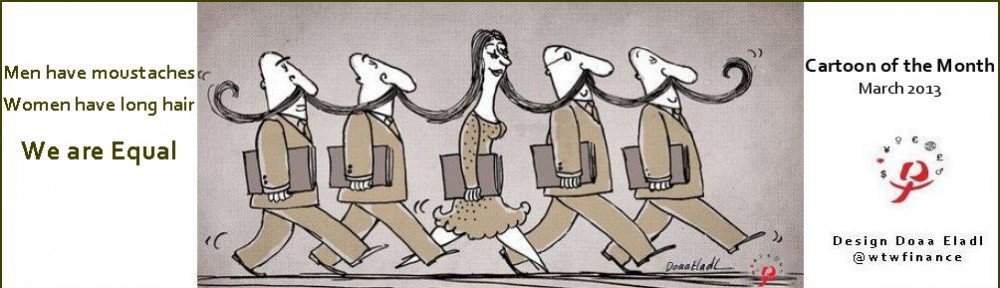
W-T-W Finance Women Integrity Awards:
Doaa Eladl
We are Equal


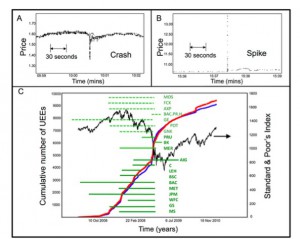
Algorithms Spike the Market

If you’ve noticed that the number of extreme events spikes around the time of the financial crisis, and the stocks most likely to experience them are bank stocks, you’ll see why the researchers are so interested in this hidden market: This pattern suggests the coupling between extreme market behaviors and global instability—”how machine and human worlds can become entwined across timescales from milliseconds to months”—and is also are seen more often before and after the kinds of “flash crashes” that people actually notice.  Regulators, though, aren’t keeping track of these events. That’s a problem, not just because of any potential forewarning, but also because trading at that speed creates volatility that makes markets less efficient.  How High Speed Trading Impacts the Market

List of stock symbols in green contains the equities that have the most extreme events, with the most likely at the bottom


Surprising Economic Trends in the US and the World

The number-one way that the finance industry makes its money is by collecting fees from people in order to manage their money. Pension funds, mutual funds, hedge funds, endowment funds…it seems like every dollar you save gets a hefty cut as it passes through the hands of middleman after middleman. And they can’t all beat the market, can they? But America’s love affair with money managers may be going lukewarm, as more and more investors move their wealth into passive management. Passive management means piggybacking on the wisdom of the market instead of paying one pro big bucks to try to out-guess the other pros. Exchange Traded Funds, offered by companies such as BlackRock and Vanguard, are one of the main passive investment vehicles that have emerged in recent years. Meanwhile, some big pension funds are turning to passive management. This could be the dawn of a new, laid-back financial age. And many other provocative thoughts.  Economic Trends That Surprise

 Passive Management