Why Are Financial Executives Not Prosecuted for Subprime Mortgage Crimes?

At a meeting of New York City securities lawyers this week, Jed Rakoff did what he does best: challenge Establishment Thinking. “While the economy has slowly improved, there are still millions of Americans leading lives of quiet desperation — without jobs, without resources, without hope.” Then he asked: Who is to blame?

Rakoff is the iconoclastic U.S. District Court judge who’s been at the heart of some of the most significant trials stemming from the financial crisis. And what he really wanted to know is why more there haven’t been more criminal prosecutions of top financial executives (the very ones who, not coincidentally, made many of the people in his audience quite wealthy). To Rakoff the answer, clearly, is gun-shy federal prosecutors.  Why Are Financial Executives Not Prosecuted for Subprime Mortgage Fraud
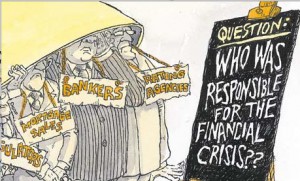
Who Is Responsible?

Quantitative Easing Assessed from the Inside

Andrew Huszar:  “I can only say: I’m sorry, America. As a former Federal Reserve official, I was responsible for executing the centerpiece program of the Fed’s first plunge into the bond-buying experiment known as quantitative easing. The central bank continues to spin QE as a tool for helping Main Street. But I’ve come to recognize the program for what it really is: the greatest backdoor Wall Street bailout of all time.”     Stepping up to the plate with Elizabeth Warren and Stanford economist, Anat Admati.  Andrew Huszar Quantitative Easer

Quantitative Easing

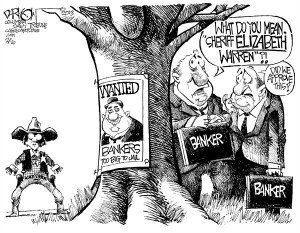
Elizabeth Warren Cautions Against Giving the Banks a Free Pass

Warren’s speech was an indictment not only of the financial institutions that “have fought to delay and hamstring the implementation of financial reform,” after “exploiting consumers, larding their books with excessive risk, and making bad bets,” but also of the regulators and lawmakers—many from her own party—who are refusing to hold the financial sector to account.

Stanford economist Anat Admati in a new book argues with Warren that banks should fund their investments by selling a lot more stock and borrowing a lot less, especially in the form of run-prone short-term debt, as most other companies do.   Elizabeth Warren on Banks Free Pass

Warren


Japan’s Debt and Abe-Economics

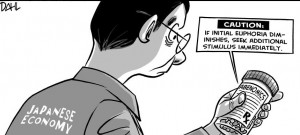
Prime Minister Abe appears to be increasing Japanese competitiveness and its total share of global demand, but not by increasing Japanese productivity, which is the high road to growth, but rather by reducing the real Japanese household income share of what is produced. Japan (like Germany and China have done over the past decade) is attempting to increase employment by reducing wages, and this means that its workers will be able to purchase a declining share of what they produce. This effectively means Japan will be growing at the expense of its trading partners. As the Japanese become less able to consume all they produce, the excess must be exported abroad.  Will Debt Derail Abe’s Economics?

Abenomics

Adaptation: Blackberry, Apple, Google, Twitter and You

A tech giant rises as another falls reported on the Financial Times. It juxtaposed Twitter’s initial public offering (IPO), which is set to raise more from the market than Google did in 2004, with the chaotic events at BlackBerry, which dropped a plan to sell itself got 4.7bn, jettisoned its chief executive and said it would raise 1bn in cheap debt.

Is that how it goes? Is the technology business a sort of one-in, one-out game? It’s certainly hard to find a company with more enthusiastic investors ahead of the bell than Twitter – though let’s see how things go once the shares are traded – nor one that has been more heftily dumped than BlackBerry, which in June 2008 boasted shares topping $144. Now they languish at $6.50.  Lessons from Blackberry

Adaptation

SEC Severely Penalizes Auditor

secSEC Biography:  Chair Mary Jo White

U.S. regulators on Thursday barred a New York firm and four of its employees from auditing public companies, saying they failed to audit properly three Chinese companies traded in the U.S.

The sanctions against Sherb & Co. and the four employees represent the Securities and Exchange Commission’s latest action against so-called gatekeepers: auditors, advisers, financiers and other professionals who work with Chinese companies and have helped them gain access to U.S. markets.
SEC_Sherp_PressRelease_7.11.13
SEC_Sherp_Admin_CAD_Order_7.11.13

SEC Chair Mary Jo White