Egyptian President Morsi Out of Touch

The fiery crash of a sightseeing balloon that killed 19 tourists has cast a further pall over this city of ancient temples and tombs, already perhaps the hardest hit by Egypt’s two-year drop in tourism, which has left hotels here empty and residents desperate for income.

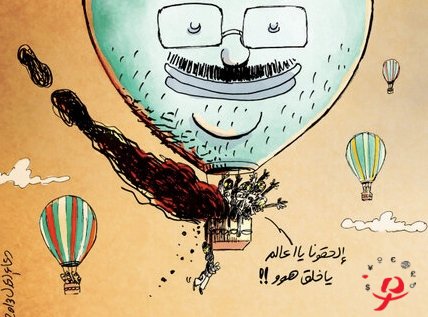
Some connected to the tourist trade in Luxor, a city utterly dependent on foreign visitors to survive, were seething with anger Wednesday at the country’s Islamist president for his silence over the crash.

Mohammed Morsi has yet to publicly speak about the balloon crash in which 19 tourists were killed. Some here took that not just as insensitivity to the victims’ families but as indifference to the vital tourism trade. Article

Cartoon courtesy Doaa EladlBallon accident


How Much Do Politicians Know About Finance?

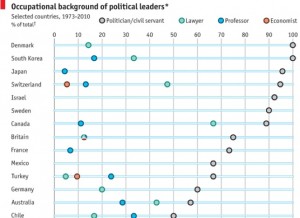
A POLITICIAN, a businessman, a comedian and an economist walk into a room. Unfortunately, this is not a joke—they all vie for the position of Italy’s next prime minister. At an election this week the politician received the most votes, but not enough to govern. A deadlock now ensues. The career background of Italy’s previous prime ministers is similarly eclectic. Between 1973 and 2010, the two main jobs held by prime ministers before they came to power were split roughly equally between lawyer, professor, and politician or civil servant. Economists featured only three times out of 23. And elsewhere, prime ministers with an economics background are also rare.  Article

chart


Statistics Can Find Financial Criminals

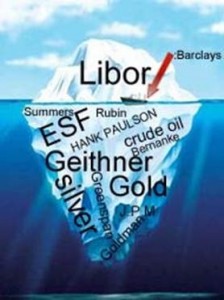
FInance guru Rosa M. Abrantes-Metz shows how statistical technqiues quickly point to financial irregularities.  Libor is a case in point. In early 2008, the Wall Street Journal published a studyshowing that the borrowing-cost estimates banks submitted for the calculation of the benchmark interest rate were bunched much too close together and bore little relation to the banks’ riskiness as reflected in the market for default insurance. Together with co-authors Albert Metz, Michael Kraten and Gim Seow, Abrantes-Metz extended the analysis to show that nonrandom patterns in the banks’ reported borrowing costs started years earlier than the period examined by the Journal and also likely involved coordinated behavior among banks. The studies pointed to the widespread misbehavior that, four years later, is proving to be one of the biggest and most costly financial scandals in history.  Articlelibor

UNODC United Nations Office on Drugs and Crime

Islamic Republic of Afghanistan High Office of Oversight and Anti-Corruption

CORRUPTION IN AFGHANISTAN: December 2012 Recent patterns and trends.

While corruption is seen by most Afghans as one of the most urgent challenges facing their country, it seems to be increasingly embedded in social practices, with patronage and bribery being an acceptable part of day-to-day life. For example, 68 per cent of citizens interviewed in 2012 considered it acceptable for a civil servant to top up a low salary by accepting small bribes from service users (compared to 42 per cent in 2009). Similarly, 67 per cent of citizens considered it sometimes acceptable for a civil servant to be recruited on the basis of family ties and friendship networks (up from 42 per cent in 2009).

The survey was based on a representative sample of 6,700 Afghan citizens aged 18 and above interviewed across Afghanistan. Of the respondents, 42 per cent were women. Corruption report Afghanistan UNODC United Nations Office on Drugs and Crime


Is Austerity the Problem?

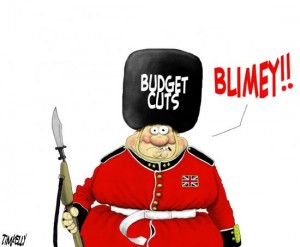
British Chancellor of the Exchequer Osborne’s latest embarrassment is his own fault. He often justifies his austerity-first fiscal policy by saying that, without it, the country’s triple-A rating would be in jeopardy. He attacked the previous government and even called for an election when public debt was put on negative credit watch in 2009. Judged by his own criterion, he has flopped.  Article

Belt Tightening

Anti-Corruption Working Group Meeting opens in Moscow

Anti-Corruption Working Group Meeting opens in Moscow

Opening the Anti-Corruption Working Group Meeting (ACWG) Dmitry Feoktistov, the Co-Chair of the meeting and Deputy Director of the Department on New Challenges and Threats of the Russian Ministry of Foreign Affairs, noted that in accordance with the working group principles the agenda is focused on the consistent discussion of the G20 Anti-Corruption Action Plan for 2013-2014. Within the course of the first ACWG meeting the discussion will be organized around four core topics: combating foreign and domestic bribery, international cooperation, cooperation with the private sector and civil society and enhancing transparency and accountability. Moreover, this year Russia has introduced several new proposals for the ACWG agenda. One of the suggestions deals with exploring the positive impact of robust anti-corruption policies on growth. G20 AC news

Background information

The G20 Anti-Corruption Working Group (ACWG) was established in June 2010, at the Toronto Summit. Its primary goal was to prepare “comprehensive recommendations for consideration by Leaders of how the G20 could continue to make practical and valuable contributions to international efforts to combat corruption.

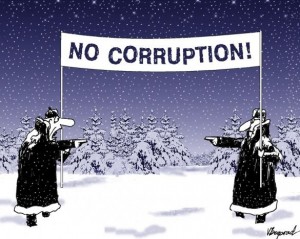
Laws are one thing, enforcement quite another. Public pressure may not create political will among decision-makers. Anti-corruption laws can be politicised and used for partisan purposes.No corruption 1