China Sneezes and the World Catches Cold?

Andrew Sheng and Xiao Geng write: The Chinese economy has caught a surprisingly severe cold this winter – a cold so bad that almost all global markets are sneezing. During the first two weeks of 2016, the Shanghai Composite Index fell 18%. On January 15, the index closed at 2,901 – very close to the trough of last summer’s stock-market crash. Foreign analysts almost uniformly predict another market crash or even a hard landing. With oil prices dipping below $28 per barrel, the specter of a global economic pandemic has appeared.

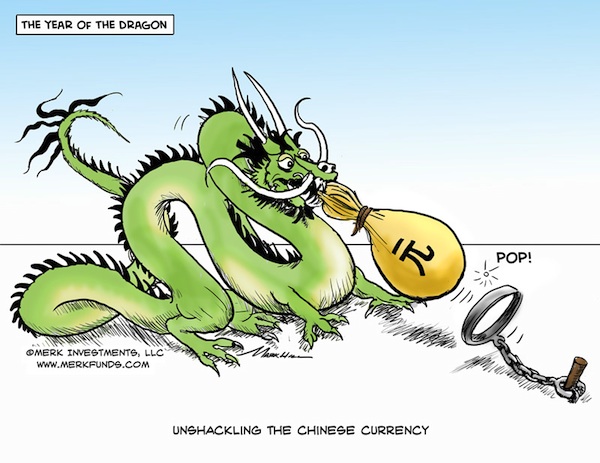
China’s New Year financial-market shock has been attributed to several causes, primarily related to policy transparency and clarity. One was the reversal of China’s attempt to install a stock-market “circuit breaker,” which, far from tempering volatility, spurred a new wave of selloffs. The other – arguably more serious – problem was market confusion about the direction of the renminbi exchange rate, following a gradual but constant ten-day depreciation against the US dollar that fueled capital outflows, until the People’s Bank of China (PBOC) intervened.

According to the PBOC, the confusion arose from a technical change in the process of setting the renminbi exchange rate, with the common reference rate against the US dollar replaced by a rate established on the basis of an undisclosed basket of key international currencies. This reform may be intended to boost the renminbi’s stability; but it is not good for markets, which prefer stability against the dollar to the uncertainty of a managed float.

This is not the first time markets have felt blindsided by well-meaning reforms. Unclear policy communication was compounded by global developments. The US Federal Reserve’s decision in December to raise the federal funds rate, together with the uncertainty generated by collapsing oil prices, has also spurred investors to reduce their China exposure and switch to dollars.

China’s government has reiterated its commitment to implementing tough market-oriented reforms, including measures to address environmental pollution, overcapacity, excessive debt, high taxes, bureaucratic red tape, and monopoly privileges for state-owned enterprises (SOEs).

All modern economies struggle with the inconsistency between sharp and volatile short-term price movements in financial markets and more gradual long-term structural adjustments in the real economy. Unlike in the past, when Chinese policymakers were able to concentrate on the real economy without worrying about excessive financial-market instability, they now must manage short-term volatility caused by liberalized interest and exchange rates, together with larger and faster capital flows both within and across borders.

Only with market-savvy central- and local-government officials and SOE managers can China implement short-term stabilization measures or long-term structural reforms. The problem  is that such talent is not widely available in the country.

The key to attracting market-oriented talent to China’s large bureaucracy is to make it clear that risk-taking – and even failure – will be tolerated. Only if skilled officials feel comfortable making real-time decisions under uncertain conditions can the state keep pace with markets, responding effectively to new developments and thus maintaining high levels of confidence.

China is in a strong position to handle the challenges that it faces. Growth, while slower than in the last three decades, remains relatively strong, as does China’s foreign-asset position and its central-government and household-sector balance sheets. Stable markets need stable policy transitions. By installing officials with strong policy credibility and the ability to handle market volatility deftly, China can complete its transition to a more market-oriented, innovation-driven economy – one that also supports stronger global growth.

China Sneezes?

Are Interest Rates More Important than Inequality?

Antonio Foglia writes:  Everyone seems to be talking about – and condemning – today’s rising level of economic inequality. Fueled by jarring statistics like Oxfam’s recent revelation that the world’s richest 62 people own as much wealth as the poorest 3.6 billion, popular support for left-wing figures like America’s Bernie Sanders and Britain’s Jeremy Corbyn is rising.

Many of those engaged in the debate on inequality nowadays cite the French economist Thomas Piketty’s 2014 book Capital in the Twenty-First Century, which makes three key points. First, over the last 30 years, the ratio of wealth to income has steadily increased. Second, if the total return on wealth is higher than the growth in incomes, wealth is necessarily becoming increasingly concentrated. Third, this rising inequality must be reversed through confiscatory taxation before it destroys society.

The points might seem convincing at first glance.

From 1980 on, nominal interest rates fell dramatically. Not surprisingly, the value of wealth rose much faster than that of income during this period, because the value of the assets that comprise wealth amounts essentially to the net present value of their expected future cash flows, discounted at the current interest rate.

The most straightforward example is a government bond. But the value of a house is determined in a similar manner: according to the rent it is expected to generate, capitalized at the current nominal interest rate. Equities, too, are valued at a higher multiple of earnings when interest rates fall.

In determining the value of total wealth, Piketty included both the income generated by assets and their appreciation. Meanwhile, incomes were capitalized at declining interest rates for more than a generation.

What impact do lower interest rates have on measured inequality? If I own one house and my neighbor owns two, and falling interest rates cause the value of those houses to double, the monetary inequality between us also doubles, affecting a variety of statistical indicators and triggering much well-intended concern. But the reality is that I still own one house and my neighbor still owns two. Even the relative affordability of houses doesn’t change much, because lower interest rates make larger mortgages possible.

The real-world impact of this dynamic on inequality is precisely the opposite of what Piketty would expect. Indeed, not only are Italians, on average, much richer than Germans; Italy’s overall wealth distribution is much more balanced.

A 2013 study of household finances in the eurozone, conducted by the European Central Bank, showed that in 2010 – the last year in Piketty’s research – the average Italian household was 41% richer than the average German household. Moreover, whereas the difference between mean and median household wealth is 59% in Italy, it is a whopping 282% in Germany.

This difference can be explained largely by the fact that 59% of households in Italy own homes, compared to only 26% in Germany. A larger share of Italians has thus benefited more from a larger drop in interest rates.

Then there are the numerous factors affecting incomes, such as demand for particular skills. For those whose skills are not in demand, the availability of skills upgrading or training opportunities will have a significant impact on income prospects.

Clearly, economic inequality is a highly complex phenomenon, affected by a wide variety of factors – many of which we do not fully understand, much less control.

Perhaps a new approach is not necessary at all. After all, globally, standards of living are continuously improving and converging. That is something that everyone, from the emerging populists to the hardened capitalists, should be able to agree on.

Interest Rates?

Impact of Devalued Renminbi

Kenneth Rogoff writes:  Since 2016 began, the prospect of a major devaluation of China’s renminbi has been hanging over global markets like the Sword of Damocles. No other source of policy uncertainty has been as destabilizing. Few observers doubt that China will have to let the renminbi exchange rate float freely sometime over the next decade. The question is how much drama will take place in the interim, as political and economic imperatives collide.

It might seem odd that a country running a $600 billion trade surplus in 2015 should be worried about currency weakness. But a combination of factors, including slowing economic growth and a gradual relaxation of restrictions on investing abroad, has unleashed a torrent of capital outflows.

Private citizens are now allowed to take up to $50,000 per year out of the country. If just one of every 20 Chinese citizens exercised this option, China’s foreign-exchange reserves would be wiped out. At the same time, China’s cash-rich companies have been employing all sorts of devices to get money out. A perfectly legal approach is to lend in renminbi and be repaid in foreign currency.

A not-so-legal approach is to issue false or inflated trade invoices – essentially a form of money laundering. For example, a Chinese exporter might report a lower sale price to an American importer than it actually receives, with the difference secretly deposited in dollars into a US bank account (which might in turn be used to purchase a Picasso).

Now that Chinese firms have bought up so many US and European companies, money laundering can even be done in-house. The Chinese hardly invented this idea. After World War II, when a ruined Europe was smothered in foreign-exchange controls, illegal capital flows out of the continent often averaged 10% of the value of trade or more. As one of the world’s largest trading countries, it is virtually impossible for China to keep a tight lid on capital outflows when the incentives to leave become large enough.

Indeed, despite the giant trade surplus, the People’s Bank of China has been forced to intervene heavily to prop up the exchange rate – so much so that foreign-currency reserves actually fell by $500 billion in 2015. With such leaky capital controls, China’s war chest of $3 trillion won’t be enough to hold down the fort indefinitely. In fact, the more people worry that the exchange rate is going down, the more they want to get their money out of the country immediately. That fear, in turn, has been an important factor driving down the Chinese stock market.

There is a lot of market speculation that the Chinese will undertake a sizable one-time devaluation, say 10%, to weaken the renminbi enough to ease downward pressure on the exchange rate. But, aside from providing fodder for the likes of Donald Trump, who believes that China is an unfair trader, this would be a very dangerous choice of strategy for a government that financial markets do not really trust. The main risk is that a big devaluation would be interpreted as indicating that China’s economic slowdown is far more severe than people think, in which case money would continue to flee.

There is no easy way to improve communication with markets until China learns how to produce credible economic data. It was a huge news story when China’s 2015 GDP growth was reported at 6.9%, just short of the official target of 7%. This difference ought to be irrelevant, but markets have treated it with the utmost importance, because investors believe that things must be really bad if the government can’t rig the numbers enough to hit its target.

A good place for the authorities to start would be to establish a commission of economists to produce a more realistic and believable set of historical GNP figures, paving the way for more believable GNP figures going forward. Instead, the government’s immediate idea for relieving exchange-rate pressure is to peg the renminbi to a basket of 13 currencies, instead of just to the US dollar. This is a good idea in theory; in practice, however, basket pegs tend to have chronic transparency problems.

Moreover, a basket peg shares most of the problems of a simple dollar peg. True, the euro and yen have fallen against the dollar over the past couple of years. If the dollar retreats in 2016, however, the basket peg implies a stronger renminbi-dollar rate, which might be unhelpful. The government has also indicated that it intends to clamp down more heavily on illegal capital flows; but it will not be easy to put that genie back in the bottle.

Life would be a lot easier today if China had moved to a much greater degree of exchange-rate flexibility back when the going was good, as some of us had advised for more than a decade. Maybe the authorities will be able to hold on in 2016; but it is more likely that the renminbi will continue its rocky ride – taking global markets along with it.

Renminbi


China, Oil and Global Recession?

Anatole Kaletsky writes:  January is usually expected to be a good month for stock markets, with new money gushing into investment funds, while tax-related selling abates at the end of the year. Although the data on investment returns in the United States actually show that January profits have historically been on only slightly better than the monthly norm, the widespread belief in a bullish “January effect” has made the weakness of stock markets around the world this year all the more shocking.

But the pessimists have a point, even if they sometimes overstate the January magic. According to statisticians at Reuters, this year started with Wall Street’s biggest first-week fall in over a century, and the 8% monthly decline in the MSCI world index made January’s performance worse than 96% of the months on record. So, just how worried about the world economy should we be?

Three fears now seem to be influencing market psychology: China, oil and the fear of a US or global recession.

China is surely a big enough problem to throw the world economy and equity markets off the rails for the rest of this decade. We saw this in the first four days of the year, when the sudden fall in the Chinese stock market triggered January’s global financial mayhem. But the Chinese stock market is of little consequence for the rest of the world. The real fear is that the Chinese authorities will either act aggressively to devalue the renminbi or, more likely, lose control of it through accidental mismanagement, resulting in devastating capital flight.

Such a scenario seemed quite plausible for a few weeks last summer, and it reemerged as a threat in the first two weeks of this year. By the end of January, however, market sentiment had moved back in favor of stability in China. This calm could be disrupted again if China’s foreign-exchange reserves show another huge monthly loss, and the authorities’ efforts to manage an orderly economic slowdown will remain the biggest source of legitimate concern for financial markets for many years ahead. But, judging by market behavior in the second half of January, the fear about China has subsided, at least for now.

That cannot be said about the market’s second great worry: collapsing oil prices. From the moment investors stopped panicking about China, in the second week of January, stock markets around the world started falling (and occasionally rebounding) in lockstep with the price of oil. Unlike the reasonable concern about China, market sentiment seems simply to have gotten the relationship between oil and the world economy wrong. In anything but the very short term, the correlation between oil prices and stock markets should be negative, not positive – and will almost certainly turn out that way in the years ahead.

When oil prices plunge by 10% daily, this is obviously disruptive in the short term: credit spreads in resources and related sectors explode, and leveraged investors are forced into asset fire sales to meet margin calls. Fortunately, market panic now seems to be subsiding, as oil prices reach the lower part of the $25-50 trading range that always seemed appropriate in today’s political and economic conditions. Now that oil prices are stabilizing at a reasonable long-term level, the world economy and non-commodity businesses should benefit. Low oil prices increase real incomes, stimulate spending on non-resource goods and services, and boost profits for energy-using businesses.

Yet, despite these obvious benefits, most investors now seem to believe that falling oil prices point to a collapse in economic activity, which brings us to the third fear haunting financial markets this winter: a recession in the global economy or the US.

Past experience suggests that oil prices are not a useful leading indicator of economic activity. In fact, if oil-price movements have any relevance at all in economic forecasting, it is as a contrary indicator. Every global recession since 1970 has been preceded by a big increase in oil prices, while almost every decline greater than 30% has been followed by accelerating growth and higher equity prices. The widespread view that plunging oil prices augur recession is a clear case of the belief that this time is different – a belief that typically takes hold in financial markets at the peaks and troughs of boom-bust cycles.

Finally, what about the falling stock market itself as an indicator of recession risks? One could quote the great economist Paul Samuelson, who famously quipped in the 1960s that the stock market had “predicted nine of the last five recessions.” There is, however, a less reassuring answer. While markets are often wrong in predicting economic events, financial expectations can sometimes influence those events. As a result, reality can sometimes be forced to converge towards market expectations, not vice versa.

This process, known as “reflexivity,” is a powerful force in financial markets, especially during periods of instability or crisis. To the extent that reflexivity works through consumer and business confidence, it should not be a problem now, because the oil-price collapse is a powerful antidote to the stock-market decline. Consumers are gaining more from cheap oil than they are losing from falling stock prices, so the net effect of recent financial turmoil on consumption should be positive – and stronger consumption should feed through to business revenues.

A greater worry is the workings of reflexivity within the financial system itself. Bankruptcies among small energy-sector companies, which are of limited economic importance themselves, are creating pressures in global banking and reducing the availability of credit to healthy businesses and households that would otherwise be beneficiaries of cheaper oil. Fears of a Chinese devaluation that has not happened (and probably never will) are having the same chilling effect on credit in emerging markets. Meanwhile, banking regulators are continuing to tighten lending standards, even though economic conditions suggest they should be easing up.

In short, nothing about the condition of the world economy suggests that a major slowdown or recession is inevitable or even likely. But a lethal combination of self-fulfilling expectations and policy errors could cause economic reality to bend to the dismal mood prevailing in financial markets.


Can Corporate Governance Be Improved?

Lucy P. Marcus writes:  Business and government leaders worry about a multitude of issues these days. Climate change, weapons of mass destruction, water scarcity, migration, and energy are the greatest threats we face, according to the 750 experts surveyed for the World Economic Forum’s Global Risk Report 2016. And at the WEF’s annual meeting in Davos this year, the sheer number of unsettled issues – the Middle East meltdown, the European Union’s future (particularly given the possibility of a British exit), America’s presidential election, the refugee crisis, China’s economic slowdown, oil prices, and more – was itself unsettling.

But consider this: None of the risks highlighted in the WEF report caused the recent spike in debt crises or the wave of scandals that engulfed – just in the last year – Volkswagen, Toshiba, Valeant, and FIFA. These developments (and many more) are rooted in a more pedestrian – and perennial – problem: the inability or refusal to recognize the need for course correction (including new management).

As anti-establishment parties and candidates gain ground with voters throughout Europe and in the United States, political leaders who continue to pursue a business-as-usual approach could find themselves looking for new jobs. And the same is true of business leaders: Activist investors are fed up and determined to force change, either with a hands-on approach or by voting with their feet and divesting from companies that don’t meet their criteria.

As Barbara Novick, a vice chair of BlackRock, noted on a panel on corporate governance and ethics at this year’s Davos gathering, her firm looks carefully at whether the boards of companies in which BlackRock invests include people who are engaged and asking hard questions consistently throughout the year.

And yet the heads of some of the world’s largest companies still seem to be in denial. I spent several hours last year with the chief executive and chair of a bank who thought it unfair that investors were planning to vote against him holding both posts. Though he agreed that having one person in both roles is, in principle, a bad idea, he insisted that he was the exception.

I had a similar conversation this year with someone who noted that most of his company’s board had served for upwards of 20 years, and that his company had just established an age limit of 80 for board members. More rapid turnover might work for other companies, he conceded; but, again, his company was somehow exceptional.

On the other hand, Hiroaki Nakanishi, CEO and Chairman of Hitachi, spoke eloquently to me about the importance of corporate governance and the changing demands that global companies faced. He noted the importance of having non-Japanese board members as Hitachi seeks to expand further internationally.

The problem is that those now speaking up for long-term investing, commitment to the community, and building companies that last are doing so over dinner, behind closed doors, or under the protection of the Chatham House Rule (which requires that reported statements remain unattributed to those who made them). Indeed, in the program for this year’s Davos meeting, the phrase “corporate governance” appeared just once (for the panel with Novick that I was on). The same was true for “board” and “boardroom,” while a search for “ethics” turned up sessions on medicine and biotech. “Governance” was primarily about political governance, and “stewardship” referred to the planet.

Many people are cynical about Davos – and they aren’t completely wrong. Years ago, it was because the meetings were so openly secretive (much like the way people perceive board meetings). Nowadays, the WEF webcasts many of its sessions, and the cynicism comes from the sense that what is being discussed is not what business and government leaders need to think about.

That’s not the WEF’s fault. Davos has extraordinary convening power and the ability to bring important issues to the fore, including LGBT issues this year. There is no reason it cannot also include issues like the pay gap between executives and labor, the impact of corporate decisions on communities and the environment, and the growing loss of trust toward business and government. What it can’t do is force CEOs, board directors, investors, and policymakers to speak about such issues openly and on the record.

It is easy for companies to see far-off risks that they cannot control. It is a lot harder, but a lot more important, for them to acknowledge the risks stemming from how they operate. And it is harder still to persuade those business leaders who do comprehend such risks to talk about them on a public stage. That reluctance to speak openly about how to restructure corporate governance in a way that improves stewardship places all of us at risk.

Shareholders v Stakeholders?

Do Low Interest Rates Boost Demand?

Adair Turner writes:  Financial markets were surprised by the Bank of Japan’s recent introduction of negative interest rates on some commercial bank reserves. They shouldn’t have been. The BOJ clearly needed to take some new policy action to achieve its target of 2% inflation. But neither negative interest rates nor further expansion of the BOJ’s already huge program of quantitative easing (QE) will be sufficient to offset the strong deflationary forces that Japan now faces.

In 2013 the BOJ predicted that its QE operations would deliver 2% inflation within two years. But in 2015, core inflation (excluding volatile items such as food) was only 0.5%. With consumer spending and average earnings falling in December, the 2% target increasingly looks out of reach.

The unanticipated severity of China’s downturn is the latest factor upsetting the BOJ’s forecasts. But that slowdown is the predictable (and predicted) consequence of debt dynamics with roots going back to 2008.

Excessive private credit growth in the advanced economies before 2008 left many companies and households overleveraged, and their attempted deleveraging after the global financial crisis erupted that year threatened Chinese exports, employment, and growth. To offset that danger, China’s rulers unleashed an enormous credit-fueled investment boom, pushing the debt/GDP ratio from around 130% to more than 230%, and the investment rate from 41% of GDP to 47%. This in turn drove a global commodity boom, and strong demand for capital-goods imports from countries such as South Korea, Japan, and Germany.

But the inevitable consequence within China was wasteful construction investment and enormous overcapacity in heavy industrial sectors such as steel, cement, and glass. So even though service-sector expansion supports strong employment growth (with 13.1 million new urban jobs created in 2015), the Chinese industrial sector is in the midst of a hard landing.

Indeed, official survey results suggest that manufacturing has contracted for six months in a row. This, in turn, has reduced demand for commodities, driving countries such as Russia and Brazil into recession, and posing a major threat to African growth. Lower industrial imports are having a major impact on many Asian economies as well. South Korea’s exports fell 18% year on year in January, and Japan’s fell 8% in December.

In the eurozone, annual inflation is running at 0.2% – still far below the European Central Bank’s target, and German exports to China are down 4%. As a result, at its March meeting, the ECB’s Governing Council may also consider moving interest rates further into negative territory, or increasing the scale of its QE program.

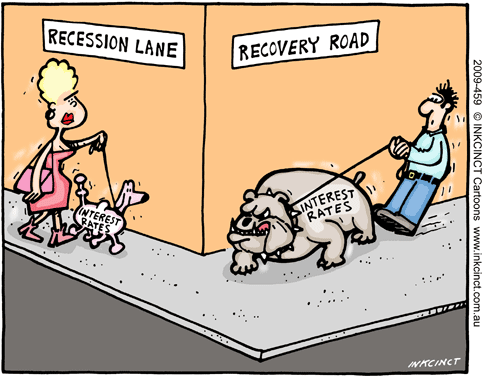
But it is increasingly clear that ultra-low short and long-term interest rates are not boosting nominal demand.

The BOJ’s announcement of a negative interest rate certainly did produce a currency depreciation. But a lower yen would help Japanese exporters only if China, the eurozone, and South Korea – all themselves struggling with deflationary pressures – do not match Japan’s rate cuts.

At the global level, currency depreciation is a zero-sum game – we cannot escape a global debt overhang by depreciating against other planets.

Depressed equity markets and falling bond yields worldwide in January 2016 thus illustrate the global nature of the problem we face. Demand is still depressed by the overhang of debt accumulated before 2008. Indeed, this pre-2008 debt has not gone away; it has simply been shifted between sectors and countries.

Total global debt (public and private combined) has increased from around 180% to more than 210% of world GDP. Faced with this reality, markets are increasingly concerned that governments and central banks are running out of ammunition to offset global deflation, with the only tools available those that simply redistribute demand among countries.

But the fact is that central banks and governments together never run out of policy ammunition to offset deflation, because they can always finance tax cuts or increase public expenditure with printed money. This is precisely what the Japanese authorities should do now, permanently writing off some of the BOJ’s huge holdings of Japanese government bonds and canceling the planned sales-tax increase which, if it goes ahead in April 2017, will further depress Japanese growth and inflation.

There are no credible scenarios in which Japanese government debt can ever be repaid in the normal sense of the word “repay”: and none in which the bulk of the BOJ’s holdings of Japanese government bonds will ever be sold back to the private sector. The sooner that reality is admitted, the sooner Japan will have some chance of meeting its inflation targets and stimulating total demand, rather than seeking to shift it away from other countries.

Interest Rates

Anomalous Economics?

Nouriel Roubini writes:  Since the beginning of the year, the world economy has faced a new bout of severe financial market volatility, marked by sharply falling prices for equities and other risky assets. A variety of factors are at work: concerns about a hard landing for the Chinese economy; worries that growth in the United States is faltering at a time when the Fed has begun raising interest rates; fears of escalating Saudi-Iranian conflict; and signs – most notably plummeting oil and commodity prices – of severe weakness in global demand.

And there’s more. The fall in oil prices – together with market illiquidity, the rise in the leverage of US energy firms and that of energy firms and fragile sovereigns in oil-exporting economies – is stoking fears of serious credit events (defaults) and systemic crisis in credit markets. And then there are the seemingly never-ending worries about Europe, with a British exit (Brexit) from the European Union becoming more likely, while populist parties of the right and the left gain ground across the continent.

These risks are being magnified by some grim medium-term trends implying pervasive mediocre growth. Indeed, the world economy in 2016 will continue to be characterized by a New Abnormal in terms of output, economic policies, inflation, and the behavior of key asset prices and financial markets.

So what, exactly, is it that makes today’s global economy abnormal?

First, potential growth in developed and emerging countries has fallen because of the burden of high private and public debts, rapid aging (which implies higher savings and lower investment), and a variety of uncertainties holding back capital spending. Moreover, many technological innovations have not translated into higher productivity growth, the pace of structural reforms remains slow, and protracted cyclical stagnation has eroded the skills base and that of physical capital.

Second, actual growth has been anemic and below its potential trend, owing to the painful process of deleveraging underway, first in the US, then in Europe, and now in highly leveraged emerging markets.

Third, economic policies – especially monetary policies – have become increasingly unconventional. Indeed, the distinction between monetary and fiscal policy has become increasingly blurred. Ten years ago, who had heard of terms such as ZIRP (zero-interest-rate policy), QE (quantitative easing), CE (credit easing), FG (forward guidance), NDR (negative deposit rates), or UFXInt (unsterilized FX intervention)? No one, because they didn’t exist.

But now these unconventional monetary-policy tools are the norm in most advanced economies.

Some alleged that these unconventional monetary policies  were a form of debasement of fiat currencies.

Instead, inflation is still too low and falling in advanced economies, despite central banks’ unconventional policies and surging balance sheets.

The reason ultra-low inflation remains a problem is that the traditional causal link between the money supply and prices has been broken. One reason for this is that banks are hoarding the additional money supply in the form of excess reserves, rather than lending it (in economic terms, the velocity of money has collapsed).  Unemployment rates remain high, giving workers little bargaining power. And a large amount of slack remains in many countries’ product markets, with large output gaps and low pricing power for firms (an excess-capacity problem exacerbated by Chinese overinvestment).

And now, following a massive decline in housing prices in countries that experienced a boom and bust, oil, energy and other commodity prices have collapsed.

The recent market turmoil has started the deflation of the global asset bubble wrought by QE.

How long markets not only ignore the real economy, but also discount political risk?

Welcome to the New Abnormal for growth, inflation, monetary policies, and asset prices, and make yourself at home. It looks like we’ll be here for a while.

Global economy

Entrepreneur Alert: Asteroid Mining?

In what is being seen as a major breakthrough  the government of Luxembourg has thrown its financial muscle behind plans to extract resources from asteroids, some of which are rich in platinum and other valuable metals. It plans to team up with private companies to help speed the progress of the industry and draw up a regulatory framework for it.

One such firm, Deep Space Industries, wants to send small satellites, called Fireflies, into space from 2017 to prospect for minerals and ice. The satellites would hitch a ride on a rocket, and larger craft would then be used to harvest, transport and store raw materials.

Metals such as nickel and iron, which are plentiful on Earth, could be processed while in orbit and used to build equipment or spacecraft. And it may eventually be possible to extract valuable minerals from asteroids cheaply enough for it to be worth bringing them back to Earth.

Rival Planetary Resources has a slightly different plan, in which telescopes would be used to analyse asteroids before craft were sent to mine them. Its backers include Google co-founder Larry Page and billionaire businessman Ross Perot, and it thinks it could be operating in space by 2025.

One of the difficulties facing these would-be space miners is cost, which is fittingly astronomical. Nasa’s Osiris-Rex expedition, which aims to bring just two kilos of asteroid material back to Earth by 2023, is set to cost $1bn. But Deep Space Industries thinks it can get the ball rolling by putting three of its Fireflies in space for just $20m.

The other obvious barrier is the technological progress that is still required if commercial asteroid mining is to become practically possible and economically viable.

However, considerable as these hurdles are, experts believe the legal component is the most pressing. Late last year, the US government made an attempt to update the law on space mining, producing a bill that allows companies to “possess, own, transport, use, and sell” extra-terrestrial resources without violating US law. The problem is that putting this into practice violates the OST.

US lawyer Michael Listner, who founded thinktank Space Law and Policy Solutions, says the US law is incompatible with the OST and risks souring international relations: “China and Russia will want in. If you have conflicts of law, things start getting dicey and that could lead to legal and political conflict.”

Newman believes that one reason why Luxembourg has included plans for drawing up a regulatory framework is to show the world that work is under way on untangling such legal knots. “This is something for investors to hang their hat on,” he says, “to give them confidence and say that there is a nascent legal framework.”

But Dr Gbenga Oduntan, a space law expert at the University of Kent, warns that the international community needs to get its act together quickly. “What we don’t want is a free-for-all over asteroids,” he says. “We need to come together and do that thinking, because the law we have right now does not allow us to repatriate resources for commercial purposes.”

One way to do this, he suggests, is to draw on existing legislation such as the UN Convention on the Law of the Sea, which governs how nations use the ocean. Another option might be to revive the Moon Treaty of 1979, which deemed space to be the “common heritage of mankind” but failed to win support from any space-faring nation.

Such complex legal wrangles could indeed prove harder to overcome than other difficulties, such as the huge costs involved. But some experts believe that investing large amounts early on could create a space economy in which costs are forced down by collaboration.

Ian Crawford, professor of planetary science at Birkbeck, London, says asteroid miners would most probably start off by mining water-ice, which can be broken down into hydrogen (for fuel) and oxygen (for supporting life).

It is much cheaper to produce water in space than to take it there, and this process could generate revenue and technical support from other players in the space game. Once companies had that revenue stream under their belts, they could start thinking more seriously about the more costly business of extracting minerals and bringing them back to Earth.

“Eventually you can imagine the whole process supporting itself,” says Crawford. “The main hurdle is the initial investment, and it seems these companies think they can get started and jump over that hurdle.” But he agrees that the more pressing concern is the legal picture, which “badly needs to be updated”.

Christopher Barnatt, professional futurist and author of The Next Big Thing: From 3D Printing to Mining the Moon, says history shows us that if governments such as Luxembourg’s get behind asteroid mining, the space industry will deliver on its promise.

“With the moon landings, the aspiration was way ahead of the technology. [President] Kennedy had spoken to Nasa and they’d said it couldn’t be done. He thought it could. We’ve got evidence from throughout history that when we commit ourselves to a broad goal, we can achieve it.”

The ramifications could be huge, he believes, as progress in one technology spurs breakthroughs in another.

“If you can use asteroids to make fuel, a lot of space exploration becomes cheaper. Then there’s progress in robotics and artificial intelligence… it all starts to make things possible.”


Deutsche Bank Strikes Out Against Central Bank Easing


A Wounded Deutsche Bank Lashes Out At Central Bankers: Stop Easing, You Are Crushing Us

 Tyler Durden writes:  Ten days ago, when Deutsche Bank stock was about 10% higher, the biggest German commercial bank declared war on Mario Draghi, as we put it, warning him that any further easing by the ECB would only push stocks (with an emphasis on DB stock which has gotten pummeled over the past few months) lower. What it got, instead, was a slap in the face in the form of a major new easing program when the Bank of Japan announced it is unveiling negative rates just three days later.

Which is why overnight a badly wounded Deutsche Bank has expanded its war against the ECB to include the BOJ as well, and in a note titled “The Risks From Further ECB and BOJ Easing” it wants that with the Zero Lower Bound already breached in nearly a third of global markets, the benefits to risk assets from further easing no longer exist, and in fact it says that while central banks have hoped that such measures would “push investors out the risk spectrum” the “impact has been exactly the opposite.”

In other words, we have reached that fork in the road within the monetary twilight zone, where Europe’s largest bank is openly defying central bank policy and demanding an end to easy money. Alas, since tighter monetary policy assures just as much if not more pain, one can’t help but wonder just how the central banks get themselves out of this particular trap they set up for themselves.

Here is DB’s Parag Thatte explaining the “The risks from further ECB and BOJ easing”

The BOJ surprised with a move to negative rates last week, while ECB rhetoric suggests additional easing measures forthcoming in March.While a fundamental tenet of these measures, in particular negative rates, has been to push investors out the risk spectrum, we remind that arguably the impact has been exactly the opposite:

  • Declining bond yields have been robustly associated with larger inflows into bonds at the expense of equities. Though a large over allocation to fixed income at the expense of equities already exists as a result of past Fed QEs and a lack of normalization of rates, further easing by the ECB and BOJ that lower bond yields globally will only exacerbate the over allocation to bonds;
  • Asynchronous easing by the ECB and BOJ while the Fed is on hold risks speeding up the dollar’s up cycle, pushing oil prices lower and exacerbating credit concerns in the Energy, Metals and Mining sectors. It is notable that the ECB’s adoption of negative rates in mid-2014 which prompted the large move in the dollar and collapse in oil prices, marked the beginning of the now huge outflows from High Yield. These flows out of High Yield rotated into High Grade, ironically moving up not down the risk spectrum. The downside risk to oil prices is tempered somewhat by the fact that they look cheap and look to be already pricing in the next leg of dollar strength;
  • Asynchronous easing by the ECB and BOJ that is reflected in the US dollar commensurately raises the trade-weighted RMB and increase the risk of a disorderly devaluation by China. The risk of further declines in the JPY is tempered by the fact that it is already very (-29%) cheap, but there is plenty of valuation room for the euro to fall.

Broad-based move across asset classes towards neutral amidst uncertainties

  • US equity fund positioning inched closer to neutral; as anticipated the returning buyback bid is being offset by large persistent outflows (-$42bn ytd);
  • European equity positioning is also close to neutral amidst slowing inflows; Japanese funds trimmed exposure from very overweight levels while flows turned negative for the first time in 2 months;
  • The large short in US bond futures has started to be cut; 2y bond shorts were cut by half this week while short-dated rates futures are already long. Robust inflows into government bond funds which began this year have continued while the pace of outflows from HY and EM funds has slowed;
  • A move toward neutral was also evident in FX positions. The surprise BoJ cut to negative rates caught yen longs by surprise, with the large initial subsequent depreciation in the yen partly reflecting a paring of positions. Meanwhile, the euro rose to a 3 month high as crowded leveraged fund shorts were being covered despite the ECB’s dovish rhetoric;
  • As the dollar fell, net speculative long positions in oil rose, reflecting mainly an increase in gross longs while shorts remain at record highs; copper shorts continue to edge back from extremes; gold longs are rising.

Declining bond yields mean larger inflows into bonds at the expense of equities

  • A fundamental tenet of central bank easing has been to push investors out the risk spectrum. The impact has arguably been exactly the opposite
  • Beyond any negative signal further monetary easing sends on underlying growth prospects, historically falling bond yields with the attendant capital gains on bonds have seen inflows rotate into bonds at the expense of equities. The correlation between equities and bond yields remains strongly positive. Notably, the best period of inflows for equities was after the taper announcement in 2013 when bond yields rose sharply

Large over-allocation to fixed income already

  • Past Fed QEs, a lack of normalization of Fed rates and easing by other central banks means that a large over-allocation already exists in fixed income while the underallocation in equities remains massive
  • Additional easing by the ECB and BoJ by encouraging inflows into bonds will only exacerbate the over allocation to fixed income

Asynchronous easing behind decline in oil and flight from HY

  • Asynchronous monetary easing by the ECB or BoJ while the Fed is on hold puts upward pressure on the dollar, downward pressure on oil prices and heightens credit concerns in the Energy, Metals and Mining sectors
  • It is notable that the huge outflows from HY began to the day with the ECB’s adoption of negative rates in Jun 2014. Those outflows from HY moved into HG, ironically moving up not down the risk spectrum
  • The risk to oil prices is somewhat tempered by the fact that oil prices are cheap to fair value and look to be pricing in the next leg of dollar strength

Asynchronous easing that is reflected in a higher dollar is reflected commensurately in the trade-weighted RMB

  • By virtue of the near-peg to the US dollar, by early 2015 the trade-weighted RMB had risen along with the US dollar by 32% in trade-weighted terms and has been in a relatively narrow range since
  • A variety of Chinese economic indicators have been strongly negatively correlated with the US dollar: Chinese data surprises (-42%); IP (-65%); and retail sales (-59%)

Further dollar strength raises the risk of a disorderly Chinese devaluation

  • Asynchronous easing by the ECB and BOJ reflected in the US dollar and in turn the trade-weighted RMB increases the risk of a disorderly devaluation by China
  • The risk of further declines in the JPY is tempered by the fact that it is already very cheap (-29%), but there is plenty of valuation room for the euro to fall
  • The surprise BoJ easing in January prompted a paring of longs, while investors are unwinding short positions in the euro despite dovish rhetoric by the ECB