Employment Hits Highs in UK

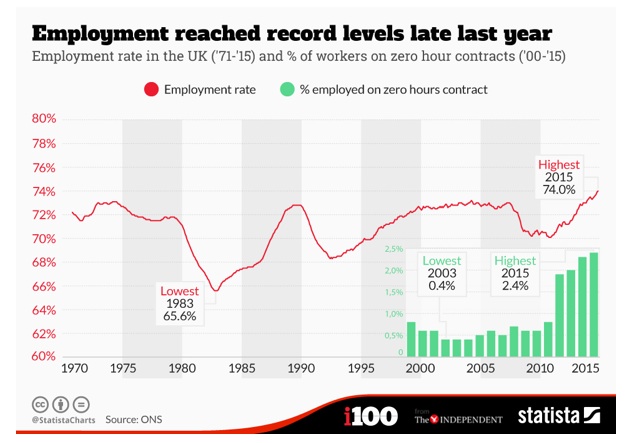
According to official figures released by the Office for National Statistics (ONS), the employment rate in the UK reached its highest level last year since records began in 1971.

Over the past 15 years, there has also been a rise in zero hours contracts.

This chart shows the employment rate in the UK and the percentage of workers on zero hour contracts.

Employment in UK


Relationship Between Subprime Mortgage Crisis and Oil Price Plunge?

Tracey Allway writes:  Is there a relationship between the subprime mortgage crash and the disorderly fall in the price of oil.

Created in January 2006 and consisting of a basket of credit default swaps (CDS) tied to the welfare of subprime mortgages, it allowed a bevy of investors to bet on the future direction of riskier home loans and helped inflate the massive amounts of leverage tied to the U.S. housing bubble. More recently it played a starring role in the film version of Michael Lewis’s The Big Short—when protagonists Christian Bale, Steve Carell, et al. are tracking their bets against the U.S. housing market, they are tracking the ABX.

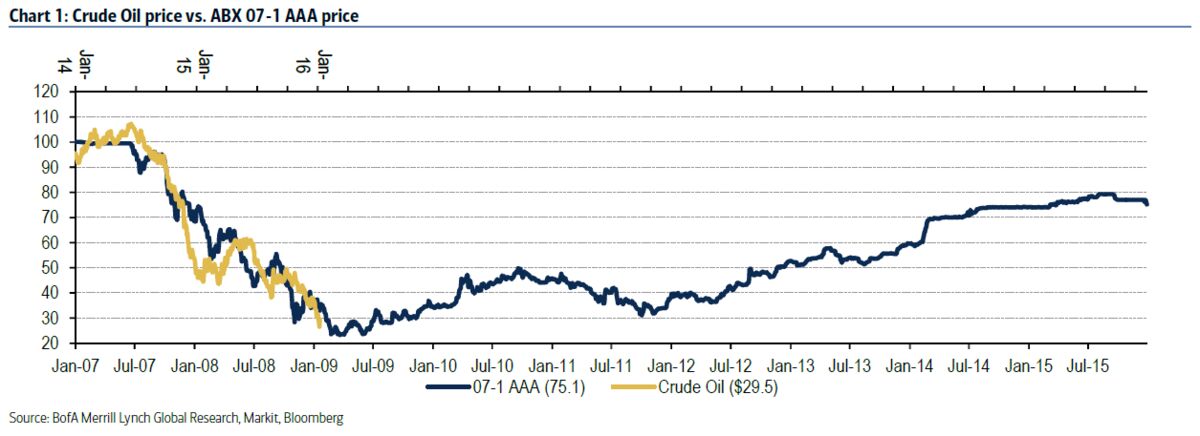
Fast-forward to today and Bank of America analysts provide an update to their previous thesis, which was that the downward spiral in the price of oil was shaping up to look a lot like the negative trend that engulfed the subprime space circa the year 2007.

Here’s what they say:

The pattern of the decline in the price of oil that began in mid-2014 is remarkably similar to the 2007-2009 pattern of the price decline of ABX, the credit derivative index that referenced subprime mortgages and, ultimately, the U.S. housing market (Chart 1). The ABX history suggests that oil will see more declines in the next couple of months and find a floor somewhere in the low 20s in the March-April time frame. Both the duration of the decline (1.5+ years) and the scale of the decline (100 neighborhood starting price down to the sub-30 neighborhood) are similar. Given that both housing and oil prices were fueled to spectacular heights in the two periods by massive credit expansion, it’s probably more than just coincidence that the respective “bubble” bursting patterns are so similar.

Consider how things tend to work. Denial on what constitutes fair value is a big component of bubbles, on the part of both market participants and policymakers. When perceived “bubbles” burst, markets take their time in steadily shredding views of the perception of fundamental value, as prices move lower and lower. Along the way, many will cite “technical factors” as the cause of the decline, which in some way suggests the price decline may not be real when in fact it is all too real. In the end, the technicals drive the fundamentals, as credit flees and borrowers go bust, and a feedback loop lower kicks in. Lower prices beget accelerated selling, as asset owners need to raise cash. It could be margin calls or it could be producer selling needs, it doesn’t really matter: the selling becomes inevitable and turns into forced selling.

Source: BofAML

The point here is not that oil is necessarily the new subprime crisis per se but that the recent action in the price of crude resembles nothing if not the bursting of a bubble and the sudden realization that the asset has been overvalued for too long. More worrying for oil investors will be BofAML’s idea of forced selling. As Flanagan notes: “The systemic margin call of 2008 seems to be back for now, albeit to a far lesser degree.”

.

Entrepreneur Alert: Fastest Growing Apps

We may still be listening to the radio, read the news and or watch television shows, but more and more often we’re doing it on our mobile devices or, to be more precise, within apps.

When the first iPhone was released in 2007, there was no App Store and the idea of a phone doing all of the stuff today’s smartphones are capable of seemed ludicrous to say the least. It was the introduction of apps that really started what we consider the mobile revolution in retrospect. Ever since Apple introduced the App Store in 2008, app usage has been growing and it continues to do so until today. According to Flurry Analytics, a company tracking usage across millions of apps, global app usage increased by 58% in 2015 (compared to 76% in 2014 and 103% in 2013).

Personalization apps (e.g. emoji keyboards or wallpaper apps) were the fastest-growing category in 2015. App sessions (that is the number of times a user opens an app) increased by 332% in this category. News & magazine apps were the second-fastest growing app category in the past 12 months. As smartphone screens keep getting bigger, consumers are increasingly open to consuming content on their mobile devises.

Fast Growing Apps


Making A Better Life Thru Ponzi Schemes

Founded in 2008 by Coral Rose Grant, TSTLC’s stated mission is to help people “live their best lives” and, ultimately, make a career out of teaching others the same.

This week, it is the subject of a major class-action lawsuit led by two former clients, Cheri Lucas and April Fisher—the latter of whom taught classes for TSTLC. Together, the two allege that the company was part of a Ponzi scheme devised by Coral and her husband, Mac, in which they pocketed investor money totaling anywhere from $8 million to $20 million, using it to “live like royalty.”

Charging people hundreds of dollars to help them find the “life of their dreams,” they instead used it to live out their own. The mastermind behind the scheme, the two claim, was a “career fraudster and federal felon” Kevin Trudeau, the “infomercial king” who is serving time in prison for diet books. Coral, they say, not only visited Trudeau in prison, but spent money trying to get him released.

Filed on behalf of “all persons who have entered into ‘coaching contracts’ or ‘investor contracts’ with any of the defendants,” Lucas and Fisher are asking for $30 million total in damages for fraud, theft, and racketeering, as well as gross negligence and deceptive trade.

The claim paints a grim picture of scam, with the master coaches turning clients into players—stripping them of hundreds of thousands of dollars and feeding them lies about “happiness.”

On TSTLF’s website users are greeted by the words “Become a Life Coach” in enormous white letters. Their definition of “living your best life” seems fairly broad. “From a middle aged soccer mom looking to lose a few pounds to an upper level executive looking to negotiate a seven-figure business deal, you will possess the confidence, skill and knowledge required to make you an invaluable resource in the lives of your Life Coaching clients,” their certification page reads. “As a Life Coaching Professional, you can demand anywhere from $75 to $500 per hour.”

Where the breakdown seems to have happened, according to the complaint, is what the Grants’ call a “commission agreement.” Essentially a “coaching contract,” the lawsuit explains it as a “commission percentage or fee” rewarded to coaches who either recruited coaching clients or taught coaching classes themselves. It’s money, they say, that never came.

On top of this, the Grants also “invited people (coaches, members, clients) to become ‘investors,’ i.e. give them flat sums in exchange for non-specific future returns.” Returns that, according to the plaintiffs, never panned out. Instead, Lucas and Fisher said the Grants pocketed the money owed to coaches and the money given by investors.

After spending all of the money that they’d pocketed from investors and commission fees, the Grants allegedly started opening up smaller companies and telling clients to direct their money there. Before doing so, they canceled previous contracts, citing “recent events,” and noting that investors would not be able to collect their money.

If the Grants set out to help people live their best lives, they may have gotten lost along the way. According to the plantiffs’ attorneys, the two went as far as to steal from clients’ life savings. “Coral and Mac Grant took advantage of a lot of people,” they told The Daily Beast. “They took millions of dollars with no intention of giving it back.”

Ponzi Scheme

EU Commission a Weak Manager?

Emmet Linvingstone writes:  The EU’s accounting watchdog blasted the European Commission for its “weak management” of the financial crisis in a report issued into five of the eight bailouts in the European debt crisis, including Ireland and Portugal.

The report by the European Court of Auditors into the bailouts of non-eurozone states Hungary, Romania and Latvia (which has since joined the single currency), and eurozone members Ireland and Portugal, found the Commission had overestimated the strength of public budgets and failed to warn EU leaders of growing fiscal imbalances prior to the crisis.

It also criticized the management of early bailout funds, saying the Commission did not apply similar conditions to countries in comparable economic situations.

The Court of Auditors’ report is one of the first to examine the Commission’s role in assisting member countries, via programs managed by the European Central Bank and IMF. Greece and Cyprus also received sovereign bailouts, which will be the subject of separate reports, and Spain received assistance for its banking system.

Among the more damning conclusions of the report is that the Commission lacked “key documents” when implementing bailout programs and that calculations underpinning the Commission’s recommendations were not rigorously checked.

The Commission’s spokesperson for economic and financial affairs, Annika Breidthardt, said Tuesday that while the report’s findings were being taken seriously, the bailout programs had clearly met their objectives.


The Commission also said that the report did not take “complex institutional settings” into account, in a written response. It said the role of the EU Council, the IMF, ECB and national governments in implementing bailouts was played down.

Bailouts


Inequality: Are Haves and Have Nots Predestined?

Yanis Varoufakis writes: The ‘haves’ of the world are always convinced that they deserve their wealth. That their gargantuan income reflects their ingenuity, ‘human capital’, the risks they (or their parents) took, their work ethic, their acumen, their application, their good luck even. The economists (especially members of the so-called Chicago School. e.g. Gary Becker) aid and abet the self-serving beliefs of the powerful by arguing that arbitrary discrimination in the distribution of wealth and social roles cannot survive for long the pressures of competition (i.e. that, sooner or later, people will be rewarded in proportion to their contribution to society). Most of the rest of us suspect that this is plainly false. That the distribution of power and wealth can be, and usually is, highly arbitrary and independent of ‘marginal productivity’, ‘risk taking’ or, indeed, any personal characteristic of those who rise to the top. In this post I present a body of experimental work that argues the latter point: Arbitrary distributions of roles and wealth are not only sustainable in competitive environments but, indeed, they are unavoidable until and unless there are political interventions to keep them in check.  Haves and Have Nots

Inequality

Vimeo: Women, Share the Screen

Including Women and Minorities is Good Business

Research shows diversity is good for business – take your pick from Harvard Business Review, Scientific American,McKinsey & Company and many more. Yet fundamental change in any industry can take time.

We’ve all seen the statistics. Tech investment in women and minorities is lacking, and while Silicon Valley is building a bubble-like paddock for unicorns, outside-the-commercial-box ideas with real social impact can be drowned out by all the eyeballs lighting up with dollar signs and ringing out ‘cha-ching’.

Discussion on diversity in industries was rampant throughout 2015, prompting the establishment of committees and policies, and the promotion of diversity leaders. Some of these efforts merely pay lip service to the cause, but some champions of diversity are taking definitive action.

The change that’s on the horizon is in no small part led by these inspiring individuals. Some are investors cognisant of the homogenous face of the tech industry and actively working to augment it. Others are attempting to change the game completely with new models of investment, while others are driving the diversity debate in the right direction.

Diversity and Women

Ayn Rand Doesn’t Work in Corporate Life

Jonathan Haidt writes:  Imagine that a major league basketball team is bought by a hedge fund manager who is a firm believer in the value of competition. Not just competition across teams, but competition within teams. He implements a radical new policy: each player’s salary is determined exclusively by the number of points he scores. Crazy, right? Anyone can see that such a policy would ruin teamwork and destroy the team’s ability to compete with more cohesive teams.

Yet this is exactly what is now happening at Sears. Five years ago, Eddie Lampert, the chairman of Sears merged with Kmart, reorganized the company so that each business unit functions like an autonomous company, with its own president, board of directors, and profit-and-loss statement.  Lampert runs Sears like a hedge fund portfolio, with dozens of autonomous businesses competing for his attention and money. An outspoken advocate of free-market economics and fan of the novelist Ayn Rand, he created the model because he expected the invisible hand of the market to drive better results. If the company’s leaders were told to act selfishly, he argued, they would run their divisions in a rational manner, boosting overall performance.

The results have been disastrous, in part because Lampert was ideologically committed to the metaphor of the invisible hand and the associated idea that people are purely selfish. Ideology is a lens – it makes some things more visible, others less so. Lampert’s ideology prevented him from seeing that he was destroying the invisible band – the bond that forms around groups that can trust each other and work together toward shared goals. Evolution is a different lens – one that we believe brings unparalleled focus and resolution when examining complex human systems. A brief look through the evolutionary lens would have made it obvious how dysfunctional Lampert’s reorganization was likely to be.  Competition and Cooperation

Invisible Hand?

Ducasse with 20 Michelin Stars Promotes Women Chefs

Laoise Casey writes:  A miniature army of black trompette mushrooms awaits its fate on a blue cloth as a chef picks over them. One is held up for inspection – a wisp of black velvet with a perfectly furled stem. Another chef – me – selects our best-looking sourdough. Nearby, Robin Gill, head chef and owner of The Dairy restaurant in Clapham, south London, paces while eyeing the pans arranged on the stove. He has cancelled his plans for today. Cancelled, because Alain Ducasse has just sat down for lunch. For Gill, this is “like having the chance to cook for Escoffier” – the grandfather of French cuisine.​

The 59-year-old French chef has 23 restaurants in seven countries, including two in London, and a total of 20 Michelin stars. He also runs cookery schools, has written numerous cookbooks, and last year he even devised a menu for the International Space Station (bon app, Tim Peake!). Back in The Dairy kitchen, seven chefs flock around each plate as it leaves the pass. Later, an excited murmur ripples through the kitchen: Ducasse liked it. That night I, the novice, hatch a plan to win an audience with the master.


5914546.jpg
Alain Ducasse with chef Laoise Casey (Anna Huix)


I’m a chef at the start of my career, and keen to learn about his view of women in the traditionally macho environment of kitchens. Several of Ducasse’s head chefs are female, of whom he speaks very highly: “It has always k been important for me to have women in my restaurants, both front and back of house.” The Michelin-starred Hélène Darroze, head chef at the Connaught in London, trained under him at the Louis XV restaurant in Monaco, and was encouraged by him to begin working in the restaurant kitchen. “Two of my head chefs are female. Laetitia Rouabah at Allard, perpetuates the legacy of Marthe Allard – a ‘mother cook’ who founded the restaurant in 1932 – and brings it up to date aptly. At the helm of Benoit, one of the last authentic Parisian bistros, we have Fabienne Eymard. Both maintain the traditions and bring their touches to those places.”

In 2011, Ducasse established the Femmes en Avenir (Women of the Future) programme in association with the French government to encourage women in the outskirts of Paris to earn a culinary diploma and then into relevant employment. Ducasse points out that cooking itself is a “social ladder” and that regardless of background, “anyone can start as a commis and become a successful chef”.

Provided, that is, that they are willing to work hard enough. “This difficult trade”, as Ducasse calls it, is often portrayed unrealistically in TV shows that claim to reveal the working life of restaurants. “Beyond the glamour, one must not forget that our trade is very demanding,” he says. “But cookery shows can reactivate the desire for young people to be part of this adventure.”

What’s more, Ducasse believes these shows could help combat the current shortage of chefs in the UK: according to reports at the end of last year, there has been a drop in the number of students enrolling in chef courses. If the trend continues, it’s thought there will be a shortfall of 11,000 chefs by 2022.

5914549.jpg
Hélène Darroze, who trained under Ducasse at Louis XV (Rex Features)

His restaurants are a portfolio of fine dining and bistro cuisine. And the one venture that Ducasse will tell me he has in store for 2016 (“I have many, many plans – too many”) is a bistro, in the Les Halles neighbourhood of Paris.

Time is pressing and his restaurant at the Dorchester beckons. If he hadn’t been a chef, he would have been an explorer and architect, he tells me: “[Now] I get to do all three.” I ask him when he might stop. He smiles… “I guess I will keep doing this for as long as I can.” Before leaving for his restaurant, he invites me to visit and stage (do kitchen work experience) at the Plaza Athénée. Who can say no to the master?