Will the US Be Replaced as the World’s Economic Powerhouse?

Adam Creighton writes:  Some of the world’s leading economists are hosing down fears that the US – and by extension the west – is about to lose its economic hegemony.

In the coming few years, even a decade, no. — Anat Admati, Professor of finance and economics at the Stanford Graduate School of Business. 

No, the primacy of the US follows from the fact that it offers the greatest scope for innovation by its population relative to any other country. Every American is thinking of a new way to do old things or a way to do new products and technologies, to make a fortune. And the venture capital market obliges by providing the finance to translate the idea of the new innovation into actual innovation. The US is a mecca for people with ideas and skills that blend into this landscape. — Jagdish Bhagwati, professor of economics, law and international relations at Columbia University.

That’s already happened as regards global trade. It is about to happen in the production of goods and services. In the area of finance, the US will remain the top dog for quite a bit longer. Willem Buiter, Global chief economist at Citigroup, former professor of political economy at LSE. 

John Cochrane.

In a peaceful world other countries should catch up to the US way of doing things. And in the current trend, the US seems to be going out of its way to pursue inefficiency. Holland is a nice place to live. It was the “powerhouse” of the 17th century. Is it a worse place to live now that other countries have caught up? — John Cochrane, Senior fellow at the Hoover Institution, Stanford. 

No, China is headed rather rapidly toward zero per cent growth. After a long period of adjustment, it will re-emerge with something like a four per cent growth rate. I am a China optimist for the long-term, but not for the next 10 years. — Tyler Cowen, Professor of economics at George Mason University, US.

No, the only potential competitor is China, and it will hit a wall, or explode, unless it figures out how to make its political system much more open. I see no evidence that the Chinese Communist Party will ever let this happen. — Eugene Fama, Professor of finance at the University of Chicago Booth School of Business. He shared the Nobel prize in economic sciences in 2013 with Robert Shiller and Lars Peter Hansen for work on the empirical analysis of asset prices.

Edward Glaeser. Picture: Harvard

In due time, the US will surely cease to have the world’s largest GDP. Even if per capita incomes in China only grow to 40 per cent of US levels, China will become the larger economy. However, over the past few years, the US has looked somewhat stronger and China has looked somewhat weaker. The US system of decentralised capitalism can also create wasteful investment and overbuilding, but we continue to also have an abundant supply of more productive entrepreneurs. Like Australia, America’s open and free culture abets innovators and encourages start-ups. America’s biggest weakness, which will surely cause us even larger problems in the 21st century, is its education system.  Edward Glaeser, Professor of economics at Harvard. With a PhD from the University of Chicago.  

Yes, eventually. For a while the US will have company from China and Europe. —Michael Spence, Professor of economics at New York University’s Stern School of Business. He shared the Nobel Memorial Prize in economic sciences in 2001. 

Not any time soon. Europe could have given the US a run for its money but I think the troubles there will resurface; the single currency is a problem. — Richard Thaler, Professor of behavioural science and economics at the University of Chicago Booth School of Business. 

I doubt it. I would not deny that the economy of the US has structural problems, not least in the areas of education, health and infrastructure. Yet, when we look at China and Europe, potential US rivals, the problems they face seem even bigger. Future prosperity will also depend increasingly on innovation, and there the US still leads by a wide margin. — William White, Chair of the OECD’s economic and development review committee. 
European Banks Need Further Overhaul?

If you had to pick the moment when European banking reached the point of no return, which would you choose? The July day in 2012 when Bob Diamond resigned as Barclays’s chief executive officer amid the Libor rigging scandal? Or the fall morning later that year when UBS announced it was pulling out of fixed income and firing 10,000 employees? How about Sept. 12, 2010, when Basel III’s raft of costly capital requirements started upending the economics of global finance?

All signature events, to be sure. But try May 21, 2015. That’s when 40 per cent of Deutsche Bank stockholders gave co-CEOs Anshu Jain and Jürgen Fitschen a big thumbs down. By the end of June, Jain was out and Fitschen had agreed to leave the company by May of this year.

Illustration by David Foldvari

Investors are running out of patience with European bank chieftains, and no wonder. Since the fall of Lehman Brothers in September 2008, eight of Europe’s biggest banks have announced layoffs adding up to about 100,000 employees, paid $63 billion in legal penalties, and lost $420 billion in market value. In 2015, Deutsche Bank lost a record €6.8 billion ($7.6 billion). In mid-February the industry suffered an epic selloff as subzero interest rates, China’s slowdown, the oil crash, and looming regulatory and litigation costs triggered an outbreak of fear not seen since the fall of 2008. Just last year new CEOs took over at Barclays, Credit Suisse, Deutsche Bank, and Standard Chartered.

Credit Suisse’s new CEO, Tidjane Thiam, is “right-sizing” the investment bank and pushing for a 61 percent jump in pretax income from his international wealth management unit over the next two years. At Barclays, Jes Staley wasted no time cutting 1,200 investment banking jobs and closing offices in Asia and Australia after taking charge in December. Meanwhile, John Cryan, the British executive who replaced the India-born Jain, is pursuing an unprecedented overhaul of Deutsche Bank’s entire information technology infrastructure to shore up shaky risk-management systems.

Deutsche agreed to pay $2.5 billion in penalties to U.S. and U.K. authorities for its role in the Libor rate rigging. (No current or former member of the bank’s management board was implicated.) But something deeper was at work, too. European banks aren’t going through a stormy phase that will eventually clear and permit them to claim a new golden age.The industry is undergoing a metamorphosis that will demand a thorough and radical alteration of its core operating model.


Will Brazil’s Rough Patch Become a Swamp?

Otaviano Canuto writes:  After decades of rapid economic growth and per capita income gains, Brazil is struggling. According to the International Monetary Fund, the country’s GDP is poised to contract by more than 7% in 2015-2016. No single factor explains this reversal of fortune. Four do.

For starters, there is the structural trend of rising primary government expenditure as a share of GDP, which reached 36% in 2014, up from 22% in 1991.

The second factor shaping Brazil’s fortunes is the commodity-price super cycle. The upswing in commodity prices that began in 2004 brought many benefits for Brazil: external surpluses, the accumulation of foreign-exchange reserves, positive wealth effects, and higher investment in natural-resource-related sectors. Add to that exchange-rate appreciation and rising minimum-wage floors – not to mention public-sector disbursements indexed to the latter – and Brazil enjoyed a virtuous domestic cycle featuring positive feedback loops between demand for services and formal employment.

The problem is that Brazil allowed high commodity prices simply to reinforce the underlying growth model, instead of preparing its economy for the inevitable bust. Profitability levels in the manufacturing industry were crushed by exchange-rate appreciation and rising domestic production costs, and levels of production practically stagnated from 2008, before starting to decline in 2014. When world metal prices began to fall in 2011, followed by food prices in 2014, Brazil’s economy lost its growth engines.

Brazil’s government did make adjustments to its growth pattern following the global financial shocks of 2008-2009. But it took a shortcut, relying on counter-cyclical fiscal and monetary policies to boost growth. This is the third key factor contributing to Brazil’s current travails.

Given structural factors, however, the main outcome of this second round of stimulus was fiscal deterioration.

Over the last year, Brazil has been struggling to unwind that attempted shortcut. The realignment of regulated prices with market prices, together with that of foreign and domestic prices (through exchange-rate depreciation), produced an inflation shock, with the consumer-price index reaching a 13-year high last year. In order to contain the shock and control inflation expectations, Brazil’s central bank was driven to increase interest rates.

The fourth factor undermining Brazil’s economic performance arose unexpectedly last year, when a multibillion-dollar corruption scandal engulfed the state-controlled oil company Petrobras, prompting a far-reaching investigation of high-level politicians and triggering a collapse of private investment.

The medium-term silver lining is that the Petrobras investigation demonstrates Brazil’s commitment to the rule of law, implying that the country’s reputation among investors will recover.

In an effort to minimize the budget deficit, the authorities have proposed new tax measures, including new rules on capital gains and the reenactment of a tax on financial transactions. Given the current dependence of taxation on consumption and the ongoing current-account adjustment, the tax on financial transactions, in particular, will be vital to buy time for mandatory public expenditures to be reviewed. Among the expenditures that will come up for review are pensions, as social security expenditure probably reached close to 8% of GDP last year. Efforts to make the labor market more flexible and reduce the cost of tax compliance will also help to improve Brazil’s investment climate.

To recapture strong and reliable growth, however, the key will be improved confidence – and that hinges largely on the government’s capacity to overcome the current political crisis. If it fails, Brazil’s current economic rough patch could well turn into a swamp.

Swamp

Effective Anti-Corruption Techniques?

Bjorn Lomborg writes:  Some $1 trillion was lost to corruption last year. This is money that was not available for expanding health care, broadening access to education, improving nutrition, or cleaning up the environment. According to Transparency International, 68% of the world’s countries have a serious corruption problem, and no country is completely immune.

Corruption is one facet of poor governance; indeed, it correlates with ineffective public administration, weak accountability, low transparency, and inconsistent implementation of the rule of law. So it is little wonder that the United Nations’ brand-new Sustainable Development Goals, coming into force this year, aim to fight it. Nonetheless, the SDGs represent a departure from the previous development framework, the Millennium Development Goals, which contained no explicit targets relating to corruption.

The problem is that the SDGs have so many targets – 169 in total – that they promise virtually everything to everyone. Without enough time or resources to focus on everything, countries will prioritize.

Nobel laureate economists identified 19 super-targets that would do the most good for the world for each dollar spent. These include achieving universal access to contraception, stepping up the fight against tuberculosis, and expanding preschool access in Sub-Saharan Africa. The economists recommended that the world’s donors and governments focus first on these investments.

The UN’s 12 corruption and governance-related targets weren’t among these phenomenal investments. One reason is that several of the UN’s “targets” in these areas are so broad as to be meaningless. Indeed, it is all very well to say that we want to “develop effective, accountable and transparent institutions at all levels,” and to “substantially reduce corruption and bribery in all their forms,” but where do we start?

Higher wealth and economic growth lead to better governance.  A study of 80 countries where the World Bank tried to reduce corruption revealed improvement in 39%, but deterioration in 25%. More disturbing is that all of the countries the World Bank didn’t help had similar success and failure rates – suggesting that the Bank’s programs made no difference.

But the experts enlisted by the Copenhagen Consensus Center found one governance-related target that actually would do some good for each dollar spent: “By 2030, provide legal identity for all, including birth registration.”

Achieving this target requires functioning public services to provide registration facilities and maintain records. Establishing such institutional capacity would create a clear model for how other services could be provided effectively. In practice, a functioning registration service would almost certainly not exist in a vacuum, and thus would be a sign of emerging administrative competence.

But this is not just about bureaucracy; there are real benefits for citizens. They can claim legal rights, including property rights, which are vital to allow individuals to prosper and the economy to grow. Likewise, elections become less vulnerable to corruption and fraud when voters are properly registered.

If we want to place a high priority on fighting corruption, we should not settle for overly broad, well-meaning slogans. We should work on specific, proven, and effective approaches such as providing legal identity for all.

But we also have to confront the possibility that when it comes to helping the world’s poor, anti-corruption policies may not be the best place to spend our money first. This is partly because there are much more effective ways to tackle problems like tuberculosis or access to contraception, and partly because current anti-corruption policies are expensive and do little or no good.

This is not to deny that corruption hits the world’s poor hard. But there are many challenges, from lack of healthcare to starvation and pollution, that also hurt the poor but that we can address more effectively.

Focusing on what we can do well seems less impressive than promising everything to everyone – until it’s time to deliver. Those who prioritize properly will end up helping many more people.

Corruption

Will Legalizing Marajuana Help?


The widespread legalization of marijuana as a painkiller could help to bring America’s epidemic of opioid misuse under control. That’s the opinion of Massachusetts Senator Elizabeth Warren anyway, having spoken this weekend of the importance of national health bodies seriously and comprehensively considering regulatory change.

She spoke of the terrifying extend of prescription painkiller addiction in her letter to Thomas Frieden, head of the US Centers for Disease Control and Prevention. She made clear her belief that to explore the possibilities with legalized marijuana could make an enomous difference to a problem that’s already entirely out of control.

“Our country is faced with an opioid epidemic that only continues to grow at an alarming pace,” she wrote on Monday.

“Opioid abuse is a national concern and warrants swift an immediate action.”

“I hope that the CDC continues to explore every opportunity and tool available to work with states and other federal agencies on ways to tackle the opioid epidemic and collect information about alternative pain relief options,” she wrote.

“Your agency has produced an enormous amount of scientific and epidemiological data that has helped inform stakeholders on the breadth of this crisis — however there is still much we do not know.”

She insisted that the time had come to intelligently and realistically study the “effectiveness of medical marijuana as an alternative to opioids for pain treatment in states where it is legal,” while at the same time evaluating “the impact of the legalization of medical and recreational marijuana on opioid overdose deaths.”

Reports from the CDC suggest that opioid overdose deaths are skyrocketing across the United States each and every year – increasing more than 200% since the year 2000. Advocates argue that not only could marihuana be made available much more widely and for a lower price, but that it is considerably less addictive and almost impossible to overdose on.

Legalize Marajuana?

Can Ukraine Survive without the IMF?


“Ukraine risks a return to the pattern of failed economic policies that has plagued its recent history.”

Lagarde’s message struck at the heart of concerns of Ukrainians who joined three months of enthusiastic but ultimately bloody protests that brought down the ex-Soviet republic’s Russian-backed leadership in February 2014.

Polls show public frustration with Poroshenko and Prime Minister Arseniy Yatsenyuk mounting and hopes ebbing away that Ukraine was finally ridding itself of mind-numbing bureaucracy and bribe-taking.

That angst was encapsulated by this month’s resignation of reform-minded Aivaras Abromavicius as economy minister in protest at alleged influence-peddling by one of the most senior members of the president’s inner circle.


The IMF chief had said bluntly that it was “hard to see how the ($40-billion, 35-billion-euro) IMF-supported programme can continue” without Ukraine making good on its promise to take radical streamlining steps ignored in the past.

Both Yatsenyuk and Poroshenko know they cannot survive without foreign assistance and that early legislative polls could return to power Russian-backed deputies who just might be enticed into warming Kiev’s frozen relations with Moscow.

Ukraine’s central bank chief warned that the mounting uncertainty was putting renewed pressure on the hryvnia just as it was starting to find its footing from a 68-percent slide against the dollar since the start of 2014.

“Without IMF support, we should expect devaluation and social instability,” said Anatoliy Oktysyuk of Kiev’s International Centre for Policy Studies.

“The alternatives (to IMF support) are not even currently being considered because they are all apocalyptic,” Oktysyuk said.


Lawmakers have already shown their resolve by blocking a constitutional change pushed by Poroshenko that the West hoped would end Ukraine’s 21-month separatist conflict by giving limited special status to pro-Russian rebel-run parts of the east.

Analysts believe that deputies’ instinctive desire to keep their jobs and avoid snap elections will keep Yatsenyuk in place and lead only to a minor government shakeup aimed primarily at preserving the current coalition intact.

“If the government fails in Kiev, it will have a direct effect on political and economic support from the West. Ukraine’s many sceptics will gain the upper hand, and its few friends will face a steep uphill struggle,” said Joerg Forbrig of the US-based German Marshall Fund policy research institute.

“Reduced assistance — whether political, financial, administrative or military — will eventually forfeit the modest gains Ukraine has made and expose the country’s many vulnerabilities,” Forbrig said.

Negative Rate Creep?

The negative-rates club is growing. But there is a limit to how low rates can go, according to the economist.  But they do not define what that limit is.

The Economist suggests: Let’s take a different look at what negative interest rates mean from the point of view of supply and demand.  The -1% deposit rate for Switzerland indicates the expectation that the Swiss franc will buy about 10% more than it will today in 10 years.  (To be exact, the expectation is for 10.46% more value.)  Why will it buy more?  Well, for just the opposite reason that +1% interest rates indicate a 10% loss of value expectation over 10 years.  With the loss of value the effect is known as inflation which is generally considered due to too much money chasing too few goods.  The solution for inflation is to make money more expensive or less available.  The opposite applies for monetary deflation implied by negative interest rates:  There is not enough money available to buy the goods available.  In the current environment the shortage results from an excess of “debt goods” to be bought.  So the solution to deflation is either to make the goods more scarce (write off debt) or increase the amount of money available.  QE is a process attempting to make debt instruments more scarce in the economy, although the scarcity may be temporary if the central bank later sells debt securities, as opposed to debt write-off which is forever permanent.  (“Forever permanent ” is a deliberate redundancy, for emphasis.)  See the preceding article for a view that rising wages and incomes are going to supply the money that will reduce deflation (or increase inflation).

But we ask the following question:  Where will the money come from to pay the higher wages?  The choices we suggest are (the third is not done today with the existing monetary system):

  1. Fewer people employed.
  2. More debt to create additional money.
  3. Infusion of money without the creation of debt.

How Women in the Workforce Help the Norwegian Economy

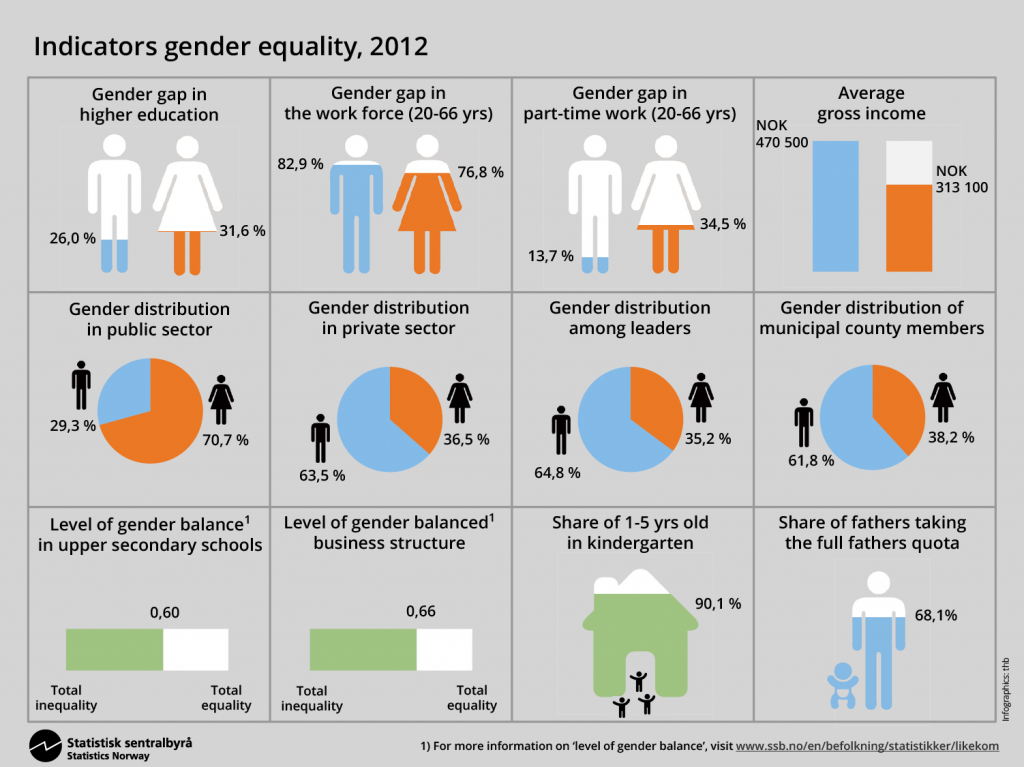
Any country’s main asset is its workforce, and Norway, with its oil wealth, is no exception. Sustainable policies for low unemployment and high participation rates for women, men and young people are predominant and the burden sharing of the cost of the welfare state is carried on the back of the labour force.

In the last 50 years, there has been a tremendous change in women’s participation in paid work in most OECD countries. Labour market participation has been a key to economic independence for women. It has given women the possibility to develop and use their professional skills. Employment among women is also crucial for economic performance. This may prove especially important in the years to come, as an ageing population will place an increasingly severe burden on public finances. Old age pension expenditure will increase, as will government outlays for health care. Low birth rates will add to the problem, and a shrinking working-age population will have to provide for an increasing number of pensioners. To encourage women with children to go out to work, Norway and the other Nordic countries have implemented policies that make it easier to combine work and family life.

Now some 83% of mothers with small children are employed. Fertility rates have risen along with the rise in labour participation, from 1.75 children per woman at the end of the 1970s to 1.9 children per woman today–one of the highest fertility rates in Europe.

The increase in female employment in Norway took place at a time when there was a rise in demand for labour, and alongside a remarkable boost in educational attainment among women. Secondly, employment among women was stimulated by comprehensive parental provisions and subsidised day-care for children. In 1970 only 13,000 Norwegian children were enrolled in day-care centres. Today the number is about 280,000 with coverage of almost 90% of all 1-5 year olds. Parental leave for employed mothers and fathers is paid from public budgets and has been extended from 12 weeks 30 years ago to 47 weeks today. Other measures are a statutory right to paid leave to stay at home with sick children and a right to work part-time until the youngest child turns 12.

Choosing workers from a pool of male and female workers, as opposed to choosing from a pool where half of the potential talent is excluded, leads to productivity gains. Secondly, higher female labour participation has led to productivity gains through a higher degree of specialisation. And finally, female employment has added more workers to the work force at a time when average work hours per employed person have been declining. .

In fact, if the level of female participation in Norway were to be reduced to the OECD average, Norway’s net national wealth would, all other factors being equal, fall by a value equivalent to our total petroleum wealth, including the value of assets held in the Government Pension Fund-Global (GPG, formerly the petroleum fund).

The next step for Norway will be to find ways to encourage people to move from part-time work to full-time work. With family provisions and childcare already in place,  this is within reach.

Women in the Norwegian Workforce