The internet can be responsible for worsening behavior already harmful to the marginalized; in this case, we delve into the issue of human sex trafficking, and how the internet has turned it into an epidemic. Human Sex Trafficking Report

The internet can be responsible for worsening behavior already harmful to the marginalized; in this case, we delve into the issue of human sex trafficking, and how the internet has turned it into an epidemic. Human Sex Trafficking Report
In what is being seen as a major breakthrough the government of Luxembourg has thrown its financial muscle behind plans to extract resources from asteroids, some of which are rich in platinum and other valuable metals. It plans to team up with private companies to help speed the progress of the industry and draw up a regulatory framework for it.
One such firm, Deep Space Industries, wants to send small satellites, called Fireflies, into space from 2017 to prospect for minerals and ice. The satellites would hitch a ride on a rocket, and larger craft would then be used to harvest, transport and store raw materials.
Metals such as nickel and iron, which are plentiful on Earth, could be processed while in orbit and used to build equipment or spacecraft. And it may eventually be possible to extract valuable minerals from asteroids cheaply enough for it to be worth bringing them back to Earth.
Rival Planetary Resources has a slightly different plan, in which telescopes would be used to analyse asteroids before craft were sent to mine them. Its backers include Google co-founder Larry Page and billionaire businessman Ross Perot, and it thinks it could be operating in space by 2025.
One of the difficulties facing these would-be space miners is cost, which is fittingly astronomical. Nasa’s Osiris-Rex expedition, which aims to bring just two kilos of asteroid material back to Earth by 2023, is set to cost $1bn. But Deep Space Industries thinks it can get the ball rolling by putting three of its Fireflies in space for just $20m.
The other obvious barrier is the technological progress that is still required if commercial asteroid mining is to become practically possible and economically viable.
However, considerable as these hurdles are, experts believe the legal component is the most pressing. Late last year, the US government made an attempt to update the law on space mining, producing a bill that allows companies to “possess, own, transport, use, and sell” extra-terrestrial resources without violating US law. The problem is that putting this into practice violates the OST.
US lawyer Michael Listner, who founded thinktank Space Law and Policy Solutions, says the US law is incompatible with the OST and risks souring international relations: “China and Russia will want in. If you have conflicts of law, things start getting dicey and that could lead to legal and political conflict.”
Newman believes that one reason why Luxembourg has included plans for drawing up a regulatory framework is to show the world that work is under way on untangling such legal knots. “This is something for investors to hang their hat on,” he says, “to give them confidence and say that there is a nascent legal framework.”
But Dr Gbenga Oduntan, a space law expert at the University of Kent, warns that the international community needs to get its act together quickly. “What we don’t want is a free-for-all over asteroids,” he says. “We need to come together and do that thinking, because the law we have right now does not allow us to repatriate resources for commercial purposes.”
One way to do this, he suggests, is to draw on existing legislation such as the UN Convention on the Law of the Sea, which governs how nations use the ocean. Another option might be to revive the Moon Treaty of 1979, which deemed space to be the “common heritage of mankind” but failed to win support from any space-faring nation.
Such complex legal wrangles could indeed prove harder to overcome than other difficulties, such as the huge costs involved. But some experts believe that investing large amounts early on could create a space economy in which costs are forced down by collaboration.
Ian Crawford, professor of planetary science at Birkbeck, London, says asteroid miners would most probably start off by mining water-ice, which can be broken down into hydrogen (for fuel) and oxygen (for supporting life).
It is much cheaper to produce water in space than to take it there, and this process could generate revenue and technical support from other players in the space game. Once companies had that revenue stream under their belts, they could start thinking more seriously about the more costly business of extracting minerals and bringing them back to Earth.
“Eventually you can imagine the whole process supporting itself,” says Crawford. “The main hurdle is the initial investment, and it seems these companies think they can get started and jump over that hurdle.” But he agrees that the more pressing concern is the legal picture, which “badly needs to be updated”.
Christopher Barnatt, professional futurist and author of The Next Big Thing: From 3D Printing to Mining the Moon, says history shows us that if governments such as Luxembourg’s get behind asteroid mining, the space industry will deliver on its promise.
“With the moon landings, the aspiration was way ahead of the technology. [President] Kennedy had spoken to Nasa and they’d said it couldn’t be done. He thought it could. We’ve got evidence from throughout history that when we commit ourselves to a broad goal, we can achieve it.”
The ramifications could be huge, he believes, as progress in one technology spurs breakthroughs in another.
“If you can use asteroids to make fuel, a lot of space exploration becomes cheaper. Then there’s progress in robotics and artificial intelligence… it all starts to make things possible.”
Which is why overnight a badly wounded Deutsche Bank has expanded its war against the ECB to include the BOJ as well, and in a note titled “The Risks From Further ECB and BOJ Easing” it wants that with the Zero Lower Bound already breached in nearly a third of global markets, the benefits to risk assets from further easing no longer exist, and in fact it says that while central banks have hoped that such measures would “push investors out the risk spectrum” the “impact has been exactly the opposite.”
In other words, we have reached that fork in the road within the monetary twilight zone, where Europe’s largest bank is openly defying central bank policy and demanding an end to easy money. Alas, since tighter monetary policy assures just as much if not more pain, one can’t help but wonder just how the central banks get themselves out of this particular trap they set up for themselves.
Here is DB’s Parag Thatte explaining the “The risks from further ECB and BOJ easing”
The BOJ surprised with a move to negative rates last week, while ECB rhetoric suggests additional easing measures forthcoming in March.While a fundamental tenet of these measures, in particular negative rates, has been to push investors out the risk spectrum, we remind that arguably the impact has been exactly the opposite:
Broad-based move across asset classes towards neutral amidst uncertainties
Declining bond yields mean larger inflows into bonds at the expense of equities

Large over-allocation to fixed income already

Asynchronous easing behind decline in oil and flight from HY

Asynchronous easing that is reflected in a higher dollar is reflected commensurately in the trade-weighted RMB

Further dollar strength raises the risk of a disorderly Chinese devaluation

It is inconceivable to imagine Africa without its elephants. Yet as poaching reaches critical levels, we are heading ever-closer to that grim reality. We take an in-depth look at why the demand for ivory skyrocketed, how the illegal wildlife trade is a threat to global security and what is being done to save Africa’s elephants from extinction.
A draft deal to reform Britain’s relationship with the European Union has fiercely divided the Square Mile, prompting cheers from big business groups and drawing sharp criticisms from sceptical economists and industry leaders.
European Council President Donald Tusk tabled a tentative agreement yesterday for a “new settlement” for the UK in the EU, and in a letter to the leaders of all 28 EU member states, Tusk said his proposals go “really far in addressing all the concerns raised” by Prime Minister David Cameron.
But Tusk added: “This has been a difficult process and there are still challenging negotiations ahead. Nothing is agreed until everything is agreed.”
The circulation of the draft kicks off another two weeks of high-stakes negotiations ahead of a meeting of EU leaders later this month. Cameron has said that he wants to secure a final deal at the meeting, paving the way to hold an in/out vote as soon as June.
TheCityUK and Confederation of British Industry (CBI) welcomed yesterday’s draft, calling it a “milestone” in the reform process, while the Institute of Directors said the proposals were “better than expected”.
Economists and industry leaders, however, slammed the deal, saying it fell short of earlier promises made by the Prime Minister and chancellor George Osborne.
“Britain’s business leaders and finance professionals will remain to be convinced that today’s draft deal is the right formula for a better future in Europe,” said ICAS chief executive Anton Colella.
Quidnet Capital Partners chief executive Richard Tice agreed, telling City A.M.: “There is no genuine reform in any of this. The Prime Minister talks about substantial changes, but this is a restatement of the existing system.”
Osborne wrote in City A.M. last September: “One of the greatest threats to the City’s competitiveness comes from misguided European legislation. A central demand in our renegotiation will be that Europe reins in costly and damaging regulation.”
But Jon Moynihan, former executive chairman of PA Consulting Group, said he saw little in the draft that would curb harmful regulations. “Even the small set of concessions achieved will either be just ignored by the EU as such agreements have in the past,” Moynihan said. “They are sort of meaningless as far as business is concerned.”
Among the proposals included in the draft is a so-called safeguard mechanism protecting non-euro countries from being discriminated against by the Eurozone.
The draft calls on Eurozone countries to “respect the competences, rights and obligations of member states whose currency is not the euro” and allows the UK to call a summit of EU leaders if it is concerned about punishing Eurozone rules, including those related to financial services. But the draft stops short of allowing the UK and others to veto Eurozone legislation.
“It’s not a mechanism that has any actual impact,” Europe Economics executive director Andrew Lilico told City A.M., calling the measure “completely worthless”.
Michael Haltman writes: The December increase was implemented despite inflation remaining well below the Fed’s target rate of 2% and in the face of a recovery that could be, at best, termed tepid.
At the time some speculated that the Fed needed to raise rates so that they would have the ability to lower them again should the economy weaken. Still others thought that to retain any credibility they needed to make a move.
Neither one of those could be called solid reasoning when making decisions impacting the U.S. economy.
And since the rate hike suggests the counterintuitive track of 2-year treasury note yields courtesy of treasury.gov…
The Federal Reserve has acknowledged that the U.S. economy has slowed down but provided little guidance about when it would raise interest rates again.
The central bank began pulling back its support for the recovery in December and signaled it anticipated increasing its benchmark rate four times this year. But weeks of turmoil on Wall Street have spurred doubts about whether the Fed will forge ahead.
For now, the central bank is standing pat. In a unanimous vote Wednesday, the Fed left the range for its benchmark interest rate unchanged between 0.25 and 0.5 percent. Its official statement emphasized the resilience of the job market despite the weakened recovery and pointed out strength in consumer spending and the housing sector.
So do we feel that the Fed as an institution with HUGE responsibilities, has a firm grasp on accomplishing its mandate?
Is the Federal Reserve, in effect the arbiter of the global financial system is run by academicians with little to no actual experience with business.
The Federal Reserve has no need to innovate or to push the envelope.
Government in effect has no responsibility to a bottom-line or a need to grow in any way other than raising taxes to bring in more revenue or to increase infrastructure to create more jobs.
Either way, whether through taxes or through government growth, the cost is borne by you and I, the taxpayer.
To further compound the problem of government bureaucrats setting policy for businesses and individuals is that I would venture to guess that many if not the majority have little to no actual business experience.
A perfect example might be the government mandated minimum wage of $15 an hour that might sound great to the voter, but will undoubtedly have unintended consequences politicians can’t be bothered with worrying about.
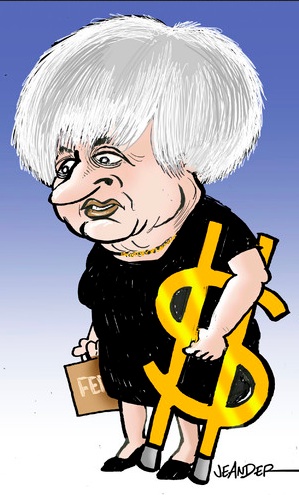
The above mentioned description certainly seems to be the case with Fed Chair Janet Yellen, an appointed government official who has much of the worlds financial future (at least in the near to medium-term) in her hands.
Emily EIsner of the NY Fed writes: The main liabilities of central banks are typically currency (banknotes) and reserves, a form of money that can only be held by banks at the central bank Banks use reserves to make payments among themselves and to the central bank. In addition, some central banks issue deposits to the government. These accounts function as the government’s “checking account” at the central bank.
The Federal Reserve was a central bank that, before the crisis, held mostly currency as its main balance sheet liability. Currency represented 93 percent of the Fed’s liabilities in December 2006, with reserves only 1.5 percent and the Treasury’s general account half a percent. Currency is a sizable liability on most central bank balance sheets in normal times.
Other central banks had a much larger share of their liabilities as reserves before the crisis. One reason to issue a lot of reserves in normal times is to help interbank payments run smoothly; if the supply of reserves is small, banks concerned about running out of reserves at the end of the day may choose to delay payments to other banks, which can create “gridlock.”
As an example, the Norges Bank issued a relatively large amount of reserves before the crisis – 7 percent of its liabilities. Almost 50 percent of the liability side of the Norges Bank balance sheet at the end of 2006 was made up of treasury deposits, and currency represented only 16 percent of liabilities, so its balance sheet looked more like the figure below.
Currency and reserves are “immediate” maturity liabilities, since they can be instantly transferred to other parties for payment. Some central banks also issue term maturity liabilities, either term deposits, which are only available to counterparties that hold a central bank account, or term repos, which are collateralized and available to counterparties beyond depositing institutions. Some central banks have the authority to issue bills. Like Treasury bills, central bank bills are available to nonaccount holders in the secondary market, although some central banks restrict primary issue to account holders. Term liabilities can be issued both to reduce the amount of reserves in the system and to control the central bank’s target interest rate. (This composition is depicted in the figure below.)
For instance, the Bank of England (BoE), the European Central Bank (ECB), the Fed, and the Reserve Bank of Australia (RBA) have been fine-tuning term deposit facilities and repo instruments that have longer maturities than overnight. The BoE, the ECB, the Swiss National Bank, and the RBA are among the central banks that have the ability to issue bills, the Fed does not currently have this authority. Central Bank Assets
The EU has approved €3bn ($3.3bn; £2.2bn) in funding to help Turkey cope with record numbers of Syrian migrants.
The organisation hopes the fund will lower the number of arrivals into EU nations.
Under the deal, the EU’s executive is contributing €1bn to the fund, while the 28 member states will contribute the rest.
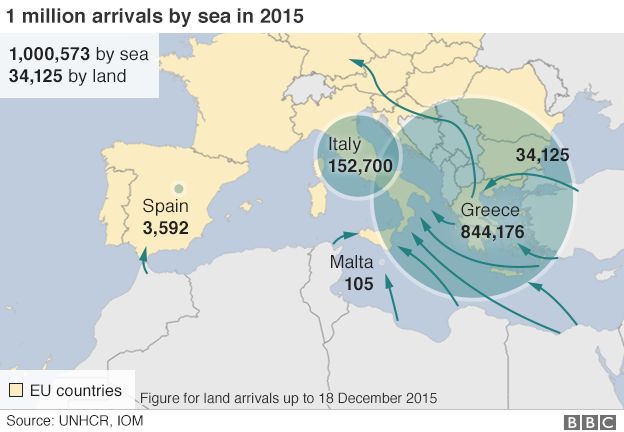
More than a million migrants reached the EU last year by sea, many of them travelling through Turkey.
Turkey is home to nearly three million refugees, most of them fleeing the conflict in neighbouring Syria.
A deal was struck last year between Turkey and the EU, offering Turkey funding and political concessions in return for tightening its borders.
However, financing was only secured on Wednesday after Italy dropped its objections.
Italy had questioned how much of the money should come from EU budgets but the measure has now passed unanimously.
Welcoming the move, European Commission Vice-President Frans Timmermans said: “The money we are putting on the table will directly benefit Syrian refugees in Turkey.
“I also welcome the measures already taken by the Turkish authorities to give Syrian refugees access to the labour market and to reduce the flows.”
Are missing refugee children being exploited?
More than 10,000 refugee children have disappeared in the past two years after registering for asylum in Europe, European Union law enforcement agency Europol warned, as EU leaders looked to stem the flow of migration ahead of warmer weather. Cold winter temperatures and increasingly dangerous sea conditions have not stopped tens of thousands of people from trying to make the risky journey to Europe in January, and young children face added dangers of exploitation both along the trip and upon arrival in the EU.
“Not all of them will be criminally exploited; some might have been passed on to family members,” Europol Chief of Staff Brian Donald said, Agence France-Presse reported Sunday. “We just don’t know where they are, what they’re doing or whom they are with,” said Donald, noting that the 10,000 figure was likely a conservative estimate.
Escalating violent conflicts in the Middle East and North Africa sent more than 1 million people to seek asylum in Europe in 2015, with more than half of them coming from war-torn Syria. While around 27 percent of all refugees that have arrived since 2015 are children, recent research from the United Nations reported that in January, around 55 percent of new asylum-seekers in Europe were women or children.Europol’s report on missing refugee children looked at those who registered as asylum-seekers at some point in Europe and then disappeared. Around 5,000 of the 10,000 missing children disappeared in Italy, a country that has been a popular point of entry for tens of thousands of refugees looking to cross into Europe via the Mediterranean Sea — often coming from North Africa.
Greece has been another frequent point of entry because of its close proximity to Turkey, and EU leaders such as German Chancellor Angela Merkel have looked to stem the flow of refugees traveling from Greece to northern European countries like Sweden and Germany. European authorities have attempted to slow migration by creating a bottle-neck in Balkan countries like Macedonia by adding additional border guards and police vehicles as leaders look for a permanent solution to the crisis, the Wall Street Journal reported.
“So no matter what, we need to prevent the influx from massively increasing again in the spring,” German Interior Minister Thomas de Maziere said, as reported by German magazine Der Spiegel, adding, “time is running out.”
Stephen Foley writes: The world’s largest asset managers have held secret summit meetings to hammer out proposals for improving public company governance to encourage longer-term investment and reduce friction with shareholders.
Jamie Dimon, chief executive of JPMorgan Chase, and Warren Buffettconvened the sessions with the heads of BlackRock, Fidelity, Vanguard and Capital Group to work on a new statement of best practice that would cover the relationship between U.S. companies and their investors.
The unusual collaboration comes at a time of rising shareholder activism and a raging debate about whether public markets demand short-term profits at the expense of long-term investment.
In recent years, some private companies have shunned early public listings, and technology bosses such as Michael Dell have argued that equity markets are too focused on short-term gains. Some large technology groups have also opted to go public with dual-class share structures that limit shareholder rights in an effort to minimise the influence of activist hedge funds.
The group is discussing a statement of best practice on corporate governance. Discussions have focused on issues such as the role of board directors, executive compensation, board tenure and shareholder rights, all of which have been flashpoints at U.S. annual meetings.
Mr. Dimon, in particular, has reason to hope for a rapprochement between boards and long-term shareholders. He has faced personal criticism for combining the role of chairman and chief executive at JPMorgan, and at the company’s last two annual meetings, more than a third of its shareholders voted that he should split the roles.
As well as being a major player in capital markets, JPMorgan also has an asset management arm that is one of the U.S. equity market’s largest investors, with $1.7 trillion in assets. Mr. Buffett, a long-time friend of Mr. Dimon, has eschewed many corporate governance norms at his company, Berkshire Hathaway.
No participants agreed to be quoted on the initiative, which is not expected to come to fruition for several months. The asset managers hope to come up with a list of best practices that they will support at the companies they invest in.
The move comes amid a debate on shareholder rights and responsibilities and on the balance of power between investors, boards and management. Activist hedge funds with more than $100 billion in assets have used their muscle to demand board changes and push companies to increase returns to shareholders, often through share buybacks.
An increasing number of U.S. companies have also agreed this year to offer long-term shareholders the right to nominate their own candidates for board directors.