Sandberg and Lagarde Speak for Women?

Do Sheryl Sandberg  and Christine Lagarde represent women?

Dawn Foster: Will young women be convinced that the freedom they’ve inherited is part of the natural state of affairs and not the temporary outcome of a long battle that is still being waged, and in which everything could suddenly be lost”.

Anyone familiar with abortion rights campaigns, for example, knows this to be true. Reproductive freedoms have been hard won in many countries, but millions of women worldwide are still denied the right to abortion, and religious groups are committed to chipping away at reproductive rights across the globe.

Women’s rights are precarious. It’s not simply a question of marching towards a more equal future: we have to keep an eye on the past too. For every battle won, there remain people who will happily reverse those decisions and cast women back decades in terms of social progress. This is the problem with using individual women’s successes as bellwethers of feminist progress. Sheryl Sandberg (COO of Facebook), Marissa Mayer (CEO of Yahoo!) and Christine Lagarde (managing director of the International Monetary Fund) may talk about women’s equality, and proffer their own positions as proof of progress – but post-crash, many women feel their lives are measurably worse.y.

It’s all well and good to encourage women in business to speak up more in meetings, but most women don’t – and will never – work in managerial roles. And for them, being told women must be the architects of their own fortune won’t wash. A broader understanding of how inequality is perpetuated, and how the economy disadvantages women, can yield policy that is fairer to women.  Representative Women


Impact of Banks on the Economy

Katrina Brindle writes:   On the morning of September 15 2008, the Lehman Brothers declared bankruptcy, introducing a chain of events that would throw Wall Street and the global market into a state of crisis and economic paralysis. Delegates assuming the roles of key figures in both the private and public sectors of the US economy were introduced to this crisis during the second “Too Big to Fail” committee meeting at McMUN. While certain ideological divisions between representatives for the federal government and CEOs of financial juggernauts within the committee were to be expected, the cleavages found within this crisis extended much further than the domestic squabble about who would be truly to blame for such systemic financial failures.

CEO of Goldman Sachs Lloyd Blankfein proposed a directive emphasizing the importance of reaching out to foreign markets to help mitigate this meltdown. He insisted that there is no use for a “fatalist attitude” when facing this kind of adversity. Unfortunately, this commitment to reject any pessimistic or reactionary stance did not sit well with France’s foreign policy, and the country decided to freeze all US trading assets as an expressly punitive action. What France’s Minister of Finance Christine Lagarde demanded from the committee was to act in ways which would restore confidence and trust in the American economy, a demand that was echoed by an American public on the precipice of a recession and devastating financial loss.

The 2008 crisis was not only one of financial turmoil, but one that spoke directly to the psychological ramifications of having the “American Dream” ripped out of the foundation of a country built on the pillars of prosperity and a successful free market economy. Stabilizing banks could be done through federal bailouts and foreign investment, but how could one influence a country’s public perception in any meaningful way during a time of such urgency? After the stunning announcement from the French Minister of Finance, the committee stayed true to its goals of overcoming political differences and passed five different directives by the end of the session, one of which directly targeted public perception of the crisis. “Keep Confidence High”, proposed by Lloyd Blankfein, Ken Lewis and Ron Logue, suggested that the federal government should lower interest rates to 2%, in order to increase liquidity and bail out mid-market troubled banks, but most importantly encouraged an increased transparency in the government handling of this market failure, through public announcements and updates.

As the market failure unfolds and the problems that are given to the delegates will exponentially grow in complexity, the issue of assigning guilt and culpability will become increasingly less relevant. In order to survive this simulation, the delegates cannot simply formulate policies that satisfy the demands of foreign finance ministers. They will have to answer to the fears and insecurities of the American public, the body that has the most to lose in the blame game of Wall Street.

Tentacles of the Big Banks


China and the Exchange Rate

China has no intention of devaluing its currency to push up exports nor any plans to enter into a currency war, Premier Li Keqiang assured the managing director of the International Monetary Fund, or IMF, Christine Lagarde, in a telephone conversation.

Addressing concerns over the depreciation of the Chinese currency, Li reiterated there is no basis for a continued devaluation of the yuan and denied China was reducing the value of its currency to boost weakening exports.

China exercises tight control over the renminbi exchange rate, setting a daily reference rate, and only allowing for a maximum fluctuation of 2 percent.

Some analysts interpret yuan devaluation as an attempt by the country to boost its slowing economy, while Beijing argues it is a way to gauge its currency against the dollar.

Li also assured Lagarde, China will increase communication with the market to “keep the RMB exchange rate basically stable at an adaptive and equilibrium level” and requested the IMF head to repose confidence in the Chinese economy despite the slowdown.

Li said China was capable of maintaining stable and sustainable growth, a week after it was revealed the Asian giant’s GDP grew 6.9 percent in 2015, its lowest ever in 25 years.

The discussion between Li and Lagarde comes shortly after the IMF’s quota reforms – that gives greater say to emerging economies including China – take effect, and at a time when Lagarde is looking for support to renew her tenure as head of the financial institution.

However, it is unknown if the Chinese premier offered to endorse Lagarde, who has already received backing from several European governments, as also from Japan and Brazil.

Yuan and Dollar

Warren Asks: Is Justice Rigged?

Senator Elizabeth warren finds punishments meted out to financial industry shockingly weak.

Democratic U.S. Senator Elizabeth Warren released on Friday a report criticizing what she called “shockingly weak” punishments for corporate crimes and condemned the Justice Department and Securities and Exchange Commission for their lax approach.

Warren, in a 13-page report titled “Rigged Justice,” outlined 20 civil and criminal cases from 2015 that she said illustrated patterns of weak and problematic enforcement of white-collar crimes, either as a result of “limited resources or lack of political will.”

“The Obama administration has made repeated promises to strengthen enforcement and hold corporate criminals accountable, and the DOJ announced in September that it would place greater emphasis on charging individuals responsible for corporate crimes,” Warren wrote.

“Nonetheless … accountability for corporate crimes is shockingly weak.”

Warren, a favorite among progressives, criticized the Justice Department and federal law enforcement agencies for rarely prosecuting individuals.

She called the SEC “particularly feeble” and said loose regulation at other agencies often turns legal rules into suggestions, which companies can freely ignore.

Warren said federal law is unambiguous in stating that if a corporation has committed a violation, individuals working there also must be at fault, but that federal agencies rarely pursue convictions of large corporations or their executives.

“If justice means a prison sentence for a teenager who steals a car but it means nothing more than a sideways glance at a CEO who quietly engineers the theft of billions of dollars, then the promise of equal justice under the law has turned into a lie,” she wrote.

“The contrast between the treatment of highly paid executives and everyone else couldn’t be sharper.”

The report, which Warren said will be the first in an annual series on enforcement, described low-punishment cases ranging from for-profit colleges engaging in deceptive recruitment practices to General Motors covering up years of ignition switch problems in its vehicles.

Another example listed was the Upper Big Branch Mine Disaster, in which Massey Energy CEO Donald Blankenship was convicted of one misdemeanor following a mine explosion that killed 29 people, despite his company’s history of safety failures.

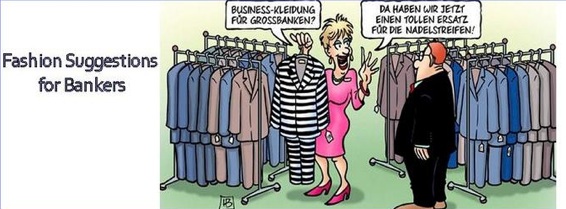
Jail Offending Bankers


With the Cloud, Do We Still Have to Move Brains on Planes?

Ricardo Hausmann writes:  Think about it: You can call, email, and even watch your counterparty on FaceTime, Skype, or GoToMeeting. So why do companies fork out more than $1.2 trillion a year – a full 1.5% of the world’s GDP – for international business travel?

The expense is not only huge; it is also growing – at 6.5% per year, almost twice the rate of global economic growth and almost as fast as information and telecommunication services. Computing power has moved from our laptops and cellphones to the cloud, and we are all better off for it. So why do we need to move brains instead of letting those brains stay put and just sending them bytes? Why waste precious work time in the air, at security checks, and waiting for our luggage?

Before anyone starts slashing travel budgets, let’s try to understand why we need to move people rather than information.

More populous countries have more business travel in both directions, but the volume is less than proportional to their population: a country with 100% more population than another has only about 70% more business travel. This suggests that there are economies of scale in running businesses that favor large countries.

By contrast, a country with a per capita income that is 100% higher than another receives 130% more business travelers and sends 170% more people abroad. This means that business travel tends to grow more than proportionally with the level of development.

While businesspeople travel in order to trade or invest, more than half of international business travel seems to be related to the management of foreign subsidiaries.

But why do we need to move the brain, not just the bytes?  First, the brain has a capacity to absorb information, identify patterns, and solve problems without us being aware of how it does it. That is why we can, for example, infer other people’s goals and intentions from facial expressions, body language, intonation, and other subtle indicators that we gather unconsciously.

When we attend a meeting in person, we can listen to the body language, not just the spoken word, and we can choose where to look, not just the particular angle that the video screen shows. As a consequence, we are better able to evaluate, empathize, and bond in person than we can with today’s telecom technologies.

Second, the brain is designed to work in parallel with other brains. Many problem-solving tasks require parallel computing with brains that possess different software and information but that can coordinate their thoughts. That is why we have design teams, advisory boards, inter-agency taskforces, and other forms of group interaction.

Conference calls try to match this interaction, but it is hard to speak in turn or to see one another’s expressions when someone is talking. Conference calls have trouble replicating the intricacy of human conscious and unconscious group interactions that are critical to solve problems and accomplish tasks.

The countries that account for the most travel abroad, controlling for population, are all in Western Europe: Germany, Denmark, Belgium, Norway, and the Netherlands. Outside of Europe, the most travel-intensive countries are Canada, Israel, Singapore, and the United States, a reflection of the fact that they need to deploy many brains to make use of their diverse know-how.

Interestingly, countries in the developing world differ substantially in the amount of know-how they receive through business travel. For example, countries such as South Africa, Bulgaria, Morocco, and Mauritius receive much more know-how than countries at similar levels of development such as Peru, Colombia, Chile, Indonesia, or Sri Lanka.

The fact that firms incur the cost of business travel suggests that, for some key tasks, it is easier to move brains than it is to move the relevant information to the brains. Moreover, the fact that business travel is growing faster than the global economy suggests that output is becoming more intensive in know-how and that know-how is diffusing through brain mobility. And, finally, the huge diversity of business travel intensity suggests that some countries are deploying or demanding much more know-how than others.

Rather than celebrate their thrift, countries that are out of the business travel loop should be worried. They may be missing out on more than frequent flyer miles.


 Business Travel

Can the Welfare State Afford to Take in Immigrants?

Hans Werner-Sinn writes:  The armed conflict destabilizing some Arab countries has unleashed a huge wave of refugees headed for Europe. About 1.1 million came to Germany alone in 2015. At the same time, the adoption of the principle of freedom of movement within Europe has triggered massive, but largely unnoticed, intra-European migration flows. In 2014, Germany experienced an unprecedented net inflow of 304,000 people from other EU countries, and the number was probably similar in 2015.

Some EU members, including Austria, Hungary, Slovenia, Spain, France, and the initially welcoming Denmark and Sweden, have reacted by practically suspending the Schengen Agreement and reinstating border controls. Economists are not really surprised at this. In the 1990s, dozens of academic papers addressed the issue of migration into welfare states, discussing many of the problems that are now becoming apparent.

A fundamental issue is at stake. Welfare states are defined by the principle that those who enjoy above-average income pay more taxes and contributions than what they get back in the form of public services, while those with below-average earnings pay less than they receive. This redistribution, channeling net public resources toward lower-income households, is a sensible correction to the market economy, a kind of insurance against life’s vicissitudes and the rigors of scarcity pricing that characterize the market economy and have little to do with equitableness.

Welfare states are fundamentally incompatible with the free movement of people between countries if the newcomers have immediate and full access to public benefits in their host countries.  Only if migrants received only wages could efficient self-regulation in migration be expected.

British Prime Minister David Cameron drew the right conclusion from this: Welfare magnetism not only leads to an inefficient geographical distribution of people; it also erodes and damages the magnet. That’s why Cameron is demanding a limitation of the inclusion principle, even for intra-European economic migrants. Even if they find a job, says Cameron, migrants should get access to tax-financed welfare benefits only after four years.

The proposal does not necessarily imply hardship for EU migrants; it simply means that any support they may require over the four-year period is to be financed by their home country.

The home-country principle would usually be impossible to apply in these cases. But, for the same reasons outlined above, these migrants cannot be integrated by the hundreds of thousands into the welfare state without jeopardizing the system’s viability.

Therefore, the currently prevailing wage-replacement benefit system, which is applied when recipients do not work, should be replaced with a system offering wage supplements and community work. This would lower the benefits’ net costs and weaken incentives to migrate. Andrea Nahles, Germany’s labor minister, recently suggested as much, defending what Germans call the one-euro-jobs concept, which basically converts welfare into a wage.

That is sound advice in an otherwise chaotic state of affairs. If freedom of movement within Europe is to be maintained – and if high inflows of non-EU citizens continue – European welfare states face a stark choice: adjust or collapse.

Costly Immigrants

How to Measure China’s Slowdown

Stephen S. Roach writes:   The prospect of an economic meltdown in China has been sending tremors through global financial markets at the start of 2016. Yet such fears are overblown. While turmoil in Chinese equity and currency markets should not be taken lightly, the country continues to make encouraging headway on structural adjustments in its real economy.

Consistent with China’s long experience in central planning, it continues to excel at industrial reengineering. Trends in 2015 were a case in point: The 8.3% expansion in the services sector outstripped that of the once-dominant manufacturing and construction sectors, which together grew by just 6% last year.

This significant shift in China’s economic structure is vitally important to the country’s consumer-led rebalancing strategy. Services development underpins urban employment opportunities, a key building block of personal income generation. With Chinese services requiring about 30% more jobs per unit of output than manufacturing and construction, combined, the tertiary sector’s relative strength has played an important role in limiting unemployment and preventing social instability – long China’s greatest fear. On the contrary, even in the face of decelerating GDP growth, urban job creation hit 11 million in 2015, above the government’s target of ten million and a slight increase from 10.7 million in 2014.

The bad news is that China’s impressive headway on restructuring its real economy has been accompanied by significant setbacks for its financial agenda – namely, the bursting of an equity bubble, a poorly handled shift in currency policy, and an exodus of financial capital. These are hardly inconsequential developments – especially for a country that must eventually align its financial infrastructure with a market-based consumer society. In the end, China will never succeed if it does not bring its financial reforms into closer sync with its rebalancing strategy for the real economy.

Capital-market reforms – especially the development of more robust equity and bond markets to augment a long dominant bank-centric system of credit intermediation – are critical to this objective. Yet in the aftermath of the stock-market bubble, the equity-funding alternative is all but dead for the foreseeable future. For that reason alone, China’s recent financial-sector setbacks are especially disappointing.

But setbacks and crises are not the same thing. The good news is that China’s massive reservoir of foreign-exchange reserves provides it with an important buffer against a classic currency and liquidity crisis. To be sure, China’s reserves have fallen enormously – by $700 billion – in the last 19 months. Given China’s recent build-up of dollar-denominated liabilities, which the Bank for International Settlements currently places at around $1 trillion (for short- and long-term debt, combined), external vulnerability can hardly be ignored. But, at $3.3 trillion in December 2015, China’s reserves are still enough to cover more than four times its short-term external debt – well in excess of the widely accepted rule of thumb that a country should still be able to fund all of its short-term foreign liabilities in the event that it is unable to borrow in international markets.

Of course, this cushion would effectively vanish in six years if foreign reserves were to continue falling at the same $500 billion annual rate recorded in 2015. This was precisely the greatest fear during the Asian financial crisis of the late 1990s, when China was widely expected to follow other so-called East Asian miracle economies that had run out of reserves in the midst of a contagious attack on their currencies. But if it didn’t happen then, it certainly won’t happen now: China’s foreign-exchange reserves today are 23 times higher than the $140 billion held in 1997-98. Moreover, China continues to run a large current-account surplus, in contrast to the outsize external deficits that proved so problematic for other Asian economies in the late 1990s.

Still, fear persists that if capital flight were to intensify, China would ultimately be powerless to stop it. Nothing could be further from the truth. China’s institutional memory runs deep when it comes to crises and their consequences. That is especially the case concerning the experience of the late 1990s, when Chinese leaders saw firsthand how a run on reserves and a related currency collapse can wreak havoc on seemingly invincible economies. In fact, it was that realization, coupled with a steadfast fixation on stability, that prompted China to focus urgently on amassing the largest reservoir of foreign-exchange reserves in modern history. While the authorities have no desire to close the capital account after having taken several important steps to open it in recent years, they would most certainly rethink this position if capital flight were to become a more serious threat.

Yes, China has stumbled in the recent implementation of many of its financial reforms. The equity-market fiasco is especially glaring in this regard, as was the failure to clarify official intentions regarding the August 2015 shift in exchange-rate policy. These missteps should not be taken lightly – especially in light of China’s high-profile commitment to market-based reforms. But they are a far cry from the crisis that many believe is now at hand.

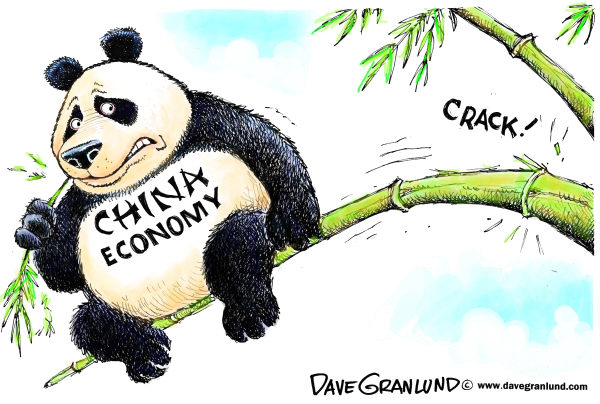
China's Slowdown

Employment Hits Highs in UK

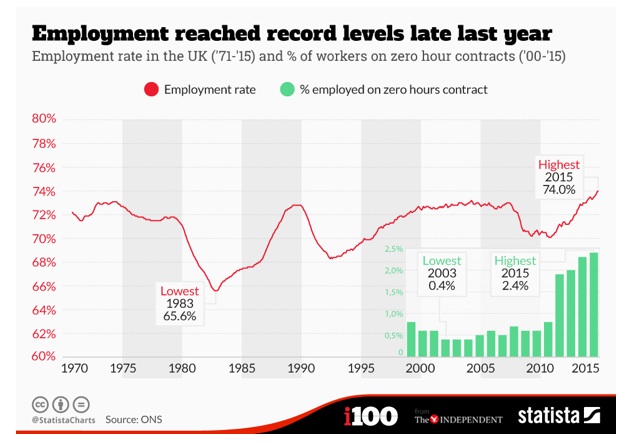
According to official figures released by the Office for National Statistics (ONS), the employment rate in the UK reached its highest level last year since records began in 1971.

Over the past 15 years, there has also been a rise in zero hours contracts.

This chart shows the employment rate in the UK and the percentage of workers on zero hour contracts.

Employment in UK


Relationship Between Subprime Mortgage Crisis and Oil Price Plunge?

Tracey Allway writes:  Is there a relationship between the subprime mortgage crash and the disorderly fall in the price of oil.

Created in January 2006 and consisting of a basket of credit default swaps (CDS) tied to the welfare of subprime mortgages, it allowed a bevy of investors to bet on the future direction of riskier home loans and helped inflate the massive amounts of leverage tied to the U.S. housing bubble. More recently it played a starring role in the film version of Michael Lewis’s The Big Short—when protagonists Christian Bale, Steve Carell, et al. are tracking their bets against the U.S. housing market, they are tracking the ABX.

Fast-forward to today and Bank of America analysts provide an update to their previous thesis, which was that the downward spiral in the price of oil was shaping up to look a lot like the negative trend that engulfed the subprime space circa the year 2007.

Here’s what they say:

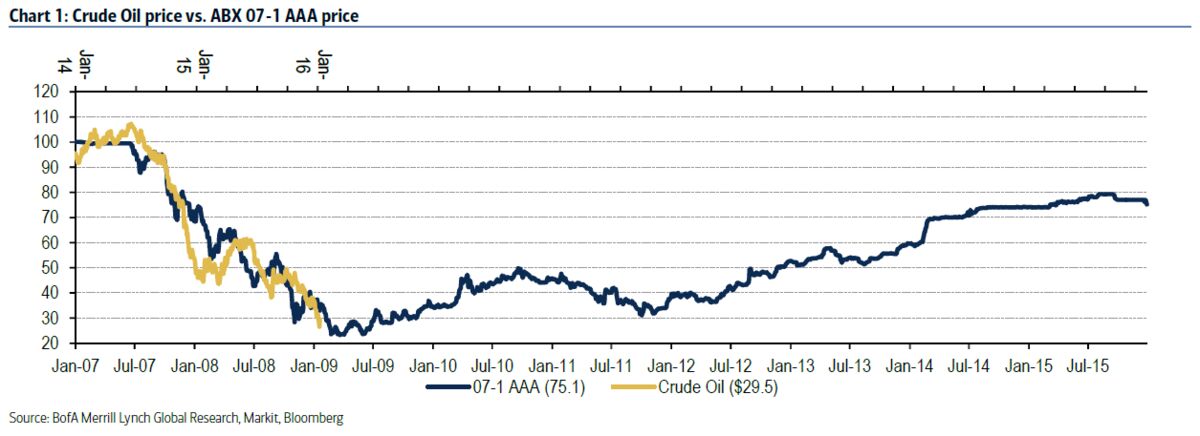
The pattern of the decline in the price of oil that began in mid-2014 is remarkably similar to the 2007-2009 pattern of the price decline of ABX, the credit derivative index that referenced subprime mortgages and, ultimately, the U.S. housing market (Chart 1). The ABX history suggests that oil will see more declines in the next couple of months and find a floor somewhere in the low 20s in the March-April time frame. Both the duration of the decline (1.5+ years) and the scale of the decline (100 neighborhood starting price down to the sub-30 neighborhood) are similar. Given that both housing and oil prices were fueled to spectacular heights in the two periods by massive credit expansion, it’s probably more than just coincidence that the respective “bubble” bursting patterns are so similar.

Consider how things tend to work. Denial on what constitutes fair value is a big component of bubbles, on the part of both market participants and policymakers. When perceived “bubbles” burst, markets take their time in steadily shredding views of the perception of fundamental value, as prices move lower and lower. Along the way, many will cite “technical factors” as the cause of the decline, which in some way suggests the price decline may not be real when in fact it is all too real. In the end, the technicals drive the fundamentals, as credit flees and borrowers go bust, and a feedback loop lower kicks in. Lower prices beget accelerated selling, as asset owners need to raise cash. It could be margin calls or it could be producer selling needs, it doesn’t really matter: the selling becomes inevitable and turns into forced selling.

Source: BofAML

The point here is not that oil is necessarily the new subprime crisis per se but that the recent action in the price of crude resembles nothing if not the bursting of a bubble and the sudden realization that the asset has been overvalued for too long. More worrying for oil investors will be BofAML’s idea of forced selling. As Flanagan notes: “The systemic margin call of 2008 seems to be back for now, albeit to a far lesser degree.”

.

Entrepreneur Alert: Fastest Growing Apps

We may still be listening to the radio, read the news and or watch television shows, but more and more often we’re doing it on our mobile devices or, to be more precise, within apps.

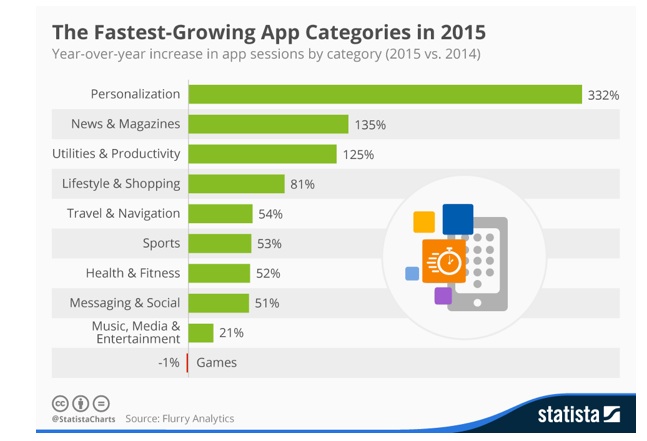
When the first iPhone was released in 2007, there was no App Store and the idea of a phone doing all of the stuff today’s smartphones are capable of seemed ludicrous to say the least. It was the introduction of apps that really started what we consider the mobile revolution in retrospect. Ever since Apple introduced the App Store in 2008, app usage has been growing and it continues to do so until today. According to Flurry Analytics, a company tracking usage across millions of apps, global app usage increased by 58% in 2015 (compared to 76% in 2014 and 103% in 2013).

Personalization apps (e.g. emoji keyboards or wallpaper apps) were the fastest-growing category in 2015. App sessions (that is the number of times a user opens an app) increased by 332% in this category. News & magazine apps were the second-fastest growing app category in the past 12 months. As smartphone screens keep getting bigger, consumers are increasingly open to consuming content on their mobile devises.

Fast Growing Apps