Technology’s Impact on Banking?

Does regulation inhibit new forms of banking?

Dambisa MoyoIt writes:  Banking is a rare industry nowadays that is not at risk of being upended by digital technology. Amazon, having swept away bookshops, is now laying siege to the rest of the retail sector. In transportation, Uber is outrunning traditional taxi companies, while Airbnb is undermining the foundations of the hotel industry. Meanwhile, smartphones are transforming how we communicate and revolutionizing the way we discover and patronize businesses.

So it is no surprise that banking and financial-services companies are not safe from the immense transformations wrought by technological innovation. Indeed, for the last decade, digital startups have been penetrating areas traditionally dominated by the financial industry. But there is reason to believe that finance will prove resilient.

Today, money can be sent to the other side of a country – or the world – simply by tapping an app, without ever interacting with a traditional financial-services company. Migrants’ remittances alone, which the World Bank estimates will total $586 billion this year, represent a tremendous growth opportunity for companies competing with banks to move money.

Meanwhile, would-be disrupters are offering opportunities to save and invest – the very heart of traditional banking institutions’ operations. Startups such as Acorns – an app that automatically allocates a proportion of everyday purchases to a pre-selected investment portfolio – are making rapid inroads into a very competitive marketplace.

Acorns, launched in 2014, already manages more than 650,000 investment accounts. The company – and others like it – are not just moving into the market; the simplified investment and savings processes they offer are expanding and transforming it. According to research by the digital ad agency Fractl, approximately 85% of millennials are saving a portion of their paycheck – a larger percentage than their predecessors.

Lending, too, is being transformed by technology. Crowdsourced funding and peer-to-peer lending schemes give borrowers the opportunity to circumvent many of the hurdles of traditional banking – including, in some cases, collateral requirements and credit ratings.

According to the research firm Massolution, the crowdfunding market has grown exponentially, from $880 million in 2010 to $16.2 billion in 2014. Global crowdfunding volumes are expected to double this year, surpassing $34 billion. In 2016, crowdfunding is expected to provide more funding than traditional venture capital.

Even financial services traditionally characterized by face-to-face dealings with clients, such as investment banking advisory services, have been affected. When Google conducted its initial public offering in 2004, it chose to bypass the investment banking industry, which traditionally underwrites the process of taking a company public. Instead, the company opted for an electronic auction in which anyone could participate. Other companies – like the financial research firm Morningstar – have followed suit. While these attempts to revolutionize the equity capital markets have yet to gain widespread traction, their very existence is evidence of the opportunities for disruption in this sector.

But it would be premature to conclude that traditional banking has yielded to new financial platforms. Many of the new entrants have benefited from advantages that would be difficult to maintain were they to scale up in size and importance.

Traditional banking is subject to intense oversight, and regulations have only become more onerous in recent years, as regulatory authorities reacted to the 2008 global financial crisis by tightening rules on leveraging ratios and know-your-customer requirements. Many upstarts in the sector have carved out a competitive advantage by avoiding thresholds beyond which they would face substantial regulatory scrutiny and requirements.

This places a significant constraint on the size and type of financial transactions these new companies can offer. By steering clear of services that might draw the scrutiny of financial authorities, digital startups face a natural limit to the size of their market. Indeed, this arrangement – albeit informal – can be viewed as the way regulators manage the systemic risk posed by new entrants.

As the digital revolution evolves, much of the financial terrain in which technology companies are making the deepest inroads will come into much sharper regulatory focus. This will favor the established players. As a result, the digital revolution’s assault on the traditional banking industry is by no means overwhelming. In finance, at least, technology firms should not be viewed simply as a threat, but as a source of productivity-boosting innovation.

Banking and Technology
Banking and Technology

Norway’s Investors Look Hard at China

Yngve Slyngstad runs the world’s biggest sovereign wealth fund and travels around China for a week once a year.

Understanding what’s poised to become the world’s largest economy is crucial for Slyngstad as he manages a fund that Norway predicts will reach $1 trillion in less than three years. He’ll be in China this month, visiting Beijing and other cities.

Growth in China is slowing and the lack of transparency is making it hard for investors to understand exactly why.

Slyngstad, who last year visited Shenzhen, Hangzhou and the Shandong province, is looking for investments to channel billions of dollars in Norway’s oil cash. He has been lobbying the Chinese government to allow the fund a bigger quota than the $1.5 billion it’s permitted to place in Chinese A shares.

Norges Bank Investment Management, which runs the fund as part the central bank, owned 1.3 percent of global stocks at the end of last year.

Figuring out how to invest in China is just one of many hurdles. Slyngstad said one of the main worries now is how monetary policy will affect his investment decisions. Continued turmoil in the EU and distortions in credit markets also cause concern.

Slyngstad said the fund is now “less invested in” credit markets after excess liquidity distorted prices. He’s adjusting the portfolio even after corporate bonds were the fund’s best performing asset class in the third quarter.

The financial crisis — during which the fund has bought up cheap securities everyone else was selling — has challenged truths about investment, monetary policy, the economy and the financial markets, he said. It has showed that the financial industry has the capacity to heal itself, with or without the help of regulators, according to Slyngstad.

The power of the crisis could be called “Schumpeterian creative destruction,” said Slyngstad, who has studied German philosophy.  “Crisis within the financial sector also serves a purpose,” he said. “You have to be careful about something that without a crisis looks stable, but may also turn stagnant.”.

A discussion on broadening the asset mix of the fund is coming “no matter” what, and a tipping point could be when it has reached 4 percent in real estate, Slyngstad said. The fund has so far snapped up properties on Times Square in New York,  the Avenue des Champs-Elysees in Paris, Regent Street in London as well as San Francisco, Washington and Zurich among other cities.

“That will be a natural touch point,” he said. “Both for the real estate question, and for the real assets question.”

Norway's Investments

AIG Against the US

Lawyer David Boies has a shot at an upset win in the trial of Maurice “Hank” Greenberg’s $25 billion bailout case against the U.S. government, a turnaround from the weak odds he was given just a month ago.

Boies, representing Greenberg and other AIG shareholders, has had a series of evidentiary rulings go his way since the trial began Sept. 29 in Washington.

Beyond the money at stake, Justice Department lawyers are also fighting to prevent a verdict that the Federal Reserve acted illegally by charging a high interest rate and demanding equity as a condition for the loan. Such a ruling could limit the tools available to the government in a future economic crisis.

In their defense, the three top designers of the bailout, former Treasury Secretary Henry Paulson, ex-Federal Reserve Chairman Ben Bernanke and Timothy Geithner, the former Treasury secretary who was president of the Federal Reserve Bank of New York in 2008, all testified that the U.S. rescued AIG to avert the catastrophic damage that would have occurred if the insurer went bankrupt.

The heart of Starr’s argument is that however noble the government’s aims, it used power it didn’t have to take over AIG and further harmed shareholders by failing to pay just compensation.

As an example of how shareholders’ due process rights were violated, Boies highlighted the more favorable treatment troubled investment banks including Goldman Sachs and Morgan Stanley.

U.S. Court of Federal Claims Judge Thomas Wheeler frequently overruled government objections to Boies’s questions and handed him beneficial evidence rulings.

In a skirmish over the so-called Doomsday Book, the New York Fed’s compendium of confidential legal opinions on its emergency powers, Wheeler said he was inclined to grant broad access to Starr.

Wheeler rebuked Justice Department lawyers several times for attempting to rely on hearsay testimony, introducing exhibits in violation of trial rules about redactions, and dragging out proceedings by reading lengthy passages from documents.

The case going to trial at all was a victory for Boies and Greenberg, because the judge’s refusal to dismiss it was a rejection of the notion by some legal experts that the lawsuit was without merit.  .

Wheeler in July 2012 wrote that he agreed with Starr’s argument that the only consideration for a loan under the Fed’s emergency powers can be an interest rate set by the Board of Governors — not a demand for equity.  In the same 2012 ruling, Wheeler wrote that he didn’t buy a government assertion that authority for demanding equity came from the “incidental powers” section of the Federal Reserve Act, which deals with unspecified actions needed “to carry on the business of banking.”

Boies’s position that the U.S. didn’t have authority to demand equity was bolstered by testimony from Bernanke, who told Boies that he didn’t read the word ‘rate’ in the emergency-powers section of the Federal Reserve Act to include equity.

The government countered with testimony from the general counsel for the Federal Reserve Board of Governors. Alvarez said he concluded that the board could empower a reserve bank “to extend credit and in giving that authorization can set whatever limits and restrictions and rules the Federal Reserve Board believes is appropriate,” including demanding equity..

Geithner testified he barely looked at the Doomsday Book because much of its counsel for the Fed was formulated during the Great Depression.

If guidance for the future is Wheeler’s goal, it may nonetheless have little impact, said Philip Wallach, a fellow at the Brookings Institution.  Regulators faced with a crisis will do what they think is necessary and worry about the consequences later.

Bailing Out

Japan Spreads its WIngs

A weak domestic econmoy has encouraged Japanese businesses to exapnd abroad.  Japanese investment in Southeast Asia doubled to $24 billion last year.

Jaan focused on the automotive and electronic sectors of Thailand, Malaysia and Singapore during the 1980s and 90s.  japan moved its focus to China’s cheap laobor market at the end of the century.  But now relations between Japan and China have soured and Southeast Asis looks good again.

QE and newly created money under Shinzo Abe’s policy has left Japan with money to invest abroad.  But if this policy changes, that market will dry up.  Abe wnats Japanese firms to invest more at home.  A weak yen makes it possible to do this.  Canon is trying to shift production back to Japan, but Mitsubishi is building a new plant in Indonesia.  Impovements in corporate governancce have forced Japanese firms to look for profits they overlooked in the past.

Japan risks becoming a rentier economy, living off profits made in other countries and failing to getbroad-based wage growth at home.

Japan Builds in Southeast Asia

Deutsche Bank Struggles

Deutsche Bank is in trouble, some of it its own making.  Its history is in many ways the history of big banks in the 20th going into the 21st century.  To sum up:

1.  About 25 years ago DEutsche Bank started its transformation from a small German lender to a global investment bank, trading bonds, currencies and commodities (FICC).

2. DB offered issuing of bonds, hedging of foreign exchange risks to its corporate clients, mostly mid sized colmpanies in Germany.

3.  Gobal markets gave DB a chance to speculate for its own account and DB shares traded at twice the vallue of tangible DB assets.

4.  The outsized FICC business becomes a liability andthe hgiher the ahreof cinome from trading, the lower the share price.

5.  European banks argue that they need a trading floor to serve corporated clients.

6.  Low interest rates and bond market stability make corporate clients less prone to juggle their accounts

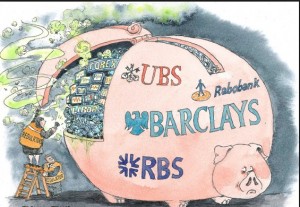
7.  All the big banks have been subected to big fines including DB.

8.  Post recession regulation is a big drag on big banks.  Rules imposed on domestic lenders in the US will be extended to foreign banks.  Regulators in the US have called DB reprorting, “low quality, inacurate, and unreliable.

Deutsche Bank Struggles


Anti-Competition and Tax Breaks in the EU

Joaquín Almunia steps down as ‘competition” commissioner.  Many European politicians have objected to his anti-trust efforts, particularly against Google.  He also tried to investigate tax favoritism for big corporations who promised to bring jobs to countries in exchange for low tax rates.  Among the companies he targeted: Apple in Ireland, Starbucks in the Netherlands, Amazon and Fiat SpA in Luxembourg.

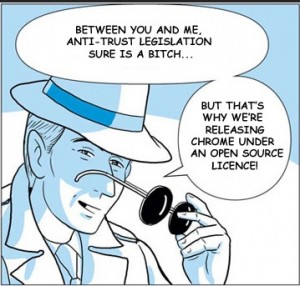
The Google case has caused the most furor.  Almunia has said that it should not be a poitical football, but his efforts to come to a peaceful resolution with the company have come to naught.

Search engine favoritsm for consumers who subscribe to many Google products is being challenged as anti-competitive. In the US too people are beginning to realize that there is no free lunch.  Products you use for free from Google, Facebook, Twitter and Skype also subject your personal data to wide dissemination.

Google


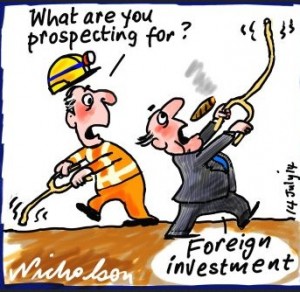
Looking Forward to the End of Sanctions in Iran

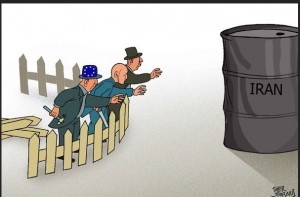
The prospects of sanctions against Iran ending and the opening up of that market are enticing to entrepreneurs and business people the world over.  Familiar faces are returning to the country.  Peugeot, which once had 20% of the car market, is coming back.

Sanctions have depressed the GDP by 25% in the last three years. Iran has $1.8 billion in purchasing power and is by that measure 18 on the world list.  The population is well-educated.  Its oil and gas reserves are huge.

The Teheran stock exchange is seond biggest in the Middle East.  Turkey’s stock exchange is 50% owned by foreigners; Iran’s 0.1%.

Among attractive investments for foreigners are manufacturing and retail.  The country has a need also for bankers.

Iran’s oil reserves are the world’s largest and yet it has only 1% of the world market.

At first, entreprise in Iran will be cramped by their limited capacity to handle foreign capital.  Privitization and economic reforms have to happen.  Many important areas of the economy are controlled by the Revoutionary Guard, part army and part intelligency agency.  Its presence has been expanded in business over the past several years.

End of Iran Sanctions?


Turkey Is Expanding Islamic Banking

Turkey’s government has moved to expand Islamic banking by inviting public banks into the sector. Earlier this month, the largest state-run bank, Ziraat, received approval to establish an Islamic unit, a landmark move in a country where public lenders have so far stayed out of the Islamic finance realm.  In a first for Turkey, a state-run bank is poised to enter the Islamic banking sector, and other major state lenders are expected to follow.

Ziraat Bank got permission to set up a “participation bank” with $300 million in capital. Islamic banks are called “participation banks” in Turkey, a moniker for interest-free banking that refers to participation in profits from certain financial instruments.

Ziraat has nine months to establish the new bank. But a key question remains unanswered: Where will the capital come from? Ziraat is a conventional bank, whereas paying and charging interest is prohibited in Islam. How is a bank that charges and pays interest supposed to create a bank that rejects interest? If Ziraat’s interest-based earnings are considered illicit, how is it going to establish the capital of an interest-free bank?

To resolve the conundrum, the Treasury is reportedly planning to proivde the required caiptal. The Treasury, too, operates on the basis of interest — but perception is what matters. Hence, the Treasury is expected to transfer $300 million to Ziraat, a sum that will first figure in Ziraat’s assets and then become the capital of the prospective participation bank.

The government, seeming quite enthusiastic on the issue, is not expected to stop there. Another state-run lender, Vakifbank, is planning to follow in Ziraat’s steps. Things are likely to be easier for it since Vakifbank’s main shareholder, the Directorate General of Foundations, will provide the capital for the planned participation bank without stumbling over interest snags.

Simultaneously or shortly after, the third state-run bank, Halkbank, is expected to follow suit as the state descends on the sector with all its might.

The government has already submitted a bill to parliament to clear legal hurdles in Vakifbank and Halkbank’s path to Islamic banking.

Faik Oztrak, deputy chairman of the main opposition Republican People’s Party and a former Treasury undersecretary, argued that the state-run banks’ venture into Islamic banking would be a constitutional breach.

How is participation banking different from conventional? In participation banking, the interest, considered illicit in Islam, is replaced with dividends paid to depositors from profits derived through various investment instruments.

In Turkey, participation banks use mostly the “murabaha” and “sukuk” techniques. In murabaha, the bank buys a commodity from a company in the portfolio it has created, adds a margin and then sells it. Clients are informed in advance how much profit they will get and in what time, just as with interest. The earning, however, is called a “profit share” rather than interest. The collected deposits, meanwhile, serve to provide capital support for companies whose commodities are sold.

Sukuk can be described simply as an interest-free bond. Purchasers of sukuk issued by participation banks receive yields under names other than interest. The key difference is that conventional bonds are Treasury guaranteed, while a sukuk certificate is issued on the basis of a tangible material asset.

Islamic banking, based largely on temporary partnerships in company profits, is popular in the Gulf, other parts of the Middle East and Far East.  Participation banks, which debuted in 1985 in Turkey, have total assets of 81.5 billion Turkish lira ($36.9 billion) and 869 branches across the country today. The total financing they have made available to the real economy has exceeded 60 Turkish lira ($27.2 billion).

Globallly more than 700 Islamic banking institutuions, relying mostly on Gulf money, operate in 75 countries, offering 52 financial instruments. Their total assets reached $1.8 trillion as of 2013. The sector is expected to be worth $6.5 trillion in 2020. Observers note that Islamic banking has grown in popularity and expanded quickly since the 2008 global crisis.

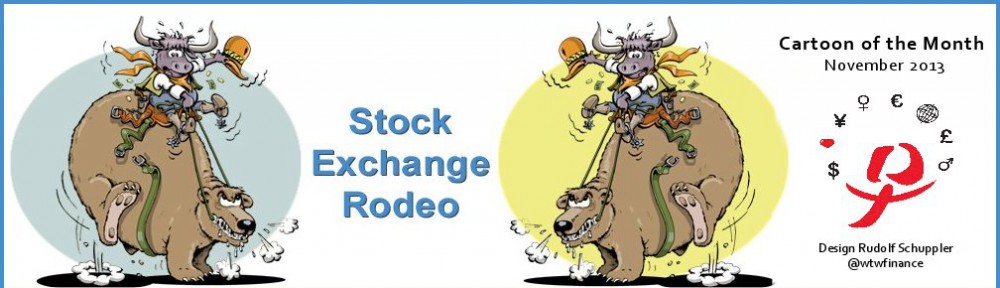
Is the Turkish state going to move out of the interest zone completely and shift into the interest-free one? Or is it planning to grow in interest-free banking as well before privatizing entities in both realms?Cartoon of the Month Bank


How to Make Money in the Commodities Market?

Go figure.  Matt Levine does a dizzy dance explaining that somewhere between 50 and 90 percent of the world’s copper is now in the London Metals Exchange warehouse.  No one knows who it belongs to.  Levine asks: Is the market being cornered.

He goes on to explain the heart of the commodities market.  There are people who really take possession of pork bellies, oil and copper.  And there are people who play with possession.  These are two different markets.

Hedge funds now take possession of oil and hold it on boats until the price goes up.  Pure manipulation.  Obviously when they sell, the market for the commodity is effected.

Whoever is holding the copper in London is holding a percentage of the supply.  In fact, forinstance, what is being held in the LME warefhouse is a tiny portion of the world’s copper.  What makes a difference is the time period when the copper actually needs to be use. Immediate delivery copper will have a higher price.  Long term delivery lower. And so on.

Algoirthms invented by those MIT grads who work in finance are surely being developed not to see who wants how much copper in the future, but how much money can be made right now.  A conundrum.

Pennies from Heaven?

Pennies from Heaven?

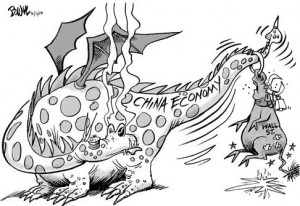
China: Bust or Boom

William Pesek writes:   Is China headed for a boom or bust? Depending on whom you read, the world’s most populous nation is on the cusp of either a debt meltdown, or a middle-class expans

I’ve written before about the possibility of China suffering its own Minksky moment– the point when a debt-driven speculative bubble comes to a sudden and nasty end. Yet there’s also evidence the country may be approaching something of a Henry Ford moment, when a manufacturing-based economy matures to point where workers can afford to buy the products they’re making. The reality, as unsatisfying as it may be to those looking for a dramatic headline, is probably somewhere in between.

Authors David Hoffman and Andrew Polk predict Chinese gross domestic product growth will drop below 4 percent in the next decade. At the same time, more optimistic takes from the Asia Society Policy Institute and the Rhium Group argue that financial upgrades are underway in China that could produce a more sustainable growth path. Those who fear a slowing economy might spark riots and instability also have to be heartened by new data that suggest incomes across China — which is what matters most to ordinary Chinese — are rising more than is commonly acknowledged.

For now, the best strategy for outsiders may be to look the other way, as best they can. Instead of obsessing over every tick up or down in China’s GDP growth rate, the investment world needs to give Chinese leaders time and space to implement the reforms they’ve pledged thus far.

There are many ways to take China’s pulse. Economists’ favorite reality-check indicators include HSBC’s purchasing manager’s index, rail-freight traffic, export and import data (which can be confirmed by cross-checking the numbers with trading partners), electricity-use trends and the trajectory of prices of commodities China dominates like iron ore and coal. Even if this is a non-starter, let’s at least encourage Beijing to forgo a growth target next year.

Xi’s challenge was clear last week when the global media convulsed over news China had grown the slowest in five years in the third quarter. Editors and bankers tripped over themselves to urge Beijing to do more to spur growth. This is what’s truly hypocritical: Even though everyone acknowledges that China must stop artificially pumping up its economy, markets panic at the slightest hint GDP is losing altitude — as if China were some giant company that must constantly impress us.

The last thing China should do is embark on a fresh stimulus kick to placate the nail biters: That would result merely in more debt and unproductive investment and even bigger asset bubbles. The world needs a stable China more than it needs a fast-growing one. And on that front, the economy is doing surprisingly well.

China's Economy