Joining the AIIB?

Will Kickey writes: March 31 marked the deadline for charter founders to line up for the new China-led Asian Infrastructure Investment Bank, 亚洲基础设施投资银行, or AIIB initiative. At the last moment Norway, Taiwan and others rushed to find the good graces of the Chinese opportunity. Many countries seek Asian influence, and Washington has been miffed by Chinese rejection of its traditional actors – the World Bank, the International Monetary Fund and the Asian Development Bank. The US and Japan, initially cool but now perhaps contemplating some eventual partnership, will remain on the sidelines.

A Chinese proverb says “they sleep in the same bed but dream different dreams.” The AIIB founding members are a diverse group with a range of investment agendas:
South Korea, marginalized in the Asian Development Bank, and despite US misgivings, expects to take a stake of upwards of 5 percent in the AIIB. With it heavy equipment industry, Hyundai, Doosan and infrastructure prowess in everything from roads to ports to bridges with GS, Hanwha and POSCO, South Korea will not play second-place against Japanese industry.

Australia, another country the US had leaned heavily on not to join, counts China among its main export markets for coal, copper and iron ore through its mining giants BHP, Rio Tinto and Leighton – creating the industrial might for major infrastructure projects.
The United Kingdom, the first major EU country to clamor for AIIB membership, mystified Washington by keeping it out of the loop during secret negotiations. While the UK’s major interests in accomodating China are unclear, it undoubtedly hopes to regain Asian outcome could prove controversial: a technological marvel, but wracked  with social and environmental concerns.    Joining the AIIB

AIIB

Iceland Experiments with a Sovereign Money System

Matthew C. Klein writes: One of the oddest things about the aftermath of the financial crisis is the extent to which things haven’t changed.


Yes, there are plenty of new rules, and stress tests, and of course there are more fines for wrongdoing, but the basic structure of the financial system doesn’t look much different from before it blew up. There is still plenty of money to be made (and lost) issuing short-term “safe” debt to buy long-term, illiquid, risky assets. Lenders still exacerbate the cycle by increasing their leverage when asset prices rise only to cut back on lending when the economy sours. And everyone knows that taxpayers are still on the hook when things go bad, which acts as a massive subsidy for the financial industry.

As if all that weren’t bad enough, the current system makes it far too hard for central bankers to accomplish their mission of stabilising the economy. Right now, changes in nominal spending power are largely due to decisions made at banks and other financial firms. The level of short-term interest rates affects their behaviour, as do asset purchases, but monetary policy is only one force among many that determines total nominal spending. Modestly raising the cost of short-term funds isn’t enough to stop excessive credit growth, just as aggressive bond-buying has proven insufficient to restore the pre-crisis trend of nominal spending.

The continuity can’t be explained by the lack of better ideas. In fact, the basic alternative to the status quo — moving the power to create money from private financial firms to the state — was suggested in detail in the 1930s by a group of economists led by Irving Fisher. Subsequent proponents have included Milton Friedman, James Tobin, researchers at the International Monetary Fund, John Cochrane, and Martin Wolf. (And me.)  Iceland’s Experiment with a Soverign Money System

Is the World Bank Obsolete?

A combination of growth in lower-income and middle-income countries around the world and change in their economic development challenges is leading to a crisis in the mission of the World Bank. Although the rhetoric used by the World Bank to describe its mission has changed over time, most of what the World Bank actually does has been broadly the same for decades. It makes loans to national governments, with a heavy focus on infrastructure investment, with one set of loans and conditions for low-income countries and another for middle-income countries. This model is under challenge from several directions.   World Bank at 75

First, with sustained growth in many low-income and middle-income countries around the world, the number of countries eligible for World Bank loans is likely to fall the next few years. Morris and Gleave offer a map of the countries eligible for World Bank lending in 2015, with the countries meeting the low-income (per capita) guidelines in orange and the middle-income countries in blue. They then project what countries will fall into those categories just four years from now in 2019. Either the World Bank is going to adjust its income guidelines substantially, or it is going to become very focused on Africa and south Asia in the next few years.

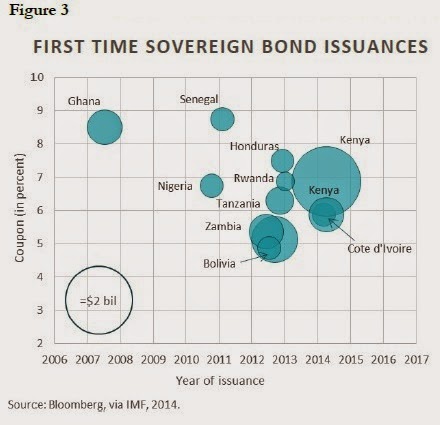
A second issue is that developments in the world financial system mean that governments and economies of low-income and middle-income countries now have access to many more alternative sources of finance.


Along with the financial flows from remittances, foreign direct investment, and a newfound ability for low-income countries to issue sovereign debt, there is even new competition in the world of development banks. There are existing regional development banks with growing financial clout like the Inter-American Development Bank (IDB), the African Development Bank (AfDB), and the Asian Development Bank (AsDB).

Maybe instead of a focus on infrastructure, the World Banks should shift some of its emphasis to public goods like research and development for agriculture or disease prevention or reducing air pollution. Or course,these kinds of projects typically involve a large component of grants, rather than loans.

  • Maybe the World Bank should put more of its focus on crisis response, like its recent response to the Ebola outbreak, or on dealing with economic risks like the danger that the price of a key agricultural export commodity will fall.
  • Maybe instead of focusing on loans to national governments, the World Bank should consider loans to subnational areas, like water or transportation infrastructure for a certain city, or to regional areas, like transportation and electricity networks across national borders.
  • Maybe instead of making loans based national per capita income, the World Bank should focus on countries where high levels of deep poverty remain, or on countries that combine low income with issues like a high level of debt accumulated in past decades that is hindering future growth, or a lack of capacity to manage public finances and collect taxes.
  • Many researchers naturally look at the World Bank as an institution that could be a knowledge leader and a clearinghouse for what is known about how to make economic development work. This mission would emphasize that World Bank loans and projects should be designed to produce the kinds of measureable inputs and outputs that can be the grist for academic research.


Should the Carry Trade be Regulated?

Harold James writes” During the early years of the global financial crisis, exchange rates were the least interesting part of the macroeconomic debate. A French proposal in 2011 for a sweeping reform of the international monetary regime went nowhere. Today, the subject has become the focus of intense anxiety – and with good reason.

Currency wars are a reminder of the fragility of the process of globalization.

The expectation that interest rates in the United States will rise is driving up the value of the dollar, even as monetary easing in Japan and Europe is pushing down the yen and the euro.

The euro’s depreciation has been greeted with delight by Europe’s business leaders. But in the US, where the dollar’s gains are threatening to choke off economic recovery, officials at the Federal Reserve are expressing signs of concern.

The swing in exchange rates could have an impact that extends far beyond the short-term rebalancing of the global marketplace.

Indeed, surges in the dollar’s value have long coincided with increased political pressure for trade protectionism. After all, the most obvious way to compensate for the apparent overvaluation of a country’s currency is by imposing import restrictions.

In the mid-1980s, the dollar’s appreciating exchange rate undermined US competitiveness, inaugurating a period of rapid and painful deindustrialization.

If anything, today’s exchange-rate swings are likely to be more extreme, and to last longer, than the surge in the dollar’s value in the 1980s or the volatility of the 1930s, when, in the aftermath of the financial crash that triggered the Great Depression, countries competed to devalue their currencies.

The problem is what is known as the carry trade, a common financial strategy in which an investor borrows money in a currency subject to a low interest rate in order to buy assets in a currency subject to a higher rate. The interest-rate differential, often combined with high amounts of leverage, provides a profit when the loans are paid off.

When exchange rates are stable and predictable, the carry trade is relatively safe. But this is rarely the case. For starters, the practice has the tendency to push exchange rates further apart, as investors sell the currency in which they borrowed to make their purchases.

The large corporate borrowers engaged in the carry trade consider themselves sophisticated investors, capable of predicting when exchange rates are about to reverse. Unfortunately, this only increases the risk, boosting the possibility of a sudden reversal as money pours back into the borrowed currency in an attempt to repay loans before the exchange rate soars to loss-generating levels.

The dangers are very real.

There is one historical precedent that could serve as a model, should we be able to muster the political will to consider it. In the 1930s, John Maynard Keynes championed limits on the movement of capital in order to blunt the more damaging consequences of globalization. The equivalent today would be to introduce regulations on the carry trade. Policymakers would do well to consider this option – before it is too late.

What Happens When Money Costs Nothing?

Daniel Gros writes:  The developed world seems to be moving toward a long-term zero-interest-rate environment. Though the United States, the United Kingdom, Japan, and the eurozone have kept central-bank policy rates at zero for several years already, the perception that this was a temporary aberration meant that medium- to long-term rates remained substantial. But this may be changing, especially in the eurozone.

Strictly speaking, zero rates are observed only for nominal, medium-term debt that is perceived to be riskless. But, throughout the eurozone, rates are close to zero – and negative for a substantial share of government debt – and are expected to remain low for quite some time.

In Germany, for example, interest rates on public debt up to five years will be negative, and only slightly positive beyond that, producing a weighted average of zero. Clearly, Japan’s near-zero interest-rate environment is no longer unique.

To be sure, the European Central Bank’s large-scale bond-buying program could be suppressing interest rates temporarily, and, once the purchases are halted next year, they will rise again. But investors do not seem to think so.

The eurozone seems stuck with near-zero rates at increasingly long maturities. What does this actually mean for its investors and debtors?

Japanese savers have been benefiting from this phenomenon for more than a decade, reaping higher real returns than their counterparts in the US, even though Japan’s near-zero nominal interest rates are much lower than America’s.

Nonetheless, nominal rates are negligible, they flatter profit statements, while balance-sheet problems slowly accumulate.

Given that balance-sheet accounting is conducted according to a curious mix of nominal and market values, it can be opaque and easy to manipulate. If prices – and thus average debt-service capacity – fall, the real burden of the debt increases.

In an environment of zero or near-zero interest rates, creditors have an incentive to “extend and pretend” – that is, roll over their maturing debt, so that they can keep their problems hidden for longer.

Japan’s experience illustrates this phenomenon perfectly. At more than 200% of GDP, the government’s mountain of debt seems unconquerable. But that debt costs only 1-2% of GDP to service, allowing Japan to remain solvent. Likewise, Greece can now manage its public-debt burden, which stands at about 175% of GDP, thanks to the ultra-low interest rates and long maturities (longer than those on Japan’s debt) granted by its European partners.

In short, with low enough interest rates, any debt-to-GDP ratio is manageable. That is why, in the current interest-rate environment, the Maastricht Treaty’s requirement limiting public debt to 60% of GDP is meaningless.

In fact, near-zero interest rates undermine the very notion of a “debt overhang” in countries like Greece, Ireland, Portugal, and Spain. While these countries did accumulate a huge volume of debt during the credit boom that went bust in 2008, the cost of debt service is now too low to have the impact – reducing incomes, preventing a return to growth, and generating uncertainty among investors – that one would normally expect. Today, these countries can simply refinance their obligations at longer maturities.

Cost-Free Money?


Financial and Economic Markets Might Mix Like Oil and Oil!

Open letter to the FInancial Times:

Sir, The European Central Bank forecasts unemployment in the eurozone to remain at 10 per cent even after €1.1tn of quantitative easing. (FT View, March 25). This is hardly surprising: the evidence suggests that conventional QE is an unreliable tool for boosting GDP or employment.

Bank of England research shows that it benefits the well-off, who gain from increasing asset prices, much more than the poorest. In the eurozone, where interest rates are at rock bottom and bond yields have already turned negative, injecting even more liquidity into the markets will do little to help the real economy.

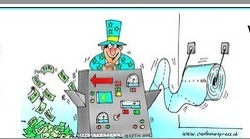
There is an alternative. Rather than being injected into the financial markets, the new money created by eurozone central banks could be used to finance government spending (such as investing in much needed infrastructure projects); alternatively each eurozone citizen could be given €175 per month, for 19 months, which they could use to pay down existing debts or spend as they please. By directly boosting spending and employment, either approach would be far more effective than the ECB’s plans for conventional QE.

The ECB will argue that this approach breaks the taboo of mixing monetary and fiscal policy. But traditional monetary policy no longer works. Failure to consider new approaches will unnecessarily prolong stagnation and high unemployment. It is time for the ECB and eurozone central banks to bypass the financial system and work with governments to inject newly created money directly into the real economy.

 Print Money

Monetary Policy and Worldwide Growth

The Dallas Federal Reserve reports:  In 2014, global real gross domestic product (GDP) grew 3 percent year over year, its lowest value since 2009. Growth in emerging markets was sluggish at 4.3 percent, the slowest pace since 2003 (excluding 2009), led by poor growth in Russia and Brazil. Advanced foreign economies also expanded modestly at 1.8 percent. Still, the global economy grew more quickly in fourth quarter 2014 than for the year as a whole at a 3.4 percent annualized rate, reflecting positive growth in the euro area and Japan. Forward-looking indicators such as the Purchasing Managers Index, which tracks the health of the manufacturing sector, ticked up in February for advanced foreign economies, suggesting a possible pickup.

Exceptionally low oil prices have contributed to lower inflation globally. Inflation in advanced foreign economies fell from 2 to 1 percent between June and December 2014. In 2015, accommodative monetary policy and low oil prices may provide a much-needed boost to global growth.  Monetary Policy and Global Growth

Design by POLYP

Design by POLYP

Issues for Hillary Clinton

Former Secretary of State Hillary Clinton will announce her run for the presidency tomorrow.   Here are the words we are looking for:

Inequality

End Glass Steagall

Break up of banks

Education reform

Afforable housing for all

Diversion of public funds by corruptioin

Commodities trading

High speed trading

Inclusive foreign policy

Mrs. Clinton AnnouncesAdd to the list on twitter or below.


Supporting the AIB?

GE Leaves Banking. A Dodd Frank Success Story?

For decades, General Electric was happy to reap the enormous profits that arose from its finance arm as it swelled into one of the country’s biggest lenders.

GE will beign by selling $26.5 billion worth of real estate assets, G.E. is hastening to return to its roots as one of the mightiest industrial companies in the world, whose operations include jet engines, oil drilling equipment and medical devices. What it will mostly shed is GE Capital, a lender with hundreds of billions of dollars’ worth of assets.

The move announced Friday reflects the shifting landscape of the financial world, especially for the largest players. They face greater regulatory scrutiny and calls from analysts and investors to slim their operations or break up. Some are shifting their focus to areas like wealth management as traditional activities like trading prove less profitable. It is no surprise that G.E. decided to re-evaluate its role in this ecosystem.

The divestiture campaign, code-named Hubble within G.E. and put together in about six weeks, will erase one of the main legacies of the conglomerate’s vaunted former chief executive, John F. Welch Jr. But it is also a recognition that manufacturing, not finance, represents the company’s future.

“We’re not sentimentalists,” Jeffrey R. Immelt, the multinational’s current chairman and chief executive, said in an interview.

G.E.’s expansive campaign will bring other changes as well. In shrinking its far-flung empire, the company will also bring back $36 billion in cash that now resides overseas, taking a $6 billion tax hit in the process. And it will also press to relieve itself from the burdens of being considered a too-big-to-fail lender, a status that brings stricter regulatory requirements.

The wide range of asset sales will help finance a huge return of money to shareholders, which G.E. estimates will eventually reach $90 billion. About $50 billion will come from a stock repurchase, one of the biggest on record.

For years, the financial tilt looked smart and relatively easy. In an interview in 2010, Jeffrey  Immelt recalled, if a deal looked like a moneymaker, it got the nod. “And you don’t have to build a factory,” he said.

Yet the big bet on finance badly wounded G.E. after Lehman’s demise, when the market upheaval left the conglomerate hard-pressed to borrow debt for its day-to-day operations.

GE Capital