Money Flows in Malayasia

Tom Wright writes: Malaysian Prime Minister Najib Razakwas fighting for his political life this summer after revelations that almost $700 million from an undisclosed source had entered his personal bank accounts.

Under pressure within his party to resign, he called together a group of senior leaders in July to remind them everyone had benefited from the money.

The funds, Mr. Najib said, weren’t used for his personal enrichment. Instead, they were channeled to politicians or into spending on projects aimed at helping the ruling party win elections in 2013, he said, according to a cabinet minister who was present.

It still isn’t clear where the $700 million came from or where it went. But a six-month Wall Street Journal examination revealed that public entities spent hundreds of millions of dollars on a massive patronage machine to help ensure Mr. Najib’s United Malays National Organization stayed in power.

The UMNO has led every Malaysian government since the country’s independence from Britain in 1957, making it one of the world’s longest-ruling political parties. Its extraordinary grip on power has delivered economically for Malaysia, boosting living standards and establishing the country as a fast-growing emerging market and U.S. ally in Asia.

But its dominance of the vote, its critics contend, has prevented Malaysia’s democracy from maturing in a similar fashion, instead leaving a system riven by patronage and vote-buying that analysts say has consistently skewed results in UMNO’s favor.

The effort relied heavily on the state investment fund Mr. Najib controlled, 1Malaysia Development Bhd., according to minutes from 1MDB board meetings seen by The Wall Street Journal and interviews with people who worked there.

The prime minister, who is chairman of 1MDB’s board of advisers, promised repeatedly that the fund would boost Malaysia’s economy by attracting foreign capital. It rolled up more than $11 billion in debt without luring major investments.

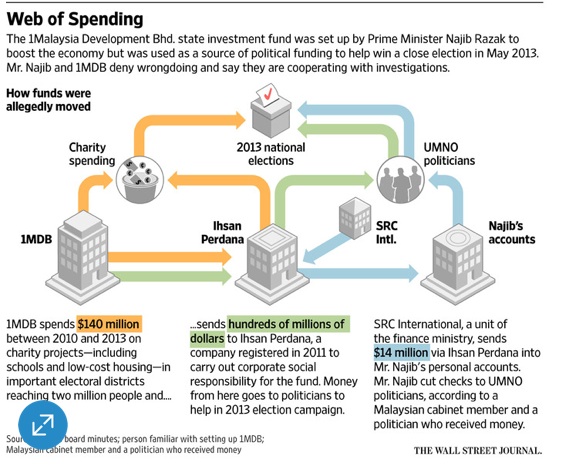
Yet Mr. Najib used the fund to funnel at least $140 million to charity projects such as schools and low-cost housing in ways that boosted UMNO’s election chances, the Journal investigation found.

Board members wondered aloud if they would get in trouble. In a meeting on Dec. 20, 2014, they discussed what to do about police who came to investigate allegations of financial irregularities, according to the minutes.

The 1MDB fund also transferred hundreds of millions of dollars to politicians through Ihsan Perdana Bhd., a company formed in 2011 to carry out 1MDB’s corporate social responsibility programs, said a person involved with setting up the fund. Ihsan Perdana is exempt from filing financial statements, according to Malaysian company records.

Malaysian investigators believe the cash that ended up in Mr. Najib’s personal accounts moved through government agencies, banks and companies linked to 1MDB. At least $14 million flowed into his accounts via Ihsan Perdana, according to documents from a Malaysian government investigation.

The source of that $14 million was SRC International Bhd., a company controlled by Malaysia’s finance ministry, which Mr. Najib also heads, the documents show.

The prime minister signed checks from his personal accounts to lawmakers, who used the money as they saw fit, according to the Malaysian cabinet member interviewed by the Journal and another lawmaker who said he accepted the money.

Mr. Najib declined multiple interview requests. He has denied wrongdoing or taking money for personal gain, while defending 1MDB spending as good for Malaysia. He hasn’t explained where the $700 million in his accounts came from or how it was used..  Money Flows in Malayasia
 Money Flows


Whistleblowers Worldwide

Forty-two percent of corporate fraud is detected by tips.  Insiders know better than anyone what is going on at Volkswagen, for instance.  Since the 2007-8 financial crisis, whistleblowing is on the increase.  How it is treated by the governments of countries varies enormously worldwide.

Some countries like Canada have weak laws protecting whistleblowers. Turkey has strong ones.  Yet whistleblowers have more protection in Canada.  The laws do not always indicate the degree to which it’s safe to suggest corruption.

After a whistleblower in Britain revealed corruption at HBOS, he suffered severe emotional consequences.  As a result, British regulatory authorities have insisted that companies they oversee have provisions for employees to safely report transgressions directly to the regulators and that companies have a post for a “whistleblower’s champion.”

Germany and Switzerland are particularly tough on whistleblowers.  Germany is now covered by the best practice guidelines from the Council of Europe, a group of 47 countries in Western and Eastern Europe.

The US, with strong protections, has a very uneven record.  The strength of the banking lobby in the US makes whistleblowing risky if you want to keep your job.

Whistleblowers


Shaping Up Middle East Bureaucracies

Public servants are the butt of jokes the world over, but they are a real curse in the Middle East, according to a recent Economist report.  A routine legal name change in Iraq can tae asmany as 18 court appearances.  Starting a business in Egypt requires permits from 78 agencies.

How did this impass come to be?  Dictators and one party states have treated the bureaucracy as employment positions for family and friends.  Funding these often non-fuctioning employees drains coffers and drives productive workers to the private sector.

Merit testing for jobs and realistic measures of job performances might help get governments functioning again if there is a political will.  Tax-authority and unionized workers have protested against change.  In Lebanon it was feared that recruiting more competent workers would unbalance a fragile system.

The only answer may be making bureaucrats responsible to citizens at the local level.


Is Banking Reform Possible?

Mrs. Clinton is ducking the big issues about big banks.

William Cohan writes:   The new movie “The Big Short” dredges up a lot of bad memories of how badly the country was screwed by Wall Street. It goes into what went horribly wrong inside the big banks seven years ago and how a small group of clever traders made fortunes betting on the crash of the American economy. After they figured out that Wall Street bankers and traders had stuffed one bad loan after another into the mortgage-backed securities they sold as solid investments the world over, the guys devised the Big Short to bet against this crazy behavior. When the economy collapsed, they cashed in. And those were the good guys. It’s not just the movie, of course, that brings back unhappy times. Judging from the kind of rhetoric being bruited about on the campaign trail, you would think Wall Street might be just a little antsy about public sentiment—starting with Bernie “big-banks-are-always-bad” Sanders and his astonishing rise in the Democratic race against Hillary Clinton. Even top GOP candidates like Donald Trump, Marco Rubio and Ted Cruz have been at it, channeling Elizabeth Warren’s populist message against the Street.

But the truth is, Wall Street isn’t the slightest bit worried these days. Indeed, it is happily making plans for the future, no matter who becomes president: Highly paid bank lobbyists are working overtime to gut Dodd-Frank regulations (as part of riders on the year-end budget bill). And what makes the elite of the Street most happy is they are hearing all the right things from Hillary Clinton, the near-certain Democratic nominee with an excellent shot at the White House.  Why Wall Street Isn’t Worried about the Political Class

 Laughing All the Way to the Bank


A Bank Proposes, the Fed Disposes?

Should the mandate of the US Fed be re-written?

Often we hear the Fed Chairperson say that their policy is being effected in order to fulfill their mandate to keep employment high in the US.  Realistically, in a changing world in which most jobs are service jobs and require education, this mandate should perhaps be dropped.

President Obama and his Secretaries of Education well understand the need to educate for jobs.  Political correctness sometimes masks the basic requirements for change. No one thinks the US Fed can help this process.

As we wait for the anticipated tiny rise in the interest rate, but at least a rise, the power of the Fed is patently clear.  The real question we should be asking is: Has the Fed become too powerful in the US?  Who is benefitting from Fed policies?

In the important new film “The Big Short” on character notes that Ben Benanke has just left the White House.  The character remarks:  “There’s going to be a bailout.”

On the one hand, no one stepped up to plate to address the economic crisis in 2008 except the Fed.  In anticipation of future crises, small and large, does it not behoove legislators to think about and act on a new leadership role when these inevitable events occur?

US Fed

Bharara Attacks Corruption in NY

Preetinder Singh “Preet” Bharara is an Indian American attorney and the U.S. Attorney for the Southern District of New York. His office has prosecuted people worldwide and has prosecuted nearly 100 Wall Street executives.

Bharara has won nine out of 10 cases against a parade of disgraced Albany lawmakers since taking the helm of the Southern District of New York in 2009, prevailing in three trials and garnering six guilty pleas.  In his crosshairs were two of New York’s biggest political animals: former Assembly Speaker Sheldon Silver and former Senate Majority Leader Dean Skelos.  He has won convictions against both of them.

Mr. Bharara may also be hunting the biggest game of all in New York: Gov. Andrew Cuomo, whom he has criticized for disbanding the Moreland Commission on public corruption. Last week, word broke that Mr. Bharara is investigating $1 billion in funding provided by the governor to help revive Buffalo. Mr. Cuomo said over the weekend that he had no role in awarding the so-called “Buffalo billion” to bidders.

Aggressive and media-savvy, Mr. Bharara portrays himself as the white knight cleaning up the “cauldron of corruption” in Albany. Even in the case he lost, the defendant ended up behind bars. In 2011, a federal jury found William Boyland not guilty, but the Democratic assemblyman was convicted three years later, courtesy of Mr. Bharara’s Eastern District counterpart Loretta Lynch, who is now U.S. attorney general.

“Bharara is on the warpath,” said James Cohen, a criminal-defense professor at Fordham University Law School. “He thinks the whole thing is a sewer, and he’s in a position to make some change.”

To do it, the prosecutor has used techniques perfected in fighting terrorists and organized crime, employing stings, wiretaps, video surveillance and undercover FBI agents to catch politicians in the act.

He then uses his perch to wage a media campaign that generates momentum and sets the stage for a trial or, in the majority of cases, a guilty plea. He has used similar tactics to snare miscreants on Wall Street, where his track record is even more impressive, winning more than 80 convictions and guilty pleas, although one of his insider-trading victories was thrown out on appeal last year.

Bharara has won 11 corruption cases against state legislators by following the money.

In the NY Assembly the Chairman of the Ethics  committee has never been allowed to hold a hearing.  If you are allowed to have outside income, you can hide it as a bribe.  If you oppose one of the leaders you are banished.

But you can not trade in exchange for getting something to line the pockets of yourself or a family member.  You take an oath of office to serve the public.  You are guilty of public corruption.  Bharara is making sure these laws stick.

Bribes

Up Loss-Absorbing Shareholder Equity to Keep Banks Safe

Of the three remaining mainstream Democratic candidates, all three propose changing rules for the financial sector.  Only Mrs. Clinton would not re-instate Glass Steagall, the wall her husband broke down between investment and commercial banking activities.  It is well  to remember that both Clintons have made  fortune lecturing to the banking industry and that the Clinton campaign is based on contributions from banking.  The Clinton son-in-law runs a hedge fund that was set up for him by Goldman Sachs.

Simon Johnson writes:  The three candidates disagree on whether there should be legislation to re-erect a wall between the rather dull business of ordinary commercial banking and other kinds of finance (such as issuing and trading securities, commonly known as investment banking).

This issue is sometimes referred to as “reinstating Glass-Steagall,” a reference to the Depression-era legislation – the Banking Act of 1933 – that separated commercial and investment banking. This is a slight misnomer: the most credible bipartisan proposal on the table takes a much-modernized approach to distinguishing and making more transparent different kinds of finance activities. Sanders and O’Malley are in favor of this general idea; Clinton is not (yet).

This argument that some financial firms that got into trouble in 2008 were standalone banks like Lehman or an insurance company like AIG.  What happened “last time” is rarely a good guide to fighting wars or anticipating future financial crises. The world moves on, in terms of technology and risks. We must adjust our thinking accordingly.

At worst, the argument is just plain wrong. Some of the greatest threats in 2008 were posed by banks – such as Citigroup – built on the premise that integrating commercial and investment banking would bring stability and better service. Sandy Weill, the primary architect of the modern Citigroup, regrets that construction – and regrets lobbying for the repeal of Glass-Steagall.

Second, leading representatives of big banks argue that much has changed since 2008 – and that big banks have become significantly safer. Unfortunately, this is a great exaggeration.

Ensuring a financial system’s stability is a multifaceted endeavor – complex enough to keep many diligent people fully employed. But it also comes down to this: how much loss-absorbing shareholder equity is on the balance sheets of the largest financial firms?

In the run-up to the 2008 crisis, the largest US banks had around 4% equity relative to their assets. This was not enough to withstand the storm. (Here I’m using tangible equity relative to tangible assets, as recommended by Tom Hoenig, Vice Chairman of the Federal Deposit Insurance Corporation, and a beacon of clarity on these issues.)

Now, under the most generous possible calculation, the surviving megabanks have on average about 5% equity relative to total assets – that is, they are 95% financed with debt. Is this the major and profound change that will prove sufficient as we head through the credit cycle? No, it is not.

Finally, some observers – although relatively few at this point – argue that the biggest banks have greatly improved their control and compliance systems, and that the mismanagement of risk on a systemically significant scale is no longer possible.

This view is simply implausible. Consider all the instances of money laundering and sanctions busting (with evidence against Credit Agricole and  Deutsche Bank and almost every major international bank in the past few years).

This is the equivalent of near misses in aviation. If the US had the equivalent of the National Transportation Safety Board for finance, we would receive detailed public reports on what exactly is – still, after all these years – going wrong. Sadly, what we actually get is plea bargains in which all relevant details are kept secret. The regulators and law-enforcement officials are letting us down – and jeopardizing the safety of the financial system – on a regular basis.

The best argument for a modern Glass-Steagall act is the simplest. We should want a lot more loss-absorbing shareholder equity. We should ensure that various activities by “shadow banks” (structures that operate with bank-like features, as Lehman Brothers did) are properly regulated.

Building support for legislation to simplify the biggest banks would greatly strengthen the hand of those regulators who want to require more shareholder equity and better regulation for the shadows. These policies are complements, not substitutes.

Low Income Means Shorter Life in US

Income inequality is real and life threatening.

Joseph E. Stiglitz writes:  The Nobel Memorial Prize in Economics went to Angus Deaton “for his analysis of consumption, poverty, and welfare.”  Deaton has published some startling work with Anne Case in the Proceedings of the National Academy of Sciences – research that is at least as newsworthy as the Nobel ceremony.

Analyzing a vast amount of data about health and deaths among Americans, Case and Deaton showed declining life expectancy and health for middle-aged white Americans, especially those with a high school education or less. Among the causes were suicide, drugs, and alcoholism.

America prides itself on being one of the world’s most prosperous countries, and can boast that in every recent year except one (2009) per capita GDP has increased. And a sign of prosperity is supposed to be good health and longevity. But, while the US spends more money per capita on medical care than almost any other country (and more as a percentage of GDP), it is far from topping the world in life expectancy. France, for example, spends less than 12% of its GDP on medical care, compared to 17% in the US. Yet Americans can expect to live three full years less than the French.

The racial gap in health is, of course, all too real. According to a study published in 2014, life expectancy for African Americans is some four years lower for women and more than five years lower for men, relative to whites. This disparity, however, is hardly just an innocuous result of a more heterogeneous society. It is a symptom of America’s disgrace: pervasive discrimination against African Americans, reflected in median household income that is less than 60% that of white households. The effects of lower income are exacerbated by the fact that the US is the only advanced country not to recognize access to health care as a basic right.

The Case-Deaton results show that America is becoming a more divided society – divided not only between whites and African Americans, but also between the 1% and the rest, and between the highly educated and the less educated, regardless of race. And the gap can now be measured not just in wages, but also in early deaths. White Americans, too, are dying earlier as their incomes decline.  Impact of Income Inequality in America


Subprime Mortgage Crisis Revisted on Film

Will US citizens wake up when they see the new film, “The Big Short,” which describes the origins of the subprime mortgage crisis?

The mortgage crisis as primarily the fault of mortgage originators and mortgage securitization financiers, aided and abetted by the executives of the largest banks.  At the heart of this story is a court case in California where the defense successfully proved financial fraud was not committed by mortgagors induced by mortgage issuers to sign “lairs loans” paper work.  Why? Because they were compensated for writing mortgages and securitizing them, not for the quality of the mortgages for repayment.  The perverse incentives built into the system created the crisis.  The “liars” were often victims of a Pied Piper system to which they were susceptible because of their financial naivety.

he securitization process put purely junk mortgages into AAA-rated securities based on the assumption that only 1% (the historical limit) would default.  When several times that previous limit occurred AAA-rated securities defaulted.

mortgage-default-rate-history