Corruption Perceptions Index 2013
1
 corruption. The index draws on 13 surveys covering expert assessments and views of businesspeople. The Corruption Perceptions Index is the leading global indicator of public sector corruption, offering a yearly snapshot of the relative degree of corruption by ranking countries from all over the globe.2013_CPIBrochure_EN
Senator Warren says, “We have got to get back to running this country for American families, not for its largest financial institutions.”
The four biggest Wall Street banks are 30% larger than before the financial crisis, she said, while the five biggest institutions hold more than half the bank assets in the country.
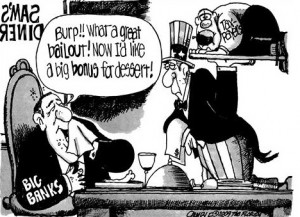
Warren claimed this amounted to an $83bn-a-year taxpayer subsidy for some Wall Street institutions, because they were so large that they could safely rely on a government bailout in the event of a future crisis, and were therefore able to take bigger risks than rivals. She cited research that suggests the crash cost up to $14tn, or $120,000 for each American household.
“Where are we in making sure behemoth institutions on Wall Street can’t bring down the economy again? And make wild gambles that suck up all the profits in the good times? And stick the taxpayer with the bill when it goes wrong?” she demanded.
“Three years since Dodd-Frank was passed, the biggest banks are bigger than ever, the risks to the system have grown and the market distortions continue.” She said current regulators do not give “much reason for confidence” and added: “It is time to act: the last thing we should do is wait for another crisis.” Cost of Financial Crisis 21stCenturyGlassSteagall
News around this move by the finance minister of the tiny British crown dependency has a curious mix of definitions of the bitcoin, which soared to over $1200 today.
An independent company will provide the Bitcoins. If the price plunged, neither Alderney nor the Royal Mint would lose anything. The company would put the Bitcoins in an escrow account at an agreed price. Meanwhile, the Royal Mint would take customers’ orders for its minted Bitcoins and receive money from those coin sales. The virtual Bitcoins backing the physical coins would be held in digital storage facilities by Alderney.
The Mint would issue the commemorative Bitcoin, paying for the value of the gold content itself. Alderney would receive royalties from sales of the coins.
Coins could be redeemed for sterling at any point in Alderney for the price of a Bitcoin on that day.
It seems to be currency (it is backed by sterling), it is called a ‘commemorative coin’ by the mint, and if worse came to worse, could be melted down for the small amount of gold the coin itself contains. So it is currency, commemorative and gold rolled into one…what? Alderney to Manufacture Bitcoins The Financial Times Reports:
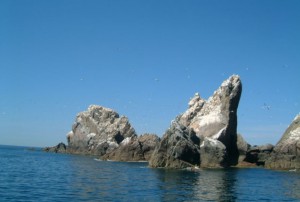
ALDERNY, LITTLE MORE THAN A ROCK
Switzerland has been listed alongside well-known tax havens in a new ranking by the Organisation for Economic Co-operation and Development (OECD), showing the country still has work to do on banking secrecy despite recent steps aimed at tackling the issue.
OECD’s Global Forum on Transparency and Exchange of Information for Tax Purposes released ratings for 50 jurisdictions at a meeting in the Indonesian capital.
The forum has rated jurisdictions on how well they comply with rules on tax transparency.
Switzerland, however, failed even to make it past the first stage of a two-stage assessment.
Other countries which also did not make it to the second stage included Panama, the Marshall Islands and Trinidad and Tobago, although OECD’s final judgement on them was harsher than on Switzerland.
It came after Switzerland took steps last month to tackle its long-criticised banking secrecy, including signing an international tax evasion agreement brokered by the OECD and introducing new legislation to increase cooperation on money-laundering.
Swiss authorities have come under pressure from the international community to clamp down on the concealment of illicit funds and on tax evasion, in the wake of the global financial crisis of 2008 and the subsequent euro zone debt crisis.
Despite Switzerland’s failure to complete the process, OECD’s head of tax issues, Pascal Saint-Amans, struck an upbeat note, telling it was now “moving ahead”.
He, however, said the OECD would continue to monitor the country closely to ensure its recent steps “are actually enacted and become law, which is not yet the case”.
Of the jurisdictions that completed the two-stage assessment, 18 were deemed to be “compliant” with the tax transparency rules set out by the forum; many others were considered “largely compliant”; while Austria and Turkey were “partially compliant”.
Four were deemed to be “non-compliant”: Cyprus, Luxembourg, the Seychelles and the British Virgin Islands.
OECD_GF_Ratings_22.11.13
OECD_GF_Background
 More Corruption Reports
International banking consultant Andreas Frank writes: Afghan opium cultivation has reached a record level, with more than 200,000 hectares planted with the poppy for the first time, the United Nations says.
The UNODC report said the harvest was 36% up on last year, and if fully realised would outstrip global demand. Half of the cultivation area is in Helmand province. Most of the rise comes from this province, where British troops are preparing to withdraw. One of the main reasons the UK sent troops to Helmand was to cut opium production.
The head of the UN office for Drugs and Crime (UNODC) in Kabul, Jean-Luc Lemahieu, said that production was likely to rise again next year, amid uncertainty over the withdrawal of most foreign troops and the presidential election.
He said that the illegal economy was taking over in importance from legitimate business, and that prices remained high since there was a ready availability of cash in Afghanistan because of aid. “As long as we think that we can have short-term, fast solutions for the counter-narcotics, we are continued to be doomed to fail,” he added.
Mr Lemahieu said there had been some recent successes, including the arrest of leading figures in the drugs industry, but it could take 10-15 years to deal with Afghanistan’s opium crisis, even if policies improved.
The report said the total area planted with poppies rose from 154,000 to 209,000 hectares, while potential production rose by 49% to 5,500 tonnes, more than the current global demand.

The consequences of Afghanistan’s huge opium production have had an effect across society here. There are believed to be more than a million opium and heroin addicts – one of the largest levels in the world – taking advantage of plentiful supplies.
The amount of land given over to opium in 2013 was 209,000 hectares. The potential production from that is estimated to be more than annual global demand, according to the head of the UN office for Drugs and Crime in Kabul, Jean-Luc Lemahieu.
After rising sharply in the years after the Taliban successfully stopped production, the harvest last peaked in 2007 and is expected to continue rising.
Mr Lemahieu said that the rise since 2010 was caused principally by what he called a “hot political market” – uncertainty over the process of transition from US control. That uncertainty will continue with the end of foreign combat operations and the presidential election next year. Meanwhile two northern provinces which had previously been declared poppy-free – Faryab and Balkh – lost that status.
The findings of the latest report reverse a decline in production last year attributed to bad weather and disease. However, cultivation has been rising yearly since 2010 despite government efforts to eradicate the crop. More farmers have been trying to grow the poppy as the price of opium has been rising.
The report describes the capture of “well over 10%” of production by tripling the effectiveness police as an encouraging sign.
Afghanistan produces more than 90% of the world’s opium.
The report calls for an integrated, comprehensive response to the problem. “If the drug problem is not taken more seriously by aid, development and security actors, the virus of opium will further reduce the resistance of its host, already suffering from dangerously low immune levels due to fragmentation, conflict, patronage, corruption and impunity,” it said.
There are clear indications that the war against drugs is lost and the world will drown in a tsunami of drugs. Afghan Opium Survey
We interviewed Simone Nadelhofer on the current state of Swiss Banks. She discussed the impact of the requirement to disclose, and the fees banks’ charge clients for services.
Our colleague, Andreas Frank, an international banking consultant in Switzerland reports: The U.S. Department of Treasury Assistant Secretary for Terrorist Financing, Daniel Glaser, called on for the Lebanese state to uproot money laundering, terrorist financing and other forms of illicit finance from the Lebanese financial system.
The Lebanese financial system is a critical asset to the Lebanese people and the basis of the national and regional economy, Glaser said at the Arab Banking Conference.
He pointed out that Lebanon’s ability to retain its its position as an important regional and international financial center requires constant vigilance.
Professionalism and stability, which have been the hallmark of the Lebanese financial system, can be maintained only through the efforts of both the public and private sectors to ensure a hostile environment for terrorists, criminals, narcotraffickers, and sanctioned regimes such as Iran and Syria. Glaser lashed out at Hezbollah during his speech, stressing that working together we can stop illicit financial activities of groups that seek to destabilize the region such as al-Qaida and Hizbullah.
He highlighted the case of the Lebanese Canadian Bank. That scheme involved the laundering of hundreds of millions of dollars in narcotics proceeds through the Lebanese financial system using bulk cash shipments and trade-based money laundering involving used car sales and consumer goods. These drug trafficking proceeds were often funneled to Lebanon through several Lebanese exchange houses that utilized accounts at LCB branches.
The LCB narcotics money laundering scheme is indicative of a broader trend: international criminals are developing increasingly sophisticated means to move funds and obscure the illicit activities and actors involved. The narcotics trafficking exposed by our actions against LCB spanned several continents and involved financial flows of hundreds of millions of dollars across many jurisdictions.
In the case of LCB, Hezbollah benefitted from a global narcotics trafficking network. This should not be surprising given Hezbollah’s involvement in a wide range of illicit activities. These illicit activities, combined with its ties to sanctioned regimes such as Iran and Syria, should call into question all financial relationships with Hezbollah or its agents. And the risks of engaging in such relationships will only increase as more
countries apply sanctions on Hezbollah, which continues to engage in destabilizing military activity in Syria and attacks in Europe.
As Syria continues to be destabilized by horrific acts of violence, leading us to sanction both the Assad regime and al-Qa’ida affiliates, the region faces new and unprecedented economic challenges. Treasury Department Glaser’s Speech
Our UK partner, Sarah Pavlou of International Women in Business, called our attention to new breaking news item: Chairman Reverend Flowers with a background in drugs and interest in porn is left in charge of one of the UK’s major banks, Cooperative. The bank is going bust. Questions are being asked why and how he got this position. There are suspicions that Labour and Reverand Flowers have been in some form of corrupt relationship. Former Co-op Bank chair Paul Flowers investigated for expenses claims and suspended from drug charity

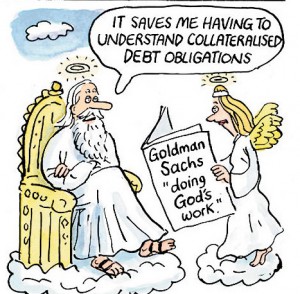
The investment banks, fearing that talented college seniors will shy away from them after their contributions to the financial meltdown, are telling prospects that they are in the business of doing social good. Goldman Sachs Now a Do Gooder Firm
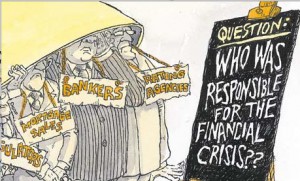
At a meeting of New York City securities lawyers this week, Jed Rakoff did what he does best: challenge Establishment Thinking. “While the economy has slowly improved, there are still millions of Americans leading lives of quiet desperation — without jobs, without resources, without hope.” Then he asked: Who is to blame?
Rakoff is the iconoclastic U.S. District Court judge who’s been at the heart of some of the most significant trials stemming from the financial crisis. And what he really wanted to know is why more there haven’t been more criminal prosecutions of top financial executives (the very ones who, not coincidentally, made many of the people in his audience quite wealthy). To Rakoff the answer, clearly, is gun-shy federal prosecutors. Why Are Financial Executives Not Prosecuted for Subprime Mortgage Fraud