Child Labor in Switzerland

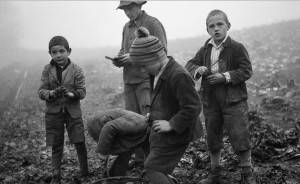
The hills were alive with the sounds of children working.  From the mid 19th century until very recently poor children were removed from Swiss homes and sent to farms to work.  Some children were sent to homes were they clearned house before and after school.

Historians estimate there were hundreds of thousands such children. For one year alone in the 1930s, records show 30,000 children were placed in foster families across Switzerland.

“It’s hard to know precisely how many contract children there were as records were kept locally, and sometimes not at all,” says Loretta Seglias. “Some children were also placed by private organisations, or their own families.”

The extent to which these children were treated as commodities is demonstrated by the fact that there are cases even in the early 20th Century where they were herded into a village square and sold at public auction.

Seglias shows me some photographs. One child looks barely two – surely she couldn’t be a contract child? “She could, she would be brushing floors bringing in the milk. Sometimes they came as babies on to the farms, and the bigger they grew the more work they would do,” Seglias says.

“Children didn’t know what was happening to them, why they were taken away, why they couldn’t go home, see their parents, why they were being abused and no-one believed them,” she says.

“The other thing is the lack of love. Being in a family where you are not part of the family, you are just there for working.” And it left a devastating mark for the rest of the children’s lives. Some have huge psychological problems, difficulties with getting involved with others and their own families. For others it was too much to bear. Some committed suicide after such a childhood.

Social workers did make visits. David Gogniat says his family had no telephone, so when a social worker called a house in the village to announce that she was coming, a white sheet was hung out of a window as a warning to the foster family. On the day of this annual visit David didn’t have to work, and was allowed to have lunch with the family at the table. “That was the only time I was treated as a member of the family… She sat at the table with us and when she asked a question I was too scared to say anything, because I knew if I did the foster family would beat me.”

Today we regard poor children as a social problem.  But the lingering idea that the poor alone are responsible for their plight plagues countries around the world to this day.

Child Labor


Internet Taxes?

Huge crowds in Budapest marched to protest the imposition of an internet tax. The government has drafted a law which would levy a fee on each gigabyte of internet data transferred.  The EU has condemned it as a bad idea that could threaten political freedom.

Protests began in Hungary on Sunday, when demonstrators hurled old computer parts at the Budapest headquarters of Prime Minister Viktor Orban’s ruling Fidesz party.

Under the proposals, internet providers would be made to pay 150 forints (£0.40; €0.50; $0.60) per gigabyte of data traffic. The fee is one of a series of measures proposed by the government to bring down the budget deficit.  The ruling Fidesz party has tried to stem the anger by proposing a 700-forint cap on the tax for individuals and 5,000 forints for businesses.  But opponents believe the tax reflects the increasingly authoritarian style of Mr Orban.

For the first time, the ruling party’s opponents from across the whole political spectrum, from the left to the far right now have a common cause.  Despite divisions within Fidesz, Mr Orban commands broad popularity in Hungary and the party has won three elections this year.  The government criticised US charge d’affaires Andre Goodfriend after he was photographed among the protesters on Sunday.

Internet taxation is being debated around the world.

Protesting Internet Tax

China: Bust or Boom

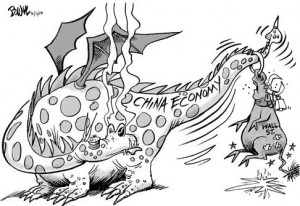
William Pesek writes:   Is China headed for a boom or bust? Depending on whom you read, the world’s most populous nation is on the cusp of either a debt meltdown, or a middle-class expans

I’ve written before about the possibility of China suffering its own Minksky moment– the point when a debt-driven speculative bubble comes to a sudden and nasty end. Yet there’s also evidence the country may be approaching something of a Henry Ford moment, when a manufacturing-based economy matures to point where workers can afford to buy the products they’re making. The reality, as unsatisfying as it may be to those looking for a dramatic headline, is probably somewhere in between.

Authors David Hoffman and Andrew Polk predict Chinese gross domestic product growth will drop below 4 percent in the next decade. At the same time, more optimistic takes from the Asia Society Policy Institute and the Rhium Group argue that financial upgrades are underway in China that could produce a more sustainable growth path. Those who fear a slowing economy might spark riots and instability also have to be heartened by new data that suggest incomes across China — which is what matters most to ordinary Chinese — are rising more than is commonly acknowledged.

For now, the best strategy for outsiders may be to look the other way, as best they can. Instead of obsessing over every tick up or down in China’s GDP growth rate, the investment world needs to give Chinese leaders time and space to implement the reforms they’ve pledged thus far.

There are many ways to take China’s pulse. Economists’ favorite reality-check indicators include HSBC’s purchasing manager’s index, rail-freight traffic, export and import data (which can be confirmed by cross-checking the numbers with trading partners), electricity-use trends and the trajectory of prices of commodities China dominates like iron ore and coal. Even if this is a non-starter, let’s at least encourage Beijing to forgo a growth target next year.

Xi’s challenge was clear last week when the global media convulsed over news China had grown the slowest in five years in the third quarter. Editors and bankers tripped over themselves to urge Beijing to do more to spur growth. This is what’s truly hypocritical: Even though everyone acknowledges that China must stop artificially pumping up its economy, markets panic at the slightest hint GDP is losing altitude — as if China were some giant company that must constantly impress us.

The last thing China should do is embark on a fresh stimulus kick to placate the nail biters: That would result merely in more debt and unproductive investment and even bigger asset bubbles. The world needs a stable China more than it needs a fast-growing one. And on that front, the economy is doing surprisingly well.

China's Economy


Rouseff Edges Out a Victory in Brazil

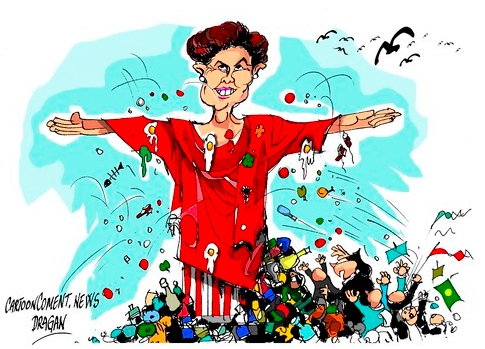
Rouseff is victor in the Brazilian election, but in an almost evenly split vote.  In the past three decades, one three incumbents in Latin American countries have lost.  Rouseff provided generous support to the poor of her country.  In turn, poor areas in the north and northeast of the country voted overwhelmingly for her.  On her watch, unemplyment has been low, wages on the rise and the inequality gap closed somewhat.

Rouseff has been mired in an investigation into bribes by Petrobras, the state-controlled oil giant.  A Congress of 28 parties up from 22 will be unwieldy to manage.  The Petrobras scandal will not go away.  And high inflation and lack of competitiveness will hound Rouseff.  Protests of 2013 against political corruption may rise again.

Rouseff

Should Human Reproduction Be Commercialized?

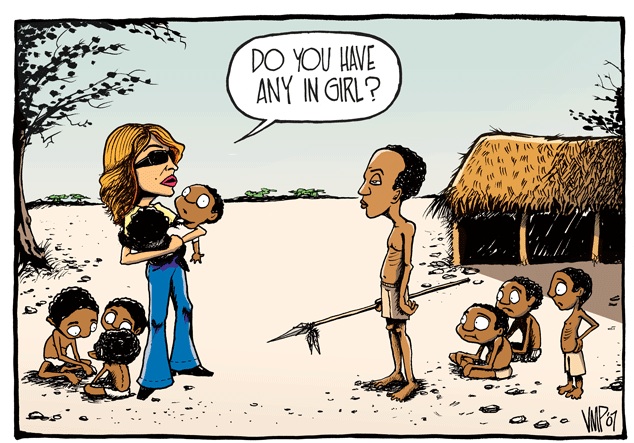
After the frist surrogate deivery in India in 1994, India has become an international destination for surrogate birth.  Has India exploited women as baby producers?

Loosely draftd agreements with commissioning parents leave surropate mothers vulnerable.  What is parents decide against taking the child?  And from the parents point of view, are they guaranteed delivery of ths child by the surrogate?   These quesitons are seldom answered definitively in legal agreements.

The larger moral question about whether human reproduction should be commerdaized remains.

SUrrogate Parenthood

Japan Has Problems with Student Loans

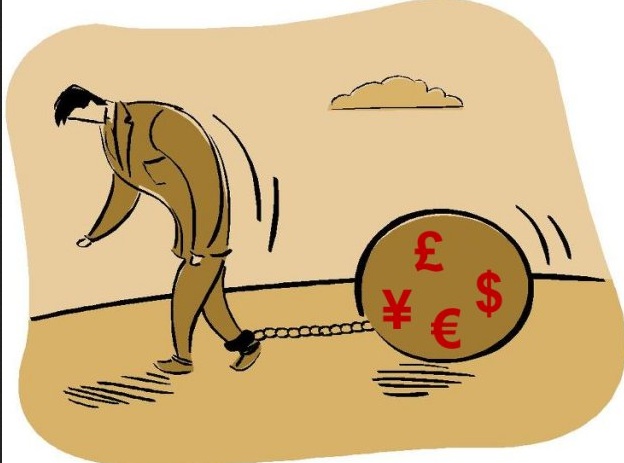
The US is not the only country whose students are burdened by debt.  More and more students are being forced out of colleges and universities in Japan because they cannot afford tuition.  More and more students are asking for tuition exemptions and spit payments.  Long term debt can be an intolerable burden.  The educational system will create an unfair gap between the rich and the poor unless other methods of financing educaion are found.

Student Debt

Argentina’s Education System Stalled by Digital Gap

Technology has not entered the school system in Argentina.  Teachers are still more uncomfortable with technology than their students are.  The debate between educators who want to move the country forward to become competitive in areas of science and technology and those that feel that all children must be brought up to digital literacy before a new upgrade is undertaken has not been resolved.  The education system is stallled.

Education?

India Empowers the Poor

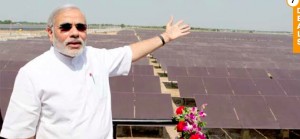
Modi has instituted more toilets and bank accounts for the poor.  But his program that directly engages the poor in their progress is the installation of solar panels. Modi wants every home to have one light bulb by 2019.

300 million Indians have no electricity at all.  Millions more have only sporadic power.  For them, solar is a way to leap frog over conventional fossil-fuel energy into clean energy.  If people can put solar panels over their homes or in empty spaces they can participate in their own uplift.

The potential for solar power is huge. Of the world’s twenty top economies it has the most sunlight.  Timing is ripe.  Solar power is nearing the cost of coal.  China, Africa and other parts of the world are rushing to solar, but India has the potential to be champion of solar.

Solar Power

Piketty on the Campaign Trail in the US

Mark Bloomfield writes:  Election 2014 is upon us; all eyes are on targeted races around the country and the balance of power in Washington. One young French economist may shape outcomes on Nov. 4 and beyond more than any other candidate: Thomas Piketty. Since earlier this year, Piketty has made tremendous waves as a critic of free markets and an advocate of a global wealth tax in his bestselling academic treatise, Capital in the 21st Century. He has been published in over 20 countries, while his influence has been seen in governments from the Netherlands to Columbia. I even found the bestseller on bookshelves in South Africa during my recent trip there.

Here in the U.S., he is providing the intellectual ammunition for President Obama and allies who call income inequality “the defining challenge of our time.”

Of course, Piketty is not truly a candidate for office, but the buzz surrounding his repetitious messaging of “income inequality” is weighing on the psyche of voters. Consider a CNNMoney survey conducted earlier this summer. Nearly six in 10 respondents concluded that the American Dream is out of reach.
So does this mean that voters will only support candidates that pledge to close the divide by hiking wages at the bottom or punishing super salaries at the top with pay caps, the Buffett Rule or even Piketty’s favorite global wealth tax?

Not so fast. Another recent survey by the Global Strategy Group found by almost the same percentages that Americans prefer a candidate who focuses on economic growth to one who emphasizes economic fairness.

The 2014 election will be the first test of Piketty and the inequality issue. The second will be in the 114th Congress, where the stage is already being set for a major discussion on tax reform. Paul Ryan (R-Wis.), the heir apparent to take the reins from retiring House Committee on Ways and Means Chairman Dave Camp (R-Mich.), forecasts that tax reform could happen within one to three years.

On the campaign stump, several Republican candidates are departing from traditional red meat about “tax cuts” and talking more about real tax reform, such as California Rep. John Campbell, the No. 4 Republican on the House Budget Committee: “We have to stop being one-trick ponies. We can’t say tax cuts will cure this, cure that and cure the other thing, because it’s just not credible. The purpose of tax reform is not to cut revenue to the government or to cut taxes — it’s to grow the economy.”

Piketty


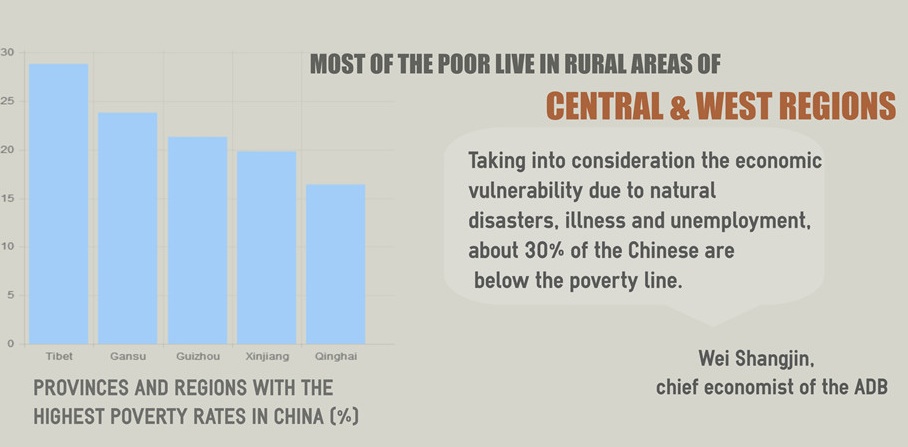
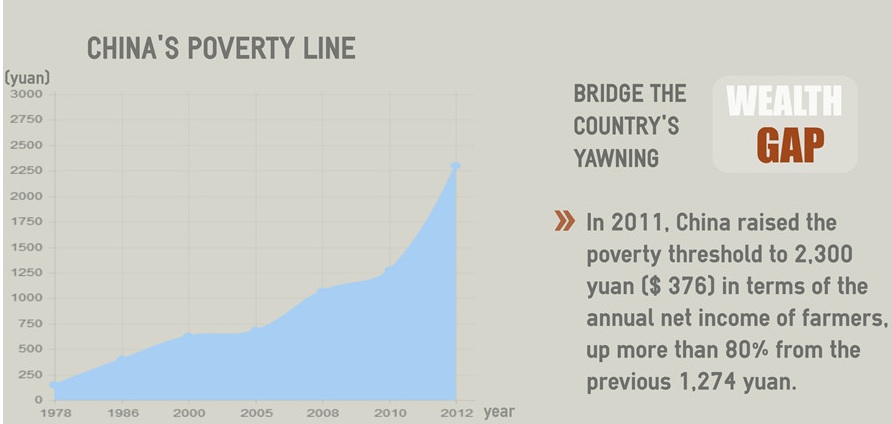
China Takes Aim at Rural Poverty

On poverty alleviation day, as many as 310 central government organs were arranged with targeted poverty relief work for 592 key counties that receive relief and preferential policies,” Zheng Wenkai, deputy director of the Poverty Alleviation and Development office, said.  Wenkal has said that China helped nearly 40 million poor rural residents overcome poverty last year.

The government will use the upcoming “Poverty-Relief Day” to provide funds, labor and other help to industries such as energy and e-commerce, both big factors in helping develop poor areas, in poverty-stricken counties.

China vows to reduce the number of rural people in poverty by 10 million this year, on the eve of China Poverty Alleviation Day.

rural poor 1Rural Poor 2