Greece: Coming to Terms?

Yanis Varoufakis writes:  Three months of negotiations between the Greek government and our European and international partners have brought about much convergence on the steps needed to overcome years of economic crisis and to bring about sustained recovery in Greece. But they have not yet produced a deal. Why? What steps are needed to produce a viable, mutually agreed reform agenda?

We and our partners already agree on much. Greece’s tax system needs to be revamped, and the revenue authorities must be freed from political and corporate influence. The pension system is ailing. The economy’s credit circuits are broken. The labor market has been devastated by the crisis and is deeply segmented, with productivity growth stalled. Public administration is in urgent need of modernization, and public resources must be used more efficiently. Overwhelming obstacles block the formation of new companies. Competition in product markets is far too circumscribed. And inequality has reached outrageous levels, preventing society from uniting behind essential reforms.

Beginning with fiscal consolidation, the issue at hand concerns the method. The “troika” institutions (the European Commission, the European Central Bank, and the International Monetary Fund) have, over the years, placed Greece in an austerity trap.

When fiscal consolidation turns on a predetermined debt ratio to be achieved at a predetermined point in the future, the primary surpluses needed to hit those targets are such that the effect on the private sector undermines the assumed growth rates and thus derails the planned fiscal path. Indeed, this is precisely why previous fiscal-consolidation plans for Greece missed their targets so spectacularly.

Our government’s position is that backward induction should be ditched. If this means that the debt-to-GDP ratio will be higher than 120% in 2020, we devise smart ways to rationalize, re-profile, or restructure the debt – keeping in mind the aim of maximizing the effective present value that will be returned to Greece’s creditors.

Besides convincing the troika that our debt sustainability analysis should avoid the austerity trap, we must overcome the second hurdle: the “reform trap.”  The previous reform program was founded on internal devaluation, wage and pension cuts, loss of labor protections, and price-maximizing privatization of public assets.

Our government believes that this program has failed, leaving the population weary of reform. The best evidence of this failure is that, despite a huge drop in wages and costs, export growth has been flat.

Additional wage cuts will not help export-oriented companies, which are mired in a credit crunch. And further cuts in pensions will not address the true causes of the pension system’s troubles (low employment and vast undeclared labor). Such measures will merely cause further damage to Greece’s already-stressed social fabric, rendering it incapable of providing the support that our reform agenda desperately needs.

The current disagreements with our partners are not unbridgeable. Our government is eager to rationalize the pension system (for example, by limiting early retirement), proceed with partial privatization of public assets, address the non-performing loans that are clogging the economy’s credit circuits, create a fully independent tax commission, and boost entrepreneurship. The differences that remain concern how we understand the relationships between the various reforms and the macro environment.

None of this means that common ground cannot be achieved immediately.
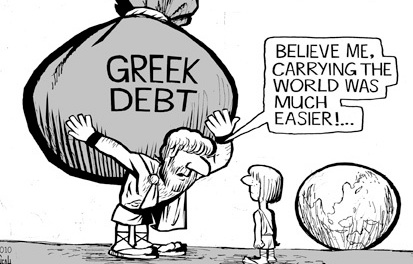
Greek Debt

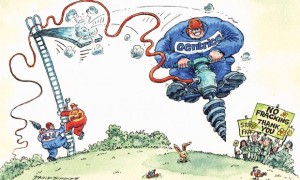
Shale Productions Costs Plummet

The cost to drill and complete a well is obviously the most critical cost category from the prospective of operator’s economics. This capital expenditure is incurred upfront whereas operating cash flows from the well are received over a long period of time and are heavily discounted as a result. The undiscounted upfront cost therefore has a strong effect on the IRR and is “grandfathered” (locked in) in the event the cycle turns and commodity prices improve.

The Upstream industry’s success in achieving fast cost cuts is evidenced by the recent reports by oilfield service providers according to which the recent drop in both activity levels and margins for Lower 48 is unprecedented in its speed. These are comments that came from both Schlumberger and Halliburton in the service majors’ conference calls in the past several days. Pricing for tubular goods and completion services were among the first to roll over as these, as well as certain other, oil service categories traditionally have weak contract and price protection. Premium rigs, on the other hand, had very strong dayrate and utilization protection under contracts going into 2015. As a result, cost reductions to E&P operators will continue to be realized on the drilling side as rig contracts roll over to lower dayrates. The same is true about the remaining service contracts on the completion side.

While these very deep cost reductions for the E&P sector are unlikely to be sustained in the long run, the very favorable cost environment may last, possibly through the end of 2016. Even if drilling activity begins to gradually pick up again towards the end of this year, it will take time for the service industry to restructure its capacity, without which pricing power will be weak. In the most immediate term, the vector of the cost change should remain in favor of E&P operators, until the pricing for services reaches its cyclical bottom, most likely in Q3 2015.

It should be noted that the service industry is also taking radical steps to respond to the macro challenge and has announced very deep layoffs and operating base consolidations in the U.S. As a harbinger of retirements of older, less efficient equipment, Helmerich & Payne recognized a loss in this morning’s quarterly report on the decommissioning of its 17 SCR FlexRigs.

The need to re-hire personnel and re-establish regional operational presence may again become a bottleneck and source of increasing costs for the industry as a whole, should the cycle turn around again.

Shale Oil Production

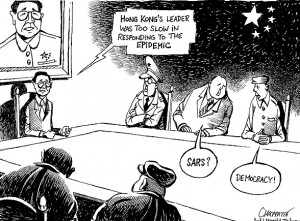
HSBC to Hong Kong?

HSBC proclaims that the world is its oyster.

HSBC Holdings Plc, less than two weeks before Britain’s general election, said it’s reviewing whether to move its headquarters out of the country because of rising tax and regulatory costs.

A move to Hong Kong, viewed by analysts as the bank’s most likely destination should it relocate, would unpick a structure that’s existed since the Hongkong and Shanghai Banking Corp. acquired Britain’s Midland Bank Plc in 1992. A transfer should cost no more than $1.5 billion because HSBC still has a base in the former British colony, said Chirantan Barua, an analyst at Sanford C. Bernstein Ltd. in London.

“The work is underway,” Chairman Douglas Flint told shareholders at the bank’s annual meeting in London on Friday. “The question is a complex one and it is too soon to say how long this will take or what the conclusion will be.”

 Flint has been under pressure from investors to consider moving from the U.K., where a levy imposed on banks’ global balance sheets following the financial crisis cost HSBC 750 million pounds ($1.1 billion) last year, more than any other lender. Europe accounts for less than a quarter of profit at the bank, which operates in more than 70 nations.

“They may not like the U.K., but I’m not sure there’s exactly going to be a raft of people queuing up to have them” because of the size of HSBC’s $2.6 trillion balance sheet, said Edward Firth, head of European bank research at Macquarie Group Ltd. in London. “Hong Kong is the only serious possibility.”

In a statement, the Hong Kong Monetary Authority noted what it called HSBC’s “deep historical links” and said it would take a “positive attitude” should the lender decide to move.

Finance Director Iain Mackay said in an interview: HSBC won’t just look at Hong Kong, but other countries with a strong regulatory framework including Canada, the U.S., China, Australia, Singapore, France and Germany.

HSBC also said it’s concerned about Britain’s potential exit from the European Union.

Standard Chartered, another British bank that like HSBC makes most of its profit in Asia, is also being urged by investors to relocate because of the cost of being in London. The U.K. levy cost Standard Chartered $366 million last year, accounting for about 9 percent of its $4.2 billion of pretax profit.

Hong Preferred Home for Bankers?


Family Businesses Deserve Attention

Report from the Economist:  Family companies are much more than just half-formed public companies. They are a category of companies in their own right. They have unique advantages in the form of long-term thinking and concentrated ownership. They have unique disadvantages in the form of succession problems and family feuds. And they have unique ways of dealing with these problems. Given the sheer number of family companies of all sizes, and their economic importance, they deserve a lot more attention, in particular from three groups of people: business analysts, professional managers and theorists of the firm.

Business analysts would do well to add some new tools to standbys such as company prospectuses and analysts’ reports. They might read more novels—say Jane Austen’s “Pride and Prejudice” for its observations on the marriage market and Thomas Mann’s “Buddenbrooks” for its insights into the fading of the entrepreneurial spirit across the generations. They should also follow the gossip columns.  A bad marriage can doom a business empire.

They should certainly keep an eye on problems of succession. A huge transfer of corporate wealth and power is currently taking place in two parts of the world—Asia and the Middle East—which have little experience of such things. The fate of two of the world’s biggest companies, Samsung and Hutchison Whampoa, is being shaped by family succession.

Business analysts like to argue that conglomerates will become less prevalent as markets develop, but conglomerates are also driven by families’ desire to provide opportunities for their offspring.  LVMH has managed to buy a number of family-owned luxury companies because they are much happier selling to another family firm than to an anonymous public company. Estée Lauder is pursuing a similar strategy in buying up family-owned beauty companies.


A consulting trio argues that public companies have a lot of important lessons to learn from family companies, from the value of long-term thinking to the virtues of frugality. They commended family companies on their ability to develop a cadre of loyal staff. Nestlé, a Swiss food company, slightly underperforms its big competitors in good times but outperforms them in bad. Essilor, a global leader in optical lenses, is obsessed with cost, keeps its debt low and has little staff turnover.

The more companies compete to sell “meaning” as well as mere products, the better family companies will do.

The most intriguing challenge posed by the enduring success of the family company is to one of the building blocks of modern economics: the theory of the firm.

Put companies and families together, and you have a uniquely potent combination

The prevalence of family companies in so much of the world suggests that theorists of the firm need to think more in terms of groups of firms rather than just individual firms.

Inheritance and ownership bring with them a whole collection of problems that are every bit as tricky as agency and transaction costs. Heirs frequently quarrel about their inheritance, and some owners behave less responsibly than others.

The company is one of the most powerful instruments ever produced by human beings; it allows investors and workers to pool their resources to serve the needs of strangers to mutual benefit.  Families with names like Rothschild and Baring played a starring role in creating modern capitalism. Families with names like Godrej and Lee will play a starring role in re-creating it in a more global age.

Family Businesses

US Economic Dominance and the AIIB

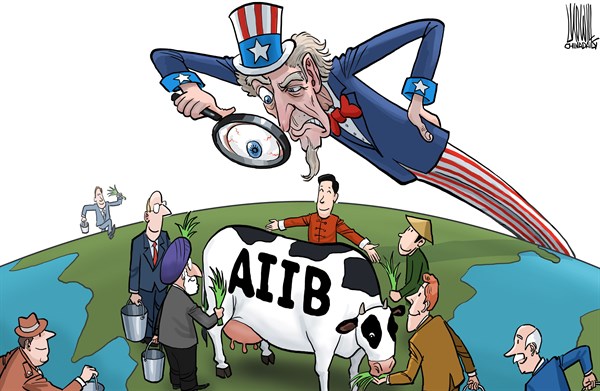
Mark Fleming-Williams writes:  Former U.S. Treasury Secretary Lawrence Summers wrote on April 5 that this month may be remembered as the moment the United States lost its role as the underwriter of the global economic system. His comments refer to the circumstances surrounding China’s launch of a new venture, the Asia Infrastructure Investment Bank, (AIIB).  Wary of China’s growing ambitions and influence, the United States had advised its allies not to join the institution, but many signed up anyway. The debacle was undoubtedly embarrassing for Washington, but even so, Summers’ prophecy is a bit premature at this stage.  US Economic Dominance

US and AIIB

Wall Street’s Stringer?

Matt Levine points out how politics works US style.  Particularly in New York, the traditional home of US finance:

Remember how New York City Comptroller Scott Stringer was shocked to find out that New York’s pension funds pay investment management fees to “Wall Street”? Which includes paying a few basis points to traditional stock and bond managers, and one or two hundred basis points to “alternatives” (private equity, real estate, etc.) managers?

Stringer was pushing Albany lawmakers to pass a bill that would have allowed an additional 10 percent of the city’s $160 billion pension system — or $16 billion — to be invested in alternatives. Assuming the industry standard 2 percent management fee on such investments, that shift could have generated more than $300 million in new Wall Street fees every year.

Stringer championed the bill following a 2013 election campaign that saw him benefit from an influx of campaign contributions from financial executives after former Wall Street prosecutor (and former governor) Eliot Spitzer jumped into the race for comptroller. During the campaign, Stringer declared that he wanted the city to consider moving more pension money out of low-risk bonds and into Wall Street firms. Upon taking office in 2014, he argued that the existing law prohibiting more than a quarter of the city’s pension fund from being invested in alternatives was too restrictive.

Wall Street Fees

US Regulators Spoofed?

John Cochrane writes in his Grumpy Economist blog: Just when you thought financial regulation couldn’t get more expansive and incoherent, our Justice Department comes in to defend morons’ right to herd.  Mr. Navinder Singh Sarao is now under arrest, fighting extradition to the US, and his business ruined, for “spoofing” during the flash crash.

What is that? The Journal’s beautiful graph at left explains.Spoofing 1Spoofing 2
The obvious question: Who are these traders who respond to spoofing orders by placing their own orders? Why is it a crucial goal of law and public policy to prevent Mr. Sarao from plucking their pockets? Is “herding trader” or “momentum trader” or “badly programmed high-speed trading program” or just simple “moron in the market” now a protected minority?

Why is Mr. Sarao being prosecuted and not all the people who wrote badly programmed algorithms that were so easily spoofed? If this caused the flash crash (how, not explained in the article) are they not equally at fault?

I don’t mean by this a defense of the crazy stuff going on in high speed trading.  I think one second batch auctions are a much better market structure.  But the whole high speed trading thing is largely a response to SEC regulations in the first place, the order routing regulation, discrete tick size regulation, and strict time precedence regulation. A fact which will probably not enter at Mr. Sarao’s trial (he doesn’t seem to have billions for a settlement) and will give him little comfort in jail.

And maybe, just maybe, there is something more coherent here than the Journal lets on. I’ll keep reading hoping to find it and welcome comments who can.

A larger thought. We still really want to rely on regulators to spot all the problems of finance and keep us safe from more crashes?

How to Address Currency Manipulation?

Kemal Davis writes: It is impossible to deny that trade and exchange rates are closely linked. But does that mean that international trade agreements should include provisions governing national policies that affect currency values?

Some economists certainly think so. Simon Johnson, for example, recently argued that mega-regional agreements like the Trans-Pacific Partnership should be used to discourage countries from intervening in the currency market to prevent exchange-rate appreciation;

As it stands, the relevant international institutions — the World Trade Organization and the International Monetary Fund — are not organized to respond effectively to possible currency manipulation on their own. Incorporating macroeconomic policies affecting exchange rates into trade negotiations would require either that the WTO acquire the technical capacity (and mandate) to analyze and adjudicate relevant national policies or that the IMF join the dispute-settlement mechanisms that accompany trade treaties.

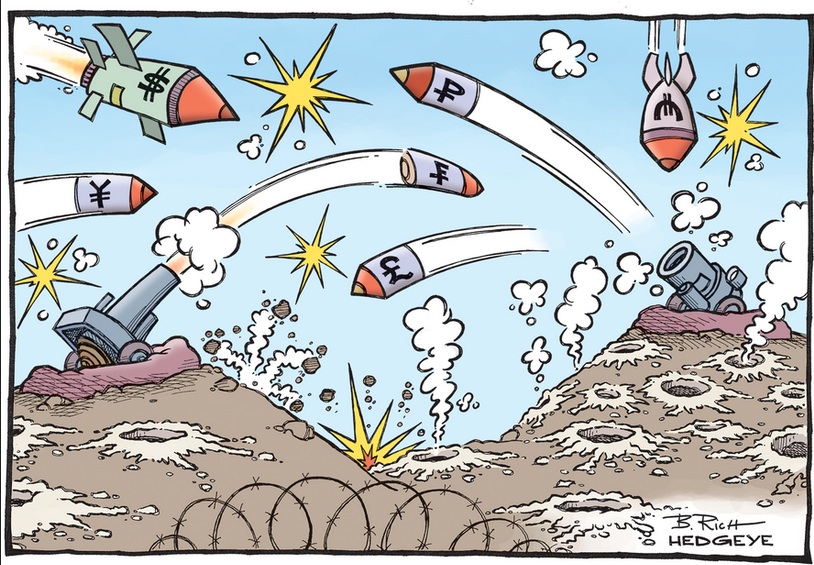
The most direct method is purchases of foreign assets. But, in a world of large short-term capital flows, central-banks’ policy interest rates – or even just announcements about likely future rates — also have a major impact. Moreover, quantitative easing affects exchange rates and trade, even if central banks purchase only domestic assets, as demonstrated by recent movements in the exchange rates of the dollar, the euro, and the yen.

Consider the problem that would be posed by the eurozone.  Most eurozone countries have lately been forced to tighten fiscal policy, thereby reducing or eliminating their current-account deficits.  As a result, the total eurozone trade surplus is now massive. Because individual eurozone members have no monetary-policy tools at their disposal, the only way that Germany can reduce its surplus while remaining in the eurozone is to conduct expansionary fiscal policy. The economist Stefan Kawalec has explicitly referred to the current policy mix in the eurozone as “currency manipulation.”

None of this means that macroeconomic policies that affect exchange rates are not problematic. They are. But trade negotiations are not the right forum for discussing the causes and consequences of current-account imbalances.

A better approach would include strengthening the IMF’s multilateral surveillance role. Doing so would broaden discussions of macroeconomic policy to include employment issues — specifically, the potential impact of large foreign-trade surpluses on domestic jobs. And it would give trade negotiations a chance to succeed.

Currencies

Encouraging Girls to Enter the Technology Field

Angela Merkel celebrate International Girls in ICT Day in Berlin before she left for Brussels.

International Girls in ICT Day is an opportunity for girls and young women to see and experience ICTs in a new light encouraging them to consider a future in technology. To date, over 111,000 girls and young women have taken part in more than 3,500 events held in 140 countries around the world.  Ghana, Lebanon, Brazil, et cetera!

The Girls in ICT initiative of the International Telecommunication Union (ITU) is a global effort to raise awareness on empowering and encouraging girls and young women to consider studies and careers in ICTs. The initiative is committed to celebrate and commemorate the International Girls in ICT Day on the fourth Thursday of every April as established by the ITU membership.

The Girls in ICT Portal is a tool for girls and young women to get an insight into the ICT sector as well as for partners to understand the importance of the International Girls in ICT Day, developed by the Digital Inclusion programme of ITU Telecommunication Development Bureau.

Girls in Tech

Ten Sustainable Companies for Earth Day

Andrew Winston writes in the Harvard Business Review:   The NGO Ceres has gotten an impressive array of companies to sign onto the Climate Declaration, which states that climate change is both a threat and a major economic opportunity. But this year, a smaller Ceres group, BICEP, which is calling for more aggressive policies like a tax on carbon, added some very mainstream companies such as General Mills, Kellogg’s, and Nestle (perhaps not coincidentally, General Mills announced early this year that its earnings were reduced by extreme weather).

In the wonky, trendy vocabulary of working together, “collaboration” isn’t exciting enough without the now-hot modifier of “pre-competitive” (meaning: stuff fierce rivals can do collectively that doesn’t diminish their ability to compete). Walmart and Target demonstrated how this works by convening a Personal Care Products Sustainability Summit. All the major players in the personal care product value chain — the giants of consumer products, chemicals, and fragrances — were there (as was I). The general topic was how this group could reduce the physical and chemical impacts of all those gels and liquids we use on our bodies, and the group will continue to work together and convene to tackle thorny issues in the value chain.  Sustainability

Sustainability