Turkey Stream?

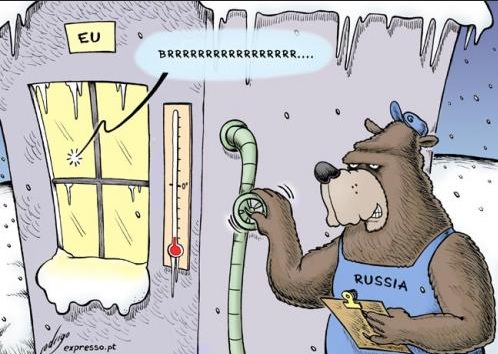
Mehmet Cetingulec  writes:  Russia cancelled the South Stream oil pipeline in December.  Without the commission’s approval, Bulgaria declared South Stream could not cross its territory. Russia, upset with the Europeans’ position, responded with the Turkey Stream project.

Putin’s move surprised the Europeans. Federica Mogherini, EU foreign affairs and security policy chief, declared on Euronews TV that the Russian decision illustrated the urgent need for Europe to diversify its gas procurement channels. The scrapped project was to have been 3,600 kilometers (2,237 miles) long and would have transported gas to Croatia, Hungary, Serbia and Slovenia.

Andras Deak, of the World Economy Institute, told Euronews: “The European Commission, by explaining why reconciliation would be more beneficial to both sides, could induce Russia to take a step back and thus boost its own prestige as well.” Neither Europe nor Putin, however, chose to step back. In fact, Putin moved forward, on his new project, meeting in February with Hungarian Prime Minister to discuss Turkey Stream.

After keeping Hungary onboard, Putin met with Prime Minister Alexis Tsipras in Moscow April 7, Putin proposed that Turkey Stream provide natural gas via Greece to the central Europe countries of Austria, Hungary, Macedonia and Serbia. Putin noted that the project could earn Greece hundreds of millions of euros every year. Tsipras’ only objection was to the name of the project — Turkey Stream.

As with South Stream, the European Commission is not in favor of Turkey Stream. With debate continuing over the project, Russia issued a warning to the European Union on April 14. the CEO of Gazprom, said EU obstruction of Turkey Stream would be a grave mistake that might prompt Gazprom to suspend the project and redirect its natural resources to Asian markets. He said that for Turkey Stream to be ready by 2019, construction should have already begun.

Gas will be brought to Trachea [on the European part of Turkey], and the project will be financed by finding buyers from the spot market. Greece, Serbia, Macedonia and Hungary want to participate in this project, but if Russia and Ukraine fully sort out their problems, this project could be forgotten. In its current form, it is not really economical. There is no buyer other than Turkey.

On the other hand, Yardim believes the Russians will not go back on their word and that the Turkey Stream project will be realized. He said four pipelines will be laid to carry 63 billion cubic meters of gas annually to Turkey.

Yardim said Russia, in delivering natural gas to Europe’s border via Turkey Stream, does not anticipate encountering financial problems. Will Russia give up on Turkey Stream? According to Yardim, “I know that Russia has decided on this issue. I worked with Russians for 25 years. They don’t easily change their minds. I don’t think they will revert to South Stream.”
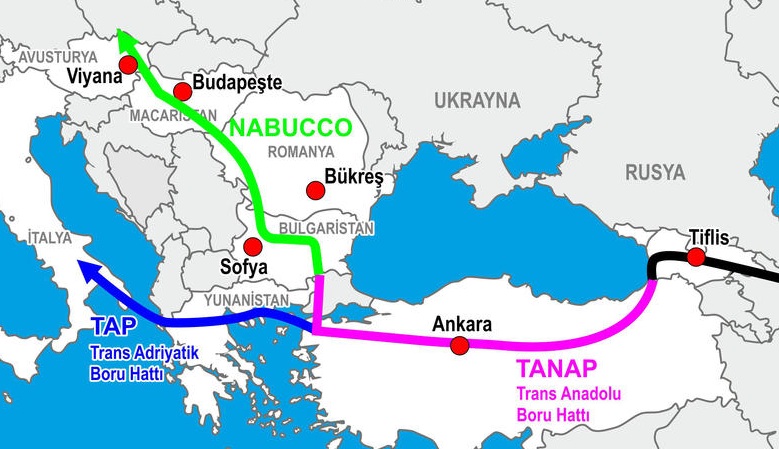
Turkey Stream

EU and Gazprom

Tim Boersma writes:  Policies on trade and competition have become a new field of international conflict and the European Commission (EC) has shown its willingness to use them as a weapon. Yesterday, the EC sent a Statement of Objections to Russian state-owned gas company Gazprom for its alleged abuse of market power in Central and Eastern European gas markets. It is the next step in an antitrust case that was first opened in August 2012. In an initial response, Gazprom states that the claims of the EC are unsubstantiated. Of course, in the current political climate it is difficult to see this as a regular antitrust case, but that is exactly how it should be assessed.

The case:

  • Gazprom might be hindering cross-border gas sales, by imposing export ban clauses, destination clauses (stipulating that natural gas can only be consumed in a certain country, or sold to a limited number of customers within that country), or requiring wholesalers to obtain Gazprom’s approval for exports. According to the EC, Gazprom has included territorial restrictions in its supply agreements with eight EU member states: Bulgaria, the Czech Republic, Estonia, Hungary, Latvia, Lithuania, Poland, and Slovakia. Territorial restrictions on gas sales are anticompetitive, as for example ruled by the EC in 2009 when it fined France’s EDF and Germany’s E.ON for making agreements not to sell gas from the MEGAL pipeline in each other’s markets.
  • Gazprom allegedly has an unfair pricing policy. The EC is investigating whether the prices that wholesalers and industrial customers pay are unfair, and how Gazprom’s price formulae—which are based on oil price indexes—have contributed to the unfairness. The EC has preliminarily concluded that Gazprom has charged unfair prices in five EU member states, Bulgaria, Estonia, Latvia, Lithuania, and Poland.
  • Concerns on gas transport infrastructure. According to the EC, Gazprom leveraged its market dominance in Bulgaria and Poland by making gas supplies conditional upon obtaining certain infrastructure commitments from wholesalers. In Bulgaria, for instance, this iinvolved the South Stream pipeline, which Gazprom cancelled in December 2014.  EU and Gazprom

 EU and Gazprom

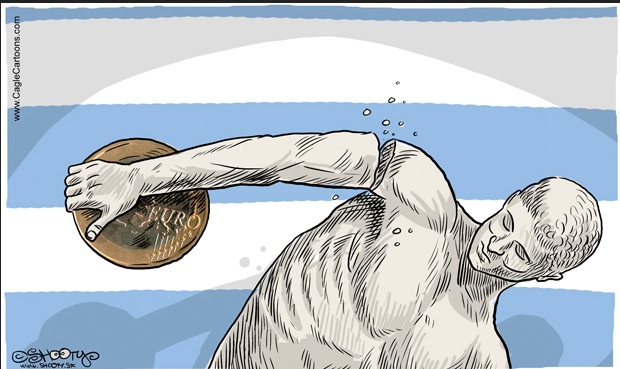
Varoufakis Wants Deal on Greece

Greece is willing to make compromises to reach a deal on its debt, Finance Minister Yanis Varoufakis said after tense talks with his euro zone peers on this issue.

“We want an agreement and we are willing to make compromises to achieve this,” Varoufakis told reporters. “The cost of not having a solution would be huge for all of us, Greece and the euro zone.”

Varoufakis said the process to achieve to a deal was difficult but that “we will have a solution in the end.”

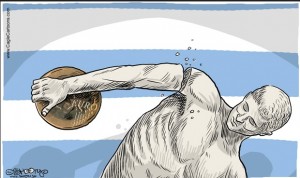
Grexit? or Deal?

Hold Out for a Better Deal on Iran?

Aaron Arnold:  Speaking from the White House earlier this month, President Obama announced details of a framework agreement between Iran and the P5+1—the United States, Russia, China, France, the United Kingdom, and Germany—that limits Iran’s path to building a nuclear weapon over the next 10 to 15 years. Although negotiators will finalize technical details between now and the June 30 deadline, the parameters provide Iran with sanctions relief in exchange for limits on its uranium enrichment, converting its Arak heavy water reactor, limiting the number and type of centrifuges, and agreeing to intrusive inspections. Should Iran cheat or fail to uphold its end of the bargain, however, the United States and its allies reserve the right to “snap-back” into place tough economic and financial sanctions.

The view that holding out for a “better deal” by strengthening sanctions does not consider the reality of the current sanctions regime.

Myth No. 1: International partners will continue to support US-led sanctions. Sanctions on Iran’s energy, shipping, and insurance sectors, along with almost complete financial isolation, have taken a toll. It is easy to imagine that these tough sanctions brought Iran to the negotiating table and, therefore, that the United States should continue to apply sanctions in hopes of gaining a more comprehensive agreement.

Iranian oil exports currently hover at almost 1.1 million barrels a day, down from 2.5 million in 2011—costing Iran more than $40 billion in lost revenue in the last year alone. Globally, low oil prices and oversupply also mean that Iran will face stifff market competition.  If sanctions were lifted, it is uncertain whether Iranian oil exports would return to pre-2011 levels.

Myth No. 2: “Snap-back” sanctions will be ineffective against economic momentum in Iran.   Critics of the feasibility of snap-back sanctions fail to recognize a number of challenges that Iran will have to overcome once the United States, the European Union, and the United Nations begin to lift nuclear-related sanctions.

For one, President Hassan Rouhani’s austerity budget does not take into account a deal with the P5+1.

Tehran’s second challenge would be re-joining the international banking system, which it has been increasingly frozen out of since 2011 when the United States designated Iran as a jurisdiction of primary money laundering concern under Section 311 of the USA PATRIOT Act.

Iran will also have to contend with its continued designation by the Financial Action Task Force (FATF)—the global standard-setting body for money laundering and terrorist financing—as a high-risk jurisdiction.

Myth No. 3: The United States can continue to control the world financial system. Although not without controversy, the extraterritorial provisions of US-led sanctions provide the backbone to freezing Iran out of the global economy.

The effectiveness of these provisions, however, relies in part on the structure of the international financial system; imposing tougher sanctions for a better bargain rests on the premise that this structure will remain intact.

Reality versus myth. Calls for a “better deal”—relying in part on strengthening sanctions—do not take a realistic view of the current state of the global sanctions regime against Iran. The system is changing, and domestic politics has yet to catch up.

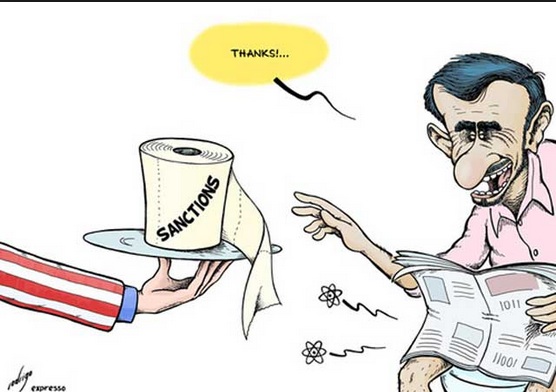
Sanctions and Iran


EU to Join UN in Libyan Immigration Solution?

Most refugees trying to flee to safety in Europe hail from wartorn Syria, or are Africans shuttling through the chaos in Libya for a way off the continent. Although many Syrians try to cross into Europe through Turkey, increasing numbers travel to the Libyan coast via Egypt in order to find smugglers who will put them in dodgy dinghies – or worse. And they pay a lot of money to do it.

After hundreds of refugees drowned this week when their boats sank, and video footage captured the tragedies, European politicians reacted. The European Commission proposed a 10-point plan that boils down to improving search-and-rescue operations and basically doing more of the same.

One theory has been thoroughly disproven: Cutting down on sea rescue operations, which is what happened when the EU nations pulled the plug on Italy’s Mare Nostrum operation, does not motivate refugees to stay on African shores.

Undoubtedly the European Union should beef up its operations to rescue people in distress and find ways to evenly distribute them across the EU member states. But Europe should also actively pursue the stabilization of Libya.

The current situation in Libya is reminiscent of Lebanon during its civil war. Several groups are at once trying to take control of the country. What remains of the national government is powerless. Government services such as the border police and customs have collapsed. It is in this chaotic vacuum that people smugglers find the freedom they need to strip desperate refugees of their money – and all too often, their lives.

Aside from this, the vacuum is also giving rise to Islamofascist groups like ISIS. The self-labeled Libyan chapter of ISIS likes to engage in the slaughter of innocents. What they carry out is the kind of butchery.

Just a few years ago, Europeans and Americans removed the murderous dictator Moammar Ghaddafi. The Europeans made the same error they had accused Americans of after toppling Iraq’s Saddam Hussein in 2003: neglecting to engage in proper nationbuilding, or even having a strategy for it. Now as Libya descends into civil war, it presents a gateway to Europe not only to refugees, but also to ISIS terrorists.

It is time to own up to Europe’s mistakes and stem the tide in Libya. The European Union should engage with the United Nations to set up a large peacekeeping force with a tough mandate, and go to Libya to restore stability, separate the warring factions and disarm them – by force if necessary. Then organize a conference with the factions and establish a democratic federal republic that restores border patrols and law and order.

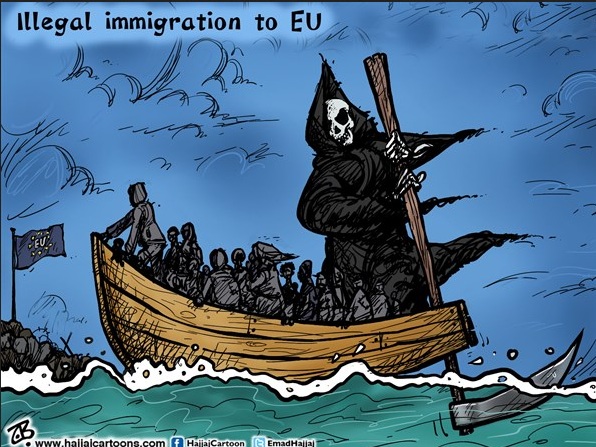
Immigration to EU

US and the Artic Council

Baffin Island in Canada’s far north is the site for a biennial summit meeting of the Artic Council

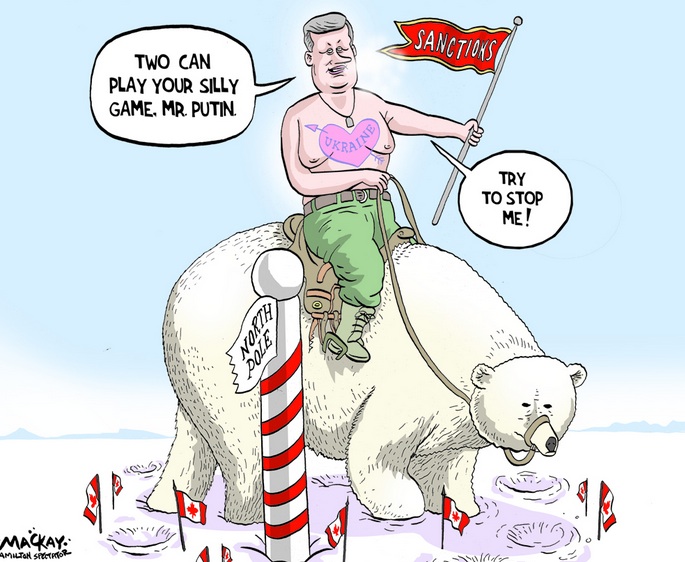
Russia’s involvement in Ukraine  has resulted in sanctions and travel bans on dozens of officials and a prohibition of the sale of American technology and services to help Russia tap its potentially enormous energy resources in the Arctic.

President Vladimir V. Putin views those as hostile acts.   “There is a pushing of the envelope here,” said Senator Lisa Murkowski, Republican of Alaska, who attended the meeting of the Artic Council as part of an American delegation led by Secretary of State John Kerry.

“The Arctic should be this zone of peace,” Ms. Murkowski said during a recent speech at the Center for Strategic and International Studies in Washington, alluding to the council’s founding purpose. “I absolutely believe that, adhere to it, but I also recognize that within a zone of peace, there is respect that you show for one another.”

The Arctic Council — made up of Canada, Denmark, Finland, Iceland, Norway, Russia, Sweden and the United States, as well as observer nations and organizations — was created in 1996 as a diplomatic forum to address issues that arose from the increased activity in the region.

The council was never intended to be a forum for debating military and security matters, and until recently, it appeared to be immune to broader political differences.

At the council’s meeting in Nuuk, Greenland, in 2011, the members adopted their first legally binding agreement to coordinate search-and-rescue operations over 13 million square miles of ocean.

At this year’s meeting, the nations agreed to discuss how to reduce the amount of methane and black carbon emitted by burning wood or fuels in the Arctic.

Russia’s military activity in the Arctic and its vast territorial claim to waters there highlight the strategic priority that Mr. Putin has given to the region. The intensifying competition over natural resources has increased the possibility of confrontation.

The spat over the Russian excursion to the North Pole centered on the delegation’s layover in the Svalbard archipelago, Norwegian territory about 500 miles north of the mainland that, under a 1920 treaty, grants commercial and residential rights to other countries, including Russia.

The United States has taken over the chairmanship of the council from Canada, allowing it to set the organization’s agenda for the next two years until the next summit meeting, to be held in Alaska.

In his remarks on Friday, US Secretary of State Kerry outlined what he called an ambitious set of goals, focused on ocean safety and security, economic development and, in particular, several steps to address climate change as part of President Obama’s push for stronger international action.

Artic Counctil

Equity Boom in China?

Angus Nicholson writes:   In 1987, a young man quit his job at the Hebei Oil Pipeline Bureau and went to seek his fortune in the nascent private property market of Hainan province’s Special Economic Zone. He was Pan Shiyi, now chairman of SOHO China, and one of China’s first private property developers. But he also experienced modern China’s first big real estate bust, when Hainan property prices crashed back to reality prices following a 1992 bull market inspired by Deng Xiaoping’s Southern Tour promoting his ‘reform and opening up’ policy platform.

Hainan is again at the forefront of a Chinese property slowdown.

Hainan may be an extreme case, but China’s property market will not return to its glory days of unrestrained growth.

The March figures from China’s National Bureau of Statistics (NBS) suggests that China’s property market slowdown will continue through 2015.

Construction starts that saw the most dramatic drop. Starts have dropped to their lowest level since October 2009, just before the Chinese government’s enormous 2009 stimulus package. This points to where the property slowdown is being felt most acutely, in new investment. Developers are now far less willing to invest in new projects and believe the market environment has shifted dramatically.Yu Liang president of major Chinese property developer Vanke Group, states that while government policies will help support the market, he is not expecting a major rebound. Yu thinks we have seen the end of the ‘Golden Age’ of the Chinese property market.

As if in unison, as the property market began its outright decline in the second half of 2014, China’s equity market sparked into life.

While the Chinese government does not control China’s stock markets, they are highly driven by policy changes. The share of bank financing in China’s financial sector and the associated concentration of risk has been a major concern for Chinese policymakers. The need to diversify risk across the financial system has driven the Chinese government’s support of corporations pursuing direct financing through China’s financial markets.

What the Chinese government really has little influence over is Chinese investors’ hunger for capital growth. With limited avenues for investment, Chinese investors often pile into asset classes all at once.

New brokerage account registrations and margin financing have exploded.

These are figures that would strike fear into the hearts of most central banks. But the People’s Bank of China (PBOC) is already battling on a number of fronts. The slowing economy, steady capital outflows and the disinflationary trend has tightened domestic liquidity.

This has lead the PBOC to begin, in the words of ANZ’s Liu Ligang, ‘an aggressive easing cycle’ with the weekend announcement of a 100 basis point cut to banks’ reserve requirement ratio (RRR).

How the government manages the equity market boom without precipitating a dramatic crash will be one of the most important stories for China in 2015. In the current environment one can sympathise with investors like Pan Shiyi who are diversifying into overseas assets.

China's Equity Market?

No Plan B for Greece?

Slovenian finance chief Dusan Mramor led the calls at a meeting of the bloc’s 19 finance chiefs on Friday to consider a “plan B” to mitigate the fallout if negotiations with Greece fail.

As Greece struggles to pay pensions and salaries, its government has failed to present a plan to revamp its economy that passes muster with euro-area officials who are withholding further aid.

In February, finance ministers gave the Greek government until the end of June to complete the deal and said they expected a list of reforms by the end of April.

“Some countries have said, because of their concern on the lack of progress and the attitude on the Greek side, ‘if it continues like this, we will really get into trouble,’” Dutch Finance Minister Jeroen Dijsselbloem said “In that context plan B has been mentioned.”

Still, ministers were left frustrated that European Economic Commissioner Pierre Moscovici clamped down on discussions of a backup plan. They went on to air their concerns without him, one of the people said.

Finance chiefs aren’t saying in public that they’re contemplating alternative outcomes because that would send the message to markets that it’s game over, the person said.

“The central scenario is that in the Greece case we’re going to reach an agreement,” Spanish Economy Minister Luis de Guindos told reporters on Saturday. “That’s the only one that we’re considering.”

Varoufakis, who was attacked by his colleagues for his handling of the negotiations, joined Moscovici’s effort to prevent others in the group taking precautions in case the talks fail.

While finance ministers’ immediate concern is how to keep Greece in the euro area, if talks over refinancing break down, failure to prepare for a Greek default also risks reawakening the contagion threat that shook the bloc during the darkest days of the debt crisis.

Technical inspectors assessing the needs of Greece’s economy on behalf of the EU and International Monetary Fund told Friday’s meeting that they need to have better access to officials with political responsibility in Athens in order to speed up the process, according to de Guindos.

The dilemma for finance ministers is that just raising the prospect of a plan B risks making it a self-fulfilling prophecy.

Grexit?

Reform in China?

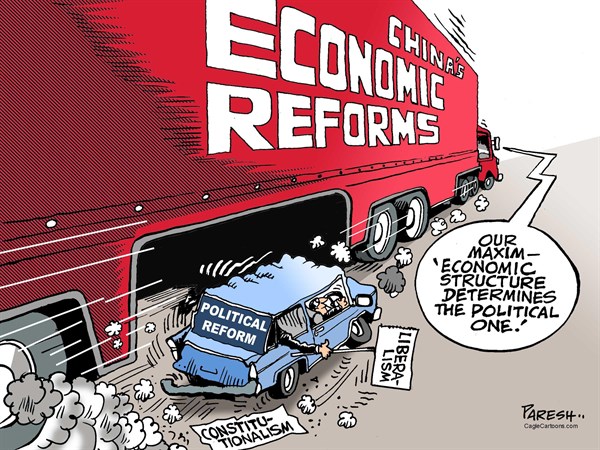
A scholar based in China writes:  Since the start of its post-Mao reforms in the late 1970s, the communist regime in China has repeatedly defied predictions of its impending demise. The key to its success lies in what one might call “authoritarian adaptation”—the use of policy reforms to substitute for fundamental institutional change. Under Deng Xiaoping, this meant reforming agriculture and unleashing entrepreneurship. Under Jiang Zemin, it meant officially enshrining a market economy, reforming state-owned enterprises, and joining the World Trade Organization. Under Hu Jintao and Wen Jiabao, it meant reforming social security. Many expect yet another round of sweeping reforms under Xi Jinping—but they may be disappointed.

The need for further reforms still exists, due to widespread corruption, rising inequality, slowing growth, and environmental problems. But the era of authoritarian adaptation is reaching its end, because there is not much potential for further evolution within China’s current authoritarian framework. A self-strengthening equilibrium of stagnation is being formed, which will be hard to break without some major economic, social, or international shock.

One reason for the loss of steam is that most easy reforms have already been launched. Revamping agriculture, encouraging entrepreneurship, promoting trade, tweaking social security—all these have created new benefits and beneficiaries while imposing few costs on established interests. What is left are the harder changes, such as removing state monop­olies in critical sectors of the economy, privatizing land, giving the National People’s Congress power over fiscal issues, and establishing an independent court system. Moving forward with these could begin to threaten the hold of the Chinese Communist Party on power, something that the regime is unwilling to tolerate.

Reform in China


Another reason for the loss of steam is the formation of an increasingly strong antireform bloc. Few want to reverse the reforms that have already taken place, since these have grown the pie dramatically. But many in the bureaucracy and the elite more generally would be happy with the perpetuation of the status quo, because partial reform is the best friend of crony capitalism.

China and the US in the Global Economy?

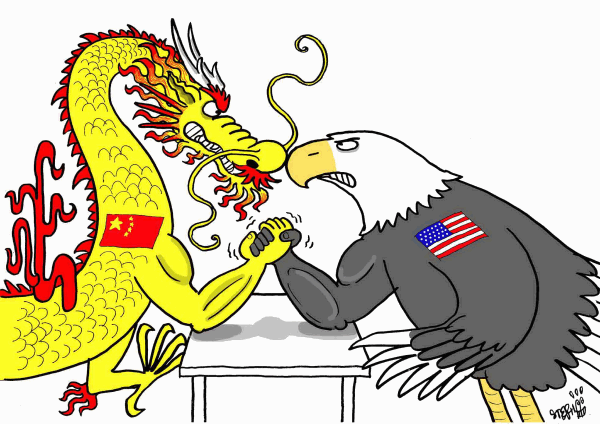
Jeffrey Frankel writes: China and the United States seem to regard Asia-Pacific relations similarly: as a zero-sum game. Are countries signing up for China’s Asian Infrastructure Bank or America’s Trans-Pacific Partnership?  Will China be welcomed, or humiliatingly rebuffed, in its effort to persuade the International Monetary Fund to include the renminbi in its unit of account, Special Drawing Rights (SDR)? Is the US still the world’s largest economy, or did China surpass it in 2014?

However tempting it may be to focus on such questions, they are the wrong way to think about the global economy. There is no reason why some countries should not join both China’s AIIB and America’s TPP, or why overlapping memberships should not expand over time – or, indeed, why the hostesses should not eventually attend each other’s parties.

There is nothing wrong with joining the AIIB. Asia needs more help with infrastructure investment than the World Bank and the Asian Development Bank can provide; China can play a useful leadership role; and the participation of countries with high governance standards can help prevent the cronyism, corruption, and environmental damage to which large-scale infrastructure projects are prone.

Likewise, the TPP negotiations are sometimes characterized as a US attempt to isolate China. But, given the Asia-Pacific region’s high trade volumes, and its dense set of trading arrangements running in every direction, no one, including China, is about to be isolated.

Exchange rates are another area where zero-sum thinking prevails.

Every five years, the IMF reconsiders its composition, which currently is defined in terms of the dollar, euro, yen, and pound.  A misplaced focus on country rankings can do real damage.

Such is the case with the stalled IMF quota reform, an issue where the rankings in fact are of some importance, but not in a zero-sum way. quota shares, implying greater financial contributions and greater voting weights.

Thirty years ago, the West wanted nothing more than for China to become a capitalist economy. It has done so, with spectacular success. The rules of the game now require that China be given a bigger share in the governance of international institutions.

China and the US