Match.com for Jobs?

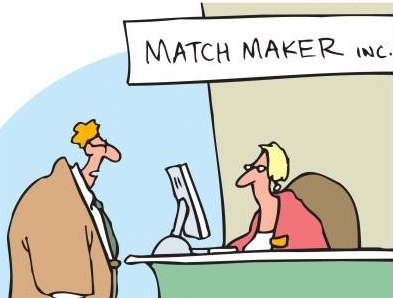
Should Match.com be brought into the workforce and match employees with jobs?  The US Secretary of Labor, Thomas Perez, thinks this would be a good idea.

Labor Secretary Thomas Perez wants the Obama administration to be the economic version of a dating website. “Match.com: Our goal is to match jobseekers who want to punch their way to the middle class with businesses,” Perez said Wednesday at a speech in Washington. He added that U.S. officials need to “step up our game” and reevaluate the old models that ushered young people into the economy.

“We’ve got to get rid of the old models of train-and-pray where you train people for jobs and pray people will find them for those jobs,” Perez said at the forum, hosted by the center-left think tank Third Way. “If people aren’t hiring widget makers — we shouldn’t train people to be widget workers.”

Match.com for Jobs

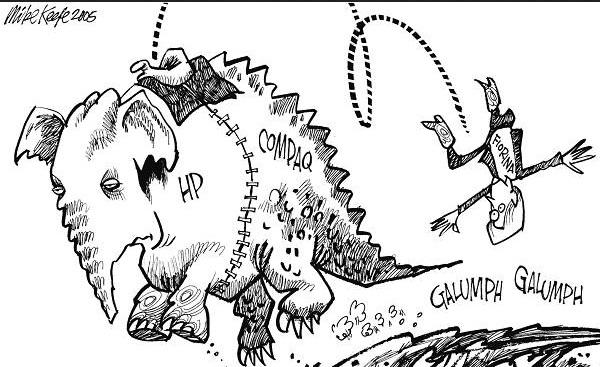
Fiorina Throws Her Hat in the Presidential Ring

Kevin Cirilli writes:  Carly Fiorina’s political future depends on whether she can defend her record as CEO of Hewlett-Packard.

Fiorina said members of her own board leaked confidential information to the media to undermine her decisions, though she stopped short of alleging outright sexism. She was the first female CEO of a Fortune 20 company.

“Men understand other men’s need for respect, but they don’t always understand women’s need for respect,” Fiorina said. “The situation that transpired in the boardroom was all about certain board members wanting to protect their position when they felt threatened, because their behavior was against the code of conduct, and they knew that I as a leader would not tolerate that conduct.”

When asked again if she thought underlying sexism contributed to her firing, she said, “There’s no question that women in positions of authority are scrutinized differently, criticized differently and characterized different.”

Following her departure, she said HP officials monitored her phone calls to see if she had been the one leaking the negative information.

“Set aside the legality for a moment — that is a terrible practice for a board to engage in, and it’s evidence of their dysfunction,” she said.

Both critics and supporters portray her as a determined leader. She was ousted, detractors say, partly because of declining stock price and a controversial merger with Compaq that butted heads with HP’s founders’ vision for the future.

Still, she said President George W. Bush called to offer her a job in his administration the day after she was fired, though she declined to say which one.

Another phone call she received was from the late Apple CEO Steve Jobs. She said he urged her to take her time and not do anything for at least six months. She said Jobs told her HP would “regret” firing her one day.

Fiorina is hardly a presidential front-runner. But as the only likely female Republican presidential candidate, she has an important place in the field.

She is often mentioned as a potential vice presidential pick to the eventual Republican nominee. And her supporters praise her fiery speeches that frequently take on Hillary Clinton, the Democratic front-runner.

But her business record has resurfaced as she’s stepped back into the media limelight. Earlier this month, MSNBC’s “Morning Joe” co-host Mika Brzezinski confronted Fiorina about her business record during a contentious appearance.  Fiorina said she made tough choices that were best for the company.

Carly Fiorina and HP

Abe Pitches TPP

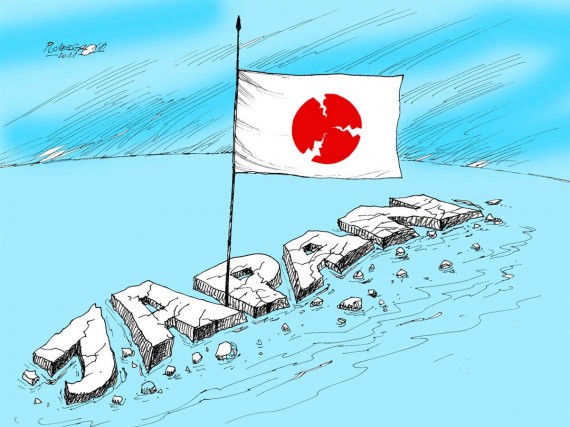
John Hudson writes:  Japanese Prime Minister Shinzo Abe made his most high-profile pitch yet for a trans-Pacific trade pact that has divided U.S. lawmakers and turned liberal Democrats against the White House over concerns about job losses and wage stagnation.

Abe said the Trans-Pacific Partnership, a trade proposal that would lower tariffs and harmonize regulations across 12 Pacific Rim countries, would strengthen the Japanese and American economies while bringing competing nations in line with an array of labor and environmental standards — a claim many Democrats view with skepticism.

“The U.S. and Japan must take the lead,” said Abe, the first Japanese leader to address both houses of Congress since World War II. “We must take the lead to build a market that is fair, dynamic, sustainable, and is also free from the arbitrary intentions of any nation.”

Abe painted a picture of Japan as the rule-abiding, democratic partner for the U.S. in forging standards for trade in Asia. Abe’s description casts Japan as the Asian country with the same economic values as the U.S., as opposed to China, though Abe mentioned Asia’s biggest economy only in passing. Advocates of the trade deal argue that the U.S. and Japan need to write the rules for business in Asia, lest Beijing do it for them.

Both Abe and President Barack Obama have touted their progress on the Trans-Pacific Partnership (TPP) during the Japanese leader’s visit to Washington. But no breakthroughs have been announced on the significant sticking points that still exist in the negotiations, namely agriculture and automobiles.

The trade agreement, along with another European trade pact, are both part of the Obama administration’s ambitious agenda to lower barriers for U.S. companies abroad and increase exports.

TPP still faces stiff opposition both in Japan and the U.S. Many Americans associate trade pacts with job losses that happened across the country as globalization spurred outsourcing by many U.S. companies in the 1980s and 1990s.

In addition to convincing the public in America and Japan, Obama and Abe must also persuade their local industries and legislators.

A group of Democrats accused Tokyo of manipulating the yen to boost exports — a claim that is disputed by economists but has nevertheless galvanized Democrats skeptical of global trade.

While avoiding the issue of currency manipulation entirely, Abe did seek to allay concerns that a TPP deal would spawn a race to the bottom among competing Pacific Rim countries.

The Republican 2016 presidential contenders have been broadly supportive of the trade deal, as have most Republicans, but the issue has been tricky for Democratic frontrunner Hillary Clinton, whose liberal base is more skeptical of free trade. As Secretary of State, Clinton called the TPP the “gold standard” in efforts to expand free and fair trade, but in recent days, she’s been increasingly noncommittal.

But first things first: Obama and Abe still need to solve lingering trade issues between the two countries, particularly respect to rice and automobiles.

Japan and US


Migration of Illegal Minors to US Slowing

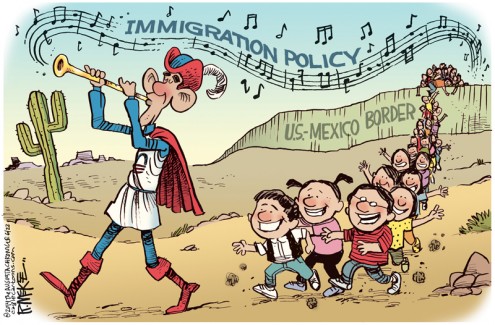
The Mexican government has been deporting illegal immigrants from Central America.  This concerted effort has in turn slowed down the migration of illegal minors across the US-Mexican border.

Those actions clearly have not halted migration. But the increasing difficulty of the trek — combined with high temperatures, the brisk pace of the deportation of Central Americans and a public-relations campaign warning people that they will not get visas in the US — is among the factors that may explain why fewer migrants are now crossing into the southwestern United States, with a particular decrease in the number of children traveling alone or with a relative.

Last month, 3,141 children traveling without a parent were apprehended at the United States-Mexico border, a 70 percent decrease from June.

Events this week in Baltimore show clearly that the US is not able to take care of its own young people, much less those of other countries. Slowing the Illegal Immigration of Minors to the US

Slowig Illegal Immigration of Minors

Upping Equity Requirements for Banks?

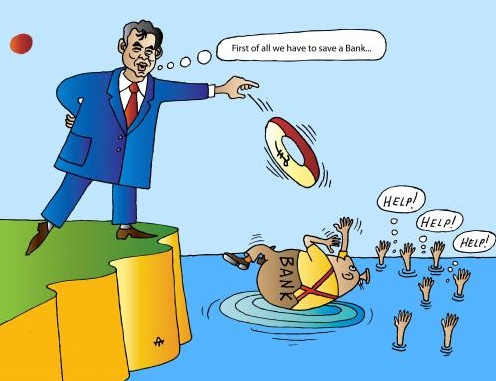
SImon Johnson writes: The main financial risk facing the United States today looks very similar to what caused so much trouble in 2007-2008: big banks with too much debt and too little equity capital on their balance sheets. Uneven global regulations, not to mention regulators who fall asleep at the wheel, compound this structural vulnerability.

All booms are different, but every major financial crisis has at its heart the same issue: major banks get into trouble and teeter on the brink of collapse.

The most important question to ask of any financial system is how much loss-absorbing equity major banks have on their balance sheets. When a company suffers losses, its shareholder equity falls in value, and less equity means that the company is more likely to default on its debts.

The capital ratios most frequently highlighted by banks and officials are misleading, because they include items – such as goodwill and deferred tax assets – that are incapable of absorbing losses. We need to look instead at tangible equity relative to tangible assets. And we should also be very careful about the accounting used for derivatives.

Thomas Hoenig, vice chairman of the Federal Deposit Insurance Corporation, publishes his own calculation of capital levels at the world’s largest banks, and these data are now available through the end of 2014. The most leveraged big US bank, Morgan Stanley, has less than 4% equity, meaning that 96% of its balance sheet is some form of debt. The average for big US banks is just under 5% equity.

This is more – but not much more – capital than some troubled banks had in the run-up to the financial crisis in 2008. Citigroup, for example, had no more than 4.3% equity, according to Hoenig’s calculation, in November 2008. At the end of 2012, when Hoenig started to publish his US GAAP-IFRS adjustment, the average for the largest US banks was roughly 4% equity. It is possible to argue that this key measure is moving in the right direction, but the pace of improvement is glacial at best.

More important, 5% equity is unlikely to be enough to absorb the kinds of losses that a highly volatile world will throw up.

The most dangerous shocks may be those that originate with the big banks themselves. The latest significant development to surface is what Better Markets, a pro-reform group that has put out a helpful fact sheet, calls “de facto guaranteed foreign subsidiaries” that trade derivatives – a murky phenomenon that likely involves all the big players. The trick here is that a de jure guaranteed foreign subsidiary of a US bank would have to comply with many US rules, including those governing conduct, transparency, and clearing (how the derivatives are actually traded). A foreign subsidiary that is supposedly independent is exempt from those rules.

The main reason why such loopholes are left open is that regulators choose not to close them. Sometimes this may be due to lack of information or awareness. But, in many cases, the regulators actually believe that there is nothing wrong with the behavior in question – either because they have been persuaded by lobbyists or because they themselves used to work in the industry (or could go work there soon.)

Sound familiar?

Saving Banks?

AIIB Connects with the World, US Excepted

Andrew Sheng writes: Despite official American and Japanese opposition, 57 countries have opted to be among the founding members of the China-led Asian Infrastructure Investment Bank (AIIB). Regardless of what naysayers believe, this remarkable turn of events can only benefit global economic governance.

According to former US Treasury Secretary Larry Summers, the AIIB’s establishment “may be remembered as the moment the United States lost its role as the underwriter of the global economic system.”

Who is right will depend largely on the decisions that the AIIB’s top shareholders make regarding its operating structure. So far, the AIIB has not sought to amend the principle that the largest contributor to a multilateral organization gets the largest say in running it.

This implies a larger global leadership role for China. Massive debts have lately undermined the ability of the US – not to mention Europe and Japan – to continue making such large contributions to hte IMF.  Fortunately, China is willing and able to fill the gap.

China has a 3.8% voting share in the IMF and World Bank, even though it accounts for more than 12% of world GDP.

The AIIB has its own objectives, which do not align precisely with those of, say, the World Bank. Specifically, the bank is a critical element of China’s “one belt, one road” strategy, which encompasses two initiatives: the overland Silk Road Economic Belt, connecting China to Europe, and the 21st Century Maritime Silk Road, linking China to Southeast Asia, the Middle East, and Europe.

Connectivity is vital to economic growth. Over the last three decades, the construction of roads, railways, ports, airports, and telecommunications systems in China has fostered trade, attracted investment, and, by linking the country’s land-locked western and southern provinces to its more prosperous coastal areas, helped to reduce regional disparities.

China’s Silk Road initiative, which aims to boost prosperity among China’s trading partners largely through infrastructure investment, is a logical next step – one on which China is spending significantly.t.

Given massive global demand for infrastructure finance – which, according to ADB estimates, will amount to $8 trillion in Asia alone over the next decade – the AIIB should not be considered a threat to the World Bank, the ADB, or other multilateral lenders.

The AIIB’s operations will most likely resemble those of the World Bank in the 1960s, when engineers with hands-on development experience dominated the staff and could design lending conditions that worked for borrowers.

The acid test of the AIIB’s effectiveness will be its governance model. One failing of the Bretton Wood institutions is their full-time shareholder boards of directors, which tend to undermine effectiveness by micro-managing and often requesting conflicting lending conditions.
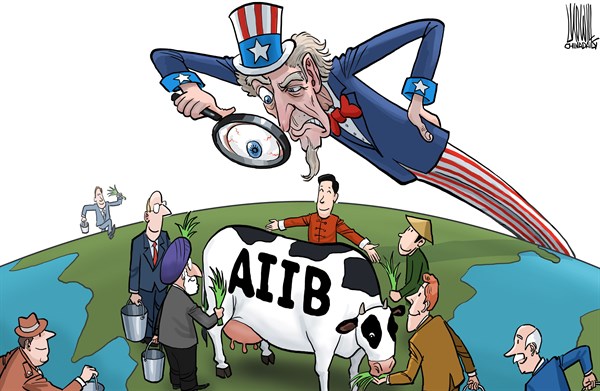
US and AIIB

Even if the AIIB does not deliver as promised, its establishment is an important reminder that in a fast-changing world, economic governance cannot remain stagnant. If Western leaders really do believe in innovation, competition, and meritocracy, they should welcome the AIIB.

Ukraine Ousting Oligarchs

Link

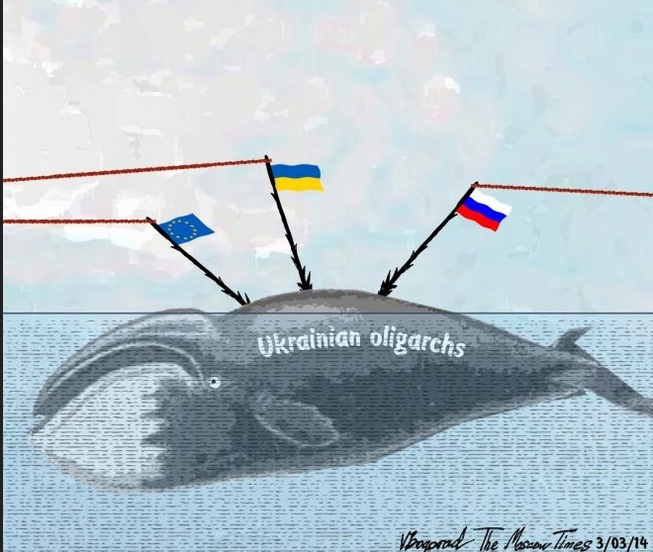
Poroschenko writes:  The former system of governance in Ukraine in which public officials and prominent businesspeople operated under the table and above the law, shut us off from the rest of Europe. For Europe, with all its existing problems and challenges, has codified a system of checks and balances and a system of laws. Europe represents Ukraine’s future.

My recent decision to  dismiss the governor of the Dnipropetrovsk region is indicative of this drive to prevent the inappropriate influence of private interests on the state. The rule of law is of utmost importance in the new Ukraine, and there is no longer any tolerance for actions that undermine equality before the law. Public officials and large business owners are regular citizens like pensioners, students, workers, and small businessmen, in fact, just like everybody else. Those accused of abuse of power, corruption, or other offences are subject to the law regardless of their personal connections or wealth.

Viktor Shokin, our general prosecutor, has said as much, stating that there are no untouchables in Ukraine – not even the prime minister or president.

But we cannot simply push our way to justice. Justice is not the revenge of new authorities over previous administrations. Justice is blind to the untouchables, whether they are from the old or new authorities. The road forward is still long, but we’ve already started.

Despite new legislation that launched judicial reforms in February, earning the praise of the Venice commission much remains to be done to entrench the rule of law in the courts. The newly adopted reforms to Ukrainian law ensure the right to a fair trial, change the rules relating to the selection of judges, return authority to the supreme court and establish transparent rules on the bodies responsible for judicial appointments. The list of disciplinary penalties and the grounds for disciplinary liability has been extended. The procedure for assessing judges’ qualifications has been introduced for all judges without exception. A judge will have to undergo a qualification assessment – a professional exam – and abide by anti-corruption legislation. In addition, a constitutional commission has been formed to craft constitutional amendments to make Ukraine a decentralised state that enshrines the rule of law and offers its citizens the right to a fair trial within a reasonable time frame.

We are also making it easier to run businesses in Ukraine. We have significantly reduced (from 56 to 38) the number of business activities that are subject to licensing. Registration of a legal entity can now be done online and a new head of the anti-corruption bureau has been appointed this month. We are introducing a total change of the rules of the game – there will be no obstacles for entrepreneurs who play fair.

Ukraine Oligarchs

Watching Apple

Apple once again beat Wall Street’s forecasts for revenues, earnings and iPhone sales with its results for the second quarter, as it said it would return another $70 billion to shareholders.  The world’s most valuable company by market capitalisation posted revenue growth of 27% to $58 billion, ahead of analysts’ expectations of around $56 billion, thanks to stronger-than-anticipated iPhone sales, up 40% to 61.2 million units. Apple said that it would expand its dividends and buyback scheme to return a total of $200 billion to shareholders by the end of March 2017, up from the $130 billionn programme of a year ago. That includes a 11% dividend increase and a further $50 billion in share repurchases. 

Apple is an interesting lesson for entrepreneurs.  Give the market what they don’t know they want but discover that they do.  Is the watch going to work?

Apple Watch


Varoufakis Sidelined

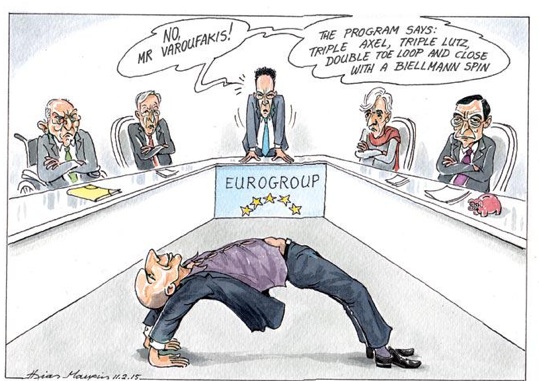
Greek Prime Minister Alexis Tsipras on Monday reshuffled his team handling talks with European and IMF lenders, a move widely seen as an effort to relegate embattled Finance Minister Yanis Varoufakis to a less active role in negotiations.

An anti-austerity economist who has angered peers with his brash style, Varoufakis is facing calls to quit after returning from a meeting of euro zone finance ministers in Riga isolated and empty-handed while Athens scrambles to avoid bankruptcy.

Deputy Foreign Minister Euclid Tsakalotos – a close Tsipras ally and soft-spoken economist liked by officials representing creditors – was appointed coordinator of the group, the official said. This would elevate him from his current position and give him a more active role in the negotiations, pushing Varoufakis to the sidelines.

The latest developments suggested Tsipras was ramping up efforts to ease tensions with lenders and strike a deal to unlock aid so Greece can avoid defaulting on payments, which could force it out of the 19-nation euro zone.

The news spurred a rally in Greek stocks and bonds. Greek two-year bond yields fell 250 basis points to a two-week low of 23.55 percent, reversing an earlier rise. Athens stocks rose 4 percent while Greek bank shares jumped 9 percent.

Later on Monday, the government said it was preparing a bill to legislate reforms already presented to the lenders, in an effort to inject new momentum into the slow negotiations.

Euro zone officials welcomed the reshuffle and the apparent effort to reduce Varoufakis’ role in negotiations with them.  “The way he behaved made him an additional obstacle in the negotiations,” said a euro zone official.

Another euro zone official questioned whether the move would bring about the substantive change lenders have been demanding.

Varoufakis was later taken to task by the media after he failed to appear at a state dinner after the meeting. He responded by tweeting a quotation by former U.S. president Franklin Roosevelt which read: “They are unanimous in their hate for me; and I welcome their hatred.”

In another move hinting at a less prominent role for Varoufakis, his general secretary, Nikos Theocharakis, who had been leading technical-level talks with the so-called Brussels Group of lenders, will now focus on drawing up a plan for growth to be the basis for a new deal with lenders in June.

George Chouliarakis, considered close to powerful deputy Prime Minister Yannis Dragasakis, will take over responsibility for talks with the Brussels group.

In an effort to show that Athens is serious about giving lenders access to data, a new team was also set up to support EU and IMF officials gathering information in the Greek capital.

Varoufakis


Correlation: Income and Credit Growth

Economists from the Atlanta Federal Reserve write:  Almost a decade has passed since the peak of the housing boom, and a handful of economics papers have emerged as fundamental influences on the way that economists think about the boom – and the ensuing bust. One example is a paper by Atif Mian and Amir Sufi that appeared in the Quarterly Journal of Economics in 2009 (MS2009 hereafter). A key part of this paper is an analysis of income of growth and mortgage-credit growth in individual U.S. ZIP codes. The authors find that from 2002 to 2005, ZIP codes with relatively low growth in incomes experienced high growth in mortgage credit; that is, income growth and credit growth were negatively correlated during this period.  Income Growth and Credit Growth Correlation