US Should Join AIIB!

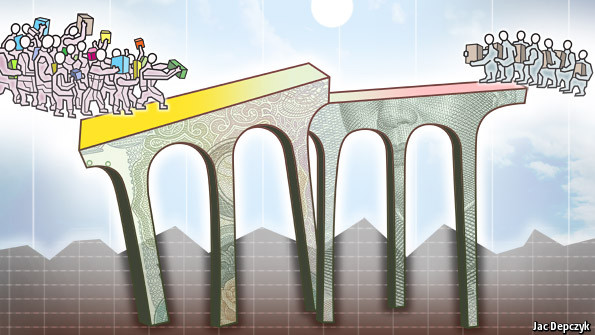
Joseph Seigliz writes: The International Monetary Fund and the World Bank are poised to hold their annual meetings, but the big news in global economic governance will not be made in Washington DC in the coming days. Indeed, that news was made last month, when the United Kingdom, Germany, France, and Italy joined more than 30 other countries as founding members of the Asian Infrastructure Investment Bank (AIIB). The $50 billion AIIB, launched by China, will help meet Asia’s enormous infrastructure needs, which are well beyond the capacity of today’s institutional arrangements to finance.

One would have thought that the AIIB’s launch, and the decision of so many governments to support it, would be a cause for universal celebration. And for the IMF, the World Bank, and many others, it was. But, puzzlingly, wealthy European countries’ decision to join provoked the ire of American officials.

America’s opposition to the AIIB is inconsistent with its stated economic priorities in Asia. Sadly, it seems to be another case of America’s insecurity  undermining an important opportunity to strengthen Asia’s developing economies.

China itself is a testament to the extent to which infrastructure investment can contribute to development.

The AIIB would bring similar benefits to other parts of Asia, which deepens the irony of US opposition.

There is a further major global advantage to a fund like the AIIB: right now, the world suffers from insufficient aggregate demand. Financial markets have proven unequal to the task of recycling savings from places where incomes exceed consumption to places where investment is needed.

When he was Chair of the US Federal Reserve, Ben Bernanke mistakenly described the problem as a “global saving glut.” But in a world with such huge infrastructure needs, the problem is not a surplus of savings or a deficiency of good investment opportunities. The problem is a financial system that has excelled at enabling market manipulation, speculation, and insider trading, but has failed at its core task: intermediating savings and investment on a global scale.

The World Bank’s assistance was sometimes overburdened by prevailing ideology; for example, the free-market Washington Consensus policies foisted on recipients actually led to deindustrialization and declining income in Sub-Saharan Africa. Nonetheless, US assistance was, overall, far more effective than it would have been had it not been multilateralized.

New attempts to multilateralize flows of assistance are similarly likely to contribute significantly to global development. The AIIB offers a chance to test that idea in development finance itself.

Perhaps America’s opposition to the AIIB is an example of an economic phenomenon that I have often observed: firms want greater competition everywhere except in their own industry. This position has already exacted a heavy price: had there been a more competitive marketplace of ideas, the flawed Washington Consensus might never have become a consensus at all.

US opposition to the AIIB is hard to fathom, given that infrastructure policy is much less subject to the influence of ideology and special interests than other policymaking areas, such as those dominated by the US at the World Bank. Moreover, the need for environmental and social safeguards in infrastructure investment is more likely to be addressed effectively within a multilateral framework.

The UK, France, Italy, Germany, and the others who have decided to join the AIIB should be congratulated.
20140719_FND000_0

Saving Greece?

Does Europe need to save Greece:

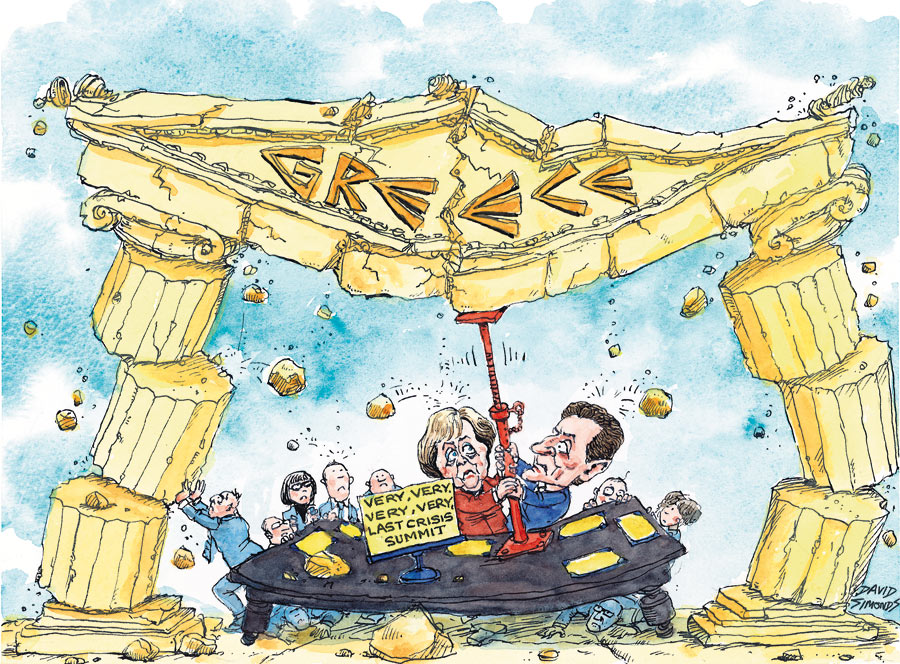
Anders Borg writes:  The fundamental problem underlying Greece’s economic crisis is a Greek problem: the country’s deep-rooted unwillingness to modernize. Greece was subject to a long period of domination by the Ottoman Empire. Its entrenched political and economic networks are deeply corrupt. A meritocratic bureaucracy has not emerged. Even as trust in government institutions has eroded, a culture of dependency has taken hold.

The Greeks, it can be argued, have not earned the right to be saved. And yet a Greek exit from the euro is not the best option for either Greece or for the European Union. Whether or not the Greeks are deserving of assistance, it is in Europe’s interest to help them.

The OECD, the European Commission, the International Monetary Fund, and the World Bank have emphasized, in report after report, the fundamental inability of Greece’s economy to produce long-term sustainable growth. The country’s education system is sub-par and underfunded. Its investments in research and development are inadequate. Its export sector is small. Productivity growth has been slow.

Greece’s economy struggles to reallocate resources, including workers, given the rigidity of the labor market.

After Greece was allowed to enter the eurozone, interest-rate convergence, combined with inflated property prices, fueled an increase in household debt and caused the construction sector to overheat, placing the economy on an unsustainable path.

In the eight years that I served on the EU’s Economic and Financial Affairs Council, I worked alongside seven Greek ministers, every one of whom at some point admitted that the country’s deficit numbers had to be revised upward.

And yet, as bad as Greece’s economy and political culture may be, the consequences of the country’s exit from the euro are simply too dire to consider.  European values at stake in that decision trump any economic considerations.

For starters, a Greek exit from the euro would be a devastating blow to Greece. Without the support of the European Central Bank, the country’s banking system would be shut off from international markets.

To make matters worse, the economic crisis could lead to a political meltdown, making it impossible to enact the structural reforms that Greece desperately needs.

Europe also needs to consider the geopolitical environment. Increased tension caused by the conflict in Ukraine risks destabilizing other parts of the continent. Expelling Greece into such an unstable international environment would leave the region more vulnerable to those – particularly Russia’s current leaders – who believe they would benefit from a weaker, less unified Europe.

There are more important questions raised by the crisis in Greece than whether the country deserves to be rescued by European taxpayers. At stake are fundamental values and strategic considerations that are central to the European project. Europe is simply more European with a stable partner in Athens.

Saving Greece?

Are Greek Reforms Progressing?

Renee Maltezou writes: Greece’s finance ministry dismissed on Sunday a report by a German newspaper which said that euro zone officials were shocked at Greece’s failure to outline plans for structural reforms at last week’s talks in Brussels.

The mood between Greece’s newly-elected leftist government and its euro zone partners has been tense during negotiations that will determine whether the cash-strapped country deserves further financial aid by its EU/IMF lenders.

Frankfurter Allgemeine Sonntagszeitung cited participants at last week’s meeting as saying that they were disappointed by Athens’ lack of movement in its plans, adding that the Greek representative just asked where the money was “like a taxi driver” and insisted his country would soon be bankrupt.

“When the readers of FAS read the minutes of the Euro Working Group meeting the newspaper will have difficulty justifying its headline and the content of its article,” the finance ministry said. “Such reports undermine the negotiation and Europe.”

A meeting of deputy finance ministers – called the Euro Working Group – on Thursday gave Athens a six working day deadline to present a revised economic reform plan before euro zone finance ministers meet on April 24 to decide whether to unlock emergency funding to keep Greece afloat.

Technical teams from Greece and its international lenders held a teleconference on Saturday to outline the agenda of talks in the coming days, a Greek finance ministry official said.

Greece’s biggest creditor Germany has said the euro zone would give Athens no extra funds until it has a more detailed list of reforms.

Greek Reforms


Slowdown in Turkey. Why?

Cenk Sidar writes:  For most of the past decade, Turkey’s economy has enjoyed remarkable success. Between 2002 and 2006, during the first term of the Justice and Development Party (AKP), growth averaged 7.2 percent per year, making Turkey a star performer in an otherwise difficult region.

While external factors played some role in Turkey’s success, one would be remiss not to give due credit to the ruling party. The positive steps the AKP took after winning power — continuing the IMF-led reforms initiated by its predecessors and maintaining a responsible fiscal and monetary policy — helped the country achieve the macroeconomic stability necessary to attract foreign capital.

This picture has changed significantly over the past few years, as Turkey has turned from an exemplary emerging market into a country that grabs headlines with stories of economic weakness and financial vulnerability. The current list of problems is daunting: rising inflation, slowing growth, foreign exchange pressure, rising fiscal expenditures, increased unemployment, overall debt, and loss of export competitiveness. The IMF expects Turkish GDP to grow only 3 percent in 2015 and 2016. The lira has lost over 10 percent of its value since the beginning of this year. Moreover, the country is falling behind rival emerging markets. In 2014, India and China left Turkey’s 2.9 percent growth rate in the dust with impressive rates of 7.5 and 7.4 percent respectively.

Turkey’s slowdown is mainly caused by longer-term structural factors, pointing to an urgent need for fundamental reform. And this is where the economic track record of President Recep Tayyip Erdogan and the ruling AKP has begun to suffer. Even as the Turkish economy sputters, the AKP government is focusing on unsustainable, and sometimes destructive, short-term measures, such as pressuring the central bank to maintain a loose monetary policy, jeopardizing its independence and legitimacy in the process. Meanwhile, the structural reforms needed to ensure the country’s longer-term development are being put off.   Turkey’s Economic Problems

Turkey


Entrepreneurs Alert: US and Cuba Talking

Shell Companies Revealed in Argentine Bond Investigation

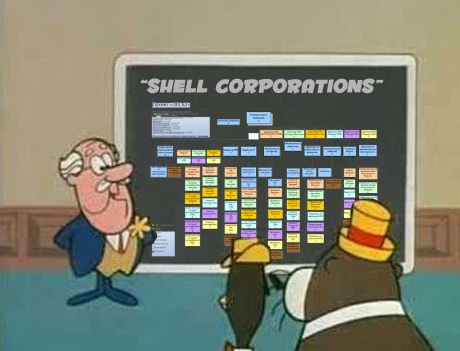
The Economist reports:  “VULTURE” funds, which chase distressed borrowers for payment of outstanding debt, have few friends outside finance. Occasionally, though, their hunt for profit aligns neatly with calls for greater financial openness by campaigners, winning the rapacious funds unlikely admirers. So it has proved as Elliott Management looks to enforce court rulings demanding that Argentina cough up $2 billion it owes to the hedge fund. A collateral benefit of the fund’s hunt for assets is that it has put a crack in the wall of secrecy around American shell companies, which are among the world’s most impenetrable and thus often used for nefarious purposes.

The case involves $65m suspected of having been embezzled and laundered abroad by Lazaro Baez, a building tycoon with ties to Cristina Fernández de Kirchner, Argentina’s president, and her late husband (and predecessor), Nestor. Elliott joined the sleuthing, its logic being that any stolen money was misappropriated state funds and could therefore be grabbed to satisfy judgments in its favour.

The money trail led to Nevada, home to 123 brass-plate firms that Elliott suspected of being linked to the alleged fraud. But piercing the corporate veil in the state is far from easy. Its record-keeping requirements are minimal even by American standards.

Elliott sued in Nevada for information on the shell companies from their agent, MF Nevada, and, by association, Mossack Fonseca, the Panamanian law firm understood to be MF’s parent. Even if no records were held in Nevada, Mossack could be ordered to disclose what was on file in Panama or a third jurisdiction, Elliott hoped.

MF Nevada claimed, implausibly, that it was independent of Mossack. In a series of legal skirmishes, Elliott established numerous links between MF and Mossack: for instance that MF sets up Nevada companies exclusively for Mossack’s clients and that the employment contract of MF’s sole employee was signed by Mossack’s bosses.

Satisfied that MF was an “alter ego” of Mossack, a judge recently ruled that Mossack was subject to the jurisdiction of American courts and had to comply with the information subpoena. This was a big win for Elliott—and for anyone wanting to know more about shell companies. America is on some measures less compliant with anti-money-laundering standards for corporate vehicles than any other country.

The ruling will also increase scrutiny of one of the biggest purveyors of such vehicles: Mossack is an industrial-scale incorporator of anonymous companies. Shells it helped set up (but is not legally liable for) have been linked to tax evaders and kleptocrats. Mossack says it does not advise clients on the use of companies it forms, and that “we have never been investigated for any crime, including money-laundering.”

Elliott is not alone in trying to penetrate the murk, but its combination of money, tenacity and legal nous is rare. The fight is not over, however. If the relevant records are in Panama, a country with strict secrecy laws, they are unlikely to be produced in a hurry. Mossack has challenged the alter-ego ruling. The case will now move to a federal court. Separately, Elliott has won an order in the Seychelles, requiring Mossack to provide information on firms there linked to the Nevada entities. But the law firm is yet to hand over any documents.

Elliott is confident it can build a clear picture of the alleged fraud and use it to claw back some of what it is owed. Its efforts have a collateral benefit, too. Argentina’s elites are no longer universally hostile towards the firm, some of them applauding its fight to expose the corruption of political and business rivals.

Shell Companies

Iceland Experiments with a Sovereign Money System

Matthew C. Klein writes: One of the oddest things about the aftermath of the financial crisis is the extent to which things haven’t changed.


Yes, there are plenty of new rules, and stress tests, and of course there are more fines for wrongdoing, but the basic structure of the financial system doesn’t look much different from before it blew up. There is still plenty of money to be made (and lost) issuing short-term “safe” debt to buy long-term, illiquid, risky assets. Lenders still exacerbate the cycle by increasing their leverage when asset prices rise only to cut back on lending when the economy sours. And everyone knows that taxpayers are still on the hook when things go bad, which acts as a massive subsidy for the financial industry.

As if all that weren’t bad enough, the current system makes it far too hard for central bankers to accomplish their mission of stabilising the economy. Right now, changes in nominal spending power are largely due to decisions made at banks and other financial firms. The level of short-term interest rates affects their behaviour, as do asset purchases, but monetary policy is only one force among many that determines total nominal spending. Modestly raising the cost of short-term funds isn’t enough to stop excessive credit growth, just as aggressive bond-buying has proven insufficient to restore the pre-crisis trend of nominal spending.

The continuity can’t be explained by the lack of better ideas. In fact, the basic alternative to the status quo — moving the power to create money from private financial firms to the state — was suggested in detail in the 1930s by a group of economists led by Irving Fisher. Subsequent proponents have included Milton Friedman, James Tobin, researchers at the International Monetary Fund, John Cochrane, and Martin Wolf. (And me.)  Iceland’s Experiment with a Soverign Money System

Is the World Bank Obsolete?

A combination of growth in lower-income and middle-income countries around the world and change in their economic development challenges is leading to a crisis in the mission of the World Bank. Although the rhetoric used by the World Bank to describe its mission has changed over time, most of what the World Bank actually does has been broadly the same for decades. It makes loans to national governments, with a heavy focus on infrastructure investment, with one set of loans and conditions for low-income countries and another for middle-income countries. This model is under challenge from several directions.   World Bank at 75

First, with sustained growth in many low-income and middle-income countries around the world, the number of countries eligible for World Bank loans is likely to fall the next few years. Morris and Gleave offer a map of the countries eligible for World Bank lending in 2015, with the countries meeting the low-income (per capita) guidelines in orange and the middle-income countries in blue. They then project what countries will fall into those categories just four years from now in 2019. Either the World Bank is going to adjust its income guidelines substantially, or it is going to become very focused on Africa and south Asia in the next few years.

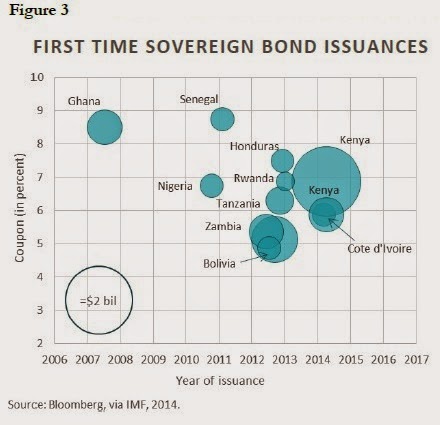
A second issue is that developments in the world financial system mean that governments and economies of low-income and middle-income countries now have access to many more alternative sources of finance.


Along with the financial flows from remittances, foreign direct investment, and a newfound ability for low-income countries to issue sovereign debt, there is even new competition in the world of development banks. There are existing regional development banks with growing financial clout like the Inter-American Development Bank (IDB), the African Development Bank (AfDB), and the Asian Development Bank (AsDB).

Maybe instead of a focus on infrastructure, the World Banks should shift some of its emphasis to public goods like research and development for agriculture or disease prevention or reducing air pollution. Or course,these kinds of projects typically involve a large component of grants, rather than loans.

  • Maybe the World Bank should put more of its focus on crisis response, like its recent response to the Ebola outbreak, or on dealing with economic risks like the danger that the price of a key agricultural export commodity will fall.
  • Maybe instead of focusing on loans to national governments, the World Bank should consider loans to subnational areas, like water or transportation infrastructure for a certain city, or to regional areas, like transportation and electricity networks across national borders.
  • Maybe instead of making loans based national per capita income, the World Bank should focus on countries where high levels of deep poverty remain, or on countries that combine low income with issues like a high level of debt accumulated in past decades that is hindering future growth, or a lack of capacity to manage public finances and collect taxes.
  • Many researchers naturally look at the World Bank as an institution that could be a knowledge leader and a clearinghouse for what is known about how to make economic development work. This mission would emphasize that World Bank loans and projects should be designed to produce the kinds of measureable inputs and outputs that can be the grist for academic research.


Entrepreneur Alert: Maple Syrup Cartel

Twenty-five years ago, Quebec made a bold move to produce the most maple syrup in the world. Today, the syrup giant is unstoppable.

Just ask those in its path, like small producer Angèle Grenier, who will face criminal charges if she sells this year’s harvest to her buyer of choice.

In previous years she has sold syrup to a broker in New Brunswick. But this year, a Quebec court order will force her to hand all the syrup produced on her small patch of land to the Federation of Quebec Maple Syrup Producers.

The family has three choices for the upcoming harvest — capitulate to the demands of the court, cease production, or continue to sell it outside the province and face criminal charges.

“The federation’s goal by taking our maple syrup is that by taking our income, we cannot pay our lawyers,” says Grenier. “We’ll send our syrup to them this year because we need the money.”

Welcome to Big Syrup.    Maple Syrup Cartel in CanadaMaple Syrup

Should Indian Entrepreneurs Embrace Robots?

Avainish Persaud writes:  Prime Minister Narenda Modi’s declaration on the ramparts of the Red Fort last year that the world should come and make products in India, did not upset workers. Rightly or wrongly, they do not worry that India will eat their lunch. They are convinced that machines are already doing so.

What kept the angst in check was that while robots were increasingly doing complex things, like  IBM’s Deep Blue beat world champion Garry Kasparov at chess, they couldn’t get the hang of simple things. Computers could make human tasks easier but they could not do away with the human altogether and so a Nobel Laureate was able to say that “we see the computer age everywhere except for the productivity statistics”.

But after 50 years of the application of Moore’s Law—where the power of computers doubles every 18 months—that barrier has finally cracked.
Amazon’s Kiva Robots lift shelves that weigh around 1,360kg, 24×7, without a toilet break, lunch hour, health insurance or pension plan.  No surprise then that the world’s largest manufacturer of electronic products, Taiwan’s Foxconn, is considering replacing its workforce with one million “Foxbots”.
Economists tend to reject the lump of labour idea—that there are only so many jobs and if they no longer exist people would not have work. Back in 1810, 90% of the US workforce was employed in agriculture. Today it is just 2% and the 88% are not unemployed.  Yet John Maynard Keynes said our discovery of means of economizing the use of labour outruns the pace at which we find new uses for labour.
Some believe this process has been underway for a while and underscores a secular stagnation and worsening inequality in the advanced economies. The typical worker in the US has not seen a rise in their living standards since 1979 and since then income inequality has steadily worsened.
The rise of robots also questions whether this is the time for India to don the overalls of the world’s manufacturer and for Indian workers to compete against the Foxbots. In 1983, Wassily Leontief, the economist, predicted that the role of humans as the most important factor of production is bound to diminish in the same way that the role of horses in agricultural production was first diminished and then eliminated by the introduction of tractors.
Is the geography of manufacturing not about to change from production economies of scale to a world in which consumers pay to download the software that allows their robot to make the product they want? In which case is this not the time to build on India’s brand as a software powerhouse?
Perhaps the government should eliminate the high barriers to doing things in India, whatever it may be, and redistributing enough income to provide greater equality of opportunity for as many as possible. If the robots are coming, we should not try to compete against them or hide from them. We should embrace them, write their code, own them or tax their owners.
Manufacturing in India?