China’s Ability to Change and Adapt

Andrew Sheng and Geng Xiao write: China’s leaders are taking action to support the shift to more sustainable growth models. The finance ministry has raised the central-government budget deficit from 1.8% of GDP in 2014 to as much as 2.7% in 2015, and will allow highly leveraged local governments to swap CN¥1 trillion ($161.1 billion) of debt maturing this year for bonds with lower interest rates.

Likewise, the People’s Bank of China (PBOC) has provided monetary support, gradually lowering interest rates and reserve requirements. Because wages are still rising, the inflation target for 2015 has been set at 3% – higher than the actual 2014 inflation of 2%, even though producer-price inflation has been negative for 36 months. The PBOC also has projected a stable exchange-rate environment for this year – despite the steep depreciation of the Japanese yen, the euro, and emerging-economy currencies against the dollar – thereby promoting global stability.

These policies reflect a remarkable determination to continue on the path of structural reform, despite strong headwinds from the deteriorating external environment and domestic structural adjustments. In short, China’s government seems to have a clear long-term vision.

The claimby some that China’s economic and political development is in jeopardy seems to ignore the country’s adaptive learning process, which shapes every economic, diplomatic, military, and social policy. This process – characterized by experimentation, assessment, and adjustment – emerged from the CCP’s military experience of the 1930s, was applied by Deng Xiaoping to his reform program in the 1980s, and has been refined by subsequent Chinese leaders. Because no economy had ever experienced such rapid growth on such a large scale, the only way to manage China’s development was, as Deng put it, to “cross the river by feeling the stones.”

Some experiments have had less clear results, making, say, a positive contribution to GDP growth, but also contributing to problems like excess industrial capacity, pollution, corruption, and the creation of ghost towns.  The mere fact that problems have emerged in no way suggests that China is headed for disaster; that would be the case only if these problems were allowed to persist.

China’s “new normal” needs to go beyond policies intended to sustain economic growth. Reforms must aim to bolster inclusivity, advance environmental sustainability, promote innovation, and boost competitiveness. And this is precisely the four-pronged approach that China’s leaders seem to be taking.

Indeed, from slashing coal consumption to address air pollution to plans for integrating information technologies with modern manufacturing, the government has shown time and again that it recognizes its reform imperatives. And, by remaining dogged in its efforts to root out official graft, it has demonstrated its will to do what is needed to ensure that China succeeds..

Market forces will benefit from the growth in households’ spending power. Indeed, continued real-wage growth is forcing inefficient industries that relied solely on cheap labor out of the market, while bolstering the competitiveness of producers that appeal to the evolving tastes of China’s increasingly potent consumers. To support this process, China is now implementing deposit insurance, for example.

At the same time, China is reforming its inefficient approval-based system of initial public offerings to one based on registrations. A more active and efficient IPO market will allow companies to meet their financing needs without bank intermediation – a step that is vital to helping firms eliminate their debt overhangs.

Despite the recent rebound, China’s stock-market capitalization amounts to only 40% of GDP, while banking assets total 266% of GDP. Meanwhile, only 10% of total social funding comes from the equity market.

Improved bankruptcy procedures for failed borrowers must be implemented.  Unless failed borrowers and projects exit the system quickly and smoothly, the market will be saddled with bad debt and incomplete projects, undermining its performance.

China has repeatedly proved its durability and adaptability. Now, it must do so yet again, by ensuring that its “new normal” is as stable, sustainable, and inclusive as possible.

Failure may be the mother of success – but only if one makes the effort to learn from it. Fortunately, China’s leaders seem intent on doing just that.
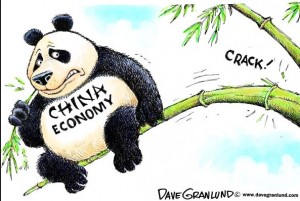
China's Economy

Pay Ratios in American Corporations

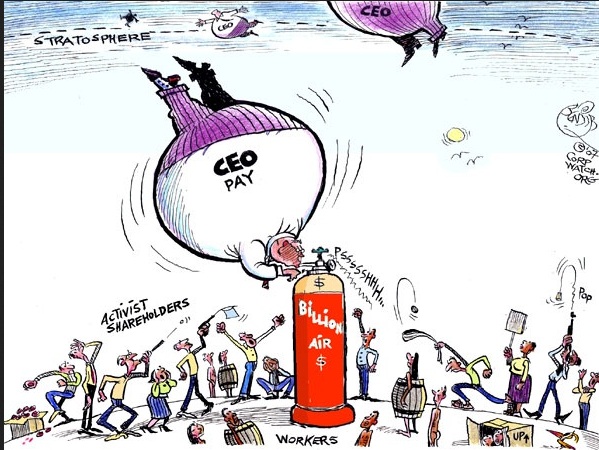
Jim Lardner of Americans for FInancial Reform writes: Out-of-control compensation played a big part in the cycle of reckless lending, opaque securitizing and systematic offloading of responsibility that led to the financial and economic meltdown of 2008. In one very modest response, the Dodd-Frank Act directed banks and other public companies to reveal more about their pay practices.

More specifically, the statute said to companies: tell us how much money your CEO makes, how much your median employee makes, and the ratio of the first number to the second. It’s one of the simplest of all of Dodd-Frank’s provisions. And yet, more than four-and-a-half years after the law’s enactment, the Securities and Exchange Commission has yet to put this requirement into effect.

Investors deserve more information about pay practices, both to guard their pocketbooks against self-seeking executives and to better evaluate the long-term soundness of companies in light of evidence that runaway pay at the top inhibits teamwork and reduces employee morale and productivity.

Wall Street and the Chamber of Commerce have raised a preposterous hue and cry about the supposed burden of compiling the data. But a number of large companies have done so without difficulty. It is time – past time – for the SEC to finalize a strong pay-ratio rule, and one that includes part-time and overseas workers.

In January 2013, when Mary Jo White was nominated to lead the SEC, she pledged to make this rule a priority. Last fall, she spoke of getting the job done by the end of 2014. Now that it is March 2015, we are writing again about the pay-ratio rule. The SEC commissioners should  get on with it and, once the rule is in place, to work with their fellow regulators on other legally mandated steps to combat questionable corporate pay practices.

Pay Ratio in Corporations

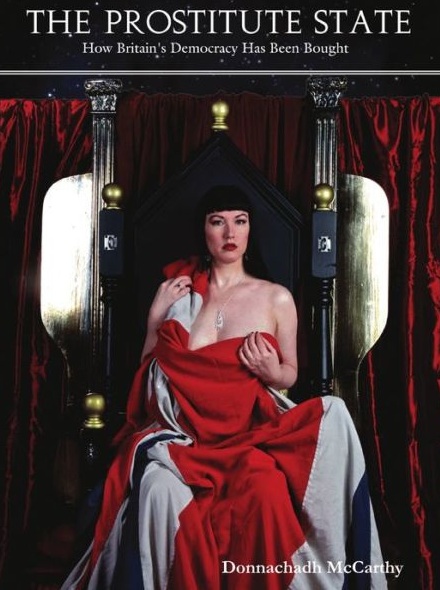
Has the UK Become a Prostitute State?

Donnachadh McCarthy has written a book about based on his early  experiences in British poltiics.  He was a Deputy Chair of the Liberal Democrats during the two years leading up to the Iraq War and an elected member of its Federal Executive for 7 years.  He was a founder and a leader of the “new radicalism” Lib Dem campaign group for six years. During this period he was one of the party’s most successful developers of conference policy proposals.

The summer of 2014 marked the 22nd anniversary of his involvement as an environmental campaigner, after spending time with the Yanomami people in the heart of the Amazon forest and seeing first-hand the destruction wreaked there by our consumer anti-society. Since then I have pursued many paths to try and tackle this.  Here is an outline of his book.

Pillar 1 – Our Corrupted Democracy
As a senior Lib-Dem I got a wide range of eco-friendly and progressive policies adopted by the party-conference. But invariably the corporate lobbyists, who surrounded the party’s leadership, smothered almost every single democratic decision. Reams of the top party echelons are or were corporate lobbyists. It is the same in the other major parties. Corporate lobbyists are calling the shots, not we the voters. Take for example the nuclear industry.

Almost every single former Labour Minister for Energy is a lucratively paid nuclear-lobbyist, as was Nick Clegg’s last general election Lib Dem Treasurer. Despite the public favouring renewable-power over nuclear by huge margins, all three main parties are now committed to pouring billions of our money into poisonous new nuclear white-elephants. Huge swathes of government are now under corporate influence including our civil-service, the armed forces and police, the House of Lords and even our regulatory systems.  The Prostitute State  Available at Barnes and Noble. 

The Prostitute State

Fraud in Magnetic Cards?

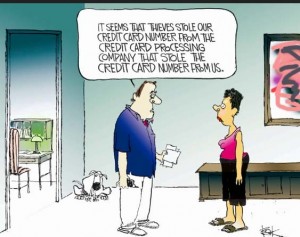
Fraud alert from the Atlanta Federal Reserve: U.S. migration to EMV (chip) cards. Fraudsters in our magnetic-stripe environment can create counterfeit payment cards.

Other posts have mentioned that ubiquitous tenant of the criminal world – the person always on the lookout for the weakest link or the easiest target. And that criminal does not close up shop and go away in the chip-card world. There is clear evidence from other countries that criminals, after an EMV migration, look for, and find, other targets of opportunity – just as when you squeeze a balloon, you’re constricting the middle, but both ends simultaneously expand.

One major area that criminals target post-EMV is online commerce, an activity referred to as card-not-present (CNP) fraud. However, criminals also target two other areas, according to speakers at the recent 2015 BAI Payments Connect conference: checks and account applications. Well before the EMV card liability shift occurs in the United States (October 1, 2015), a number of financial institutions have reported a marked increase in counterfeit checks and duplicate-item fraud, usually by way of the mobile deposit capture service. In many cases, the fraud takes place on accounts that have been open for more than six months, long enough to allow the criminal to have established an apparent pattern of “normalcy,” although there are reports of newly opened accounts being used as well.

Canadian financial institutions report that fraudulent applications for credit and checking accounts have increased as much as 300 percent since that country’s EMV liability shift. Criminals are opening checking accounts to perpetrate overall identity theft fraud as well as to create conduits for future counterfeit check or kiting fraud. And they’re submitting fraudulent credit applications to purchase automobiles or other merchandise that they can then sell easily.

The time to examine and improve your fraud detection capabilities across all the channels customers use is now. Financial institutions should already be evaluating their check acceptance processes and account activity parameters to spot problem accounts early. Likewise, financial institutions should make sure their KYC, or know-your-customer, processes and tools are adequate to handle the additional threat that the credit and account application channel may experience. Be proactive to prevent the fraud in the first place while ensuring you have the proper detection capabilities to react quickly to potential fraudulent attempts. If we want to constrict the balloon of fraud, we’re going to have to constrict the whole thing with consistent, equal pressure.

Credit Card Fraud

DeutscheBank Splitting Up?

Kathrin Jones writes:  Deutsche Bank’s retail operations will bear the brunt of its planned restructuring and will most likely be spun off in a stock market listing, two sources familiar with internal discussions at Germany’s biggest bank said on Saturday.

The bank’s supervisory board held a 14-hour meeting in Frankfurt on Friday, spending part of the time reviewing three scenarios proposed by the management board, the sources said.

The supervisory board favors one proposal that would see the bank’s retail operations, including its Postbank subsidiary, bundled up and spun off with a separate stock market listing.

The proposal marks a dramatic shift from Deutsche Bank’s “universal” strategy that sees it sell everything from derivatives in Tokyo to mortgages in Munich.

Rising capital demands from regulators have made the universal model too unwieldy and shedding the retail operations would help the bank to trim its balance sheet and meet capital requirements more easily.

Dumping retail would transform Deutsche into an investment and merchant bank aimed at companies, capital markets and investors, similar to Goldman Sachs. It would represent a reversal by a group that took pains to broaden its earnings beyond volatile business such as investment banking.

A second possibility would see Postbank integrated into the group’s Deutsche Bank-branded retail chain following a dramatic cost cutting plan, the source said.

A third plan would see only Postbank sold.

Under the most-favored plan, ongoing efforts to integrate Postbank into the Deutsche Bank-branded branch network would continue to reduce costs. Those efforts would see the combined retail chain ready for the stock market by 2017.

The group’s global investment banking activities would suffer some restructuring under this scenario, but its position at the center of the business has faced little challenge since the bank launched its strategic review in December.

New rules still being hammered out by regulators are expected to increase capital demands further still.

Discontent has risen among Deutsche’s shareholders as its share price has lagged that of other major investment banks and it is falling far short of its profit targets, which were already watered down once in 2014.

Deutsche still faces high costs, low profitability, and potential fines, and its plan to become Europe’s “last man standing” in investment banking has turned into an expensive wait as Europe’s recovery stalls.

Deutsche Bank Splitting Up

Reconciliation: Greece and the EU?

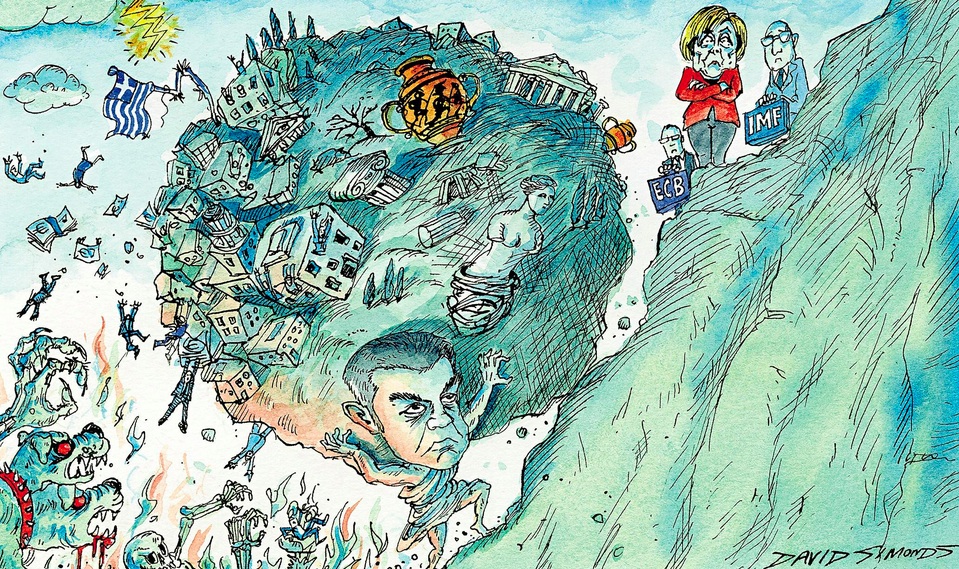
The European Union has two billion euros ready for Greece to use in projects that would boost the country’s economic growth potential, cut youth unemployment and help the poorest citizens, European Commission President Jean-Claude Juncker said.

The Commission has already set up a team of officials to help Greece absorb the money as part of its efforts to help alleviate what Greece’s Prime Minister Alexis Tsipras calls a “humanitarian crisis” after years of recession, Juncker said.

New Greek Prime Minister Alexis Tsipras and German Chancellor Angela Merkel, the bloc’s main paymaster, offered somewhat divergent understandings of how much Athens must do and how quickly. But EU officials insisted there was a broad agreement to act now on an accord struck a month ago.

Merkel said Greece, which faces a cash crunch within weeks, would receive fresh funds only once its creditors approve the comprehensive list of reforms Tsipras promised to present soon.

But she signaled some flexibility on what reforms Tsipras would have to make — crucially giving his leftist-led coalition the chance to offer alternative savings strategies that will help it persuade its voters it is breaking with what Tsipras calls the failed austerity policies of his defeated predecessor.

Tsipras said he would fully respect a deal struck with euro zone finance ministers on Feb. 20 that extended an EU bailout deal until June. But he insisted that a condition in that pact requiring Athens to pass a final review of its efforts to bring its debts under control before receiving funds did not apply.

The risk of a continued standoff, exactly a month after Greece secured a last-gasp four-month extension of an EU/IMF bailout, was highlighted by comments from Merkel and Tsipras.

“The agreement of Feb. 20 is still valid in its entirety. Every paragraph of the agreement counts,” Merkel told German journalists who questioned whether she was now offering cash for promises that many of her supporters have stopped believing in.

Tsipras appeared to differ. “It is clear that Greece is not obliged to implement recessionary measures,” he said. “Greece will submit its own structural reforms which it will implement.

Tsipras had indicated he could offer a full package of reforms within a week or 10 days.

Nonetheless, with some German leaders saying they might prefer Greece out of the euro zone, and Tsipras trying to satisfy a coalition of radicals unused to power, senior EU officials do not rule out a further collapse of the process.

Crucial for the Greek leader, EU officials believe, is being able to present his package as a break with his conservative predecessor — even if many of the measures are broadly similar.

A German comedian has sparked confusion after claiming that he faked a controversial video apparently showing Greek Finance Minister Yanis Varoufakis raising his middle finger to Germany.

Satirist Jan Boehmermann said he doctored the video, which caused controversy after airing on German TV.

But he later said the clip had been taken out of context.

Mr Varoufakis denies making the sign. The row comes ahead of crucial talks between Greece and EU leaders.

Merkel and Tsipras

Integrating Muslim Neighbors?

Is Islam Bashing a Lucrative Industry?

The US-based Pew Forum on Religion and Public Life predicts that over the next two decades, Muslims will make up 26.4% of the world’s population of 8.3 billion people. This means that the worldwide Muslim population will have grown by 25% at the end of 2030.

However, while the population of Muslims in the West is growing, a fear of Islam as an ideology is increasing. This has sometimes resulted in aggressive and discriminatory measures against Muslims, which compels some scholars and thinkers to warn against the rise of “Islamophobia.” The belittling and mocking of Islamic beliefs, the Quran and the Prophet Muhammad — often in popular culture and the media — indicate that Muslims face a serious challenge: How to continue living in Western societies peacefully, while being on the receiving end of hate crimes, the denigration of their faith and the restriction of social freedoms.

Nathan Lean is an American scholar and writer, who has investigated Islamophobia extensively.  Lean believes that Islamophobia is a lucrative “industry” that wins skyrocketing salaries for those who promote and contribute to it.

Nathan Lean: An unfortunate consequence of the War on Terror was that it operated on the premise of a “foreign enemy, domestic threat.” While the Bush and Obama administrations went to great rhetorical lengths to avoid conflating the actions of extremists with the peaceful majority, the policies they put in place reinforced the notion that the religion of Islam, and by extension all Muslims, deserved special scrutiny.

Thus, we see a plethora of examples of religious discrimination in the name of national security: The NYPD collaborated with the CIA to spy on Muslim communities in New York, in some cases designating entire mosques as “terrorist organizations”; the FBI paid informants to infiltrate mosques and entrap Muslim worshippers — in one California case, the informant was instructed to sleep with Muslim women; the State Department, in concert with federal immigration offices, delayed or denied visa, passport and citizenship applications based on nothing more than the applicant’s name or country of origin; Congress held a series of McCarthy-esque hearings on “radicalization” of American Muslim communities that produced no evidence such a thing was occurring; and more recently, the White House announced its “Countering Violent Extremism” program, which unlike its broad name, has a narrow focus on the Muslim American community.

Lean: Charlie Hebdo and Jyllands-Posten had the “right” to publish their cartoons. But having that right does not mean that what they did was right. In Western societies, free speech is fast becoming a weapon. We don’t fight for it as much as we fight with it.

Free speech is about as sacred to most people as are their religious values: When it works for them, they embrace it. When it doesn’t, they reject it.  Interview on Muslim Bashing

Muslim Bashing?


Should Nigeria Follow in Dubai’s Steps?

As Barakat Akinsiku writes: As Nigerians prepare for a presidential election amid a Boko Haran a nsurgency, the question remains: What about the economy? With falling oil prices, a depreciating foreign reserve and a plunge in the value of the naira, Nigeria econoimic future is uncertain.   Whoever emerges victorious from the polls on March 28 will have his work cut out for him.

With 174 million people, Nigeria has one of the worst poverty levels in the world, At least 61% of the population survive on less than a dollar a day, and this was during a period of economic boom when crude oil averaged about $120 a barrel, far beyond the country’s budget benchmark.

While the gains of the oil boom were reportedly stashed in Nigeria’s foreign reserve and Excess Crude Account, most of the funds have since been frittered away. Electricity is almost non-existent, with a measly 4,500 megawatts generated for the population; refined crude is still being imported in a nation that is a major exporter of crude oil. Unemployment is at an all-time high, and virtually nothing works. Nigeria is about to feel the full brunt of a recession.

Other countries have experienced economic challenges like Nigeria’s.  As one of the seven emirates making up the UAE, Dubai has been through its own economic boom and bust. It is now a world destination for tourism, a center of commerce and a model for major oil exporters seeking to diversify their economy.

Like Nigeria, Dubai wasn’t always so savvy in economic principles. In the 1900s, the main stay of the Dubai economy was pearl trading and pearl diving. However, following the emergence of artificial pearls from Japan in the late 1920s and the Great Depression of 1929, Dubai’s economy took a downward spiral.

A parallel can be drawn here with the current situation in Nigeria. Not only has the country lost a major customer for its crude oil in the United States, but Nigeria also has to face stiff competition and price wars from the Arabian Peninsula in the battle for market share. While the robust economies of the Gulf Cooperation Council allow them to offer discounts to Asian buyers even in the face of dwindling oil prices, such tactics do not come easily for Nigeria. As it stands, Nigeria faces problems financing its 2015 budget, while the naira is losing value.

Just like pearl divers in Dubai learned to cast their nets for fish rather than jump in for pearls, Nigeria would be wise to seek other sources of revenue while the oil market gains some form of stability.

What makes the emirate worthy of emulation is that despite being in a region bedeviled with crises and an arid landscape, Dubai has gone from being a desert to a world-class state, dazzling and ambitious in development.

Nigeria’s biggest problem is corruption.  Nigerians have remained poor while oil wealth is concentrated in the hands of a few.

The absence of constant electricity has been a major impeding factor to an industrial revolution in Nigeria, and successive governments seem to have no idea how to change the trend. When oil was discovered in 1966, Dubai’s leaders chose to quickly use the receipts from oil rent to finance mass infrastructure, building large ports and 5-star hotels that would one day make the emirate a major trading hub and tourist destination.

So, as harsh economic realities beckon, it is time for Nigeria to overhaul its corrupt institutions, revamp its educational system, invest in critical infrastructure and perhaps revisit the cocoa plantations and groundnut pyramids the country was once known for.

 Corruption in Nigeria


Put Women on US Currency?

Should women be on American paper currency?

Boys Comment on CurrencyAn organization called Women on 20s is encouraging President Obama to put a woman on the 20-dollar bill, but they want to know which woman the public wants to see. For some background, it’s not all that difficult to change the face on cash. Women on 20s explains it:

“Fortunately, it doesn’t take a messy act of Congress to change a portrait on paper money. It requires an order from the Secretary of the Treasury. With the stroke of a pen, the President can direct the Treasury Secretary to make the change. President Obama already has publicly expressed an interest in featuring more women on our money. With at least 100,000 [signatures], we can get the President’s ear. That’s how many names it takes to petition the White House for executive action.”

So let’s make it happen! Look at this list of 15 candidates and vote for three. You just need to provide your name and email address. From those 15, the top three plus Cherokee Nation Chief Wilma Mankiller will move to the final round, where you can choose your favorite. Women on 20s will submit the winner to President Obama and encourage him ask the Treasury to make a change.

This really is something we can make happen.

Women Entrepreneurs: Create Memory Forests?

Women entrepreneurs.  Are memory forests the net graveyards:  Jeffrey Tousey writes: What if we could end up in a beautiful place like this?

Italian designers Anna Citelli and Raoul Bretzel have come up with an idea.

I think I might really be into it:

Capsula Mundi is a 100% biodegradable coffin.

It’s shaped like an egg and made from from starch plastic (which is made primarily from potato and corn plants).

For burial, the body is placed inside the capsule in the fetal position.

The egg is then planted in the soil, and a tree is planted on top of it.

There are a variety of trees you can pick from, and you can decide which one you want or let your family deal with the logistics.

Wouldn’t it be great to know that your body is helping provide oxygen, carbon dioxide, humidity, clean water and air, conserving energy, slowing down climate change, and protecting wildlife, among other things?

Unfortunately, this type of burial is not yet legal in the United States or Italy. But it’s certainly worth giving it some thought.

(Memory forests don’t exist yet, but this is what I imagine one would look like.)

When it’s my time to go six feet under, I would find a lot of comfort in knowing it’s so a tree can grow.