Is Saudi Arabi Deliberately Going After US Oil Production?

Saudi Arabia is largely responsible for the dramatic fall in oil and gas prices in recent months, a U.S. government official said.

Richard Fisher, the head of the Dallas Federal Reserve, said “the Saudis have engineered” the oil crisis. He was speaking at the Economic Club of New York.

“We are a huge supplier of energy. The Saudis took a while to realize what was going on,” Fisher said, referring to the massive growth of the U.S. oil industry in recent years.

Fisher is the most prominent U.S. official to pin the blame largely on Saudi Arabia.

As recently as July, oil traded at over $100 a barrel. By January, it had plunged below $50.

Saudi officials have repeatedly blamed supply and demand for the price meltdown. They say they were caught off guard by the price decline, and acknowledge this is putting a lot of pressure on U.S. shale.

“Although Saudi Arabia and OPEC countries did not engineer the reduction in the price of oil, there’s a positive side effect, whereby at a certain price, we will see how many shale oil production companies run out of business,” Prince Alwaleed bin Talal, a member of the Saudi royal family and prominent global investor, said in January.

The oil games: While the price of oil started falling at the end of the summer, it was exacerbated on Thanksgiving Day when OPEC, led by Saudi Arabia, voted not to scale back on production. That send oil prices diving.

Fisher also noted that the Saudis benefit not just economically, but politically from the oil price decline. Low oil prices especially hurt their biggest regional rival: Iran.

“I’m sure King Abdullah thought to himself, ‘I’ve also done a favor vis-a-vis Iran,'” Fisher said.  Iran’s economy needs oil to trade around $135. Saudi has far larger cash reserves and is thus able to withstand a downturn in prices for much longer.

What’s ahead for oil prices? Given how motivated Saudi Arabia is to keep prices low right now, Fisher doesn’t expect oil will shoot up to $100 a barrel again any time soon.

“From a budget stand point, [the Saudis] have reserves that can handle this,” he said.

While many energy companies are laying off workers and slashing spending, Fisher said that cheap oil’s overall impact on the U.S. economy will be positive. A typical American driver is expected to save $750 this year at the pump, according to government estimates.

Even in his home state of Texas, Fisher said the economy has diversified a lot more beyond oil, so it’s unlikely to be nearly as bad of an effect as the last oil bust of the 1980s.
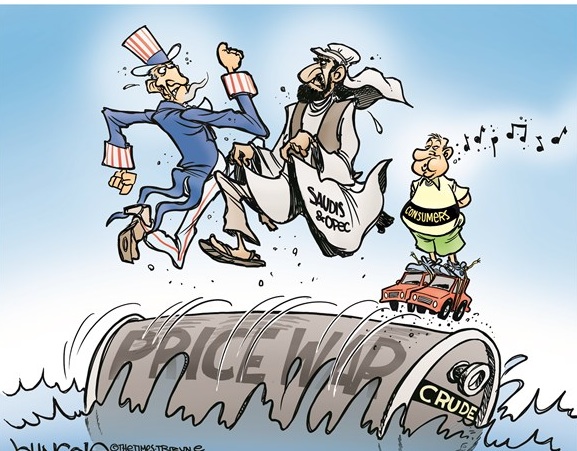

Oil Price Wars

How to Turn Turkey West?

Martti Ahtisaari, Emma Bonino and Albert Rohan write:  Later this year, Turkey will host the 2015 G-20 Leaders’ Summit, the tenth annual meeting of the G-20 heads of government. The country’s prominence on the world stage comes at an odd time, when it finds itself surrounded by a widening arc of instability.

Indeed, two geopolitical orders are unraveling in Turkey’s immediate neighborhood: the post-Cold War entente with Russia, and the national borders in the Middle East defined by the 1916 Sykes-Picot Agreement and 1919 Treaty of Versailles. Never have the European Union and Turkey needed one another more, and yet rarely have they been so distant.

Turkey is no longer the rising regional star that it was during the first half of President Recep Tayyip Erdoğan’s 12 years in office. Long gone are the days when the country was booming economically and advancing toward true democracy, a source of inspiration to many in the region.

Turkey cannot confront its challenges alone. The EU accounts for almost 40% of Turkish trade, 70% of its foreign direct investment, and more than 50% of its tourism industry. Meanwhile, the country’s economic ties with its southern neighbors have spiraled downward since the Arab Spring in 2011.

This reality is reflected in Turkish public opinion, with support for the EU rising from a low of 34% in 2009 to 53% last year. Simply put, Turkey is waking up to the reality that it has no attractive alternative to the EU and close cooperation with the transatlantic community. The country’s “EU Strategy” announced by European Affairs Minister Volkan Bozkir last fall can be read as an implicit recognition of this fact.

Meanwhile, Europe has never had a greater interest in a stable, democratic, and Western-oriented Turkey.

And yet, rather than being drawn closer together, the EU and Turkey are drifting apart. Freedom of expression, the separation of powers, and the rule of law have been progressively eroded under Erdoğan. The country risks being sucked into the region’s sectarian conflicts – and being tempted by the authoritarian sirens of Vladimir Putin’s Russia.

The EU-Turkey relationship hit a new low at the close of last year, when Turkey increased its pressure on media close to the self-exiled Islamic leader Fethullah Gülen. The clampdown triggered strong criticism by the EU, which Erdoğan, in turn, angrily rejected.

Some in Europe argue that the deterioration of rights and freedoms in Turkey is so serious that the already-moribund EU accession process should be suspended. Indeed, it would be difficult to make the case that Turkey fulfills the Copenhagen political criteria. For example, Turkey slid in Reporters Without Borders’ World Press Freedom Index to 154th place (out of 180 countries).

But it is unlikely that a formal suspension of accession negotiations would do anything other than remove the last incentive for Turkey to pursue democratization and EU harmonization. Instead, the EU should redouble its efforts, strengthening both its criticism of Turkey’s democratic backsliding and the credibility of its accession process.

Until now, Cyprus has posed the biggest obstacle to Turkish accession. EU member states should engage more actively with the Cypriot government to bring about the necessary change.

Lifting its blockade on negotiations would benefit Cyprus as much as Europe. No country would gain more than Cyprus from stable democracy in Turkey.

Beyond the EU accession process, other important measures should be taken to rebuild trust and deliver concrete benefits to both sides, thereby revitalizing an ailing and yet increasingly strategic relationship. Such steps should include upgrading and modernizing the customs union agreement (as the World Bank recently advocated) and vigorously pursuing visa liberalization.

Though these measures are not alternatives to a revamped accession process, they would help to revive it. Above all, by embedding Turkey within the European family, such measures would counter the country’s dangerous drift away from our common European values.

Wolfgang Ischinger, Chairman of the Munich Security Conference; Hans van den Broek, a former Dutch foreign minister and EU commissioner for external relations; Marcelino Oreja Aguirre, a former Spanish foreign minister; Michel Rocard, former French Prime Minister; and Nathalie Tocci, Deputy Director of the Istituto Affari Internazionali in Rome.

Turkey

Investment: Pre-Emerging Countries

Dani Rodrik writes: So-called “frontier market economies” are the latest fad in investment circles. Though these low-income countries – including Bangladesh and Vietnam in Asia, Honduras and Bolivia in Latin America, and Kenya and Ghana in Africa – have small, undeveloped financial markets, they are growing rapidly and are expected to become the emerging economies of the future. In the last four years, inflows of private capital into frontier economies have been nearly 50% higher (relative to GDP) than flows into emerging market economies. Whether that should be cheered or lamented is a question that has become a kind of Rorschach test for economic analysts and policymakers.

We now know that the promise of free capital mobility has not been redeemed. By and large, the surge in capital inflows has boosted consumption rather than investment in recipient countries, exacerbating economic volatility and making painful financial crises more frequent. Rather than exerting discipline, global financial markets have increased the availability of debt, thereby weakening profligate governments’ budget constraints and over-extended banks’ balance sheets.

The best argument for free capital mobility remains the one made nearly two decades ago by Stanley Fischer, then the International Monetary Fund’s number two official and now Vice Chair of the US Federal Reserve. He argued that the solution was not to maintain capital controls, but to undertake the reforms required to mitigate the dangers.

Fischer made this argument at a time when the IMF was actively seeking to enshrine capital-account liberalization in its charter. But then the world witnessed financial crises in Asia, Brazil, Argentina, Russia, Turkey, and eventually Europe and America. To its credit, the Fund has since softened its line on capital controls. In 2010, it issued a note that recognized capital controls as part of the arsenal of policy tools used to combat financial instability.

Yet free capital mobility continues to be the ultimate goal, even if some countries may have to take their time getting there.

There are two problems with this view. First, as advocates of capital mobility tirelessly point out, countries must fulfill a long list of prerequisites before they can benefit from financial globalization. These include the protection of property rights, effective contract enforcement, eradication of corruption, enhanced transparency and financial information, sound corporate governance, monetary and fiscal stability, debt sustainability, market-determined exchange rates, high-quality financial regulation, and prudential supervision. The list is not only long; it is also open ended.

The second problem concerns the possibility that capital inflows may be harmful to growth, even if we leave aside concerns about financial fragility.

But many developing countries are constrained by a lack of investment demand, not a shortage of domestic saving. The social return on investment may be high, but private returns are low, owing to externalities, high taxes, poor institutions, or any of a wide array of other factors.

Capital inflows in economies that suffer from low investment demand fuel consumption, not capital accumulation. They also fuel exchange-rate appreciation, which aggravates the investment shortage.

Such concerns have led emerging economies to experiment with a variety of capital controls. In principle, frontier market economies can learn much from this experience.

That is not because they fail to affect the quantity or composition of flows, but because such effects are quite small.

Capital controls by themselves are no panacea, and they often create worse problems, such as corruption or a delay in needed reforms,  Treating capital controls as the last resort, always and everywhere, has little rationale; indeed, it merely fetishizes financial globalization. The world needs case-by-case, hardheaded pragmatism, recognizing that capital controls sometimes deserve a prominent place.

Capital Controls

Mary Jo White, SEC head, Defends Use of Waivers

Bartlett Naylor writes:  On March 12, Securities and Exchange Commission Chair Mary Jo White publicly returned fire for the first time on the charge from outsiders and two of her fellow commissioners that her agency is soft on Wall Street.

Cut through her rhetoric, however, and what she’s saying: “The SEC trusts Wall Street.”

Here’s the background. The Department of Justice has fined major Wall Street firms for serious violations. The firms have settled by paying billions of shareholder funds in penalties. These infractions trigger other sanctions including the loss of certain privileges at the SEC. But the SEC has generally waived these sanctions. Commissioners Kara Stein and Luis Aguilar have voted against these waivers in several cases, arguing, among other reasons, that waivers dilute the deterrence effect of the automatic sanctions.

On March 12 Chair White drew a line in the sand. These sanctions should not be viewed as deterrence. She explained: “It must be emphasized, however, that it would not be an appropriate exercise of our authority to deny a waiver to further punish an entity for its misconduct or history of misconduct, or in an effort to deter it or others from possible future misconduct, by letting stand an automatic disqualification where the circumstances do not warrant it.”

White undoubtedly penned this speech well before the eve of the speech and advantaged the prodigious legal talent on the SEC staff to buttress her legal case. The written speech includes footnotes and the assertion just quoted contains a footnote to a rule the SEC approved in July 2013. White approved this rule. In fact, however, the rule does not buttress her case. On the contrary, the rule speaks directly about deterrence. The rule makes reference to deterrence five separate times.

Leaders in Congress side with Stein and Aguilar. Rep. Maxine Waters, (D-Calif.) and ranking Democrat on the House Financial Services Committee has promised to introduce legislation to limit the use of waivers and bolster the deterrence effect.  Sen. Sherrod Brown also challenged White’s use of waivers.

From high altitude, Wall Street has escaped true justice. Even as the DOJ claims that major firms committed massive fraud contributing to the financial crisis of 2008 that evicted millions from their homes and jobs and erased $12 trillion from the economy, no Wall Street executive went to prison.

There’s an additional troubling element to White’s position. White says that the only factor that the SEC should consider is whether the firm can honestly provide the services that the sanctions would otherwise interrupt.  That’s a precarious place for the SEC. She’s essentially asking her fellow commissioners to enter the attestation business. That’s a process used in enforcement at companies where CEOs are required to attest that their firms comply with accounting or other rules. The default position should be what the law and rules dictate—loss of privileges. If a firm can build an independently verifiable case that it can honestly serve the market in a division separate from where the violations took place, then the SEC might grant a waiver. Short of that, the SEC should not be saying: “We trust Wall Street.”

Mary Jo White

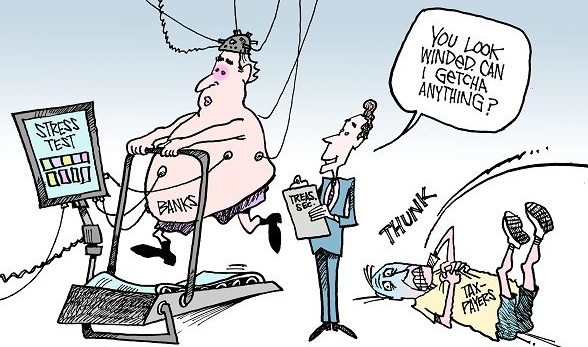
Stress Tests Flummoxing US Banks

And this is good!  While no big U.S. bank failed the test, some of Wall Street’s marquee names were shocked by the disparity between their expectations and the Fed’s, such as projections for how banks’ assets and net income would fare in a severe economic downturn, said people close to the banks.

“We all ended up having a wake-up call on what [the Fed] thought our losses could be,” said a person close to the process.

Matt Levine estimates that discussions about how unpredictable these tests should be suggests: enough to keep the banks on their toes and make them think seriously about their crisis modeling, but not so much as to be a random outcome that makes modeling pointless.

How much the three revise-and-resubmitters took out of their revised capital plans: Morgan Stanley cut out a $4.9 billion preferred-stock buyback, JPMorgan cut out about $6 billion of capital return, and Goldman probably cut out about $3 billion.

Stress Test

Rate Cut Battles Across the Globe

Willaim Pesek writes:  The Bank of Korea has no shortage of diplomatic ways to explain yesterday’s surprise rate cut, including weak domestic demand, sluggish business investment and anemic exports. But it’s worth being clear what this move was really about: Japan.

For weeks, South Korean Finance Minister Choi Kyung Hwan and other politicians have been demanding that the BOK weaken the won so Korean exporters could better compete with their counterparts in Japan. Which was fair enough: Since mid-November 2012, when Tokyo began devaluing its currency, the won has surged 44 percent against the yen. Yesterday, BOK Governor Lee Ju Yeol finally bowed to the pressure, slashing the central bank’s repurchase rate a quarter of a percentage point to a record low 1.75 percent.

In some sense, however, South Korea still isn’t taking Japan seriously enough. South Korea should be less concerned about its short-term export woes and more concerned about the prospect of mimicking Japan’s lost economic decades since the 1990s. Unless policymakers act far more aggressively in the near future, they still riska long term state of “Japanization,” a semi-permanent deflationary funk that strangles living standards. Here are three ways Seoul can avoid that fate.

First, it should end its monetary stinginess. South Korea’s high household debt levels — currently at a record $962 billion, or 70 percent of gross domestic product — are said to have dissuaded Lee from cutting rates sooner.

Second, South Korea should prod companies to raise wages. Beginning this year, South Korea’s family-owned conglomerates, or chaebol, will be subject to a 10 percent tax on excessive hoarding of cash that could be better spent on wages or investments.

South Korean President Park Geun Hye could help change this situation by using her bully pulpit to shame companies that underpay workers. She could also push for tax laws that would give those companies financial incentives to hire their part-time staff to full-time contracts.

Third, South Korea needs to stop obsessing ovre exchange rates. The country needs to become more competitive, but it would be a mistake to pursue that goal solely through depreciation.

Park seems to recognize that South Korea must learn to thrive even when exchange rates move against it. She has pledged, for example, to build a creative economy that produces new industries, generates good-paying jobs and reduces the dominance of the chaebol. But for too long, South Korea has relied on depreciation to shield the country from creative destruction.

The BOK’s recent rate cut was the right move for now; in the short term, it should help exporters keep pace with their competitors. But if South Korea wants to avoid ending up in Japan’s economic rut, its ambitions will have to go beyond interest rates.

Interest Rates in Asia

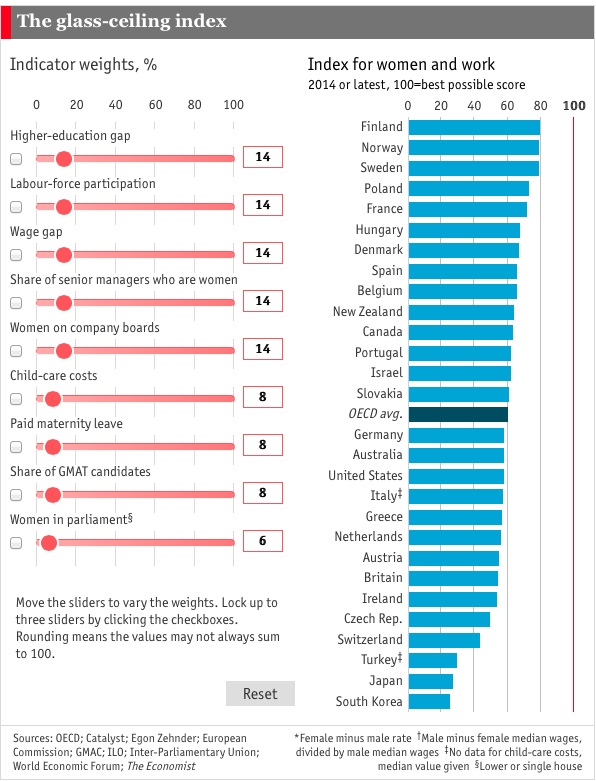
Kleiner Trial Reveals Women’s Problem in High Tech

Katie Benner comments on the Kleiner trial and women in high tech.  The common thread that runs through the stories of both Vassallo and Ferraioli is that they were encouraged — implicitly or explicitly — to stay quiet about the way they’d been treated. Complaints were thought to be bad for “the team.”

If being on the team means giving up basic respect and safety, no wonder so few women want to make the bargain.

Silicon Valley isn’t purely bad. Ferraioli, who’s now at Google, says she’s found an engineering job she loves, with people who respect her. Vassallo, who was described by her Kleiner colleagues as a world-class investor, still serves on boards and acts as an independent adviser.

Unfortunately, most tech companies are way more comfortable attacking the pipeline problem, donating money to educational programs that draw women into the kind of math and science classes that feed into technology jobs. Apple just donated $50 million to this effort. Kleiner partner John Doerr often says something must be done to bring more women into his profession.

But if these companies want women in their ranks, they need to do more for the women they’ve already hired. They need to create a workplace where women want to be.  Kleiner Trial and Women in High Tech

Women in High Tech


Woman Power

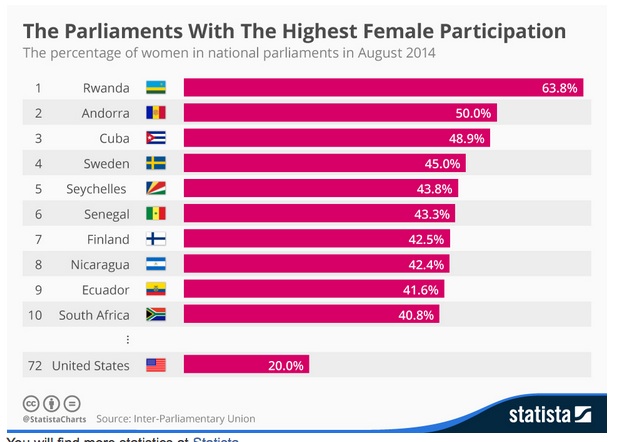
Globally, approximately 22 percent of elected parliamentary seats go to women but in Rwanda, that figure is an impressive 64 percent. In the wake of the Rwandan genocide, 70 percent of the country’s surviving population was female, and this along with a quota requiring 30 percent of political candidates to be female, helped bring about massive change.

How does Rwanda compare to other countries across the world? Andorra, perched high in the Pyrenees between France and Spain, comes second with a 50-50 gender split in its parliament. Cuba rounds off the top three with just under 49 percent. What about the United States? It’s all the way down in 72nd position – only 20 percent of government seats in the United States are held by women.

Parliaments with the Highest Female Participation

Should the US Fed be Transparent?

Barry Eichengreen writes: The Federal Reserve is under attack. Bills subjecting the United States’ central bank to “auditing” by the Government Accountability Office are likely to be passed by both houses of Congress. Legislation that would tie how the Fed sets interest rates to a predetermined formula is also being considered.

Anyone unaware of the incoming fire only had to listen to the grilling Fed Chair Janet Yellen received recently on Capitol Hill. Members of Congress criticized Yellen for meeting privately with the president and treasury secretary, and denounced her for weighing in on issues tangential to monetary policy.

Still others, like Richard Fisher, the outgoing president of the Dallas Fed, have inveighed against the special role of the Federal Reserve Bank of New York. Reflecting the New York Fed’s heavy regulatory responsibilities, owing to its proximity to the seat of finance, its president has a permanent seat on the Federal Open Market Committee, the body that sets the Fed’s benchmark interest rate. This, its detractors warn, privileges Wall Street in the operation of the Federal Reserve System.

Finally, some object that bankers dominate the boards of directors of the regional Reserve Banks, making it seem that the foxes are guarding the henhouse.

This criticism reflects the fact that the United States has just been through a major financial crisis, in the course of which the Fed took a series of extraordinary steps. It helped bail out Bear Stearns, the government-backed mortgage lenders Freddie Mac and Fannie Mae, and the insurance giant AIG. It extended dollar swap lines not just to the Bank of England and the European Central Bank but also to the central banks of Mexico, Brazil, Korea, and Singapore. And it embarked on an unprecedented expansion of its balance sheet under the guise of quantitative easing.

These decisions were controversial, and their advisability has been questioned – as it should be in a democracy. In turn, Fed officials have sought to justify their actions, which is also the way a democracy should function.

There is ample precedent for a Congressional response. When the US last experienced a crisis of this magnitude, in the 1930s, the Federal Reserve System similarly came under Congressional scrutiny. The result was the Glass-Steagall Act of 1932 and 1933, which gave the Fed more leeway in lending, and the Gold Reserve Act of 1934, which allowed it to disregard earlier gold-standard rules.

The Banking Act of 1935, as amended in 1942, then shifted power from the Reserve Banks to the Board in Washington, DC, and confirmed the special role of the Federal Reserve Bank of New York.

These reforms reflected an overwhelming consensus that the Fed had been derelict in fulfilling its duties. It had failed to prevent the money supply from contracting in the early stages of the Great Depression. Heedless of its responsibilities as an emergency lender, it had allowed the banking system to collapse. When financial stability hung in the balance in 1933, the Reserve Banks’ failure to cooperate prevented effective action.

Given such incompetence, it is not surprising that subsequent reforms were far-reaching. But these reforms went in precisely the opposite direction from today’s proposed changes: fewer limits on policy makers’ discretion, more power to the Board, and a larger role for the New York Fed, all to enable the Federal Reserve System to react more quickly and robustly in a crisis. It is far from clear, in other words, that the right response to the latest crisis is an abrupt about-face.

Ultimately, whether significant changes are warranted should depend on whether the central bank’s interventions in fact aggravated the recent crisis, as they aggravated the crisis of the 1930s. But the Fed’s critics have been curiously nonspecific about what they regard as the Fed’s mistakes. And where they have been specific, as with the accusation that the Fed was fomenting inflation, they have been entirely wrong.

Fed officials, for their part, must better justify their actions. While they would prefer not to re-litigate endlessly the events of 2008, continued criticism suggests that their decisions are still not well understood and that officials must do more to explain them.

In addition, Fed officials should avoid weighing in on issues that are only obliquely related to monetary policy. Their mandate is to maintain price and financial stability, as well as maximum employment. The more intently Fed governors focus on their core responsibilities, the more inclined politicians will be to respect their independence.

Finally, Fed officials should acknowledge that at least some of the critics’ suggestions have merit. For example, eliminating commercial banks’ right to select a majority of each Reserve Bank’s board would be a useful step in the direction of greater openness and diversity.

US Fed Transparency