New Valkyries and Wonder Women

The new Valkyries are promoting Wonder Women.  The best-selling comic strip right now is Saga, a science fiction series about a pair of star-crossed lovers–as in from separate parents.  The series is narrated by their daughter.  The first volume has been on the bestseller lists for over a year and a half and has earned about $6 milllion for Image Comics.  Success is attributed to female buyers.  A network of female comic shop clerks who call themselves the Valkyries increased publicity and sales.

Small independent publishers which release predominantly fantasy and sci-fi stories have profited most from this female fan base.  The superhero franchises are male-centric.

In the 1990s girls were obsessed over Warner Bros. Buffy the Vampire Slayer and also discovered The Sandman by Neil Gaiman.

The large break through came through manga, Japanese comic books, which were introduced in the US in the mid 2000s.

Can these books which make women larger than life make women feel larger than life?  Are their entrepreneurial opportunities for women here?

Saga


Swedish Women Against Putin

Nathalie Rothschild writes: Everywhere one looks on the eastern fringes of Europe, the Russian bear menaces. From Ukraine to Estonia, Russian troops are either engaged in outright warfare or testing the borders of Russia’s neighbors. In Sweden and Finland, Russian planes and vessels are prodding at coastal defenses. Nordic defense officials now speak of a fundamentally altered security environment in the Baltics.

There is a measure of the surreal to these developments and Sweden’s response to them. When in October Swedish forces hunted what was all but certainly a Russian submarine in the Stockholm archipelago, Swedish media dispatched reporters into dinghies, where they breathlessly tried to intuit news in the movement of naval vessels. And when Sverker Göranson, the supreme commander of Sweden’s armed forces, went before the media last month to present concrete evidence that a submarine had violated his country’s territorial waters, a Russian newspaper responded by calling the officer “unmanly.”  Swedish Women and Putin

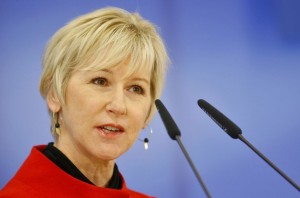
Swedish Foreign Minister Speaks Up

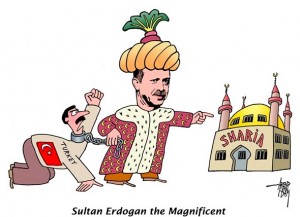
Is Turkey A Bad Place for Women?

Yüksel Sezgin writes:  On Nov. 24, Turkish President Recep Tayyip Erdogan announced at a women’s rights conference that he did not believe in gender equality because it contradicted the laws of nature.

Turkey before the 2002 election of the AKP was no feminist utopia. In 2001, under the rule of a secular coalition government led by the social democrat Bulent Ecevit, Turkey ranked only 81 out of 175 countries in the United Nations Development Program’s Gender-related Development Index, which measures the gender gap in human development in terms of health, education and income. Turkey lagged behind not only the Western European democracies but also such Muslim-majority states as Saudi Arabia (68), Lebanon (70), Jordan (75) and Tunisia (76). Similarly, according to the UNDP’s 2001 Gender Empowerment Measure.

In pre-AKP Turkey, about one in 10 women in the east lived in polygamous marriages (despite the prohibition of polygamy since 1926), and about 200 girls and women every year were killed by close relatives in the name of protecting “family honor.” In July 2001, the social democratic-led coalition government passed a regulation requiring female nursing students to undergo virginity tests before being admitted into their studies.

The first AKP government under Erdogan’s premiership was actually cause for some hope among many Turkish women. In 2004, Erdogan’s government passed a new penal code.  It criminalized marital rape, eliminated the old penal code’s patriarchal and gender-biased language and imposed a number of measures to prevent sentence reductions traditionally granted by Turkish courts to perpetrators of honor crimes.

Despite these positive legislative initiatives, things have not improved on the ground. Indeed, Turkey has become one of the worst countries in terms of violence against women.

Nor has economic growth offered significant improvements. According to the UNDP, Turkey’s GDP per capita income (in 2011 purchasing power parity terms) rose from $13,090 in 2000 to $18,167 in 2012. In other words, there was about a 39 percent increase in per capita income over a period of 12 years – the last 10 years of which were under AKP rule. According to the World Economic Forum’s Gender Gap Index, in 2013 Turkey ranked 123 out of 136 countries in terms of women’s participation in the labor force.

On the same index, Turkey ranked 103 in terms of women’s political empowerment.

According to the UNDP, economic expansion did not translate into better health and education opportunities for Turkish women. In 2002, Turkey ranked 70 out of 169 countries on UNDP’s GDI. In 2007, about five years after AKP came to power, Turkey was still 70 on the GDI index, even though its rank on the Human Development Index improved from 88 to 79 over the same period. In 2008 on UNDP’s Gender Inequality Index (GII, a composite index that replaced the earlier GDI and GEM) Turkey ranked 77, while in 2013 it ranked 69 out of 187 countries. Over the same period, Turkey’s HDI rank also improved from 83 to 69. Despite an overall increase in income and access to education and health care, the Turkish government has largely failed to improve the status of women and reduce persisting gender inequalities, especially with respect to women’s participation in the labor force and political empowerment.

While this sorry record reflects poorly on the AKP governments, it should not be used to forget the long history of struggles for Turkish women. Turkey was one of the worse places in the world to be a woman before the AKP, and it still is today.

Turkish Women

Derivatives Insured by US Taxpayers?

Sen. Elizabeth Warren on Wednesday sought to rally opposition to the $1.1 trillion government funding bill, spearheading a revolt on the left that has put her influence in the Democratic Party to the test.

The Massachusetts Senator pleaded for House Democrats to withhold support for a government funding package due to a provision she said would change the Dodd-Frank financial reform law to let “Wall Street gamble with taxpayer money.”
Her call gave voice to opposition among liberals to provisions tucked in the “cromnibus” deal that they argue would let big banks engage in the same risky trading that toppled the economy in 2008.

With House Republican leaders acknowledging they’ll need Democratic support to get the legislation through, unified opposition from liberals could prove fatal. A vote on the House floor is set for Thursday.

Warren dodged when asked how far she’d go to stop the bill if it reached the Senate with the Dodd-Frank provisions intact, stressing that the House must act first.

“We’re trying to get it out of the House omnibus bill right now,” she said. “That is where all the pressure is.”

Opposition to the funding deal began to surface early Wednesday morning as lawmakers began sorting through the surprise provisions tucked in the more than 1,600-page funding package.

While several controversial policy riders were quickly discovered, it was the change to Dodd-Frank that generated the loudest outcry.

The provision would no longer require that big banks separate trades in financial derivatives from traditional bank accounts, which are backed by the government through the Federal Deposit Insurance Corporation (FDIC). The derivatives played a key role in the financial collapse.

Derivatives

China Battles Captain Kidds

A senior US State Department official praised China’s efforts in global counterpiracy in the waters off Somalia, a busy sea lane where attacks and hijacking of commercial ships worry many nations.

The rise of piracy off the coast of Somalia spurred the creation and passage in 2008 of United Nations Security Council Resolution 1851, which authorizes states to work more closely in the fight against piracy there.

On Nov 12, the Security Council passed a new resolution reaffirming its condemnation of all acts of piracy and robbery at sea off Somalia.

Chinese Ambassador to the UAE Huang Jiemin, on behalf of Chinese Foreign Minister Wang Yi, attended the 17th plenary in Dubai, along with more than 600 representatives from 50 countries, international and regional organizations.

Huang said that participation by the international community in the escort mission in the Gulf of Aden has been fruitful. He noted that while the incidence of attacks by Somalia pirates has declined sharply, international shipping still faces a security threat off Somalia and in the Gulf of Aden.

He called for a comprehensive approach in addressing the problem by boosting the security capacity in Somalia, assisting economic development there and strengthening the capacity of other nations on that part of the Indian Ocean coast.

Thanks to the multinational efforts, the piracy off Somalia, which once cost the world economy an estimated $7 billion a year, has been largely curbed in the past year.

While the number of attacks on ships off Somalia reached 237 in 2011, with 28 of the attacks resulting in vessel hijackings and sailors held hostage for ransom, there has not been a successful raid against a commercial ship there since May 10, 2012, according to Chapman.

In 2013, there were only 15 incidents reported, down from 75 in 2012. No ships today are currently held by Somali pirates, but more than 30 merchant sailors are being held hostage by pirate gangs.

The hostages include 11 Chinese who were hijacked on March 26, 2012, in an Omani-flagged ship, now aground in Somalia. The Global Times in China published a story in late October featuring some family members of the hostages pleading for their release.

The Somali government and some subnational organizations are committed to helping young Somalis find something to do other than joining the pirates.

By October, China’s People’s Liberation Army Navy had sent 18 batches of convoy ships to the area since December 2008. They have provided escort to more than 5,700 Chinese and foreign ships. The mission was carried out at the request of the Somali government and under the authorization of the UN Security Council.

China also opened its embassy in Mogadishu, capital of Somalia, in July after it was closed since 1993, when the East African nation was plunged into civil war. Chinese Vice-Foreign Minister Zhang Ming visited Somalia in October to attend an opening ceremony, also attended by Somali President Hassan Sheikh Mohamud.

So far, 1,400 pirates and suspected pirates are in courts or prison in 21 countries. Chapman described effective prosecution of piracy in affected states as a priority.

The cost of piracy to the global economy is estimated at $18 billion a year, including declines in tourism and fishing since 2006. Pirates off the coast of Somalia and the Horn of Africa have taken in between $339 million and $413 million in ransoms the past seven years, according to a 2013 analysis published by UNODC, the World Bank and Interpol.

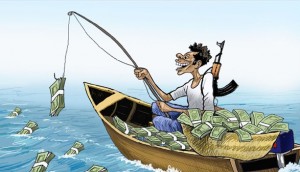
Piracy Off the Coast of Somalia


Powered by Translate

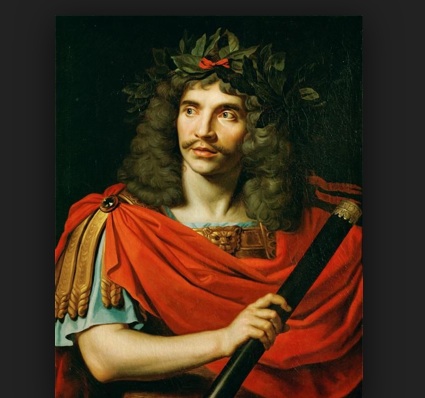
Is Hollande Tartuffe?

Brigitee Granville and Hans-Olaf Henkel ask:  In his classic comedy “Tartuffe, or The Impostor,” Molière shows that allowing pride, rather than reason, to dictate one’s actions invariably ends badly. French President François Hollande appears to have an advanced case of Tartuffe’s malady, repeatedly making political pledges that he cannot honor, partly because of factors beyond his control – namely, the European Monetary Union (EMU) – but mostly because he lacks the determination.

For France, the consequences of Hollande’s failures will be much more dramatic than his political downfall. Indeed, the country could be facing catastrophe, as Hollande’s actions risk miring the economy into sustained stagnation and driving an increasingly angry French public to elect the far-right National Front party’s Marine Le Pen as his successor.

France’s economic policies are untenable, meaning that both of the main determinants of those policies, the EMU and Hollande’s approach, must change radically. So far, that does not seem to be happening.

Earlier this month, an opinion poll showed Hollande’s approval rating plummeting to 12% – the worst result for any French president in the history of modern polling.

Consider unemployment, which in September stood at 10.5%, compared to only 5% in Germany. Hollande acknowledged that, despite his pledge, a reversal of the negative employment trend “didn’t happen” this year.

France’s unemployment problem is the result of leviathan labor regulations and a crippling tax burden on labor. Hollande’s main new promise – not to impose any new taxes, beginning next year – might have been an implicit acknowledgement of this.

In the meantime, however, there will be an increase in diesel excise duties, and a 20% surcharge on property taxes will be imposed on unoccupied second homes in densely populated areas.

Hollande’s track record: the tax burden has risen by €40 billion ($50 billion) over the last two years.  A Hollande official stated Christian that more tax hikes could not be ruled out.

EMU places considerable external constraints on French policy.

The euro’s creators were wrong to expect that the common currency would promote economic and political convergence among its members. By ruling out exchange-rate adjustment to address differences in competitiveness, the euro has forced less competitive countries to pursue painful and slow “internal devaluation.”

The deflationary impact of internal devaluation is compounded by the rule, reinforced in the 2012 “fiscal compact,” that eurozone countries are wholly responsible for their own debts and thus must adopt strict budgetary discipline. With demand relentlessly squeezed, not even depressed wages can generate adequate employment.

The only solution, many euro supporters now contend, is full political union, which would allow for fiscal transfers from the eurozone’s more competitive countries to their weaker counterparts. But southern Italy, which has not used the fiscal transfers from the north on which it has long depended to transform its economy or boost productivity, demonstrates how little impact this approach can have. The notion that a eurozone fiscal union could do better is a dangerous fantasy.

Another potential approach would be for strong eurozone economies, especially Germany, to support productivity-enhancing structural reforms in less competitive countries like France and Italy. This is probably what German Chancellor Angela Merkel meant when she reportedly said that, though Germany “cannot afford transfers to the whole of Europe,” it can “help to pay the doctors’ bills.” But, sooner or later, the weaker economies will probably opt out of such reforms, reclaiming their monetary sovereignty as a necessary – though far from sufficient – means of averting economic and social breakdown.

Hollande as Tartuffe

Global Economies Diverge

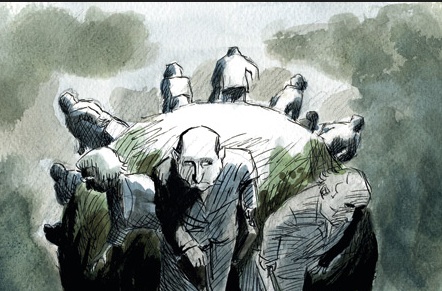
Mohamed El_Erian writes: In the coming year, “divergence” will be a major global economic theme, applying to economic trends, policies, and performance. As the year progresses, these divergences will become increasingly difficult to reconcile, leaving policymakers with a choice: overcome the obstacles that have so far impeded effective action, or risk allowing their economies to be destabilized.

The multi-speed global economy will be dominated by four groups of countries. The first, led by the United States, will experience continued improvement in economic performance. Their labor markets will become stronger, with job creation accompanied by wage recovery. The benefits of economic growth will be less unequally distributed than in the past few years.

The second group, led by China, will stabilize at lower growth rates than recent historical averages, while continuing to mature structurally. They will gradually reorient their growth models to make them more sustainable.

The third group, led by Europe, will struggle, as continued economic stagnation fuels social and political disenchantment in some countries and complicates regional policy decisions. Anemic growth, deflationary forces, and pockets of excessive indebtedness will hamper investment, tilting the balance of risk to the downside

The final group comprises the “wild card” countries, whose size and connectivity have important systemic implications. The most notable example is Russia. Faced with a deepening economic recession, a collapsing currency, capital flight, and shortages caused by contracting imports, President Vladimir Putin will need to decide whether to change his approach to Ukraine, re-engage with the West to allow for the lifting of sanctions, and build a more sustainable, diversified economy.

The alternative would be to attempt to divert popular discontent at home by expanding Russia’s intervention in Ukraine.

Brazil is the other notable wild card. President Dilma Rousseff, chastened by her near loss in the recent presidential election, has signaled a willingness to improve macroeconomic management, including by resisting a relapse into statism, the potential benefits of which now pale in comparison to its collateral damage and unintended consequences.

This multi-speed economic performance will contribute to multi-track central banking, as pressure for divergent monetary policies intensifies, particularly in the systemically important advanced economies. The US Federal Reserve, having already stopped its large-scale purchases of long-term assets, is likely to begin hiking interest rates in the third quarter of 2015. By contrast, the European Central Bank will pursue its own version of quantitative easing, introducing in the first quarter of the year a set of new measures to expand its balance sheet. The Bank of Japan will maintain its pedal-to-the-metal approach to monetary stimulus.

The problem is that exchange-rate shifts now represent the only mechanism for reconciliation.

For the US, the combination of a stronger economy and less accommodative monetary policy will put additional upward pressure on the dollar’s exchange rate.

Moreover, as it becomes increasingly difficult for currency markets to perform the role of orderly reconcilers, friction may arise among countries. This could disturb the unusual calm that lately has been comforting equity markets.

Fortunately, there are ways to ensure that 2015’s divergences do not lead to economic and financial disruptions. Indeed, most governments have the tools they need to defuse the rising tensions and, in the process, unleash their economies’ productive potential.

Avoiding the disruptive potential of divergence is not a question of policy design; there is already broad, albeit not universal, agreement among economists about the measures that are needed at the national, regional, and global levels. Rather, it a question of implementation – and getting that right requires significant and sustained political will.

The pressure on policymakers to address the risks of divergence will increase next year. The consequences of inaction will extend well beyond 2015.
Divergent Global Economies


Corporations: Neither Good Nor Bad

Klaus Schwab writes:  The effects of the most devastating financial crisis in decades have begun to fade. But debate about the fundamentals of the global economy is far from over. Indeed, there has been a new wave of heated discussion about whether companies should put profits or the common good first.

Milton Friedman, a leading proponent of the profit-oriented approach to corporate management, famously declared that “the business of business is business.” Indeed, from this standpoint, there is no contradiction between profit maximization and the common good. The pursuit of profit itself is a socially beneficial goal.

A conceptual basis for the opposing perspective, to which I adhere, lies in the Harvard economist Michael Porter’s theory of shared value creation. In fact, my own publications promote the stakeholder concept as the framework for a modern understanding of socially responsible corporate management.

The theoretical debate could continue indefinitely. But, in terms of practical company management, such ideological polarization is not particularly useful. If managers had to choose between fulfilling the expectations of shareholders and meeting their social and ethical responsibilities, their companies would probably collapse.

Instead, successful managers recognize that any company is both an economic and social entity, and thus that no stakeholder can be neglected. As I wrote more than four decades ago, a company, “like an organism…depends on several arteries,” all of which it must nurture if it hopes to survive and grow.

That sounds straightforward. But it can be very difficult when the demands of, say, the company’s shareholders conflict with the interests of its employees, customers, or local communities.

This requires, first and foremost, that the company is profitable. But profitability should not be an end in itself; it is a tool to help managers determine the most effective use of their resources and gauge the company’s competitiveness and vitality. Profitability, growth, and safeguards against existential risks are crucial to strengthening a company’s long-term prospects. But if these three factors constitute a company’s “hard power,” firms also need “soft power”: public trust and acceptance, won by fulfilling a company’s social responsibility.

In short, the real conflict is not between profit maximization and social responsibility, but rather between short- and long-term thinking.

We are emerging from a period when companies, under pressure to meet shareholder expectations, favored profitability and growth, even if it meant taking undue risks and losing public confidence.

Fortunately, companies are increasingly acting with a sense of social responsibility. By working with governments, international organizations, and civil society, companies are addressing major challenges like social integration, and creating the necessary systems to provide education and health care to those who need it most. These companies are implementing the stakeholder concept on a micro and macro level, answering to the demands of their employees, customers, and communities, and thus strengthening their brands.

In doing so, such companies offer a powerful response to the question of what their role in society should be. More important, they are showing the rest of the corporate sector that the business of advancing the common good is a worthy one.

Neither Good nor Bad When All Parts Work Together

The Ying &Yang of Immigration Policy

Ian Baruma writes: The British shadow minister for Europe, Pat McFadden, recently warned members of his Labour Party that they should try to make the most of the global economy and not treat immigration like a disease. As he put it, “You can feed on people’s grievances or you can give people a chance.”

In a world increasingly dominated by grievances – against immigrants, bankers, Muslims, “liberal elites,” “Eurocrats,” cosmopolitans, or anything else that seems vaguely alien – such wise words are rare. Leaders worldwide should take note.

In the United States, Republicans are threatening to close the government down just because President Barack Obama has offered undocumented immigrants who have lived and worked in the US for many years a chance to gain citizenship. The United Kingdom Independence Party (UKIP) wants to introduce a five-year ban on immigration for permanent settlement. Russia’s deputy prime minister, Dmitry Rogozin, once released a video promising to “clean the rubbish” – meaning migrant workers, mostly from former Soviet republics – “away from Moscow.”  Even the once famously tolerant Dutch and Danes are increasingly voting for parties that fulminate against the scourge of immigration.

Retaining one’s job in a tightening economy is undoubtedly a serious concern. But the livelihoods of most of the middle-aged rural white Americans who support the Tea Party are hardly threatened by poor Mexican migrants. UKIP is popular in some parts of England where immigrants are rarely seen. And many of the Dutch Freedom Party’s voters live nowhere near a mosque.

Anti-immigrant sentiment cuts across the old left-right divide. One thing Tea Party or UKIP supporters share with working-class voters who genuinely fear losing their jobs to low-paid foreigners is anxiety about being left behind in a world of easy mobility, supranational organizations, and global networking.  On the right, support for conservative parties is split between business interests that benefit from immigration or supranational institutions, and groups that feel threatened by them.  On the left, opinion is split between those who oppose racism and intolerance above all and those who want to protect employment and preserve “solidarity” for what is left of the native-born working class.

It would be a mistake to dismiss anxiety about immigration as mere bigotry or apprehension about the globalized economy as simply reactionary.  In the new global economy, there are clear winners and losers. Educated men and women who can communicate effectively in varied international contexts are benefiting. People who lack the needed education or experience – and there are many of them – are struggling.
In other words, the new class divisions run less between the rich and the poor than between educated metropolitan elites and less sophisticated, less flexible, and, in every sense, less connected provincials.

Populist rabble-rousers like to stir up such resentments by ranting about foreigners who work for a pittance or not at all. But it is the relative success of ethnic minorities and immigrants that is more upsetting to indigenous populations.  This explains the popular hostility toward Obama. Americans know that, before too long, whites will be just another minority, and people of color will increasingly be in positions of power.

Economic globalization cannot be undone. But regulation can and should be improved. After all, some things are still worth protecting. There are good reasons not to leave culture, education, lifestyles, or jobs completely exposed to the creative destruction of market forces.

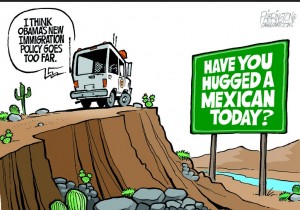
Migration Policy

Bribes are Turkish

In the Dec. 17-25 corruption investigation in Turkey millions of dollars were in shoeboxes. Sons of some ministers and bureaucrats were detained. But only a few months later, on March 30, 2013, local elections were held and the ruling AKP increased its votes by 5% compared with the previous elections, to 44.19%. Its nearest rival, the Republican People’s Party (CHP)also increased its vote totals.

That was yet another illustration that allegations of corruption and bribery did not mean much to people. But such allegations have been rapidly eroding Turkey’s image abroad. Transparency International released its 2014 Corruption Perception Index that placed Turkey 11 places lower than last year. Anne Koch, the organization’s director for Europe and central Asia said Turkey’s regression from 53rd place to 74th among 175 countries was because of the Dec. 17 operation,  Koch said, “Millions of dollars in shoeboxes, the firing or resignation of ministers, many detentions, led the news on corruption.” She said some countries in Africa and Middle East were better placed than Turkey.

Oya Ozarslan, chairwoman of the Turkey branch of Transparency International, said in Turkey one out of five persons pays bribes to benefit from public services.

A corruption report by the powerful Industry and Business Association (TUSIAD) followed. The report, based on interviews with 801 businesspeople, cited half of the respondents saying there was corruption in Turkey.

TUSIAD Chairman Haluk Dincer said their research by and large matched their predictions. “There is corruption in Turkey and the trend is for further increase,” he said. Dincer said corruption added 10% to production costs.

The Turkish National Assembly established an inquiry commission to investigate the Dec. 17-25 corruption and bribery allegations.

Main opposition CHP leader Kemal Kilicdaroglu bitterly criticized the assembly speaker, who is from the AKP. Kilicdaroglu said, “Since when has the national assembly become the protector of thieves? Your duty is to preserve the reputation of the national assembly.”

At the moment, the investigation is said to be going on, but nothing is being told to the people. Anyway, even if the people were kept informed, nobody would expect an outcome that would have the accused ministers tried in court, because the commission findings must be approved by the assembly quorum. Since AKP has 312 out of 550 parliamentary seats, such an outcome is unlikely.

In short, there were always allegations of corruption in Turkey.  They continue today. Nobody, including top businessmen, think it will ever end. Nature and the scope of corruption may change, but corruption continues to be an unchanging agenda item of the country.

Bribes in Turkey