Should We Separate Manipulation of Money and Money in Banking?

American, Swiss and British bankers banded together to fine their countries banks $4.3 billion for manpulating benchmarks used in the trading of currencies.  More fines may be in the pipeline.

Unfortuantely for the citizens of these countries, the fines are only the cost of doing businesss for JPMorgan Chase, Citigroup and Bank of America.

How do we get banks to change their ways?  The US Fed is now talking about jailing rogue bankers.  But the entire system may be rogue.

Is it possible to divide the banking and investment function of nstitutions now called ‘banks.”    Can we return to banks that take in deposits which are insured, loan money to companies that are a reasonable risk and be satisfied with 10% earnings on depostied money?  The other piece of the business would be called ‘inestment banking’, and operate as far as possible from the needs of ordinary citizens.

Jail may no longer be enouogh, especially when the targets are mid level officers and not the people at the top who tolerate unreasonable risk.

Jamie Dimon


Bankers Jailed in Vietnam

Bankers in Vietnam are going from marble and plate glass to bars.  One banking tycoon is jaiined for tax evasion and illegal lending.

Stae-owned banks have made risky oans to state-owned enterprises.  Banks are often poorly managed and there is no oversight.  It is said that bankers take loans for bribes.

Moody’s estimated that 15% of al loans and investments made by Vietnam’s banks were “problem assets.”  Vietnam’s central bank reported 4.7%.

Eugene Tarzimanow of Moody’s sees the assets as a positiv step in cleaning the banks.

Bankers Jailed?

Is Fiscal Discipline in the Eurozone Necessary?

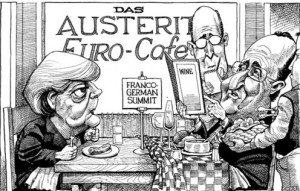
Yannos  Papantanou writes: Following the publication of the International Monetary Fund’s latest World Economic Outlook, high-profile economists like Olivier Blanchard, Larry Summers, Mario Monti, and Reza Moghadam have come out in favor of revising the eurozone’s fiscal rules to allow for public investment aimed at accelerating its economic recovery.  Given the record-low borrowing costs of about 1%, increased capital spending by governments would effectively amount to the proverbial “free lunch,” yielding sufficiently high tax revenues that the debt/GDP ratio would not rise. So why do German officials refuse to get on board?

Germany is deeply committed to upholding strong fiscal rules within the currency union. Economic behaviors like thrift and avoidance of debt are desirable, because they are consistent with ethical standards of personal behavior.

Moreover, Germans are not convinced that Keynesian policies, with their focus on boosting aggregate demand, are particularly effective in influencing long-term economic trends, despite their obvious short-term impact on output and employment. The prevailing view in Germany is that post-recession growth can more likely be attributed to structural reforms that increase productivity and bolster competitiveness.

But such reforms, the Germans believe, necessarily entail social costs, making them unpopular and difficult to execute. Only when fiscal austerity is implemented (or at least threatened), and a population is faced with rising unemployment and widespread economic misery, is a country motivated to pursue them. When austerity is relaxed and the threat is removed, discipline weakens and the drive to reform is lost. Italy’s behavior under former Prime Minister Silvio Berlusconi is frequently cited as an example of this dynamic.

Whatever the merits of Germany’s commitment to “moral” economic behavior, its stance on fiscal discipline in the eurozone remains dubious. After all, what the eurozone needs now is not to save its weaker economies from default or even to boost long-term growth; rather, it needs to recover lost output and employment, particularly in the southern countries – goals that neither fiscal austerity nor structural reforms can achieve on its own.

Germany’s fiscal stance has left it more isolated than ever. Not only has Italy’s new prime minister, Matteo Renzi, ramped up anti-austerity rhetoric; France plans again to delay meeting its obligation to reduce its deficit to below 3% of GDP within two years, and is calling for more flexibility in implementing the eurozone’s fiscal rules.

Public infrastructure investment can serve as the engine of that growth, boosting both short-term demand and long-term potential output. Investment enhances productive capacity, while serving, in the context of structural change, as the leading transmission mechanism for technological innovations. In this manner, increased infrastructure spending would address the issue of long-term growth, too.

The case for increasing public investment in the eurozone is strong.. Germany should be satisfied with the inclusion of tough controls aimed at ensuring that resources are allocated efficiently.

The European Central Bank should also step up its recently announced program of quantitative easing by overriding Bundesbank objections and moving to large-scale purchases of sovereign debt – including government bonds of struggling eurozone countries.

But accelerating public investment must be a key feature of a comprehensive strategy for economic recovery in Europe. Given that it is less controversial than unconventional monetary policies, and will take longer to produce results, it should be given top priority.

Austerity?

Long Term Investment in Low Hanging Fruit

Lucy P. Marcus writes:  Public and private investment in the real economy has been under attack since the 2008 financial crisis. In difficult economic times, it may seem logical to cut investments that yield results only in the long term, and thereby conserve money and resources to address short-term problems. In fact, cutting investment in our future – be it in people, the planet, political institutions, or business – is deeply irrational.

It is only through investment in visionary ideas, blue-skies thinking, research and development, and innovation that we can ensure that the future will be better – freer, more peaceful, and more prosperous – than the past.

Early-childhood education, preventive medicine, libraries, physical infrastructure, and basic scientific research, for example, all cost money – and studies show that they are worthwhile. But when policymakers need to cut spending, investment in these public goods is often the first thing to go, because voters do not feel the effects in the short term. Most of the pain is deferred, which is precisely why such cuts are politically attractive.

But this is low-hanging fruit that societies cannot afford to pick. We must start investing in people at the earliest possible moment – right from birth. Universal access to high-quality nutrition and preventive health care, as well as early-childhood learning programs, are necessary to provide strong foundations upon which countries around the world can ensure their future social advancement and economic growth.

Likewise, for children and adults alike, there is real value in, say, public libraries – secular and free gathering spaces that offer universal access to learning and, increasingly, provide a gateway to digital services. The same is true of cultural programs and institutions that stimulate growth in the arts and sciences; they, too, are necessary to ensure that citizens can contribute productively to their societies and economies.

The temptation to cut long-term investment in economic hard times stalks the private sphere as well. And companies around the world, big and small, have been succumbing to it since the beginning of the global economic downturn. As companies are forced to look to their bottom line and become leaner, they cut investment in research and development, employee development and training, infrastructure, and more. Making matters worse, these budget lines are the last to be restored when economic prospects brighten.

For example, in the face of investor pressure, pharmaceutical companies have cut their research activities dramatically, relying instead on acquisition strategies. The aim is to “de-risk” by buying up firms that have already carried out all of the costly blue skies research and have developed proven drugs.

Obviously, such strategies will not work in the long term if no one is willing to invest in the earliest stages of research in critical areas like biotechnology, digital technology, renewable energy sources, and the like. With early-stage investors scarce, governments turning away from blue-sky science, and funders of university-based research increasingly demanding that grantees’ show the “impact” of their work, who will fund risk-taking? If no one does, the well will run dry, and there will be nothing to acquire.

Likewise, instead of investing in new infrastructure, companies patch up the old. But patching broken things can work for only so long. By not committing resources to invest in new, cost-efficient, environmentally-friendly operations, or in developing the skills and knowledge of employees, or in innovation, companies will find that their short-term savings come at the expense of their long-term success.

The choices that companies are making not only affect their own operations, but also have profound consequences for their customers, suppliers, and the societies in which they are embedded. Failure to invest in the future will affect that future for everyone.

Not everything that is worthwhile has an immediate positive effect on financial bottom lines, or can be put neatly in a box. If public and private investment decisions are driven only by the easily measured and easily defined, we will miss out on the breakthrough moments that characterize so much of human achievement and advancement.

In both the public and private sectors, we need to commit ourselves to long-term investment, whether in children and education, science and technology, and health and medicine, or in building strong institutions that can serve as the sustainable foundations of peaceful, democratic, and prosperous societies. An investment in our future is never wasted. Investing in beginnings is the only way we will live to see happy endings.


 

Prime Ministers Talk Turkey in Teheran

Prime Minister Haider al-Abadi of Iraq and Prime Minister Ahmet Davutoglu of Turkey meet in Teheran.   In the Iraqi capital, from shopping malls to fancy hotels to the shelves of grocery stores, the influence of Turkish business is ample, underscoring an economic relationship between Turkey and Iraq has flourished even as the diplomatic relationship has soured in recent years.

Now, with the new Iraqi government struggling to keep the country together while under attack from Islamic State militants, and with Turkey dialing back its ambitions of leading a Sunni political axis that would reshape the region, the two countries are trying to come together amid mutual suspicion.

The visit by Prime Minister Ahmet Davutoglu, the first from a Turkish prime minister in nearly four years, was a vivid example of a scramble taking place all across the Middle East, as former adversaries are seeking to mend relationships, or at least try to work together, at a time of unprecedented crisis.

Mr. Davutoglu’s visit on Thursday came a week after a tentative agreement between Baghdad and officials in Erbil, the Kurdish capital, that restarted budget payments to the Kurds and allowed the Kurds to export some of their own oil.

Iran and Turkey

Damaging Side Effects of Sanctions in Iran

Iran’s drive for ‘independent’ development, in the face of international pressure over the nuclear programme, has degraded its air, water and land.

Economic sanctions may seem like an obvious tool against a target country’s econom, but the country’s response in an effort to overcome the effects of the penalties may be awful   Iran converted petrochemical factories into refineries.  In building dams they have ruined the wetlands and ivolated treaties.

The US has blocked air from major UN enviromental organizations.

topThe World Health Organization has ranked four of Iran’s cities in the top ten most poluuted in the world.

Polluted Cities in Iran

Hidden Areas Ripe for Growth in India

Anu Madgavar and Rakesh Mohan write: India’s economy could soon be on the move again. The new government is re-establishing fiscal discipline and energizing the bureaucracy, fueling optimism that rising business confidence will re-activate investment, particularly in infrastructure. But India’s overall growth prospects conceal a patchwork of economic opportunities that exist within states, districts, cities, and even towns – opportunities that companies can uncover only with careful research.
India’s economic data are promising. Annual average GDP growth is forecast to range from 6.4% to 7.7% until 2025. This compares favorably with last year’s 4.7% rate, and is close to the 7.7% average recorded in the decade up to 2012. Moreover, it contrasts sharply with the expectations of secular stagnation in the developed world. This acceleration would place India among the world’s fastest-growing large economies and increase the number of Indian consumers who can afford discretionary items from 27 million in 2012 to 89 million in 2025.
But the potential is far from uniform. According to a new report, more than half of India’s GDP growth between now and 2025 will come from just eight states (Gujarat, Haryana, Himachal Pradesh, Kerala, Maharashtra, Tamil Nadu, Andhra Pradesh, and Uttarakhand), home to just 31% of the country’s population. Along with four dynamic city-states (New Delhi, Goa, Chandigarh, and Pondicherry), these states will be home to 50 million consumers, or 57% of the country’s middle-class households.
Indeed, per capita GDP in India’s highest-performing regions could grow to twice the national level. This reflects several factors, including rapid urbanization, sustained investment in skills and infrastructure, and a shift from agriculture to industries such as automotive components, petrochemicals, pharmaceuticals, financial, and IT-enabled services.
By 2025, the economies of these regions will resemble those of middle-income countries. Maharashtra’s consumer market of 128 million will wield purchasing power similar to that now seen in Brazil. New Delhi’s 22 million people will boast living standards similar to today’s Russia.
Slightly less dramatically, though still significant, per capita GDP in Chhattisgarh, Odisha, West Bengal, Rajasthan, and Madhya Pradesh, based on current trends, is forecast to reach 0.7-1.2 times the national average by 2025, swelling the number of middle-class consumers four-fold, to 16 million. By contrast, the weakest-performing states, including Bihar, Uttar Pradesh, and Jharkhand, with per capita GDP of under 0.7 times India’s average, will struggle with low incomes and high population growth, unless they improve their governance and investment trajectory significantly.
But investors seeking the best growth opportunities will have to search beyond states’ headline figures and scrutinize India’s districts more closely, especially urban clusters and their hinterlands. We have identified 49 such high-growth clusters, located in 183 districts nationwide. In 2012, these areas accounted for half of India’s population, 70% of its GDP, and 71% of consumers. They are also home to 250 of India’s 450 cities with populations above 100,000.
Interestingly, one-third of these clusters can be found in states that have delivered low to medium economic performance, or are located close to smaller, lesser-known towns in better-performing states. The Nellore cluster in Andhra Pradesh, for example, has paddy, tobacco, groundnut, mango, and sugarcane farms. The Bikaner cluster in Rajasthan is rich in oilseed and the quarrying and production of Makarana marble and limestone. The more diversified Aurangabad cluster, in Maharashtra, is home to some of India’s largest seed companies, an active automotive, pharmaceutical, and sugar-manufacturing industry, and a tourism hub that includes the Ajanta and Ellora caves.
The location of these lesser-known clusters underscores the point that investors, seeking low-cost real estate and a skilled workforce, should look more carefully at India’s economic geography when deciding where to place their operations. These locations could eventually become knowledge-based industry or services hubs, similar to those of large Indian cities such as Bengaluru, Hyderabad, and Pune – only cheaper.
As they continue to develop, India’s dynamic economic clusters will themselves need to invest in modern sanitation and water systems, education and health, airports, railways, and road links. As such, they offer investors opportunities in many sectors, including consumer goods, financial services, housing, and infrastructure.
Given their structural advantages – including proximity to large urban centers for some – these clusters could generate some of the best returns on investment anywhere in India. Companies hoping to catch India’s next growth wave might want to consider areas that seldom feature on investment lists, but that might offer better value than marquee destinations.

Manufacturer Mattel Apologizes for Making Barbie Appear Incompetent as a Coder

Barbie can barely manage her computer in the new Barbie: I Can Be a Computer Engineer book

She is portrayed as an inept programmer who inadvertently plagues her friend’s computer with a virus and can’t fix a bug without help from a man.  The book implies that Barbie can only contribute to the design of the game she’s working on, rather than its more complicated technical structure.

According to one Amazon reviewer:  “Barbie starts out at breakfast stating that she’s designing a game but when questioned by her sister Skipper, she admits, ‘I’m only creating the design idea, I’ll need Steven and Brian’s help to turn it into a real game.’ Literally six sentences into the story, and already Barbie can NOT do it. She immediately admits she doesn’t know how to actually do computer engineering, and like a Disney princess, needs a white knight to rescue her.”

Naturally, the book has not been well received. The majority of parents reviewing it on Amazon have deemed it worthy of only one star, and the site’s sole three-star review suggests renaming the title “I Can Manipulate Boys Into Programming While I Sit Back and Take Credit.”

Barbie Needs a Man to CodeNote: Mattel has withdrawn this book title from sale.

Austerity Fails?

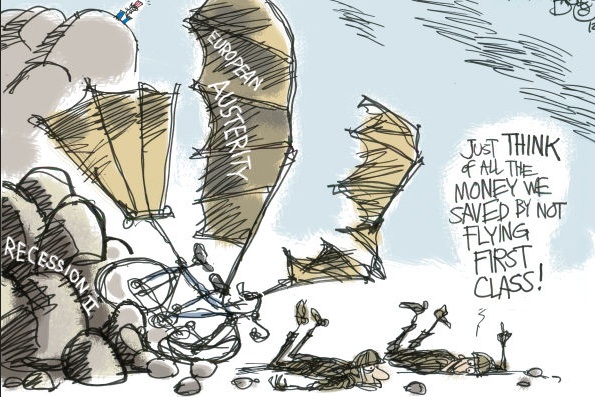
Now we know for sure George Osborne’s economic plan has failed, even on its own account. For all the self-congratulation about credit-fuelled growth, the recession in wages goes on. Four years into the coalition, most people’s living standards are still falling. Last week it seemed as though pay might have finally overtaken prices. But yesterday’s figures showed that real earnings fell by 1.6% over the past year. That continues the longest drop, of seven consecutive years, since records began in Victorian times.

The fall in living standards is greater still for the poorest, who effectively suffer higher inflation. Add in the fact that business investment as a share of national income and productivity are still declining, and no wonder David Cameron’s red lights are flashing. Of course the Tories like to boast about employment growth. But since only one in 40 of the new jobs are permanent, the number of people in enforced part-time work has doubled to 1.3 million, and there has been an explosion in artificial self-employment, the experience on the ground is something else entirely.

The most spectacular failure, however, is in the government’s central economic objective – for which all the pain was supposed to have been endured. After four years in office, the budget deficit and debt are growing, when the original plan had the books as good as balanced by now. The government’s core policy has failed on its own terms – let alone anyone else’s.

A crucial factor in that failure is falling wages and job insecurity. Cuts in real pay and growing low-wage employment have meant lower tax receipts and greater demand for benefits. Almost all the pain of benefit cuts for the most vulnerable has come to nought.

If cuts aren’t working, and low pay and insecurity are shrinking tax revenues and boosting benefit costs, you might think that would be cause for a change of direction. Not a bit of it: £50bn more cuts are lined up for the next parliament – and the government is doing everything to drive down wages and job security still further.

Austerity Fails


Oh Say Can You See US Energy Independence

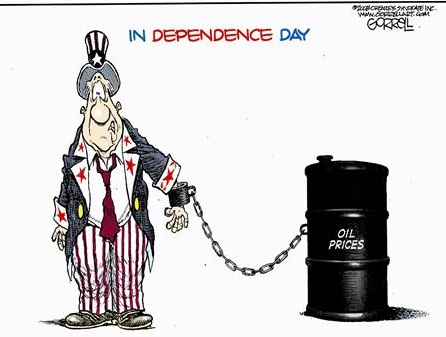
RIch Miller writes;   Cheap oil is a geopolitical gift to the US.  A new age of abundant and cheap energy supplies is redrawing the world’s geopolitical landscape, weakening and potentially threatening the legitimacy of some governments while enhancing the power of others.

Some changes already are evident.  Surging US oil production enabled America and its allies to impose tough sanctions on Iran without having to worry much about the loss of imports from the Middle Eastern nation. Russia, meanwhile, faces what President Putin called a possibly “catastrophic” slump in prices for its oil as its economy is battered by U.S. and European sanctions over its role in Ukraine.

Oil is “the most geopolitically important commodity,” said Reva Bhalla, vice president of global analysis at Stratfor, an advisory company in Austin, Texas. “It drives economies around the world” and is located in some “usually very volatile places.”

Benchmark oil prices in New York have dropped more than 30 percent during the last five months to around $75 a barrel as U.S. crude production reached the highest in more than three decades, driven by shale fields in North Dakota and Texas. Output was 9.06 million barrels a day in the first week of November, the most since at least January 1983, when the weekly data series from the Energy Information Administration began.

“For 10 years, the defining factor in the oil market was the growth of China and Chinese oil demand,” said Daniel Yerginvice chairman of Englewood, Colorado-based consultant IHS Inc. and author of a Pulitzer Prize-winning history of the commodity. “Now the defining factor is the astonishing growth of U.S. oil production.”

The most probable case is a four- or five-year cycle with prices in a general range of $65 to $80 a barrel, he said. That compares with an average of about $88 from 2008 to 2013 and a high of more than $140 at one point during that period.

The big question is whether oil-producing nations will react with accommodation or confrontation, said James Burkhard, vice president and head of oil-market research for IHS.

“That’s where the water gets a little muddy,” he said. “That story will be unfolding in the months and year ahead. It does add greater uncertainty and volatility that can often lead to negative surprises.”

Russia is the biggest loser.  Russia’s economy will contract by 1.7 percent next year after stalling out in 2014, IHS forecasts. It projects inflation will rise to 8.4 percent from 7.6 percent, boosted by a depreciating currency.

Iran has seen its revenue from oil exports fall by some 30 percent, President Hassan Rouhani said in remarks to parliament published Oct. 29 on Shana, the Oil Ministry’s news website. The nation needs to achieve a break-even sales price of $143 a barrel this year to keep its budget in balance, according to data compiled by Bloomberg.

Like Russia, Iran’s economy has been weakened by economic sanctions — in its case over its nuclear program. The steps by the U.S. and its allies have almost closed Iran’s oil and gas fields to investment in the last decade, limiting the country’s access to technology to boost output.

Venezuela lost 30 percent of its foreign-exchange revenue in the last month because of a “tremendous” drop in oil prices, Maduro said Nov. 13 in a televised national address from Caracas. He said he sent the country’s foreign minister to five oil producers, including Mexico and Russia, to drum up support ahead of the Nov. 27 OPEC meeting.

The U.S. is emerging as a big winner, according to the Nov. 11-12 poll of investors, analysts and traders who are Bloomberg subscribers.

Increasing energy independence means the U.S. is less vulnerable to supply disruptions overseas.  The boom in U.S. energy output also enhances U.S. prestige, which had been dented by the global financial crisis that originated in America’s housing market.

China is another big winner, as it imports almost 60 percent of its crude.

The world’s second-biggest economy probably will take advantage of the savings to build up its strategic reserves rather than dedicating the funds to increased spending on defense or the environment, according to Lin.

The plunge in oil prices also gives the nation leverage in its dealings with Russia. The two countries signed a $400 billion, 30-year gas-supply accord in May during a summit in China, then deepened their energy ties earlier this month by signing a preliminary agreement for a second Russia-China pipeline.

US Energy Independence