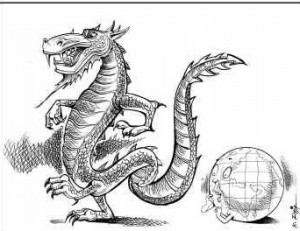
Chinese President Xi Jinping’s anti-corruption campaign is the broadest and deepest effort to purge, reorganize and rectify the Communist Party leadership since the death of Mao Zedong in 1976 and the rise of Deng Xiaoping two years later. It has already probed more than 182,000 officials across numerous regions and at all levels of government. It has ensnared low-level cadres, mid-level functionaries and chiefs of major state-owned enterprises and ministries. It has deposed top military officials and even a former member of the hitherto immune Politburo Standing Committee, China’s highest governing body. More than a year after its formal commencement and more than two years since its unofficial start with the downfall of Chongping Party Secretary Bo Xlia, the campaign shows no sign of relenting. Fighting Corruption in China
Category Archives: News Blog
US and Africa Business Forum in Washington DC
The US-Africa Business Forum brings together business executives and heads of state. The event — part of the three-day U.S.-Africa Leaders Summit and co-sponsored by the Department of Commerce and Bloomberg Philanthropies — is the first such gathering.
There is reason to be optimistic that Africa may be at a turning point, given that seven of the 10 fastest-growing economies in the world are on the continent. “This is not charity; this is self-interest” is how President Barack Obama described the new approach. In other words, growth in Africa can generate growth in the U.S.
The candor is refreshing. As the participants assemble, though, they should be mindful of the history of self-interested business dealings in Africa. While that history may be lost to Americans, Africans have a longer memory, and some sensitivity to past relationships may pay significant dividends for American business leaders operating now.
America has long traded with Africa. That’s the good news. The bad news is that for almost two centuries, the commercial connection was largely defined by the slave trade and the commerce it directly and indirectly generated, such as the shipment of sugar and the distillation of rum. Many merchants in New England built vast fortunes by shipping slaves to the New World until the cessation of the trade in 1808, accumulating enough capital to jump-start the U.S.’s industrial revolution.
After the end of the international slave trade, the era of “legitimate” exchanges with Africa commenced, as U.S. merchants, taking advantage of conflicts between European powers, managed to trade with west African countries, exchanging rum, tobacco, brandy and, eventually, manufactured goods in exchange for ivory, dyewood, gold dust and other natural resources.
The U.S.’s efforts to open markets in Africa were stymied in the second half of the 19th century. The problem lay with the European’s imperial conquest of the continent, which culminated in the Berlin conference of 1884-1885, when Europe’s powers effectively divided up the region, inaugurating a brutal period of exploitation that found fictional expression in Joseph Conrad’s “Heart of Darkness.”
Although the U.S. may have wanted a piece of the action and did what it could to profit from the mad scramble for African resources, it found itself shut out of trade with most of the new colonies, thanks to imperial trade protections. The Americans protested, with the U.S. Chamber of Commerce insisting in 1884 that places such as the Belgian Congo should remain “free from the interference or political control of any one nation.” But such entreaties generally fell on deaf ears, and American commerce in Africa dwindled.
By the early 20th century, the U.S. had managed to get a foothold in places such as South Africa, but in general, its trade paled compared with that of Britain. Moreover, it was lopsided. Americans, in other words, didn’t actually buy a whole lot from Africa. The continent was instead viewed simply as a dumping ground for U.S. products. In 1901, for instance, goods from Africa constituted a mere 1.2 percent of total U.S. imports. That figure barely budged in the succeeding years.
And actual direct investment in Africa was negligible, with the exception of Firestone’s investment in rubber plants in Liberia before the outbreak of World War II. Africa, when it appeared on the radar of U.S. businessmen, was a place to sell, not a place to make long-term investments. That job fell to imperial powers such as Britain, which had little interest in, say, setting up a competing manufacturing power in a colony.
The outbreak of World War II triggered a temporary spike in imports from Africa but little direct investment, a problem that would continue to loom large in the postwar era. South Africa’s finance minister complained in 1949 that “while American business has always been keenly interested in South Africa as a market, it has with a few notable exceptions neglected South Africa as a field of investment.”
Elswhere, the situation was worse. Investors steered clear of African nations for fear of losing assets to civil wars, nationalization campaigns and other perils that dominated the headlines in the 1950s and 1960s. (It didn’t help matters that the U.S. and the Soviet Union fought a series of proxy wars on the continent, further undermining investor confidence.)
In 1969, the book value of American direct investments in Africa was a paltry $2 billion. This was a drop in the bucket: The total book value of U.S. foreign direct investment at the time was $65 billion.
Trade imbalances remained a vexing problem throughout the postwar era. In 1979, Leopold Sedar Senghor, president of Senegal, called upon the Organization of Africa Unity to deal with the “scourges” afflicting Africa, in which “trade imbalances” ranked on par with apartheid, racial discrimination and “mercenarism.”
Business leaders now turning their eyes to Africa need to be mindful of precedent, particularly the tendency to view Africa only in terms of exploitation, not investment. Appeals to self-interest are appropriate in discussing business opportunities, but the attendees at this week’s conference should ensure that both sides’ “self-interest” gets equal representation going forward.

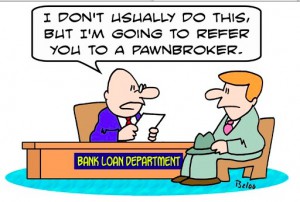
Business Lending Sluggish in US
Following the 2007–09 financial crisis, bank lending to businesses plummeted. Five years later, the dollar amount of bank commercial and industrial lending has finally surpassed the previous peak. However, despite very accommodative monetary policy and abundant excess reserves in the banking system, the spread of the commercial loan interest rates over the target federal funds rate remains above its long-run average. This suggests that business loans are not yet cheap relative to banks’ funding cost. Simon Kwan of the Federal Reserve Bank of San Francisco
China Recovery Beats Expectations
China had suffered a worrisome slowdown in the first quarter with many macro indicators weaker than market consensus forecasts, posing a significant threat to the government’s commitment to achieving “around 7.5 percent” growth target in 2014.
In response, China introduced a series of growth-supportive measures. The Chinese leadership has been intensifying the anti-corruption campaign this year indicating more strongly than ever, they desire a stable economic and financial backdrop.
Latest macro indicators suggest that these measures have been instrumental in helping China’s economy recover more quickly than expected. Many experts believe the cumulative impact of monetary easing efforts, through targeted liquidity provision, and growth-supportive measures will continue to help bolster the Chinese economy for the rest of this year.
Chinese equities made notable progress in July, with the benchmark Shanghai Composite Index advancing 7.48 percent last month. It marked the best month for China’s equity markets since December 2012. HSBC and Bank of America Merrill Lynch upgraded their forecasts for China’s year-on-year gross domestic product growth in 2014. HSBC raised its forecast to 7.5 percent from 7.4 percent, while the latter lifted its prediction to 7.4 percent from 7.2 percent.
Confidence is being restored, but the world’s second largest economy is still faced with significant pressure and risks. Among them, the property sector drew the most attention. In the second quarter, new sales and property investment in China slid, with the former contracting further and the latter’s growth sinking to a 20-month low.
Another concern is local governments’ rising debts and possibly inadequate fiscal capabilities as the central government asked them to support growth-supportive measures.
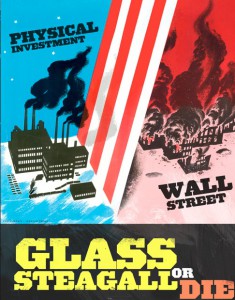
Bringing Back Glass Steagall in the US
For over half a century, the Depression-era law known as Glass-Steagall kept traditional banks separate from the high-risk world of investment banks and hedge funds. Uncle Sam agreed to insure our deposits. And the banks, in return, agreed not to use these deposits for gambling in the Wall Street casino. That all changed with the industry-backed deregulation of the 1980s and ‘90s. Once again, banks gained the ability to play risky games with government-backed funds, setting the stage for the financial and economic meltdown of 2008.
After Senators Elizabeth Warren, John McCain, Maria Cantwell, and Angus King introduced their bill to bring back Glass-Steagall, AFR and our allies wanted to show the strength of the support for making the biggest banks simpler and smaller and once again ending the public subsidy to Wall Street speculation.
Argentina’s Debt Crisis
Kenneth Rogoff writes: Argentina’s latest default poses unsettling questions for policymakers. True, the country’s periodic debt crises are often the result of self-destructive macroeconomic policies. But, this time, the default has been triggered by a significant shift in the international sovereign-debt regime.
The shift favors hardline creditors in bond issuances governed by US law. With emerging-market growth slowing, and external debt rising, new legal interpretations that make debt future write-downs and reschedulings more difficult do not augur well for global financial stability.
Are We In a Circular Economy?
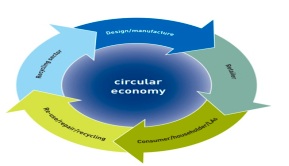
Teresa Domenech writes: A circular economy is one that exchanges the typical cycle of make, use and dispose in favour of as much re-use and recycling as possible. The longer materials and resources are in use, the more value is extracted from them. This could contribute toward reducing Europe’s dependence on critical materials such as cobalt, fluorspar or gallium, but also reduce overall demand by recovering the resources, nutrients or energy contained in products at the end of their useful life.
Extending the life of products and materials prevents the over-generation of waste and recovers the full value of products. This would create new business opportunities and revenue streams, while minimising the environmental impact of mining, resource extraction, refining and manufacture. The Circular Economy
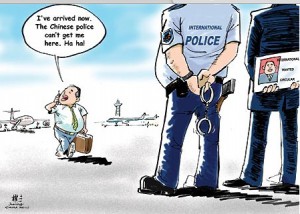
Multinational Companies Bribing Chinese Officials
Zhang Yan writes: Prosecuting departments have been handling an increasing number of cases involving bribery offered by multinational companies to government officials or State-owned enterprises, according to the Supreme People’s Procuratorate. “The worst-hit areas in terms of corruption are pharmaceuticals, the electric power sector and software,” Song Hansong, director of the procuratorate’s corruption prevention department, told China Daily.
The number of bribery cases being prosecuted has risen markedly across the country, Song said, but he declined to give further details. Because State-owned companies often need to purchase equipment and components from foreign firms, some multinational enterprises saw this as an opportunity to offer huge bribes to senior managers in State-owned companies or government officials to promote their products, Song said.
Zhao Wu’an, also a senior member of the corruption prevention department, highlighted some common methods of bribery. “Rather than directly offering cash, they usually hire agents in China to offer the bribe by other means, including supporting overseas study for their children, arranging expensive foreign holidays and, of course, depositing money in a foreign bank account.”
In some cases, he said, corrupt officials in State-owned enterprises sent their children or spouses overseas to study or invest in businesses as a disguise to get passports and visas to launder money ahead of their own departure, he said.
Last year, Chinese police accused GlaxoSmithKline China, a British pharmaceutical giant, of offering huge bribes to officials and doctors to boost their product sales.
The company also faced accusations that it transferred up to 3 billion yuan ($489 million) to 700 middlemen over six years to facilitate the corruption.
Four senior Chinese executives at the company were detained, and Abbas Hussain, president of Europe, emerging markets and the Asia-Pacific for GlaxoSmithKline in Beijing, made a public apology and said the company will fully cooperate with police in the investigation. Song said prosecuting departments face a number of practical difficulties when investigating corruption since getting their hands on evidence can be difficult as there is no paper trail.
Companies will also take more steps themselves to combat the scourge, he said.
The most effective measure, he said, is to “tighten supervision of ‘naked officials’ in State-owned companies”. This term refers to officials who have sent their children and spouses overseas to pave the way for their own departure. Greater supervision over State-owned companies, especially those involved in high-cost projects, is required.
Walgreens the Latest US Company to Relocate to Switzerland
Walgreens plans to merge with Swiss-based pharmacy chain Alliance Boots. Walgreens will then claim that it’s now a Swiss company, just to be able to pay Switzerland’s lower tax rate.
Walgreens is planning to create a massive new corporate tax loophole. They don’t want to pay their fair share of taxes. This reflects the massive problems with the US corporate tax structure. In many ways it is unfair to corporations and we are driving companies away from responsibilities they incur in the US because they use the US roads and bridges, a workforce educated in the US and our legal system.
Their stores are staying put. Walgreens will still depend on US citizens to shop there and make the company profitable. Thanks to American shoppers Walgreens made $72 billion in profit in 2013. Nearly a quarter of those sales were from services like Medicare and Medicaid that are paid for by our tax dollars.
Walgreens wants all the benefits of being an American company. It should be asked to pay its fair share of taxes here. Our representatives have not come up with an answer to this dilemma.
Europe’s Growth Strategy
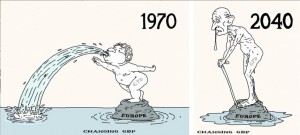
Jean Pisani-Ferry writes: Packaging existing loan portfolios and offloading them to non-bank investors, as many have proposed, should be encouraged. Beyond short-term fixes, the main priority must be to encourage a resumption of savings flows across Europe, but this time in the form of equity, not bank deposits and loans. For this, Europe needs an adequate regulatory and tax framework. Official institutions could also be involved in a suitable way. Oddly, the European Investment Bank, the EU’s financial arm, is authorized to provide only loans and guarantees, not equity investment. Substitutes should be found. Europe’s Growth Strategy
There are, finally, a few fields where national governments could act directly. Infrastructure is a case in point, provided that the current interest in investment projects is not used as an excuse to revive Europe’s love for white elephants.
Will it be enough? It is hard to know.