Should Shareholders Be Only One Stakeholder in a Corporation

Robert Reich writes: In recent weeks, the managers, employees, and customers of a New England chain of supermarkets called “Market Basket” have joined together to oppose the board of director’s decision earlier in the year to oust the chain’s popular chief executive, Arthur T. Demoulas.  Their demonstrations and boycotts have emptied most of the chain’s seventy stores.

What was so special about Arthur T., as he’s known? Mainly, his business model. He kept prices lower than his competitors, paid his employees more, and gave them and his managers more authority.  Late last year he offered customers an additional 4 percent discount, arguing they could use the money more than the shareholders.

In other words, Arthur T. viewed the company as a joint enterprise from which everyone should benefit, not just shareholders. Which is why the board fired him.

The Arthur T. business model pop up all over the place.  Pantagonia, a large apparel manufacturer based in Ventura, California, has organized itself as a “B-corporation.” That’s a for-profit company whose articles of incorporation require it to take into account the interests of workers, the community, and the environment, as well as shareholders.  The performance of B-corporations according to this measure is regularly reviewed and certified by a nonprofit entity called B Lab.

To date, over 500 companies in sixty industries have been certified as B-corporations, including the household products firm “Seventh Generation.”  In addition, 27 states have passed laws allowing companies to incorporate as “benefit corporations.” This gives directors legal protection to consider the interests of all stakeholders rather than just the shareholders who elected them.

We may be witnessing the beginning of a return to a form of capitalism that was taken for granted in America sixty years ago.  Then, most CEOs assumed they were responsible for all their stakeholders.

“The job of management,” proclaimed Frank Abrams, chairman of Standard Oil of New Jersey, in 1951, “is to maintain an equitable and working balance among the claims of the various directly interested groups … stockholders, employees, customers, and the public at large.”  Johnson & Johnson publicly stated that its “first responsibility” was to patients, doctors, and nurses, and not to investors.

What changed? In the 1980s, corporate raiders began mounting unfriendly takeovers of companies that could deliver higher returns to their shareholders – if they abandoned their other stakeholders.

The raiders figured profits would be higher if the companies fought unions, cut workers’ pay or fired them, automated as many jobs as possible or moved jobs abroad, shuttered factories, abandoned their communities, and squeezed their customers.

Although the law didn’t require companies to maximize shareholder value, shareholders had the legal right to replace directors. The raiders pushed them to vote out directors who wouldn’t make these changes and vote in directors who would (or else sell their shares to the raiders, who’d do the dirty work).

Since then, shareholder capitalism has replaced stakeholder capitalism. Corporate raiders have morphed into private equity managers, and unfriendly takeovers are rare. But it’s now assumed corporations exist only to maximize shareholder returns.

In retrospect, shareholder capitalism wasn’t all it was cracked up to be. Look at the flat or declining wages of most Americans, their growing economic insecurity, and the abandoned communities that litter the nation.

Then look at the record corporate profits, CEO pay that’s soared into the stratosphere, but the near meltdown in 2008 imposed collateral damage on most Americans).

You might conclude we went a bit overboard with shareholder capitalism.
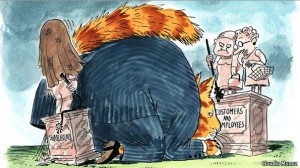
Stakeholder Capitalism


US Attractive to Investors

Norton A. Schwartz and John K. Hurley write: The recent creation of a new international development bank by Brazil, Russia, India, China, and South Africa – the so-called BRICS – is just the latest challenge to America’s global leadership. But, from an international business perspective, the United States remains in a strong position.

Perhaps the best indication of America’s enduring stature is the dollar’s dominance in international financial transactions. Last year’s Foreign Direct Investment Confidence Index based on a survey of more than 300 executives from 28 countries, showed that, for the first time since the Iraq War began in 2003, foreign investors view the US as the world’s most attractive destination for future investment.

The ability to project power internationally begins at home. And, despite its historically slow economic recovery, there is plenty of reason for optimism in the US. Business in US is Strong 

Uncle Sam Flexes his Muscles

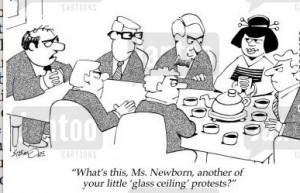
Where are the Women in the Food Business

You hear a lot about how women are underrepresented in fields like math and science, but the food world is also suffering from a staggering lack of ladies. Recently, the James Beard Foundation and the restaurant Vermillion hosted a panel discussion to address how few women there are in culinary leadership positions—and how the industry can better foster the advancement of women. Susan Ungaro, president of the James Beard Foundation, shared some pretty sobering information—namely that only seven percent of the people in leadership positions in the industry are women, even though more than 50 percent of culinary students are female.  Tips from the Top

Women in the Food Business

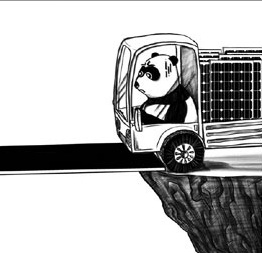
China Courts Africa with Solar Panels

Chinese company JinkoSolar Holding Co Ltd on Tuesday officially opened a solar PV module production facility in Cape Town.  The plant is expect to produce 1,300 solar panels per day with a turnover of 600 million rand ($56 million) per year.

The solar panels, which are mounted onto the roof of a house or property, are expected to help in taking the load off the power grid of the state-run electricity utility Eskom, according to Morgan Peng of Jinko Solar, which is listed on the New York Stock Exchange.

Minister of Trade and Industry, Rob Davies welcomed the opening of this facility as part of his ministry’s drive to expand the capabilities of the South African manufacturing industry, to increase the country’s industrial base and create the much needed jobs in Cape Town.

Davies said the green economy has been identified as a key focus area in his department’s Industrial Policy Action Plan, and provides significant opportunities for job creation, localisation and economic growth.
Speaking at the launch, Western Cape Premier Hellen Zille said the company’s decision to open its first factory outside China in the Western Cape was good news for job creation.  “The reason I am excited is this plant will create 250 direct jobs. Other indirect jobs will be created, as we are not expecting jobs to be created within the plant only, but there will be more work created post production through installations,” Zille said.  Tthe Western Cape provincial government has forged a partnership with a local technology tertiary institution to send local students to China in a bid to train them.

China Brings in Solar Panels

China: Rising Wages and Low-Value Added?

Zhang-Monan writes on Project Syndicate: Last year, China ostensibly reached another milestone in its meteoric rise, surpassing the United States to become the world’s largest trading country, with its total trade turnover valued at CN¥25.83 trillion ($4.16 trillion). But this achievement is largely illusory – and should not be allowed to obscure China’s need to transform its trading model.

Since the 1990s, China’s has been building up its “proessing trade”– whereby it imports intermediate inputs from other countries, processes or assembles them, then exports them – causing the ratio of intermediate-product trade to overall external trade to grow rapidly. Intermediate inputs comprise around 28% of global exports, but 40% of China’s total exports. Given that traditional trade accounting is based on country of origin, the resulting global segmentation of value added and the multilayered international division of labor can distort trade figures.  How to Measure China’s Trade Figures

China Trade Situation?


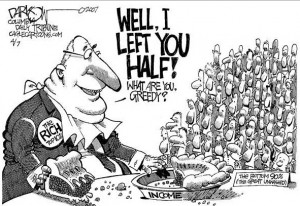
Inequality Spread May be Even Larger Than Statistics Show

The one percent is literally rich beyond measure, depriving nations of billions in tax revenue and obscuring shifts in global inequality.

Research conducted separately by European Bank economist Philip Vermeulen and London School of econoics’ Gabriel Zucman show the weath of the super-affluent hidden by tax shelters and non responsive questionaires, is undercounted. Income inequality worse than reported

Income Inequality

Goldman Sachs Investigated for Alternative Trading

Goldman Sachs Group Inc. said it was being investigated for its U.S. alternative trading system and for the potential misuse and circulation of non-public information related to its corporate developments.

New York’s attorney general is investigating the alternative trading systems, also known as “dark pools,” run by Goldman and Morgan Stanley.  Goldman, in a filing on Thursday, did not specify who was conducting the investigation.

A unit of Goldman Sachs was fined in July over pricing rule violations stemming from its dark pool SIGMA-X.  Dark pools are broker-run trading venues that let investors trade shares anonymously and only make trading data available afterwards, reducing the chance of information leaking about trade orders.

Goldman also lowered its unreserved legal costs to $3.2 billion at the end of June from $3.7 billion at the end of March, it said in the filing.

 Dark Pool Trading

Are Americans Losing Their Interest in the World?

Lee Hockstader writing in the Pew Trusts Magazine says:  Between George Washington’s admonition to avoid alliances with other countries and John F. Kennedy’s pledge to support any friend and oppose any foe in liberty’s defense, Americans have been torn over their role and obligations in the world, practically from our nation’s birth. The isolationist impulse, never long dormant, has coexisted uneasily, and sometimes unhappily, with the muscular ambitions and restless idealism of a continental power whose interests and reach are formidable.

After a decade of foreign wars that has sapped the nation’s prestige and confidence, Americans are now in many ways more ambivalent than ever. Even as they want the nation to remain strong, well-armed, and engaged in trade and economic relations overseas, their appetite for an assertive geopolitical role is drastically diminished. Likewise, their faith in the country’s ability to project power has plummeted. Even as Americans worry about the threat posed by terrorist attacks, islamic extremists, the spread of weapons of mass destruction, and cyberwarfare, an unprecedented proportion of the public wants the United States to turn its gaze to domestic problems—quite literally, to mind its own business.

An America of two minds: That is the portrait painted by “America’s place in the World 2013,” the sixth edition of the Pew Research Center’s quadrennial survey of public attitudes on foreign affairs.    Is America Leaving the World Behind

US Imprint

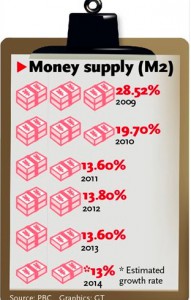
China to Continue Monetary Policies to Shore up Economy

China’s central bank said on Wednesday that it will continue to implement a targeted approach in monetary policy in the second half of 2014 and shore up weak links in the economy.
More financial support will be provided to rural areas and small businesses to reduce their financing costs, according to a statement on the website of the People’s Bank of China.  It said it will accelerate work to establish a deposit insurance scheme in the coming months.

The statement came after a meeting between the central bank governor and heads of the bank’s branches across the country to review monetary policy in the first half and map out policies for the second.  The central bank also said it will strengthen monitoring of financial risks in key sectors and industries, and handle the risks in a timely manner to prevent regional and systemic risks.

Chinese Targets

Emma Fry Starts a Vegan Travel Company

When Emma Fry wanted to go on a vegan friendly holiday in Europe, she couldn’t find a company to help. It simply didn’t exist. So she decided to launch one (after riding her motorbike around Guatemala, drinking lots of coffee and overdosing on avocados).
Now, the 31 year-old (known to friends as ‘the vegan biker’) from Dorset, runs Veganbnb Travel and divides her time between Guatemala, Spain and the UK, where she runs foodie adventures for vegans, vegetarians – and just about anyone who’s interested in being happier and healthier.   Emma Fry Interviewed

Vegan Travel