Women on Boards

Dr. Morten Huse, who holds the Reinhard Mohn Endowed Chair for Corporate Governance, Business Ethics and Social Evolution at Witten/Herdecke University (UW/H), write in the Journal of Business Ethics about some of the issues surrounding women on boards as well as employee-elected board members. We focus on women in the following synopsis:

In recent years, there has been increasing pressure from society and investors to appoint women directors on corporate boards. The number of women in top management and board positions has slowly increased. How does gender diversity contribute to variations in board tasks. Some have argued that there are greater differences among men and women than there are between men and women.

Conventional wisdom suggests that men focus more on quantitative issues and that women are more concerned with qualitative issues. How the bottom line is affected by this difference is still debated. If women are more concerned with corporate governance and social issues, how does this impact shareholder value? Does the adding of women to boards increase diversity of thought in the boardroom? And if it does, increasing studies show that decision-making is improved.

Some recent studies have re-directed the questions about if women make contributions to how women make contributions. When women are in the boardroom, discussions appear to be more open and creative. Are they?

In showing the need to go beyond board composition and corporate financial performances Huse suggests 1. Going beyond demographic descriptions of women, 2. Exploring differences related to various boards takes to include open discussions in the boardroom as a mediating variable between board member characteristics and boardroom tasks.

1. Huse’s research results emphasize that backgrounds and experiences go beyond gender and external demographics and that the personalities of the individual board members should be considered when researching the implications of diversity.

2. While women are expected to have a more questioning attitude than men and contribute to more open discussions in the boardroom, Huse has found that the contribution of women to creative discussions only existed when the women had a different background from the men. However, this relationship was weak. A possible reason for the lack of strong findings may be that women directors tend to adopt the ideas of the conventional board members.

3. Other research has found that minority board members make a contribution to their boards dependent on (1) their own previous experience in a minority position of other corporate boards and (2) previous experience by other board members in a minority position. Hence, while women directors may bring alternative back- grounds and knowledge to the boardroom, they may lack the experience of how to actually present and bring through such knowledge.

4. There appears to be correlation between women board members and concerns of Corporate Social Responsibility (CSR).

5. In the case of women directors, Huse found that esteem was positively related to budget controls, but not to the other types of control. However, the esteem of the women directors was generally found to be high and the lack of variations in the data might have caused the lack of findings.  Women on Boards

Women On Boards

China Will Build a Modern Financial System

China will endeavor to build a comprehensive, transparent and efficient fiscal and tax system by deepening reforms in the coming years, the central leadership of the Communist Party of China (CPC) said on Monday.

Priorities include improving management and supervision of government budgets, facilitating the building of a comprehensive, well-regulated and transparent modern budget system and optimizing the tax system, said a statement released after a meeting of the Political Bureau of the CPC Central Committee, presided over by its general secretary, Xi Jinping.

High priority will also be given to adjusting power and spending responsibilities between central and local governments in a rational manner, adjusting distribution of revenue between them while keeping the current division of financial resources between them stable, it added.

Can China Modernize?

.
The goal of the reforms is to set up a unified, comprehensive, well-regulated, open, transparent and efficient modern fiscal system that is conducive to better resources allocation, social equality and national stability, according to the statement.
It noted that China aims to fulfill key tasks in the new round of fiscal and tax reforms by 2016, and basically establish a modern fiscal system by 2020.

Gouging the Gauchos

Noriel Roubini writes:

Though 93% of Argentina’s creditors accepted new terms for their bonds in 2005 and 2010 in two exchange offers, a small group of holdouts sued Argentina in the United States, and, with the US Supreme Court recently ruling on the issue, have now won the right to be paid in full.
The US court decision is dangerous for two reasons. First, the court ruled for the first time that a country cannot continue to pay those creditors who accepted a big reduction (or “haircut”) on their claims until the holdouts are paid in full. So, why would any future creditor who benefits from an orderly restructuring vote for it if its new claims can be blocked by even a single holdout creditor?
Second, if the holdouts are paid in full, the majority of creditors who accepted a haircut can request to be paid in full, too. If that happens, the country’s debt burden will surge again, become unsustainable, and force the government – in this case Argentina, which is servicing most of its debt – to default again on all creditors.

Argentinian Debt

Children of War

As mothers and grandmothers and friends of mothers and grandmothers we contemplate with horror the effect of war on children.  Chris Hedges presents a dramatic, real,  Pity the Children

For people world over, the wars in Iraq and Afghanistan will be over soon. We will leave behind, after our defeats, wreckage and death, the contagion of violence and hatred, unending grief, and millions of children who were brutalized and robbed of their childhood. Americans who did not suffer will forget. People maimed physically or psychologically by the violence, especially the Iraqi and Afghan children, will never escape. Time and memory will play their usual tricks. Those who endured war will begin to wonder, years from now, what was real and what was not. And those who did not taste of war’s noxious poison will stop wondering at all.

Children of War

Viv White: Australian Entrepreneur


Viv White has an impressive thirty-year history of international work in educational reform, research, policy and practice, and is the co-founder and co-managing director of Big Picture Education.

Before Big Picture came into the picture, Viv was the CEO of the Australian National Schools Network and the Victorian Schools Innovation Commission. Through this work with schools, Viv could see that there was something fundamental in the way that schools were organised that was getting in the way of student engagement and deeper learning, despite the best efforts of teachers and school leaders and particularly in disadvantaged and regional areas.

With this in mind, she co-founded Big Picture Education Australia in 2006, with the goal of setting up one “Greenfield” public school by 2011; designed from the ground up, with the key philosophy of working with “one student at a time, in a community of learners”.

Now, in 2014, there are four Greenfield Big Picture schools across Australia and 40 Big Picture Academies and programs, as well as partnerships in New Zealand, the USA and the UK.

The Big Picture schools are constantly reviewing, researching and evaluating their practice with the aim of serving as demonstration sites for other schools around the country looking to redesign the way they function for 21st century learning.

With the help of key funding bodies and Australia’s top educational academics, Big Picture Education is disseminating the achievements of these groundbreaking schools to influence the broader debate about how we can make our public schools great.

One of the major successes of Viv’s work has been negotiating with, and working within, public education systems. She has worked to deliver millions of dollars in additional state education funding for innovative schools and programs re-engaging Australian students, from Launceston in Tasmania to Kalumbaru in far north Western Australia.

Viv has also been successful in forging models to link philanthropy with public schools, leveraging seed funding from philanthropy into significant and long-term educational investment.

As well as managing the organisation, Viv still spends a large portion of her time coaching and working with schools and students on-site. She continues to pursue her passion for energising and engaging students and teachers across Australia and the world.

One key piece of learning Viv has encountered over the span of her career is that real change comes from below, not above.

“If you engage, listen and give ownership to local communities and stakeholders you can achieve real change that is stronger than the vagaries of political mood.”

Viv White’s Strategies for Success

  1. Go wherever the interest is.
  2. Maintain and tend to your networks.
  3. Always think about who (else) should be at the table.
  4. In any situation you need to address the people, the content and the process to move forward effectively.
  5. Research, advocate and disseminate the ideas, practice and innovation.


Is This the Reason a Woman is Head of GM?

Women tend to get tough jobs in tough times.  Why would a man risk his reputation?

General Motors announced recalls of more than 8.4 million vehicles worldwide, most of those for faulty ignition switches.

That amounts to the company’s largest single day of recalls this year. In addition to the ignition-switch recalls, the automaker is recalling vehicles for faulty wiring and fasteners.

GM offered at least $1 million Monday to the families of those who died as a result of a defect in GM cars. The company has come under criticism for a decade-long delay in publicly revealing an ignition-switch flaw.

A Woman as Leader?

National Security Activity in One Chart

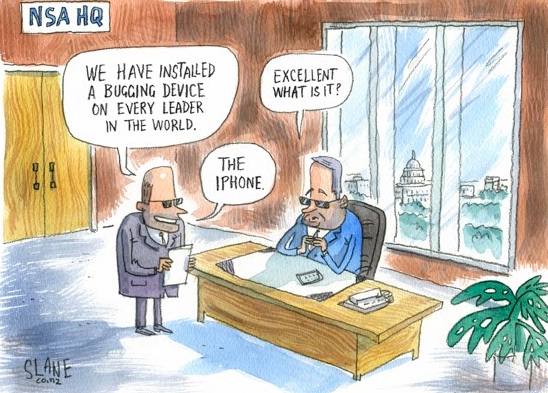
Pro Publica has prepared National Security Revelations in One Convenient Chart.

Julia Angwin and Jeff Larson, ProPublica, illustrations by Alberto Cairo, special to ProPublica

NSA Revelations


Family Friendly Corporate Policy

Women partners at the prestigious US law firm Skadden Arps are sent out to talk to the young female associates about their future. The word nanny is mentioned even before baby is.

A succesful tech company in Eugene, Oregon has taken a different path. Gwen Moran writes: Palo Alto Software, a company that develops business planning and other business-focused software, every day is Take Our Daughters and Sons to Work Day. CEO Sabrina Parsons, who has led the company since 2007, is a staunch advocate of family-friendly policies and is trying to help her employees and others in the tech sector deal with the fact that people have babies. Taking care of them shouldn’t derail your career.

Parsons says that the juggling work and parenting is tough for all parents, but the physical and societal demands placed on women hold particular challenges. From getting pregnant and giving birth to the disparity in many caregiving situations, she says parenting puts women’s careers at risk more than men’s.

“You’re in the prime of your career with all of this experience, when you get mommy-tracked. They get ‘concerned’ that you can’t do your job. That’s a huge reason why we’re not seeing women in leadership roles across Fortune 500 and Fortune 1000 companies and in politics,” she says.

So, Parsons–the mother of three boys ages 10, 7, and 4–is trying to show them how it’s done. At her 55-person tech firm, which was founded by her father, employees enjoy family-friendly policies including flex time and an environment that welcomes children. Parsons herself brought her children to work after they were born, and wore them on a sling around her neck until they were four months old, allowing her to practice attachment parenting while being the CEO of the company, she says.

Kids have comfy couches, crayons, and “there’s always a spare iPad or laptop around,” she says. The company also offers employee health club memberships, which include children’s programs on some days, so parents can take a break by bringing their children to the gym or taking them to lunch, she says.

Palo Alto’s kid-friendly policies aren’t a substitution for day care and there are limits. You can’t bring your kids to work every day, but if they have a week off of school or a particular day when your child care situation has hit a bump in the road, the policies give you options, Parsons says. Children need to sit quietly with their parents–no running and screaming in the halls allowed. And colicky babies aren’t welcome because they’re too disruptive.

While still a small firm, Parsons says that her policies have had real bottom-line benefits. First, Palo Alto enjoys a loyal workforce with little turnover, she says. Fully one-third of her development team is women versus Silicon Valley’s average of 7%.

Revenue from the company’s flagship product has grown 106% over the past 12 months, which she attributes to the contributions of loyal, happy employees. That includes the four working fathers who take advantage of the kid-friendly policies on a regular basis, she says. But there is still more work to do to get all working parents feeling supported and able to pursue their careers without having to sacrifice their roles as parents, she says.

“We need more women in a position to say that we are going to have these types of policies. It’s just assumed that it’s unprofessional. Why is it unprofessional? We need to find a way to make work and family work for everyone,” she says.

Asian Infrastructure Investment Bank: 100 Billion

The planned Asian Infrastructure Investment Bank has a capital target of more than $100 billion and will attract more than 30 countries within and beyond Asia, an official said on Sunday.
Wei Jianguo, vice-chairman and secretary-general of the China Center for International Economic Exchange, said on the sidelines of the Boao Forum for Asia on the AIIB that the bank plans to start with $50 billion from governments and at least another $50 billion from financial institutions and private capital.
Wei said the multilateral bank aimed to attract more than 30 nations. He emphasized that the AIIB is an open and inclusive platform that welcomes not just nations from Asia but others as well, including the United States and European countries.
Members of the Association of Southeast Asian Nations plus South Korea and Australia are slated to join the platform, while Japan has not yet decided, he said.
Jin Liqun, former finance vice-minister and head of the Working Group for Establishment of the AIIB, said at the meeting that China has held three rounds of talks with interested Asian countries, and an intergovernmental memorandum of understanding on setting up the bank is due to be signed this autumn.
Funds from the Asian Development Bank and the World Bank are far from satisfying the appetite for new infrastructure, while the new bank will provide a new financing channel for developing nations, especially low-income ones, Jin said.
The Asian Development Bank estimated that in the next decade, Asian countries will need $8 trillion in investments in their infrastructures to maintain the current economic growth rate.

Chinese Infrastructure

Is the Economic System Rigged Against Ordinary Citizens?

Curiously in the US, many conservatives think so.  This makes an articulate legislator like Elizabeth Warren attractive to  people of all political persuasions.  Has the left, right divide lost its meaning in economic terms?

According to a new Pew survey, 62 percent of Americans think that the economic system unfairly favors the powerful, and 78 percent think that too much power is concentrated in too few companies. 69 percent of young conservative-leaning voters and 48 percent of the most conservative voters agree that the system favors the powerful, according to Pew.

Although Warren seems an outlier in the legislative branch for her fiery discontent with inequality — and the role she says Wall Street plays in exacerbating it — the Pew survey suggests that the vast majority of Americans are at least open to her underlying premise.

Everyone, that is, except business conservatives. This faction has vastly different views of the American economic system than most Americans. Two-thirds of business conservatives think the economic system is fair to most people, and 57 percent think that large companies do not have too much power.

The demographics that bind business conservatives go a long way toward explaining why they diverge on this issue. The business conservatives that Pew surveyed were the most affluent of the seven political types they defined with family incomes above $75,000. Fifty-seven percent of business conservatives say they are interested in business and finance, and 68 percent invest in the stock market. No other type has them beat on these two measures.

Americans’ political beliefs are generally grounded in how they see politics interact or interfere with their own lives. We can focus on the diner-embed model of analyzing politics day and night, but for most Americans, gossiping about how a next-door neighbor lost their house or a cousin got a promotion at Goldman Sachs is all they’ve got. Business conservatives think the economic system is fair; others who aren’t as enmeshed in it disagree.

However, until Americans agree on what needs to be done to fix the economy, their disappointment with its underpinnings are unlikely be met with any sweeping populist changes in policy. And this poll suggests that’s not happening today.