Fixing Banks is Not the Answer?

Adair Turner writes about addresses the Eurozone’s economic problems:

A “credit crunch” – particularly in trade finance – was certainly a key reason why the financial crisis generated a real economy recession. Taxpayer-funded bank rescues, higher bank capital requirements, and ultra-easy monetary policy have all been vital to overcome credit supply constraints. But there is strong evidence that once the immediate crisis was over, lack of demand for credit played a far larger role than restricted supply in impeding economic growth.   Draghi’s Funding for Lending Scheme
That argument is persuasively made by Atif Mian and Amir Sufi in House of Debt, an important new book that analyzes US data on a county-by-county basis. Mian and Sufi show that the recession was caused by a collapse of household consumption, and that consumption fell most in those counties where pre-crisis borrowing and post-crisis real-estate prices left households facing the largest relative losses in net wealth.

Draghi


Economic Crime on the Rise in Australia

Our correspondent Andreas Frank writes: A new research reveals the extent of corruption in Australian organisations and highlights the insidious crimes committed by white collar criminals.

All forms of economic crime are up with 57 per cent of Australian organisations reporting an incident in the past two years, compared to 45 per cent in the last survey. Globally, the number of incidents reported was lower at 32 per cent and in the Asia Pacific region only 37 per cent.

“Typically Australian organisations have always reported more incidents of economic crime but that doesn’t mean we have more, quite the opposite. Results from this year’s survey confirmed what we suspected; Australian organisations take a more serious approach to detecting, investigating and reporting economic crime than other countries,” PwC Partner and Forensic Services Leader, Malcolm Shackell explained.

Over the past two years, two thirds of Australian organisations (67%) reported an incident committed by an external party to regulatory bodies including law enforcement. In the same period two-fifths (39%) reported an incident committed by an internal party to regulators including law enforcement.

The ‘big five’ crimes include asset misappropriation, cybercrime, procurement fraud, accounting fraud, bribery and corruption, according to the report.

Cybercrime:

Cybercrime continues to be of concern to Australian organisations with one in 10 reporting financial losses of more than AUD $1 million from cybercrime in the past two years.

Close to half (43%)of the organisations surveyed ranked the theft or loss of personal identifiable information as the number one concern should a cybercrime attack occur, while a third (33%) were most concerned about the theft of intellectual property and data in general.

PwC Partner Richard Bergman said, “Cybercrime is not just an IT issue. Recent high profile data breaches such as the US Target breach have increased the level of awareness and concern among senior management and the Board. But, the majority of cybercrime incidents still don’t make the headlines.”

“Information is valuable and attackers are determined to get it. Many of the attacks we’ve recently investigated have targeted merger and acquisition information and what surprises many organisations is how long attackers are inside their networks before the attack occurs.”

Procurement Fraud:

Procurement is a risky business according to a PwC survey released today which found that one third of Australian organisations (33%) experienced procurement fraud during the past two years with the mining, construction and energy sectors reporting the most incidences during that period.

According to the Australian edition of PwC’s 2014 Global Economic Crime Survey, procurement fraud was the third most frequent economic crime experienced by organisations in Australia and around the globe during the two year survey period. Asset misappropriation was number one followed by cybercrime.

Mr Shackell said most of the crime occurs where money leaves a business with a surprisingly high amount in the procurement process of awarding contracts to companies.

A common example is inappropriate relationships between a middle management insider who can authorise payments and an external contractor. The outsider might inflate invoices which are paid by the company, with the pair pocketing the extra.

Malcolm Shackell said, “Detecting and responding to any type of economic crime is challenging but procurement fraud is probably one of the more complex and difficult.”

“Procurement supply chains have many links. All of the links are susceptible to weakness and offer opportunities for employees and external providers to exploit. We see this type of fraud in contracting, inappropriate supplier relationships and the supply and disposal of goods and assets – anywhere the money is flowing.”

According to the survey results, Australian organisations are experiencing procurement fraud mostly around vendor contracts and maintenance. Globally, vendor selection is where it is most prevalent.

To stop or at least reduce procurement fraud which in turn will improve productivity, Mr Shackell suggests organisations have a greater focus on scrutinising contractors and relationships with other third parties.

“Organisations need to understand the profile of the people they are most at risk from, internally and externally, to ensure they have the right preventative controls in place,” he said.

According to the survey the majority of fraud is committed by someone internally (51%) with the following characteristics:

Increasingly in middle management roles (65% in 2014 up from 45% in 2012),

Aged between 31-40 years old (52% in 2014 down from 55% in 2012),

Predominantly male (57%); and

Increasingly qualified graduates (30% in 2014 up from 10% in 2012).

For companies acting overseas, the biggest risks include corruption, money laundering and antitrust behaviour.

Australia has also seen a rash of insider trading cases recently — where people seek to profit on the stock market through insider information.

One high profile example saw an Australian Bureau of Statisctics worker who allegedly leaked market-sensitive information to a former university friend, netting the pair $7 million according to police. ABS acting statistician Jonathan Palmer told a Senate hearing into the issue the breach was unprecedented but “it’s a very difficult threat to counter.”

“If someone has a trusted need to access the number and they only have to leak an aggregate number or communicate in some obscure way that the number is contrary to market expectations, there’s no requirement for them to take [numbers] out of the building,” Mr Palmer said.
PwC’s 2014 Global Economic Crime Survey: The Australian Story –
Corruption: From the backroom to the boardroom
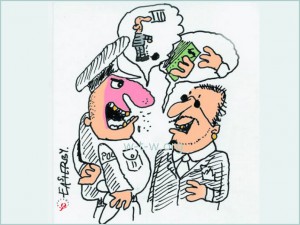
Derek Easterby www.w-t-w.org/en/cartoon/derek-easterby @Ybretsae
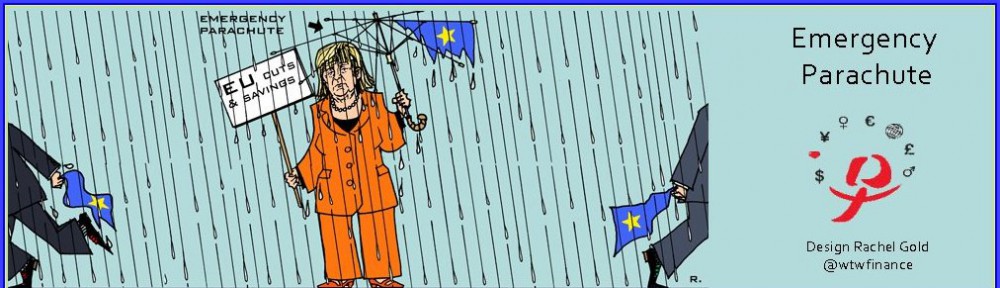
Derek Easterby

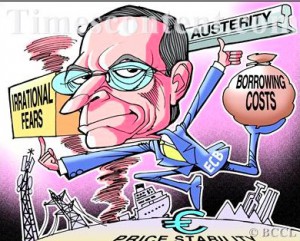
Draghi’s Stimulus Measures

The European Central Bank is all but certain Thursday to cut interest rates to try to boost ultra-low inflation and strengthen the wobbly recovery in the 18 countries that use the euro.

The ECB has been under pressure to act, especially after a report this week showed that inflation in the eurozone dropped more than expected last month to 0.5 percent – further evidence of a slack economy.  Excessively low inflation, if it persists, could become a serious economic threat. It could cause businesses and individuals to delay spending indefinitely as they await ever-lower prices. It could also make it harder for companies and countries to pare their heavy debt loads left over from the eurozone’s financial crisis.
The ECB maintains a target inflation rate for the eurozone of just below 2 percent. Fears have arisen that the continent’s excessively low inflation could slip into deflation – an outright fall in prices. Deflation can stall an economy, as it did in Japan for much of the past two decades.

Waning energy prices and a strong euro, which has reduced prices of imports, have been blamed for much of the fall in inflation. In countries such as Greece, whose government has held back government spending and state salaries in return for bailout loans from other countries, falling prices have been a consequence of official policies.

Perhaps the biggest help from rate cuts would be holding down the euro’s exchange rate against the dollar. Lower rates reduce investor returns, and thus can reduce demand for investments in a particular currency. Draghi’s statement May 8 that the bank was “not resigned” to the current low inflation and was “comfortable” taking action in June made markets think a rate cut was a sure thing – and sent the euro down from 2 { year highs around $1.40 to around $1.36.
In fact, markets have gone so far they may have set themselves up for disappointment.

Many economists have said pumping large amounts of newly created money into the financial system through large-scale bond purchases is the best way to reflate the economy. After all, that is what the U.S. Federal Reserve and the Bank of England did.
However, it’s considered the least likely. The measure faces legal, political and practical obstacles in an 18-country currency union. For one, buying government bonds raises the question of whose bonds to buy. A massive bond market intervention could lower borrowing costs – but most companies in Europe get credit from banks, not bond sales.

Draghi

Piketty Leads the Discussion Charge

Brandon DeLong, inspired by Lawrence Summers’ review of ‘Capitalism”, takes off on one area that has been much discussed.

“There is plenty to criticize in existing corporate-governance arrangements,” Summers writes. “I think, however, that those like Piketty who dismiss the idea that productivity has anything to do with compensation should be given a little pause.” Why? “The executives who make the most money are not…running public companies” and “pack[ing] their boards with friends,” says Summers. Instead, they are “chosen by private equity firms to run the companies they control. This is not in any way to ethically justify inordinate compensation – only to raise a question about the economic forces that generate it.”  Most will agree that some inequality is good and fair and even inspiring.

Private Equity Rewards

Why Women Don’t Succeed in High Tech?

The consequences of a dearth of women in technology are showing up again, this time in a show of sexism at a tech conference in Berlin.

Atlassian, the company behind software products Jira, Confluence, HipChat and more, is holding its #AtlasCamp for developers, and a developer there took the stage to present.

Jonathan] Doklovic was making a presentation called, ‘A P2 Plugin and a SaaS Platform Walk into a Bar …’ In the presentation, he threw up a slide about Maven, a plugin execution framework supported by Atlassian that developers can use to add software components to their existing applications.
“In the slide, Doklovic compared Maven to his girlfriend, saying that although she looks beautiful she ‘complains a lot, demands my attention, interrupts me when I’m working’ and ‘doesn’t play well with my other friends.’ ”

The consequences of a dearth of women in technology are showing up again, this time in a show of sexism at a tech conference in Berlin. (See update at end of post.)

Atlassian, the company behind software products Jira, Confluence, HipChat and more, is holding its #AtlasCamp for developers, and a developer there took the stage to present. Business Insider details what went down:

“[Jonathan] Doklovic was making a presentation called, ‘A P2 Plugin and a SaaS Platform Walk into a Bar …’ In the presentation, he threw up a slide about Maven, a plugin execution framework supported by Atlassian that developers can use to add software components to their existing applications.
“In the slide, Doklovic compared Maven to his girlfriend, saying that although she looks beautiful she ‘complains a lot, demands my attention, interrupts me when I’m working’ and ‘doesn’t play well with my other friends.’ ”

The slide stirred up the latest tempest of disgust on both sides of the Atlantic Ocean.

Atlassian, the company behind the AtlasCamp and the employer of the developer who put up the controversial slide, has put up a lengthy blog post apologizing for the incident on stage. An excerpt:

“We are sorry for having allowed this offensive slide into an AtlasCamp presentation. The content does not reflect our company values – nor our personal values as co-founders and individuals. Quite simply, it’s not OK.  Sexism is a difficult issue for the tech industry, and today we didn’t make it any better.”

Atlassian, the company behind the AtlasCamp and the employer of the developer who put up the controversial slide, has put up a lengthy blog post apologizing for the incident on stage. An excerpt:

“We are sorry for having allowed this offensive slide into an AtlasCamp presentation. The content does not reflect our company values – nor our personal values as co-founders and individuals. Quite simply, it’s not OK.
Sexism is a difficult issue for the tech industry, and today we didn’t make it any better.

We are going through all the events that allowed this slide to reach the public. We’ve already started immediate action. Where our organisation and process were lacking, we will add oversight. Where our culture is at fault, we will change that culture.”

What are Women Like in High Tech?

SEC Awards $875,000 to Two Whistleblowers

The Securities and Exchange Commission announced a Whistleblower Award of $875,000 to be divided equally between two individuals who provided tips and assistance to the agency in bringing enforcement actions.

W-T-W.org encourages individuals to step forward when they see corruption.  In the US, since 2011 when the Dodd-Frank Act authorized the program.  A total of 8 people have received awards so far.  If you see something, say something.

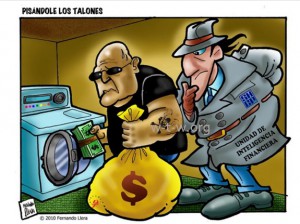
Artist Fernando Lllera

Artist Fernando Lllera

ILO: World Social Protection Report 2014-15

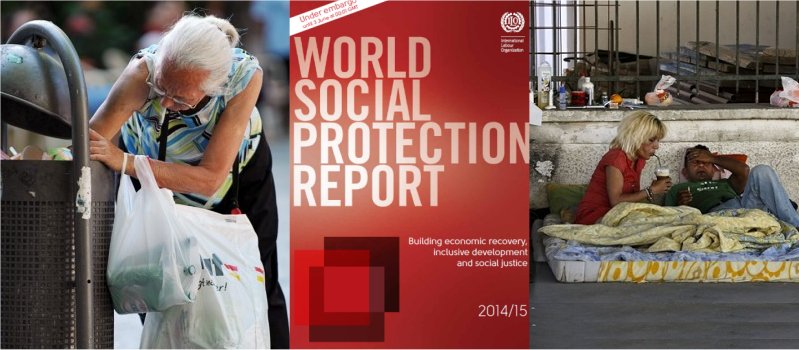
The International Labor Organization ILO has voiced its concern about the impact of austerity on social protection, saying that measures aimed at offsetting the effects of the crisis have will have long-term detrimental effects on the bloc’s economies.

In its 357-page World Social Protection report published on Tuesday, the Geneva-based UN offshoot warned that “together with persistent unemployment, lower wages and higher taxes, these measures have contributed to increases in poverty and social exclusion, now affecting 123 million people in the European Union, 24 percent of the population, many of them children, women, older persons and persons with disabilities.”..
ILO report warns of austerity ‘inflicting intense human suffering
World Social Protection Report 2014-15

World Social Protection Report 2014-15Corruption-reports


How Strong is Spain’s Recovery?

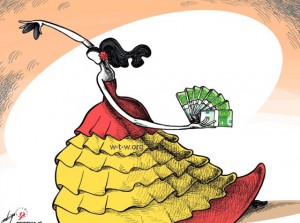
Helga Jung comments on the issues:  After fighting for its life for the last two years, Spain’s economy finally seems to have moved out of intensive care. The banking sector has been deemed “cured”; demand for Spanish bonds has soared; and the country can once again raise capital at reasonable interest rates on the market. But much more work must be done to ensure a stable long-term recovery.

Investor confidence is up but so is long-term and youth unemployment.  Relapse into reform fatigue would be disastrous.

Corruption in Spain