ICIJ Secret Files Expose Offshore’s Global Impact
Government officials and their families and associates in Azerbaijan, Russia, Canada, Pakistan, the Philippines, Thailand, Canada, Mongolia and other countries have embraced the use of covert companies and bank accounts.
The mega-rich use complex offshore structures to own mansions, yachts, art master-pieces and other assets, gaining tax advantages and anonymity not available to average people.
Many of the world’s top’s banks – including UBS, Clariden and Deutsche Bank – have aggressively worked to provide their customers with secrecy-cloaked companies in the British Virgin Islands and other offshore hideaways.
A well-paid industry of accountants, middlemen and other operatives has helped offshore patrons shroud their identities and business interests, providing shelter in many cases to money laundering or other misconduct.
Ponzi schemers and other large-scale fraudsters routinely use offshore havens to pull off their shell games and move their ill-gotten gains…ICIF_Nominee_Trick_25.11.12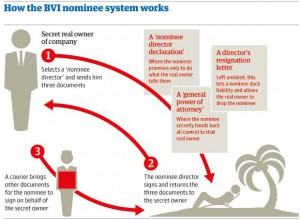 ICIJ – How the nominee trick works
A nominee director is per se not illegal and can sometimes be useful, for example in preparing “off-the-shelf” ready-made companies.
But the legal conjuring trick behind the nominee systems opens the way to abuses such as using a “shell” companies for tax evasion, fraud, money laundering and other crimes.
For the trick with nominee directors to work depends on three pieces of paper:
- A promise by a nominee director only to do what the real owner tells them.
- Under a “general power of attorney” the nominee secretly hands back all control to that real owner.
- The third commonly-used document is a signed, but undated director’s resignation letter.
A nominee director is someone who is renting his or her name to hide the beneficial owner by taking the position on paper of the company’s directors. The term of straw man or front man has been used to describe someone who is acting as the nominee. Legally, according to the incorporation documents, the nominee is responsible for the company or entity. In addition, if it is the case of a nominee that is also listed as the nominee shareholder, then they in effect also have the related ownership responsibilities as well.
The basic function of the nominee director is to shield working executives of limited and other companies from the public disclosure requirements. It is designed to help a person who would rather not disclose their interest or association with a given corporate body. Anyone performing a company search on a company with a nominee director would be unable to discover in whose name the nominee director was registered.






 Is the $150,000 a year Matthew Taylor just a small fish you can easily fry? What else goes on at Goldman Sachs?