Global Cooperation Honored

Smoothing the Road to Globalization

Three vacationing Americans from Sacramento, one who had just completed a tour of duty in Afghanistan,  and a British business man instantly stepped up on a high speed train from Brussels to Paris when an armed man started shooting.  Within 48 hours these men had been awarded the French Legion of Honor award by France’s President Hollande.

In a world which is rapidly moving toward ‘one,’ this kind of action, without a thought to either the nationality of the helper or the nationality of who is being helped, is just what we need.

This website supports globalization in all its many forms.

Legion of Honor


How Financial Corruption Impacts Foreign Policy

Eva Fedderly writes: Sarah Chayes has become a key player in the attempt to bring about a sea change in US foreign policy by showing how what some see as an innocuous crime – corruption – is actually a serious threat to international security. She has seen it at work not only in Afghanistan but in other places with violent insurgencies, such as Syria, Nigeria, and Iraq.

Within the past two years, Chayes has influenced a paradigm shift in US foreign policy, Nathaniel Heller, cofounder of Global Integrity, an independent, nonprofit organization tracking governance and corruption trends around the world, told the Monitor. “She singlehandedly got a crucial dialogue going at the highest levels of government on corruption…. She opened up a space in politics for dialogue and debate regarding corruption as a serious threat to international security.”

According to several diplomats, Chayes also has affected the diplomatic rules of engagement.

Sarah Chayes


Nobel Prize Winner Yousafzai Gets As in School

Education for All:

Malala Yousafzai, the teen who was shot by the Taliban for advocating for girls’ education, will be celebrating a string of academic successes this week.

On Friday, Ms. Yousafzai’s father took to Twitter to announce that his award winning daughter had received excellent scores on her GCSEs, an important exam taken by all British teenagers. The 18-year-old who once dodged bullets in Pakistan to attend school, can now boast of a string of As, placing her within the top tier of students who took the exam.

Yousafzai has dedicated her young life to promoting the importance of girls’ education. Her story first garnered public recognition through her anonymous diary, which was published on the BBC’s Urdu website in 2009. In her diary Yousafzai described her desire for girls in Pakistan to have access to an education. At the time, many girls’ schools were being destroyed by militants in the Swat Valley where she is from..

After she was shot by the Taliban in 2012 in retaliation for her advocacy, Yousafzai was rushed to the United Kingdom for medical treatment. Following her recovery she and her family resettled in Birmingham, England, where Yousafzai now lives and studies in a private girls’ school. Her recovery, however, did cause some delays in her education, and Yousafzai took the GSCEs two years later than most British school children.

While catching up with her studies, she continued to campaign for girls’ education. That work earned her the Nobel Peace Prize in 2014.

“For her 18th birthday on July 12, 2015, also called Malala Day, the young activist continued to take action to make global education a worldwide priority. Instead of presents, Yousafzai asked her supporters on The Malala Fund website: ‘Post a photo of yourself holding up your favorite book and share why YOU choose #BooksNotBullets – and tell world leaders to fund the real weapon for change, education!’” Yousafzai’s biography reads.

But despite her international celebrity status, Yousafzai has consistently prioritized her education.   Inundated with invitations, she eventually began to refrain from attending a variety of events in order to focus on her schoolwork.

On Friday, people in Pakistan celebrated the test results of their local star.

“Nothing that Malala Yousafzai achieves seems startling any more but she continues to make Pakistan proud,” the Express Tribune reported.  

Note: The Nobel Peace Prize for 2014 is to be awarded to Kailash Satyarthi and Malala Yousafzay for their struggle against the suppression of children and young people and for the right of all children to education. Children must go to school and not be financially exploited. In the poor countries of the world, 60% of the present population is under 25 years of age. It is a prerequisite for peaceful global development that the rights of children and young people be respected. In conflict-ridden areas in particular, the violation of children leads to the continuation of violence from generation to generation.

Education First

Sanctions Toughened: France Cancels Sale of Warship to Russia

As France faces a financial hit for suspending its much-maligned sale of a Mistral warship to Russia, some observers have a suggestion to mitigate the pain: Let the European Union buy it.

“I would have liked to see the EU buy that warship instead of it going in some freezer compartment,” says Amanda Paul, an analyst at the European Policy Center in Brussels, even as she acknowledged it would be an unlikely move. “It would have been nicer to see the EU take that step, when they are supposed to be strengthening their foreign and defense policy.”

Such a move, she says, would have ensured the deal remains a done one. Otherwise, she says, “I’m sure at some point the Russians will get their hands on it.” !

The transaction, she notes, could have accomplished two goals with one move – at least for those who want to see the EU bolster its defense capabilities. That issue is front and center at the NATO summit in Wales, where both the amount and nature of NATO member spending are under intense debate.

French officials announced Wednesday that France would not deliver the Mistral-class ship, part of a $1.7 billion weapons deal, saying that the conditions “aren’t right,” despite a possible cease-fire in Ukraine. The statement left ambiguous whether the deal could move forward in the future and under what circumstances.

France was under intense pressure to scrap the deal, even though at home, many decried the loss of jobs and the hit the economy would take.

“It was simply extremely difficult to defend morally the contract,” says Paul Ivan, an expert on European sanctions also at the European Policy Center. And France had been facing the glare of other countries who have taken a bigger hit from EU sanctions imposed on Russia, and Russia’s subsequent retaliation.

In other words, this evens the score, as much as one can when it comes to comparing bilateral trade relationships.

France’s decision also sends an important message before the EU is expected to make a new announcement about toughening sanctions on Russia tomorrow.

There are still deep divides across Europe about how to punish Russia, and who stands to lose what. But with the Mistral deal out of the way – for now – it takes one more blemish off the record.

“No other country had such a big defense contract,” says Vivien Pertusot, head of the Brussels office of the French Institute of International Relations.  ”It was not small stuff. It was very, very visible, and very big.”

Mistral Warship

China’s Ying and Yang

The Rocky Road to Globalization

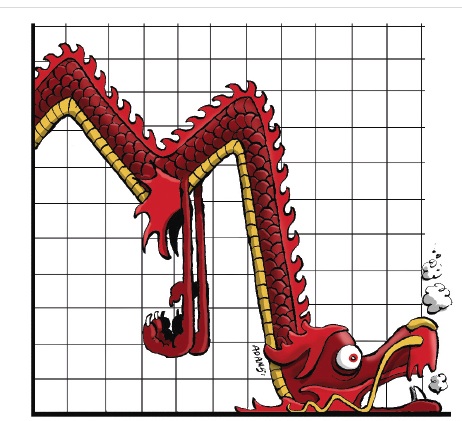
RIchard Haas writes:   Is China is best understood as a strong country, with a promising future despite some short-term difficulties, or as a country facing serious structural problems and uncertain long-term prospects. Two very different Chinas can now be glimpsed. But which one will prevail?

The question of China’s future has become unavoidable. Officially, economic growth has slowed to near 7%; but many believe the real number is below 5%. The slowdown should come as no surprise; all developing economies experience something similar as they grow and mature. Nonetheless, the speed and degree of change have caught the authorities off guard, and have stoked official fears that growth will fall short of the rate needed for the country to modernize as planned.

The government’s alarm at the sharper-than-expected economic slowdown was reflected in the freezing of stock markets in the midst of a dramatic price correction. That move was followed by a surprise devaluation of the renminbi, which suggests that the shift away from export-led growth is not working as hoped.

Corruption is pervasive, and Xi’s campaign remains broadly popular. But the wave of prosecutions that Xi has unleashed is discouraging Chinese officials from making decisions, owing to their fear that they could face criminal charges in the future.

Aside from slowing growth, there is severe environmental damage, one result of decades of rapid, coal-fueled industrialization. Air pollution may be killing 1.6 million Chinese per year.

China’s aging population, an unintended consequence of its draconian one-child policy, poses another threat to long-term prosperity. With the dependency ratio – the proportion of children and pensioners relative to working-age men and women – set to rise rapidly in the coming years, economic growth will remain subdued, while health-care and pension costs will increasingly strain government budgets.

What is increasingly apparent is that China’s leaders want the economic growth that capitalism produces, but without the downturns that come with it. They want the innovation that an open society generates, but without the intellectual freedom that defines it. Something has to give.

A slow-growth China would undermine the global economic recovery. It would be a less-willing partner in tackling global challenges such as climate change. Most dangerous of all, a struggling China could be tempted to turn to foreign adventurism to placate a public frustrated by slower economic growth and an absence of political freedom. Indeed, there are some signs that the authorities are doing just this in the South China Sea. Nationalism could become the primary source of legitimacy for a ruling party that can no longer point to a rapidly rising standard of living.

The US and others will need to push back to ensure that China does not act on such a temptation. But these countries would be equally wise to signal to China that it is welcome to take its place among the world’s leading countries if it acts responsibly and according to the rules set for all.

But the bigger policy choices will be China’s to make. The government will need to find the right balance between government interests and individual rights, between economic growth and environmental stewardship, and between the role of markets and that of the state.

China's Slowdown

Train to Treasure?

A city in south-western Poland is in a state of high suspense following claims made by two men that they have found a Nazi train packed with gold. Local authorities in Wałbrzych said they were investigating the reports, as fortune hunters from around Europe were making their way to the town in the hope of enjoying some of the potential spoils – or at least witnessing the discovery of what could yet turn out to be a spectacular historical find.

The men, reported to be a German and a Pole, have appointed a lawyer to negotiate with the authorities for a 10% finder’s fee for the train and its contents. Local news site Wiadomości Wałbrzyskie said the train contained up to 300 tonnes of gold, as well as a batch of diamonds, other gems and industrial equipment. The men said only once they have secured their fee in writing will they reveal the whereabouts of the train.

“This is a find of world significance, on a par with [discovering] the Titanic,” said Jarosław Chmielewski, the lawyer who has written to the parish council on the men’s behalf, to Radio Wroclaw.

Amber room treasures aboard?

Doing Well by Doing Good: Corporate Governance

Lucy P. Marcus writes:  Around the world, the corporate governance landscape is shifting, as efforts to improve business practices and policies gain support and momentum. The wave of reform has become visible everywhere – from tough new regulations in Japan to sovereign wealth funds like Norway’s Norges Bank Investment Management taking a more active approach to their investments – and it is certain to continue to rise.

Three factors are driving these developments. First, today’s deep economic uncertainty has broadened ordinary people’s awareness of the influence that companies have on politics, policy, and their own daily lives.

Second, there has been a burgeoning awareness among governments that economic growth requires a proactive regulatory approach.

In Japan, the Financial Services Agency enacted a Stewardship Code in 2014, with a Corporate Governance Code from the Tokyo Stock Exchange entering into force this June. By creating a more equal environment among shareholders, ensuring more disclosure and transparency, specifying the responsibilities of company boards, and requiring outside independent directors on company boards, the codes enshrine changes that make Japan more attractive for foreign investors.

In the United States, the Securities and Exchange Commission enacted a rule at the beginning of August requiring public companies to disclose the pay gap between workers and CEOs. Corporate behavior and governance has emerged as a campaign issue for US presidential candidates.

The European Union and its member states are also taking an increasingly active approach to corporate governance, including regulations concerning boardroom diversity. Italy, France, Spain, Norway, and others have all enacted boardroom gender quotas, with companies required to fill 30-40% of independent board seats with women.

The third, and perhaps most important, factor underpinning recent changes in corporate governance has been the sharp rise in cross-border investing. Sovereign wealth funds, pension funds, global investment banks, and hedge funds do not invest only in their own backyard. They scour the planet looking for places to put their money, and they expect companies that receive it to play by rational rules.

International investors are in a unique position to encourage, or even enforce, global best practices in corporate governance. If such investors show that they are willing to withdraw financing, they will gain real influence in bringing about sustainable change – to the benefit of us all.

Global funds that uphold high ethical standards concerning labor practices and environmental protections are safeguarding the global ecosystem on which they, and the rest of us, depend.

CalPERS (the California Public Employees’ Retirement System), a $300 billion pension fund, has published its corporate governance principles, which include boardroom diversity, fair labor practices, and environmental protection. Norges Bank Investment Management, Norway’s $870 billion sovereign wealth fund (the largest in the world), has also pushed for changing governance rules, including separating the role of chief executive and chairman and better reporting by companies on how they are addressing climate change.

The shift in emphasis on best-practice corporate governance is real, and it is here to stay.

New Leadership Styles

Are Growth Objectives Hurting China?

Gene Frieda writes:  China’s economy is increasingly two-tracked: a new track based on services and consumption burdened by an old, slower track made up of industries like steel and mining, which are inefficient and suffer from excess capacity. Straddling both tracks is the country’s real-estate market, which is characterized by massive overcapacity in mid-size and smaller cities and robust demand in large cities.

The problem is compounded by the Chinese leadership’s insistence on sticking with high growth targets – 7% at present – and the resulting reliance on credit to produce the requisite output.

The meteoric rise and subsequent crash in the country’s stock market has left investors badly rattled. But the real wake-up call has been the belated effort to sort out local government borrowing and misspending.

In November 2013, President Xi Jinping laid out a reform agenda that sought to increase the role of the market in China’s economy.

In early 2015, the central government announced plans to convert the local governments’ short-term, high-interest bank loans into long-term bonds. By increasing the maturity of the debt, the central government hoped to alleviate financing constraints on local governments and allow them to pursue financial stimulus.

When China’s banks balked at accepting the low yields offered on the new bonds, the goal of increasing the market’s role in the economy went out the window. The government forced banks to execute the debt swap. Unsurprisingly, banks suddenly became risk-averse. Local governments discovered that even with an improved liquidity position, banks were reluctant to extend new loans.

Meanwhile a slump in the real-estate market deprived local governments of their main revenue source: land sales.

China appears to be falling into a trap that it assiduously sought to avoid. The country’s debt problem looks set to worsen as the government neglects its reforms in favor of short-term growth objectives.

The government has sought to increase liquidity by dropping controls on the movement of capital. Doing so not only further undermines its control of the economy; it also creates the risk of a full-blown financial crisis that could engulf its neighbors and other emerging markets.

China’s property market is deflating. Its equity markets have been discredited. And its economy seems increasingly sluggish. As a result, the country’s vast pool of domestic savings is increasingly looking to move abroad. Relative to the size of China’s foreign debt and the sheer volume of money that could go abroad, even its $3.7 trillion in foreign reserves starts to look puny.

Like termites, debt has a unique capacity to make short work of an economy’s foundations. By the time the infestation is recognized, it is often too late. If China is to reverse the damage, it will need to focus on debt deleveraging, repair its capital allocation mechanism, and delay the abolition of capital controls.

China's Debt Problem

Population Decline a Plus?

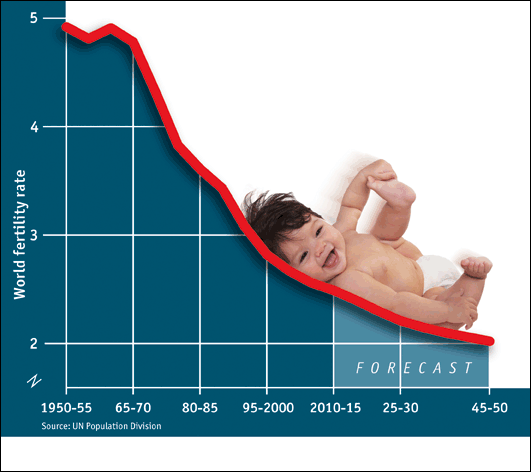
Adair Turner writes:  The United Nations’ latest population projections suggest that Japan’s population could fall from 127 million today to 83 million by 2100, with 35% of the population then over 65 years old. Europe and other developed economies are aging as well, owing to low fertility rates and increasing longevity.  Population aging in advanced economies is the manageable consequence of positive developments. By contrast, rapid population growth in many poorer countries still poses a severe threat to human welfare.

In 2008, the UN projected the world’s population reaching 9.1 billion by 2050 and peaking at about ten billion by 2100. It now anticipates a population of 9.7 billion in 2050, and 11.2 billion – and still rising – by 2100, because fertility rates in several countries have fallen more slowly than expected (in some, notably Egypt and Algeria, fertility has actually risen since 2005). While the combined population of East and Southeast Asia, the Americas, and Europe is projected to rise just 12% by 2050 and then start falling, sub-Saharan Africa’s population could rise from 960 million today to 2.1 billion by 2050 and almost four billion by 2100. North Africa’s population will likely double from today’s 220 million.
Such rapid population growth, on top of even faster increases over the last 50 years, is a major barrier to economic development. From 1950 to 2050, Uganda’s population will have increased 20-fold, and Niger’s 30-fold. Neither the industrializing countries of the nineteenth century nor the successful Asian catch-up economies of the late twentieth century ever experienced anything close to such rates of population growth.

Ensuring that women are educated and free is by far the most important demographic challenge facing the world today. Worrying about the coming population decline in advanced countries is a meaningless diversion.   The Positive Aspects of Population Decline

birth-rate

How Bad is Unemployment in China?

According to official statistics, China’s unemployment rate has remained at an exceptionally steady 4.0-4.3% since 2002, despite massive change in the economy over that period. A new National Bureau of Economic Research paper analyzing national household survey data from 1988-2009 suggests that the official index may have significantly underestimated the actual urban unemployment rate.  

From the abstract:  The rate averaged 3.9% in 1988-1995, when the labor market was highly regulated and dominated by state-owned enterprises, but rose sharply during the period of mass layoff from 1995- 2002, reaching an average of 10.9% in the subperiod from 2002 to 2009.

The survey does not cover more recent data, so their research does not show whether the labor market has deteriorated as the Chinese economy has slowed. But their figures do point to the large, lasting impact of the mass closures of bankrupt state-owned companies in the 1990s. The unemployment rate was just 3.9% from 1988-95 and then climbed steadily upwards. State firms had played the biggest role in China’s north-east and so their closures dealt the region a particularly heavy blow, with its unemployment rate averaging 12.5% from 2002-9.

Just how worrying are these findings? The data comes from the urban household survey, which is conducted by the National Bureau of Statistics.  Their unemployment index is more volatile than the registered jobless rate, making for a closer fit to the ebb and flow of economic cycles in China.

But if the official rock-steady 4.1% jobless rate is trusted by no one, the conclusion that China suffers from chronic unemployment of more than 10% is also worthy of a large dose of skepticism. As the authors readily admit, there is a major gap in their data. The survey only covers people who hold local hukou, or residency permits, and therefore excludes the tens of millions of migrants who stream to cities for work every year. In Shanghai, for example, some 14m residents hold local hukou, but another 10m people live and work in the city on a permanent basis. The latter are outside the remit of the urban household survey.

There is also good reason to think that the 10.9% unemployment rate exaggerates the problem.

The dataset doesn’t reflect rural migrant workers, even though they have been a huge source of urban labor in the last decade, making up as much as half of China’s urban workforce today.  That could mean that the actual unemployment rate is lower.   On the other hand, nearly 60% of rural migrant workers work in construction and manufacturing (link in Chinese). Given China’s slowing economy and sluggish export demand, they might soon be pushing the true unemployment rate up. 

Reporting on the new unemployment index for CBS Moneywatch, Robert Hanley notes that China’s economic slowdown has been apparent in the rising instances of labor unrest in recent years:

"Maybe unemployment is worse than I thought"

“Maybe unemployment is worse than I thought