China Begs to Enter the World. And Does.

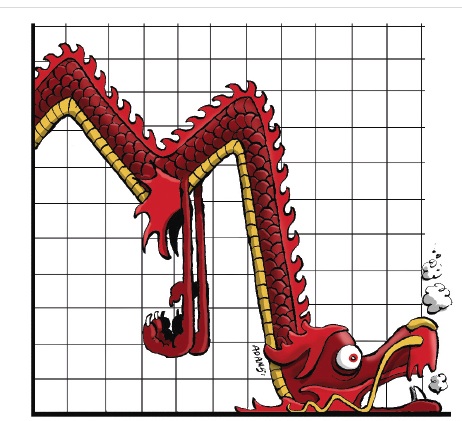
Bloomberg writes:  For years, China’s leaders have wanted the world to acknowledge their economy’s leading role in the global system. This week they got their wish. Sadly, the circumstances weren’t ideal.

The crash in global stock markets began with gloom about China’s prospects and muddle over what the authorities in Beijing intend. Global markets may be calming down, but the confusion hasn’t gone away. The Chinese government and its critics all need to think a bit more clearly about what is going on.

In the past few days, China has been a whipping boy for everyone from Japan’s finance minister to U.S. Republican presidential hopefuls.  Its central bank is accused of waging a currency war with its devaluation of the yuan two weeks ago. Before that, critics chided Chinese authorities for perpetuating a stock-market bubble by intervening extensively in equities; this week’s sell-off accelerated when the government declined to prop them up.

The world doesn’t seem quite sure what it wants from China’s leaders. Critics scold Beijing for boosting stocks, then panic when they don’t. They insist market forces be allowed to set the yuan, then howl when those forces push it down. They tell China to accept slower growth as the price of rebalancing its economy, then clamor then for stimulus when the economy slows.

To be sure, there’s confusion in Beijing as well. Leaders have promised to shift the economy onto a more sustainable growth path that’s based less on exports and more on services and domestic demand. But they’ve held to an unreasonably high growth target.

There’s an underlying tension in that mix: The leadership is sincere about its desire for markets to allocate capital more efficiently, yet mostly in order to preserve the power and position of the Communist Party. Party needs come first.

Beijing’s reluctance to surrender more fully to market discipline is understandable given the daunting list of challenges leaders face. But they’re only storing up problems for the future.

The government is paying the price now for having artificially boosted stocks earlier. The central bank is thought to be spending an estimated $40 billion a month to keep the yuan from falling further and prevent capital flight. Authorities are reportedly considering raising an additional $161 billion in bonds to fund new infrastructure projects. Some of these may make good sense, but the fact that Beijing is directing the program raises doubts..

More forthrightness now would buy China goodwill from markets when the government really does need to intervene — as the U.S., Japan and the European Union have all repeatedly judged to be necessary. Chinese leaders should remember that the currency that matters most is their credibility.


China enters the world


China Bites Apple?

Apple chief executive Tim Cook halted a 13pc drop in the tech giant’s stock on Monday after taking the unusual step of emailing a media organization to reassure investors about the business’s Chinese operation.

With Chinese stocks plunging close to 9 %, Apple shares slumped as much as 13 % to a year-low of $92 amid a sell-off in the broader US market.

Mr Cook took the rare step of commenting on the health of Apple’s business midway through a financial quarter.  He wrote to CNBC to reveal that iPhone activations in China had accelerated over the past few weeks.

He also said the App Store in China had its best performance of the year over the past fortnight.

“Obviously I can’t predict the future, but our performance so far this quarter is reassuring. Additionally, I continue to believe China represents an unprecedented opportunity over the long term,” Mr Cook wrote.

Apple’s shares then reversed its losses to trade up 2.25pc at $108.12, adding around $85 billion to Apple’s market capitalization from its earlier low.

Chinese consumers are critical to fueling demand for iPhones, and a slump in the country’s stock market and Beijing’s recent devaluation of the yuan have shaken Apple investors already worried about slowing growth in the world’s second largest economy.

Apple’s success over the past decade has made it a top holding for many portfolios and it accounts for 3.5pc of the S&P 500, indirectly affecting millions of investors saving for their retirements through passively invested index funds.

Many on Wall Street remained cautious about risks Apple faces in China’s potentially stumbling economy. After Monday’s rebound, Apple’s stock was still down about 19pc from its record high close set in February.

China’s smartphone market is widely believed to be close to saturation with fewer first-time buyers, although Apple has continued to gain market share there.

China Bites Apple?

Can We Afford Massive Immigration?

The Rocky Road to Globalization

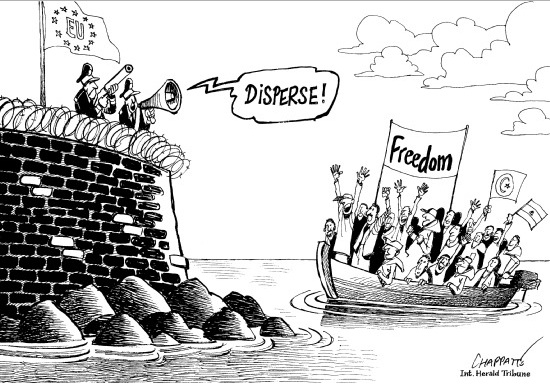
Throughout the world, desirable advanced economies who provide services to their citizens are being hammered by waves of immigrants from less developed and supporting economies.  Germany’s Chancellor Merkel says that we must welcome these people who are endangered in their home countries.   In the US whether or not to welcome immigrants and embrace people who have come to this country without going through the required legal channels is one of the prime these of the 2016 Presidential debate.

Ian Traynor writes:  Thousands of refugees were heading towards Hungary and the EU border as the German chancellor, Angela Merkel, said the union’s member states must fairly share the burden of dealing with Europe’s biggest migration crisis since the second world war.

Merkel said Europe needed to act together to deal with the chaotic scenes in Greece and the western Balkans as desperate migrants tried to reach the EU. “The current situation troubles us greatly,” she said.

Germany and France are to draft common proposals on immigration and security to deal with the worsening emergency. On Monday, Merkel said they could include building new registration centres in Greece and Italy to be run and staffed by the EU as a whole by the end of the year.

She said: “Time is running out. EU member states must share costs relating to this action.”

The two leaders also said that the EU must draw up a unified list of safe countries of origin. Asylum seekers arriving from these countries should be swiftly returned.

Berlin is increasingly determined to push a new system of mandatory quotas for refugees across the EU despite the issue being rejected by EU leaders.  Many immigrants spend three days on Greece’s northern border after Macedonia refused to allow them to enter.

At the Serbian border crossing of Miratovac, refugees walked three miles to a reception centre in the southern town of Preševo. Most carried their belongings in rucksacks and men carried small children on their shoulders. In Preševo, they received medical aid, food and papers legalising their transit through the country.

Germany is warning of reintroducing national border controls unless other countries step up to the plate and share the refugee burden more equitably. Proposals from Brussels in May to introduce mandatory refugee quotas across the EU on a small initial scale were rejected by Spain and most of eastern Europe. At their June summit, leaders debated until 3.30am and agreed nothing.

Since then, the number of migrants entering Greece, Italy and the Balkans has soared, with Germany predicting the arrival of 800,000 asylum seekers this year and the figures for the EU projected to triple compared with 2014.

Immigration

Money in US Politics

Lisa Rein writes: The world’s largest defense contractor has agreed to pay $4.7 million to settle charges that it illegally used government money to lobby top federal officials to extend its contract to run one of the country’s premier nuclear weapons labs.

Over five years starting in 2009, top executives for Lockheed Martin — who were being paid by the federal government to run Sandia National Laboratories — ran a fierce campaign to lobby members of Congress and senior Obama administration officials for a seven-year extension of their contract, according to the settlement the Justice Department announced Friday.

Lockheed executives, who hired a former New Mexico congresswoman to help them, didn’t just press people with influence to re-hire them for a deal worth $2.4 billion a year. 

Mizer said the lab, a subsidiary of Lockheed, allegedly used federal money to lobby Congress and other federal officials from 2008 and 2012, “to receive a non-competitive extension” of its contract in violation of federal law.

The case opened a window on the inner workings of power and influence in Washington. It’s not surprising that a big, politically connected defense contractor would lobby hard to keep a lucrative slice of federal business. But this case went further. It was taxpayers, not Lockheed’s corporate lobbying arm in Bethesda, Md., who paid for the influence peddling.

Excerpt from guidance that former New Mexico Republican Rep. Heather Wilson gave Lockheed Martin officials to ensure that the company’s contract to run a premier nuclear lab would be renewed. (Source: Energy Dept. Inspector General)

To clinch the contract extension, Sandia labs officials hired high-priced consultants — including a former congresswoman who was paid $226,000 — to write up a “contract extension strategy.” Among the tactics suggested by Heather A. Wilson (R-N.M.) were “working key influencers” by targeting then-Energy Secretary Steven Chu’s staff, and even his family, friends and former colleagues at another federal lab, all with the goal of keeping Lockheed Martin in charge of Sandia in Albuquerque.

Wilson was not just on Lockheed’s payroll. From 2009 through 2011, she had consulting jobs for Lockheed and three other contractors managing the Energy Department’s national lab, charging taxpayers a total of $450,000.

Wilson, who left Congress in 2009 after an unsuccessful run for the Senate, has publicly denied that she took part in any lobbing involving the Sandia contract. But Friedman at the time that she was “deeply, deeply involved” in Lockheed’s effort to renew its contract.

he world’s largest defense contractor has agreed to pay $4.7 million to settle charges that it illegally used government money to lobby top federal officials to extend its contract to run one of the country’s premier nuclear weapons labs.

Over five years starting in 2009, top executives for Lockheed Martin — who were being paid by the federal government to run Sandia National Laboratories — ran a fierce campaign to lobby members of Congress and senior Obama administration officials for a seven-year extension of their contract, according to the settlement the Justice Department announced Friday.

Congresswoman who was paid $226,000 — to write up a “contract extension strategy.” Among the tactics suggested by Heather A. Wilson (R-N.M.) were “working key influencers” by targeting then-Energy Secretary Steven Chu’s staff, and even his family, friends and former colleagues at another federal lab, all with the goal of keeping Lockheed Martin in charge of Sandia in Albuquerque.

Lobbyist

As Goes China, So Goes the World?

The Rocky Road to Globalization

European and most Asian financial markets rebounded strongly as China’s stocks continued to slide. The Shanghai Composite index dropped 7.6 percent, just a day after its biggest loss in eight years triggered worldwide market turmoil. Beijing’s central bank followed by cutting interest rates and banks’ reserve requirements in hopes of ending the mayhem that erased a combined $5 trillion from global equity markets on Monday.

Dow futures indicated a sharply higher open on Wall Street, with premarket trading showing an initial gain of around 600 points, one day after a roller-coaster session that included a 1000-point drop. Inside China, government censors appeared to crack down on editors at the state-run People’s Daily: A day after it referred to the rout as “China’s Black Monday,” the newspaper had no mention of the financial upheaval.

China's Markets

Celebrate Women?

Gina Glantz writes:  When is “celebrating” women not all that good for women?

Let’s face it. Something tagged exclusively for or about women is all too often a revenue generating strategy alongside a way to deflect criticism about the lack of attention to women and an opportunity for the powers-that-be to say, “look what we do for women.” Unfortunately, often, what they “do” is not much.

Politico’s opening news release about “Women Rule” said, “More so now than ever, women are driving the conversation in the political, business and advocacy arenas. . . . Women Rule is meant to recognize those women and share the innovative ways they are influencing some of the nation’s most important issues.” After waxing on about the influence of women, they then could only find 21 women they called “thinkers, doers and dreamers” as part of “The Politico 50,” which was made up of 81 individuals.

Food & Wine magazine touted its January “all-women’s issue” but could only find two women to feature among their 11 “best new chefs” in 2015.

CSIS featured Penny Pritzker and Samantha Power among others in their Smart Women/Smart Power series, but in 2014 they could only find one woman to speak at their premier forum titled, naturally, “Statesmen’s Forum.”

And what about TED? Despite great women appearing at TEDWomen, one can only find 33 out of 102 participants who appeared at this year’s main event. Maybe there should also be a TEDMen and the best of both should be featured at a TEDEverybody.

Design Dieter Huthmacher @wtwfinance

Design Dieter Huthmacher
@wtwfinance

Sharing Knowledge Good for Business

Sharing knowledge means that innovation spreads more quickly in clusters. A study of clusters conducted by the ETH in Zurich looked at clusters in the biotech and ICT sectors.

The study was conducted by Professor Georg von Krogh and doctoral student Nina Geilinger of the Federal Institute of Technology in Zurich (ETH), in collaboration with Canton Zurich’s Business and Economic Development Division of the Office for Economy and Labour. Von Krogh explained in aninterview on the ETH’s website that expertise from limited fields of knowledge was often insufficient to develop innovations. In this way clusters have an advantage.

Geilinger added that companies in Zurich’s biotech and ICT clusters would benefit from each other because they were prepared to swap knowledge. She said that many companies were aware that they could not survive in a vacuum. The exchange of ideas with universities is as important as it is with customers or competitors. Both are required in Zurich, which according to Geilinger is a key advantage of Canton Zurich’s “cluster eco-system”.

Von Krogh sees Zurich as the centre of the Swiss ICT industry. Here too, close proximity between companies and employees could speed up the innovation process.

Sharing Knowledge

How Does Concern About the Future Impact Economies?

David M. Smick writes:  Today the big thinkers are debating whether a growth strategy for Greece (if not the entire eurozone periphery) should entail further debt relief, this time from public creditors.  But here’s the thing: Are the smartest guys missing an even more important picture? The entire world’s public and private debt, depending on the means of measurement, now exceeds a whopping $180 trillion. What’s the significance of this massive debt? Is it sustainable? Is it one reason for the world’s subpar growth? Nobody knows. If a global deflation scenario unfolds, the level of the world’s real debt will grow to the point where massive rolling defaults could become a terrifying fact of life. In an aggressive inflation scenario, on the other hand, the debt’s value in real terms will shrink, but at a brutal cost to the livelihoods of working families if not to capitalism itself. The obvious solution is to control the growth of future debt while encouraging a global explosion in innovation and productivity growth. This is what the British did in dealing with their horrendous debt after the Napoleonic Wars.

In an environment of record-low global interest rates, in which a lot of economic activity has been moved forward, an explosion in innovation and higher productivity growth may be the only safe way eventually out of today’s low interest rate trap. But an explosion in innovation that leads to higher global growth entails the issue of human motivation. People have to believe the future will be better than the past. That’s not the case today. Yet in the period since the 2008 crisis, the smartest guys have consistently argued that money is the driver of human behavior.

In response to the crisis, for example, the world’s governments and central banks bet the farm on a giant money-driven rescue operation the size of which the world had never before seen. More than $17 trillion, or 25 percent of global GDP, went for stimulus, bailouts, and guarantees. The result: After an initial sugar rush of economic activity, global growth, trade, and cross-border financing since 2010 have all plummeted. Today’s slow-growth environment is helping spawn a geopolitical nightmare. It turns out the massive flood of money failed to drive human behavior, at least to a level expected by historic standards. The lesson here is that money is just a measuring tool. As Adam Davidson wrote in the New York Times, “What actually matters is what we make and do and feel and want.”

Stated in short: In achieving higher levels of economic growth, attitude matters. Record low interest rates and generous fiscal stimulus are meaningless if people have no confidence in the future. So where does this all end? The world faces a troubling nexus of unprecedented debt, record low interest rates, exploding central bank balance sheets, declining growth, worldwide asset prices that may or may not reflect true value because the policymakers have their thumbs pressing down on the scale, a global currency war against the dollar as dollar-denominated debt is approaching $15 trillion, all at a time when polls consistently show people believe their children’s future is in jeopardy. Does anybody know the end game to this bewildering scenario? Or should we get the smart guys on the line?   Confidence about the Future

Future?

Is Devaluation One-Off for China?

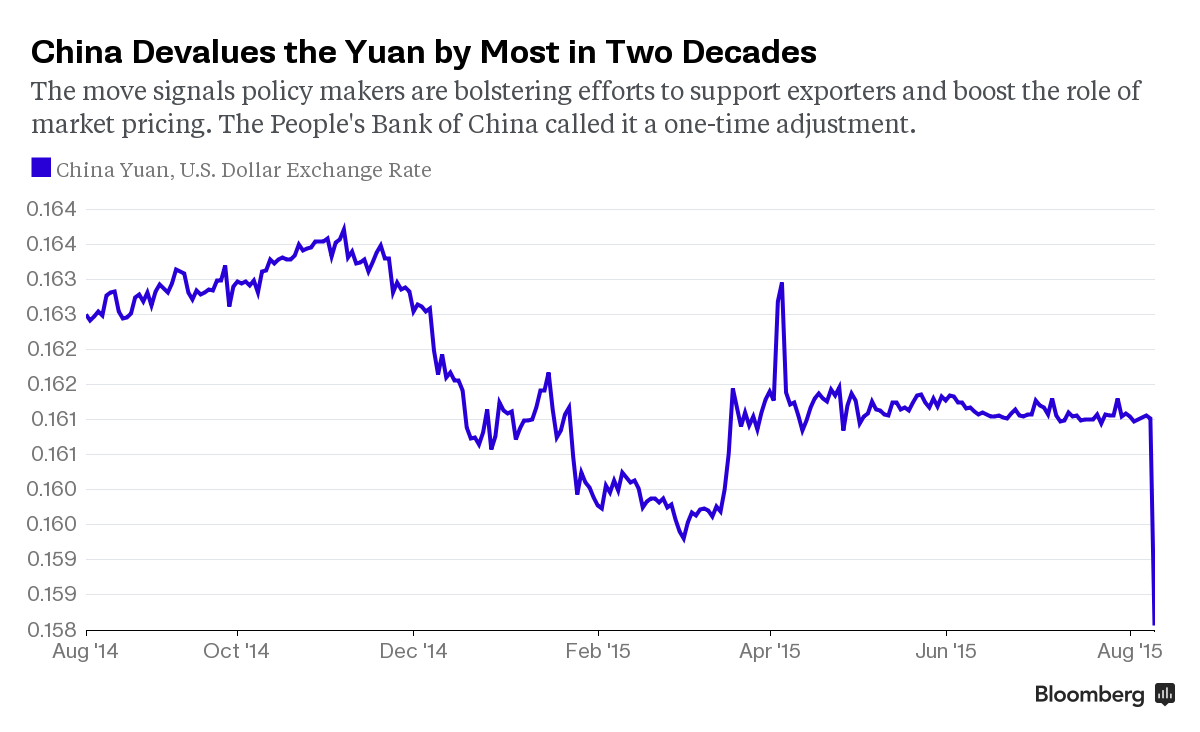
Yichio Wang writes: The People’s Bank of China (PBOC) has set its official guidance rate down by almost 3%, from 6.21 to 6.39 yuan per dollar, the lowest point in almost three years. Much of this was accomplished in one day with a decline of 1.9% (see chart below). It also changed the way it calculates the reference rate around which the yuan is allowed to trade in a two percentage point band. Last week, China’s currency dropped by a cumulative 4.4% against the U.S. dollar before recovering to trade very near the target.

This move has been explained by PBOC as a key reform that allows the currency’s value to be more responsive to market forces. China has been urging the IMF to include the yuan in the basket of the Special Drawing Rights (SDR), in order to boost international use of the yuan. As China is being accused of controlling its currency, this free-market reform can help China to have the yuan join the IMF reserve currency group.

The devaluation also suggests a growing worry about the growth after China’sexports tumbled 8.3 percent in July. A weaker currency can make Chinese exports cheaper and more competitive, while many other efforts to boost the economy seem useless.

Moreover, in order to keep the exchange rate stable, PBOC has to sell its dollar holdings to bolster the yuan’s value, which in turn offsets the effect of easing policies. As a result, China’s currency reserves have decreased $315 billion in the year to $3.65 trillion in July. Therefore, the currency devaluation could lower the cost of stabilizing the exchange rate and enhance the effect of monetary policies. One off for China?

Toxic Employees Poison Workplace

The daily life of the modern office worker is an ordeal with ever-changing trends. Sometimes workers are overstimulated to the point of burnout. At others they are understimulated to the point of boredom. Bookshelves are crowded with literature on employee psychopathology. But one phenomenon is often overlooked when people research the daily office life that takes place between the meetings and the water cooler: toxic workers who contaminate the workplace and make things a nightmare.

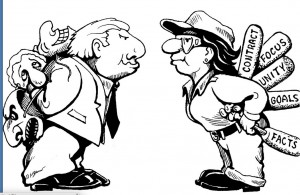
German psychologist Heidrun Schüler-Lubienetzki has now come up with a name for these types of people: “toxifiers.” For several years now, Schüler-Lubienetzki and her husband have been coaching office workers in a number of companies — employees ranging from average income workers right up to powerful executives. Soon the couple began noticing similar problems among their clients. Increasingly, similar types of people were being portrayed in their client’s stories; a type of person who utilizes all means in order to advance his or her career.

Schüler-Lubienetzki and her husband noticed a vast spread of this phenomenon, prompting them to publish a German-language book this year titled, “Difficult People in the Workplace.”

Based on her research, the psychologist assumes that five to 10 percent of all employees have a toxic nature. Women and men can be affected to the same degree. And anyone can turn into a victim — the colleague walking past in the hallway, the person in the meeting, even the boss.

The trouble with toxifiers is that they are difficult to detect. Often, toxifiers are even popular amongst colleagues, perceived as friendly and amiable. It’s only after a while that co-workers begin to notice that the toxifier is responsible for bullying an entire workplace. But it is possible to see signs.

“If a person starts to polarize — either by being extremely despised or being very loved by others — you could be dealing with a toxifier,” the authors say. Likewise, toxifiers can also often be unpredictable. One moment they can be charming and courteous, and the next they can swiftly switch into a mode of ruthless and inconsiderate behavior.

Often, they are sensitive people who are masters at the art of sniffing out the atmosphere around a team of co-workers and exploiting it. Every action — whether a performance review with a supervisor or a heart-to-heart talk with a co-worker — serves only one purpose: to execute both control and power. Toxifiers gather information in very calculating ways only to later ruthlessly exploit those insights. They deliberately bully and psychologically torture their colleagues. Indeed, the act of consciously harming others is part of the standard repertoire of the toxifier.

Surprisingly, the scheming colleague often remains undetected. Lubienetzki explains that toxifiers act in extremely skillful ways, often even establishing friendships with their victims. If they regard their supervisor as weakened, they often seek to gain control in the office through a kind of hostile takeover.

So what character traits can be found in a toxifier? He or she is not your occasional perpetrator who takes advantage of a situation only when opportunity knocks. Toxifiers act in premeditated, categorical ways with the sole goal of obtaining personal power and reaping its rewards: status, recognition, money and sometimes even sexual relations.

“Toxifiers are drawn to power like a moth to a flame,” Schüler-Lubienetzki says. This is what makes this type of person so successful and dangerous. Whenever arguments occur, the toxifier thrives. The subject matter of the dispute is unimportant because it is only the means to an end. Toxifiers enjoy it when conflicts escalate and they do not shy away from publicly humiliating their critics. Schüler-Lubienetzki describes a case in which a top manager threw his colleague’s mobile phone into the trash can because he got annoyed by the ringing. In truth, though, the episode had to do with power and submission.

Poor leadership provides the ideal breeding ground for toxifiers. If a supervisor shies away from conflict, it creates an open field in which the perpetrator can operate in scrupulous ways.

Schüler-Lubienetzki says that some fields are literally suffering from epidemics of toxifiers in the workplace. They include the political sector, the art market, financial markets and the media. In all of these areas, the authors conclude, “toxic skills are nearly essential for survival.

Toxic Employees