Is the Greek Bailout Deal a One-Night Stand?

Wolfgang Streeck writes:  Now the dust has temporarily settled over the ruins of Greece’s economy, it is worth asking if there wasn’t a brief moment when the actors had found a way to cut the eurozone crisis’s Gordian knot. At some point in July German finance minister, Wolfgang Schäuble, appeared to have realized that his dream of a “core Europe” with a Franco-German avant-garde would vanish into thin air if Greece was allowed to remain in the economic and monetary union. Rewriting the rules of the union to accommodate the Greeks, Schäuble realised, would pull the euro southwards, and France, Italy and Spain with it – forever breaking up the European core.

His Greek equivalent Yanis Varoufakis, for his part, may have learned from his encounters of the third kind with the Eurogroup that the only role there was for Greece in the Europe of monetary union was that of an underfed and overregulated welfare recipient. Not only was this incompatible with Greek national pride; more importantly, what the governors of Europe would be willing to offer the Greeks by way of “European solidarity” would, at best, be too little to live on,   The deal Schäuble offered in the last hour of July’s battle of the euro might have been worth exploring: a voluntary exit (an involuntary one not being possible under the current treaties) that gave Greece the freedom to devalue its currency and return to an independent monetary and fiscal policy, plus emergency assistance and some restructuring of the national debt, outside of the monetary union to avoid softening its rules by creating a precedent. A generous golden handshake might have also been an idea, protecting Germany from being blamed for having plunged the Greeks into misery or driven them into the arms of Vladimir Putin.   Future of Eurozone

Is the Greek Bailout Deal a One-Night Stand?

Making the Greek Deal Work?

The Greek deal needs to respond to three clear challenges.   (1)  Smart reforms:  a fundamentally different approach is needed, departing from the “laundry list” logic of disconnected reforms that suggest that there is one-size fits-all method that every European country could and should apply. Reform proposals need to bring in political considerations on what the growth model of a country is; how through well-connected and comprehensive packages of economic policy-changes a country can be led back to a plausible growth path. Also, some reforms are politically more costly than others. And some reforms can more easily be implemented in a favorable economic context than in recession.

(2)  Changing the Eurozone’s fiscal stance and investments: On investments, Mario Draghi once said, investments are today’s demand and tomorrow’s supply. That assessment is correct. Europe needs to recognize that there is only one solution to the conundrum of highdebt in the member states and the need for a change of the fiscal stance of the euro-area: a focused strategy to increase investments starting at the European level. This strategy has two pillars. First, it needs to be based on regulatory clarity. The lack of private investment in Europe derives largely from regulatory and political uncertainty in core areas such as energy or the digitalization of all sectors of the economy. A push towards European energy union could lead to a real investment boost. And an agreement on a single and identical piece of legislation on data protection by the largest possible number of European countries, replacing today’s 28 different legal contexts even if they derive from a single European approach, would increase the market size dramatically and help Europe to be more successful in innovation.

(3) Stronger cooperation between France and Germany. This relates to the necessary quantum leap in integration. The euro-area is still a weakly integrated political entity. Further work is needed on at least four fronts. First, Europe needs to start a clear and unstoppable process leading towards genuine Economic Union in Europe. EMU lacks convergence. EMU lacks mobility. EMU lacks solidarity. EMU lacks risk-sharing. EMU lacks sharing of sovereignty. We need an agreement by the Heads of State and Government to immediately setup a process in several phases leading from immediate action, to a first round of implementing measures, to finally a change of the Treaties to complete Economic and Monetary Union.    The Greek Deal

merkel_-_hollande_1677815

Germany Votes to Bailout Greece

Germany’s parliament has backed a third Greek bailout following a heated debate in the Bundestag, despite widespread misgivings over whether the country will manage to implement reforms in return for money.

Following three hours of lively debate, 453 voted in favour of the €86bn rescue package, while 113 voted against it and 18 MPs abstained.

Live German MPs approve third Greek bailout, Dutch slam ‘six months of chaos’ – live

The German Bundestag is expected to approve €86bn bailout, paving the way for Athens to meet debt deadlines.

A total of 63 MPs of Angela Merkel’s CDU/CSU conservative alliance rebelled against the government despite warnings that there would be consequences if they failed to toe the party line. Three conservative MPs were among those who abstained.

The result is a blow to Merkel, amounting to three more than the number who rebelled during a similar vote in July. It is far fewer, however, than the 120 that it was suggested might have voted against the government.

Absent from the chamber altogether were 47 politicians, with many said by colleagues to have deliberately chosen to stay away, rather than be forced to vote no and risk being accused of disloyalty towards Merkel. Of the 47 were from the CDU/CSU, and 16 from the SPD.

The Bundestag’s approval now paves the way for €13bn to be paid to Athens on Thursday to cover outstanding bills. A further €10bn will be put aside at the European stability mechanism, to be used to strengthen capital in Greek banks.

Bundestag observers said, notwithstanding that the vote was held during the summer holiday and with some MPs either ill or unable to return from far-flung places, never had so few voted in such an important vote. It was a sign of how controversial the topic has been, they added.

Addressing the parliament on behalf of the government, the finance minister, Wolfgang Schäuble, who until a few weeks ago was calling for a temporary exit of Greece from the euro, appealed to parliamentarians to vote in favor of the bailout, the third such deal in five years.

Merkel did not participate in the debate, apparently to avoid the vote becoming a decision on her leadership, even though the Greek crisis and her chancellorship are now arguably inextricably intertwined. Instead she sat in the chamber, nodding, laughing and talking to fellow MPs before casting her vote and swiftly departing with her entire cabinet for a business trip to Brazil.

Germany Goes Along

Trump’s Run No Mystery

Why Donald Trump in the US?  Jeb Bush, the party’s apparent favorite, has said that he would speak from his heart.  Americans seem to want someone who will tell it like it is, which is a bit different.

On the Democrats side, Bernie Sanders is popular because he tells his truth about the issues.  When he speaks, potential voters feel that he is addressing issues as he sees them.  He is not programed by advertising and public relations people.

Trump has the same appeal.  James Surowiecki, a leading financial reporter, writes best about Trump’s appeal:  Trump’s lack of interest in policy and his inflammatory rhetoric make him easy to dismiss him a a candidate and it is difficult to take him seriously as the Republican nominee.  But his bizarre blend of populist message and glitzy ways has allowed him to connect with precisely the voters that any Republican needs to get elected: white voters with no education.  As long as he’s in the race, he is a big problem for the party.  He’s appealing to a very important part of the base, and bringing out issues other candidates don’t want to talk about.  Republicans may be hoping his campaign is a joke, but right now he’s the only one who is laughing.

Trumps Run

End Ban on Oil Exports in the US?

The Rocky Road to Globalization

The Economist reports:  When  the economics textbooks of the future are written, America’s ban on crude-oil exports will be a fine example of the perverse effects of protectionism. Similarly, a new decision by Barack Obama’s administration to allow American firms to sell some oil to Mexico will earn an honorable footnote in the story of the ban’s demise.

Geology, engineering, economics and politics are all at stake. In the fuel-hungry 1970s, America banned crude-oil exports in an effort to stabilize domestic prices. The country’s oil refineries are still configured to deal with the heavy, sour crude oil it used to import. Now, thanks to the shale revolution, American oil imports have plunged just as production has soared. Oil from shale is another kind of crude, light and sweet. It is not ideal for America’s refineries, which must make costly tweaks to deal with it. But the ban means this oil can’t be exported, either.

That archaic rule now keeps the price of America’s domestically produced oil, signalled by the West Texas Intermediate (WTI) benchmark, at a hefty discount—currently over $5 per barrel—to the world price. That has become particularly painful since OPEC’s decision in November to stop trying to curb production, which has sent prices tumbling. American oilmen are fuming: their potential export markets are being sacrificed, they argue, to the interests of America’s petrochemical industry, which enjoys artificially cheap feedstock thanks to the ban.

Others would benefit too.  Free trade in crude would boost American output, investment, jobs, pay, profits and tax revenues—and GDP by $86 billion.  With American crude bringing prices down, most likely the cost of fuel would fall a bit—for Americans, and also for other consumers.

The administration’s decision will test this theory. Mexico’s national oil company, Pemex, has long wanted to send its heavy crude to America, and import the same number of barrels of lighter American oil.  The Commerce Department has now decided to treat Mexico as part of the domestic American market, as far as oil is concerned.

The extent of the exemption is still unclear. But this is not the first breach of the ban. The definition of what constitutes crude oil owes more to art (and bureaucratic fiat) than science. What is heavy crude?  What is light?

The ban undermines America’s moral authority at the World Trade Organisation, where the administration has berated China, for example, for imposing export bans on scarce minerals. Higher American crude-oil exports would also hurt petrostates such as Russia and Iran.

The details will still be tricky. America’s cossetted crude-oil consumers would be willing to see an end to artificially cheap raw materials in exchange for other concessions. These could include laxer environmental rules, or a change in an even more archaic law, the Jones Act, which bans foreign ships from carrying cargo between American ports. This law delights ship-owners and unions, but imposes a hefty cost on anyone wanting to send a tanker from, say, a refinery on the Gulf coast to a port in the north-east.

Such a wholesale solution to this elderly quirk in the world oil market may still be some time off. But by lowering trade barriers for Mexican oil, the Obama administration will make America richer, improve the functioning of the world oil market and highlight the potential benefits of still more dramatic reforms. 

Oil Exports and Price

Bring US Corporate Taxes in Conformity with the World’s?

The Rocky Road to Globalization

President Barack Obama said last September that he would get tough on companies that avoid tax through “inversions”—merging with or buying foreign firms so as to shift their domicile abroad—some wondered if this would end a wave of corporate emigration. Some high-profile deals were called off, but other companies have continued to tiptoe out of America to places where the taxman is kinder and has shorter arms.

For many firms, staying in America is just too costly. Take Burger King, a fast-food chain, which last year shifted domicile to Canada after merging with Tim Horton’s, a coffee-shop operator there. Before the move, it would have had to pay up to 39% tax on foreign earnings when it brought them into America. Now that it is Canadian, it pays 39% only on profits earned in America, about 26% on Canadian profits and the (often lower) local rate elsewhere.

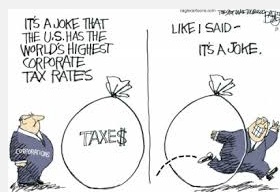
Inversions can cause a domino effect within industries, as the first companies to emigrate to a low-tax country gain an advantage that prompts rivals to follow suit. The logical way to stem the tide would be to bring America’s tax laws in line with international norms. Britain, Germany and Japan all have lower corporate rates and are among the majority of countries that tax firms only on profits earned on their territory. But the likelihood of a substantial tax reform in America is low—vanishingly so before 2017.

So, rather than making it nicer for companies to stay, the US Treasury has been trying to make it harder for them to leave. There has long been a rule whereby any inversion resulting in the American firm’s shareholders owning 80% of the merged group would be taxed as if it were still American. In September, loopholes in this rule were closed

AbbVie, a drug company, blamed these stricter rules when it abandoned plans to merge with Shire of Ireland. Walgreens, a pharmacy chain, insisted it also had other reasons for dropping a plan to move to Europe, though its patriotic decision to stay American earned it some good publicity.

Despite such speed bumps, inversions still make enormous sense for companies with large overseas operations. If anything, the rule changes have led to more companies looking to get out before it is too late.

Emigrating from Deerfield, Illinois to London, as in CF Industries’ case, or from Minnesota to Dublin, as in Medtronic’s, isn’t as dramatic as it seems. These tend to be mainly paper moves. “Here in the Netherlands you don’t even need a chimney to be domiciled,” says Indra Romgens, a corporate researcher, of the country’s many brass-plate headquarters. But the tides are slowly turning, as low-tax countries are beginning to require relocating companies to have a more substantial presence.

Now stricter anti-inversion rules make it harder for American firms to pursue de facto takeovers of foreign rivals, they are becoming the prey rather than the predators. If the American authorities succeeded in stopping inversions, all that would happen is that foreign takeovers of American firms would accelerate.

US Corporate Taxes


Bankers Go Scot Free. Shareholders Pay the Bill

William D. Cohan writes:  On May 27, in her first major prosecutorial act as the new U.S. attorney general, Loretta Lynch unsealed a 47-count indictment against nine FIFA officials and another five corporate executives. She was passionate about their wrongdoing.

Lost in the hoopla surrounding the event was a depressing fact. Lynch and her predecessor, Eric Holder, appear to have turned the page on a more relevant vein of wrongdoing: the profligate and dishonest behavior of Wall Street bankers, traders, and executives in the years leading up to the 2008 financial crisis. How we arrived at a place where Wall Street misdeeds go virtually unpunished while soccer executives in Switzerland get arrested is murky at best.

Since 2009, 49 financial institutions have paid various government entities and private plaintiffs nearly $190 billion in fines and settlements, according to an analysis by the investment bank Keefe, Bruyette & Woods. That may seem like a big number, but the money has come from shareholders, not individual bankers. In early 2014, just weeks after Jamie Dimon, the CEO of JPMorgan Chase, settled out of court with the Justice Department, the bank’s board of directors gave him a 74 percent raise, bringing his salary to $20 million.

After the savings-and-loan crisis of the 1980s, more than 1,000 bankers were jailed.
The more meaningful number is how many Wall Street executives have gone to jail for playing a part in the crisis. That number is one. (Kareem Serageldin, a senior trader at Credit Suisse, is serving a 30-month sentence for inflating the value of mortgage bonds in his trading portfolio, allowing them to appear more valuable than they really were.)

Do:Wall Street bankers make it their daily business to figure out ways to abide by the letter of the law while violating its spirit. Much of the behavior that led to the crisis involved recklessness and poor judgment, not fraud.

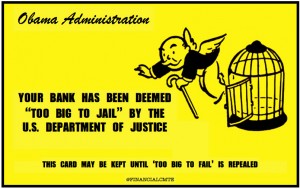
Any narrative of how we got to this point has to start with the so-called Holder Doctrine, a June 1999 memorandum written by the then–deputy attorney general warning of the dangers of prosecuting big banks—a variant of the “too big to fail” argument that has since become so familiar.

A serious national investigation of the practices of Wall Street’s pre-crash mortgage-banking activities did not begin in earnest until mid-2012—at least five years after the worst of the bad behavior had occurred—following President Obama’s call to action in the State of the Union address that January and the issuance of subpoenas to Wall Street’s biggest banks. The five-year statute of limitations for ordinary criminal fraud charges had passed while the Justice Department dithered, but civil prosecution of banks and individual bankers, which has a 10-year statute of limitations under a particular banking law, was still a possibility. Holder gave his various U.S. attorneys around the country responsibility for investigating.

In November 2013, as part of a deal that kept Wagner’s complaint from becoming public—and the specifics of Fleischmann’s revelations from being widely disseminated—JPMorgan Chase agreed to a $13 billion settlement with various federal and state agencies, then the largest of its kind. Holder heralded the settlement as an important moment of accountability for Wall Street. But extracting large settlements paid with shareholders’ money is not the same as bringing alleged wrongdoers to justice.

The Justice Department reached agreements with other Wall Street banks, among them Citigroup and Bank of America, using a similar playbook.

In February, shortly before Lynch succeeded him, Holder gave federal attorneys and their staffs a deadline: they had 90 days to bring any new prosecutions against individual bankers, traders, or executives on Wall Street before probes against them would be closed. That deadline came and went in May.

TooBigToJailCard_806

Yuan Moves

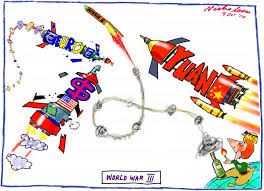
Daniel Atlmann writes: The People’s Bank of China, led by Governor Zhou Xiaochuan, has been slowly liberalizing currency and capital markets for several years now. Last week, though, it made a monetary policy move that surprised people around the world. A week later, those same people can’t seem to agree on what it means.

The central bank has long allowed the exchange rate of the dollar and the renminbi, China’s currency, to move within a band that has gotten slightly wider from year to year, until reaching its current range of 2 percent on either side of a fixed opening rate. Every morning when trading began, the midpoint of the new band would be similar to the closing rate from the previous day.

Some China hands pointed out that Beijing has been trying to gussy up the renminbi in advance of the International Monetary Fund’s (IMF) decision in November on whether to include the yuan in the basket that forms its own distinct currency, the Special Drawing Right. Inclusion would make little difference to China’s economy in itself, but it would be a stamp of approval that the renminbi was on its way to being “convertible” — freely usable and tradable around the world.

The only way to know the Chinese central bank’s true intentions is to find out exactly what it was up to last week. If the bank was injecting renminbi into the market in order to increase its supply, then the fall in the exchange rate was probably deliberate. But if the bank was sucking renminbi out of the market all along in order to support the currency — and then stopped last week — then the dip was just the currency finding its fair value. In that case, any boost for exporters was just a convenient bonus.

Pundits can claim all the expertise they want, but the answer still has to come from the mouth of a Chinese central bank official. And the bank is sticking with the market forces story. Bank officials say the currency isn’t undervalued and is unlikely to drop further.

This episode is likely to be a footnote in Chinese economic history. The overall trends are more liberalization of currency and capital flows, and more focus on domestic demand rather than exports.

Still plenty of people are still betting on short-term currency moves, and stock markets around the world are reacting to the prospect of more globally competitive Chinese exports.

Yuan Moves?

Adaptability and Flexibility Key to Emerging Countries’ Growth?

Bill Emmott writes:  Something has gone badly wrong in the emerging economies that were supposed to be shaping, even dominating, the future of the world. The search for culprits is under way: commodity prices, fracking, US interest rates, El Nino, China, these and others lead the field. But the answer is simpler and more traditional. It is politics.

Look at Brazil. There an economy once tipped for ever-lasting boom has barely grown for more than two years, and is currently shrinking. Falling prices for its commodity exports haven’t helped, but Brazil’s economy was supposed to be about far more than just harvests and extractive industries.

Or look at Indonesia. That economy is still expanding, but at a rate – 4.7% annually in the latest quarter – that is disappointing in terms both of previous expectations and of population growth. The same can be said of Turkey, where growth has sagged to 2.3% in the latest quarter – which at least beats population growth but is meager compared with the country’s go-go years of 2010 and 2011, when it expanded by 9%. Or South Africa, where economic progress has constantly been too slow, whether in boom years for gold and other resources or busts, to make any real dent in poverty levels.

Then there is China itself, whose slowdown is everybody else’s favorite explanation for their own sluggishness. There, private economists are back enjoying their favorite pastime during periods of economic stress, namely trying to construct their own indices for GDP growth as at such times they do not believe the official statistics. Officially, Chinese growth is rock-steady at 7% per year, which happens to be the government’s declared target, but private economists’ estimates mostly range between 4% and 6%.  Slowdown in Emerging Economies

Slowdown?

A Solution to Public Debt?

Yanis Varoufakis writes: Greece’s public debt has been put back on Europe’s agenda. Indeed, this was perhaps the Greek government’s main achievement during its agonizing five-month standoff with its creditors.

What does all of this mean for the eurozone as a whole.

The eurozone is unique among currency areas: Its central bank lacks a state to support its decisions, while its member states lack a central bank to support them in difficult times. Europe’s leaders have tried to fill this institutional lacuna with complex, non-credible rules that often fail to bind, and that, despite this failure, end up suffocating member states in need.

The problem with debt restructuring in the eurozone is that it is essential and, at the same time, inconsistent with the implicit constitution underpinning the monetary union. When economics clashes with an institution’s rules, policymakers must either find creative ways to amend the rules or watch their creation collapse.

The ECB could announce tomorrow morning that, henceforth, it will undertake a debt-conversion program for any member state that wishes to participate. The ECB will service (as opposed to purchase) a portion of every maturing government bond corresponding to the percentage of the member state’s public debt that is allowed by the Maastricht rules. Thus, in the case of member states with debt-to-GDP ratios of, say, 120% and 90%, the ECB would service, respectively, 50% and 66.7% of every maturing government bond.

To fund these redemptions on behalf of some member states, the ECB would issue bonds in its own name, guaranteed solely by the ECB, but repaid, in full, by the member state. Upon the issue of such an ECB bond, the ECB would simultaneously open a debit account for the member state on whose behalf it issued the bond.

The member state would then be legally obliged to make deposits into that account to cover the ECB bonds’ coupons and principal. Moreover, the member state’s liability to the ECB would enjoy super-seniority status and be insured by the European Stability Mechanism against the risk of a hard default.

Such a debt-conversion program would offer five benefits. For starters, it would involve no debt monetization. Thus, it would run no risk of inflating asset price bubbles.

Second, the program would cause a large drop in the eurozone’s aggregate interest payments.

Third, Germany’s long-term interest rates would be unaffected, because Germany would neither be guaranteeing the debt-conversion scheme nor backing the ECB’s bond issues.

Fourth, the spirit of the Maastricht rule on public debt would be reinforced, and moral hazard would be reduced.

Finally, GDP-indexed bonds and other tools for dealing sensibly with unsustainable debt could be applied exclusively to member states’ debt not covered by the program and in line with international best practices for sovereign-debt management.

There are ways in which debt could be sensibly restructured without any cost to taxpayers and in a manner that brings Europeans closer together. Taking the step proposes here  would help to heal Europe’s wounds and clear the ground for the debate that the European Union needs about the kind of political union that Europeans deserve.

Solution?