Has the IMF Failed Greece?

Arvind Subramanian writes:  Greece was offered two stark choices: Leave the eurozone without financing, or remain and receive support at the price of further austerity.

The benefits of Grexit would have included a massive devaluation, which would have restored some dynamism to what was once a fast-growing economy. But the costs were terrifying. The government would have had to default, the banks would have been ruined, and both would have struggled for years to regain the trust of financial markets. As a result, interest rates would have remained high for a long time to come, impeding efforts to restore growth. Is it any wonder that the Greek government shrank from this horror and chose the “safe” option of austerity?

The IMF could have offered the third option of an orderly exit. Greece should have been told that it could reap the benefits of devaluation, while the international community would act to minimize the attendant costs.

The  IMF would have needed to offer generous financing, covering the country’s import requirements for, say, two years while providing the liquidity to manage the transition to a new currency. Of course, this would have increased the IMF’s already-large exposure to Greece; but this would have been a worthwhile trade-off, because it would have served a strategy that would have had a much better chance of success.

The reason why an assisted Grexit was never offered seems clear: Greece’s European creditors were vehemently opposed to the idea. But it is not clear that the IMF should have placed great weight on these concerns.

Ccreditor countries have been concerned about the financial costs to member governments that have lent to Greece. But Latin America in the 1980s showed that creditor countries stand a better chance of being repaid (in expected-value terms) when the debtor countries are actually able to grow.

From an Asian perspective, by defying its European shareholders, the IMF would have gone a long way toward heralding the emergence of a new institution: a truly International Monetary Fund, in place of today’s Euro-Atlantic Monetary Fund.

All is not lost. If the current strategy fails, the third option of assisted Grexit remains available. The IMF should plan for it. The Greek people deserve some real choices in the near future.
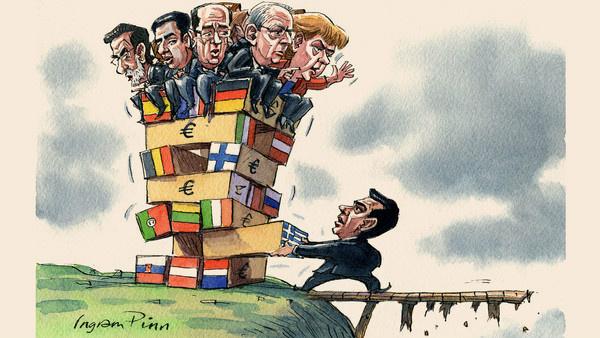
Grexit: Third Option

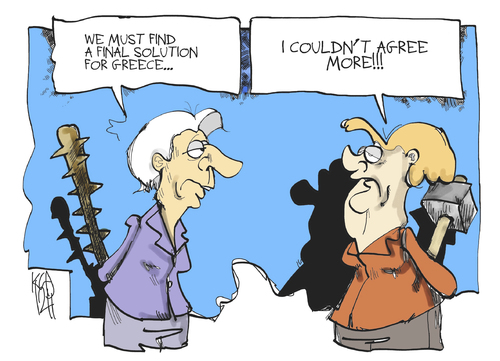
Ladies’ Day for Greece: Merkel and Lagarde

Aug 16 German Chancellor Angela Merkel said  that she expected the IMF to participate in a new rescue package for Greece, saying the Washington-based institution’s chief Christine Lagarde had promised to lobby for this with the IMF board.

“The IMF took part in the negotiations. It suppports (the Greece deal),” Merkel told German public broadcaster ZDF. “I have no doubts that what Mrs. Lagarde said will become reality.”

Merkel ruled out a so-called “haircut” on Greece’s debt but said there were other ways to provide relief by extending debt maturities and reducing interest rates.

Lagarde and Merkel

IMF Chief Lagarde: Greek Deal Good, but…

IMF chief Christine Lagarde on Friday welcomed Europe’s decision to agree a new 86-billion-euro bailout for Greece, but warned that Athens’ debt is still too high.

“I remain firmly of the view that Greece’s debt has become unsustainable and that Greece cannot restore debt sustainability solely through actions on its own,” she said.

And, while Lagarde called the agreement hammered out in Brussels “a very important step forward,” she warned it was too soon to say whether the IMF would provide funds to take part in the bailout.

“We look forward to working closely with Greece and its European partners in the coming months to put in place all the elements needed for me to recommend to the fund’s executive board to consider further financial support for Greece,” she said.

For this to be the case, she said, Greece’s European creditors would themselves have to provide “significant debt relief, well beyond what has been considered so far.”

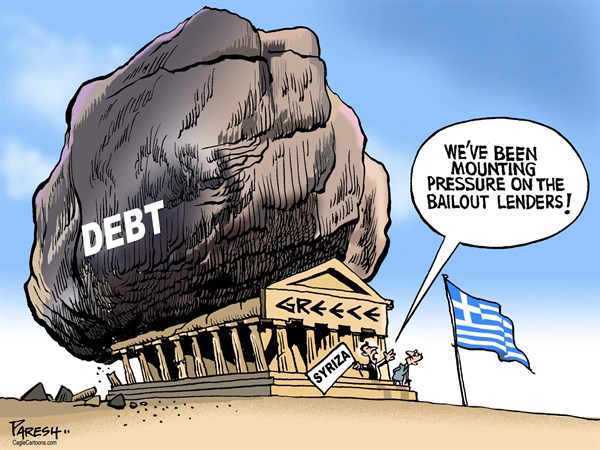
Greek Debt

Is China’s Slowdown Real?

Elliot Wilson write: In a factory building wind turbines in China, workers have been given the day off.  The factory, has not run at close to full capacity for a year. 

The company’s woes are a microcosm of the daunting challenges that face China’s stuttering economy, the world’s second largest after the United States. This week China devalued its currency by 3.6 per cent in a dramatic bid to encourage exports.  Even the threat of a significant slowdown in China’s economy could be enough to send the rest of the world tumbling back into recession. 

From the polluted central metropolis of Zhengzhou, to Shenyang in the rustbelt northeast, the overwhelming sense is one of pessimism and urban decay. Idle cranes and vacant building sites dot the landscape. The ghost towns of legend — such as Ordos City in Inner Mongolia — are all too real, and remain a silent, cautionary reminder of the perils of engineered growth. 

Over the past year, every key indicator has begun pointing to bad times ahead. Electricity consumption, usually the most reliable single gauge of economic health in the mainland, expanded at the slowest rate in three decades in the year to June. Because of falling Chinese industrial demand, global commodity prices have slumped, threatening growth in producer countries from Australia to Zambia. Chinese house prices have stagnated, while the last time rail-freight volumes were higher than the year before was last September. Last week brought yet more bad news, with exports sliding 8.3 per cent in July from last year’s figures, imports falling for the ninth month in a row, and data pointing to further weakness in industrial output, capital investment and retail spending. China’s Slowdown

China's Slowdown

What Are Banks? Investing for the Good?

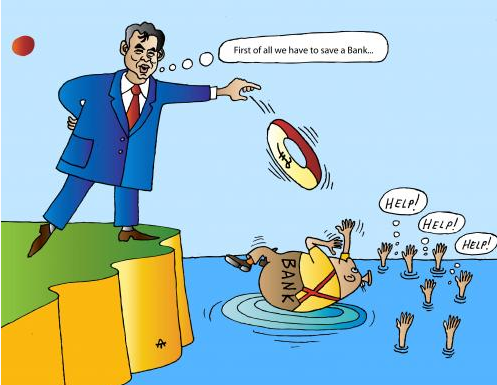
What are Banks?

Joseph E. Stieglitz writes:  The Third International Conference on Financing for Development recently convened in Ethiopia’s capital, Addis Ababa. The conference came at a time when developing countries and emerging markets have demonstrated their ability to absorb huge amounts of money productively. Indeed, the tasks that these countries are undertaking – investing in infrastructure (roads, electricity, ports, and much else), building cities that will one day be home to billions, and moving toward a green economy – are truly enormous.

At the same time, there is no shortage of money waiting to be put to productive use. Just a few years ago, Ben Bernanke, then the chairman of the US Federal Reserve Board, talked about a global savings glut. And yet investment projects with high social returns were being starved of funds. That remains true today. The problem, then as now, is that the world’s financial markets, meant to intermediate efficiently between savings and investment opportunities, instead misallocate capital and create risk.

There is another irony. Most of the investment projects that the emerging world needs are long term, as are much of the available savings – the trillions in retirement accounts, pension funds, and sovereign wealth funds. But our increasingly shortsighted financial markets stand between the two.

Much has changed in the 13 years since the first International Conference on Financing for Development was held in Monterrey, Mexico, in 2002. Back then, the G-7 dominated global economic policymaking; today, China is the world’s largest economy (in purchasing-power-parity terms), with savings some 50% larger than that of the US. In 2002, Western financial institutions were thought to be wizards at managing risk and allocating capital; today, we see that they are wizards at market manipulation and other deceptive practices.  Savings and Investment

How are Savings Used?

What Works in Oil Pricing?

Jeffrey Frankel writes: World oil prices have fallen more than 50% over the past year. The economic effects have been negative overall for oil-exporting countries, and positive for oil-importing countries. But what about the environment, which benefits from higher prices and less use.

The answer is that countries should seek to do both: Lower the price paid to oil producers and raise the price paid by oil consumers, by cutting subsidies for oil and refined products or raising taxes on them.

Consider this: America’s roads and bridges are crumbling, and the national transportation infrastructure requires investment and maintenance. And yet the US Congress shamefully continues to evade its responsibility to fund the Federal Highway Trust Fund and put it on a sound long-term basis, owing to disagreement over how to pay for it. The obvious solution, which economists have long advocated, is an increase in America’s gasoline taxes. The federal gas tax has been stuck at 18.4 cents a gallon since 1993, the lowest among advanced countries. And yet, on July 30, Congress adopted only a three-month stopgap measure, kicking the gas can down the road for the 35th time since 2009.

Fossil-fuel pricing is a striking exception to the general rule that if the government has only one policy instrument, it can achieve only one policy objective. For starters, the money saved from a reduction in subsidies or an increase in taxes in the oil sector could be used either to reduce budget deficits or to fund desirable spending (such as US highway construction and maintenance). At the same time, lower oil consumption would reduce traffic congestion and accidents, limit local air pollution and its adverse health effects, and lower greenhouse-gas emissions, which lead to global climate change. Fuel taxes are a more efficient way to achieve these environmental goals than most of the alternatives.

There is also a national-security rationale. If the retail price of fuel is low, domestic consumption will be high. High oil consumption leaves a country vulnerable to oil-market disruptions arising, for example, from instability in the Middle East. If gas taxes are high and consumption is low, as in Europe, fluctuations in the world price of oil have a smaller effect domestically.

Finally, although fuel subsidies are often misleadingly sold as a way to improve income distribution, the reality is more nearly the opposite. Worldwide, fossil-fuel subsidies are regressive:.  Poor people are not the ones who do most of the driving; rather, they tend to use public transportation (or walk).

The conventional wisdom is that it is politically impossible in the US to increase the gas tax. But other countries have political constraints, too. Indeed, some developing-country governments have faced civil unrest, even coups, over fuel taxes or subsidies. Yet Egypt, Ghana, India, Indonesia, Malaysia, Mexico, Morocco, and the United Arab Emirates have all reduced or abolished various fuel subsidies in the last year.

Besides raising taxes on fuel consumption, the US should also stop some of its subsidies for oil production. Oil companies can immediately deduct a high percentage of their drilling costs from their tax liability, which other industries cannot do with their investments. Likewise, the oil industry has often been able to drill on federal land and offshore without paying the full market rate for the leases. Most politicians know that sound economics would call for these benefits to be eliminated; but those who complain the loudest that the government must not pick corporate winners and losers seem to be the least able to summon the political will to act.

The US Congress will have to come back to highway funding in September. If other countries have found that what was politically impossible has suddenly turned out to be possible, why not the UOil PricesS?


Devaluation of Yuan Impacts US

The Rocky Road to Globalization

John Kehoe writes:  As US President Barack Obama calibrated his golf swing on vacation this week and Federal Reserve chairwoman Janet Yellen readied her trigger finger to raise interest rates, China’s currency depreciation was a shock neither leader was likely prepared for.

Politically and economically, the yuan devaluation is being felt in the United States.

For Obama, the cheaper Chinese currency has given new ammunition to American critics of the state-controlled rival economy.

Obama is due to host Chinese President Xi Jinping at the White House next month, so the rev-up of anti-Chinese sentiment from Republicans and Democrats creates a potentially awkward backdrop for the important bilateral relationship.

The US posted a record $US343 billion trade deficit with China last year. The yuan depreciation will cheapen Chinese imports and make US exports to China more expensive, exacerbating the gap.

US manufacturers blame Obama’s engagement of China for the “currency manipulation” designed to “flood the world with cheap China imports and put US manufacturers out of business”.

Scott Paul, president of the Alliance for American Manufacturing,  is pressing Congress to insert currency provisions into the Trans-Pacific Partnership trade accord.

Still, the US Treasury and the International Monetary Fund have presented a more nuanced response to China ostensibly shifting towards a more market-determined exchange rate. The Washington-based IMF was supportive and the US Treasury, which has long pressed China to adopt a market-based currency, offered faint praise.

Yet the domestic political heat on Obama will not relent, as politicians ramp up their rhetoric on the evils of Beijing in a populist pitch to voters.

A few blocks away from the White House, Yellen will be weighing the unexpected Chinese currency lowering. The Fed has been inching towards its first rate hike in nine years, which many expect as soon as September.

The yuan devaluation – and, by definition, appreciation of the US dollar – will tighten financial conditions in the US, at least at the margin. As well as worsening the trade balance, the stronger greenback against the yuan cuts the dollar earnings of US multinationals operating in China.

Investors were already skittish about companies with big exposures to China, such as Apple and Procter & Gamble, as the world’s second-biggest economy slowed in recent months.

The Fed is itching to raise rates from about zero, where they have stooped for more than six years.

The US jobless rate of 5.3 per cent has the Fed comfortable enough that the labour market is ready for a gentle rise in borrowing costs. But persistently weak inflation may be reason to hold off pulling the trigger.

If the yuan continues to fall sharply, the spectre of global deflation becomes a bigger threat. Cheapened Chinese exports could flood the world market as Beijing keeps its labour-intensive factories pumping, at a time when plunging commodity values are already pushing down world prices.

The risk is that other countries might follow China and devalue via monetary policy easing and currency interventions, unleashing a broader currency war.

Much will depend on Chinese actions from here. If the devaluation is halted in an orderly fashion at about 5 per cent, the overall impact is likely to be minimal.

But if the devaluation accelerates or the Chinese authorities lose financial control, Yellen and Obama will be in a real bind.

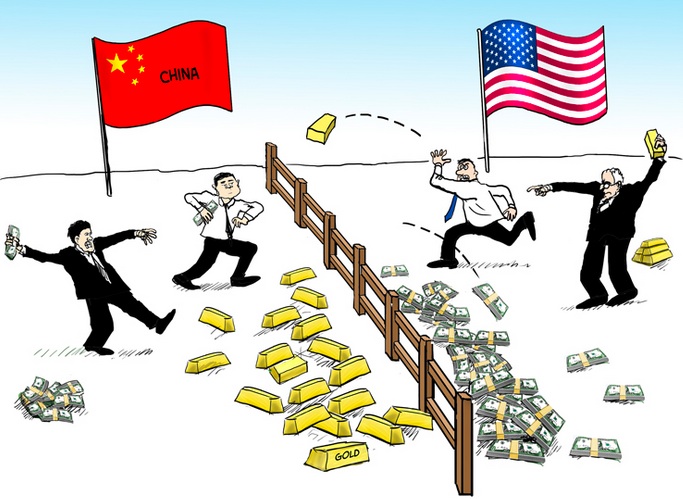
Currency US v China


Energy Problems in Ukraine

Samuel Bendett writes:  The energy situation in Ukraine has been precarious for years — going back long before the separatist rebellion in the country’s east, and the loss of Crimea to Russian military action. The crisis now stands to get much worse.

Ukrainian Prime Minister Arseniy Yatsenyuk notes an inadequate supply of coal, his nation’s main energy source. At this point, it looks like Kiev does not have enough money to buy the 7 million tons of coal needed to provide heat to its citizens — the Ukrainian government needs $500 million. If the winter turns really cold — the “very bad” scenario — $900 million will be needed in order to purchase 11 million tons of coal.

To make matters worse, coal is plentiful in the Donbas, and thus under the control of the secessionist Donetsk and Luhansk People’s Republics (DNR and LNR). According to the Russian daily Komsomolskaya Pravda, Kiev is currently negotiating coal purchases with Luhansk separatists, as well as with Russia. The progress of negotiations, given the state of belligerence between the parties, is still unclear.

Ukraine_winter_snow_295X200


Entrepreneur Alert: Is Suez II an Opportunity?

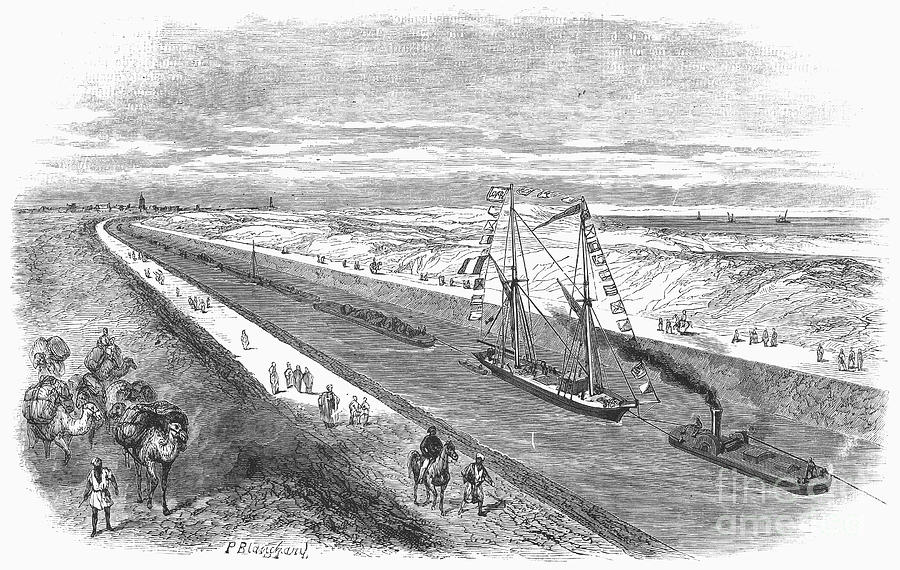
Keith Sullivan writes:  Today the Egyptian government officially inaugurated what has been dubbed “Suez Canal II,” an extension of the original canal that will accommodate two-way traffic and more development and capital projects along the important shipping route. The canal upgrade was greeted with much fanfare.

Egyptian President Abdel-Fattah el-Sissi has much riding on the new canal’s success, as do the Egyptian investors who footed the lion’s share of the project’s $9 billion dollar bill.

Moreover, there isn’t much evidence that the Suez upgrade will result in the windfall of growth and gains promised by Sissi. The new canal route will likely reduce container ship travel times slightly.

The coming months and years will make or break Sissi’s government, which has been propped up by the largesse of the Gulf monarchies and the US.

High youth unemployment plagues the country. . The regime has been under pressure from an Islamic State affiliate in the Sinai Peninsula. Political persecution of Islamists has led to radicalization and  a once vibrant political movement is being pushed back out to the fringes.

In a Middle East consumed by conflict, the United States is counting  is counting on an Egyptian strongman to keep the largest Arab country in the world in line. Can he deliver?

Suez 2?

China’s Race to the Bottom?

The Rocky Road to Globalization

Ana Swanson writes: China surprised the world by devaluing its currency, in a move likely to boost Chinese exports and support the country’s flagging economic growth. The change to the currency’s value was the most dramatic one-day change in two decades.

The move is likely to stir intense concern, as political leaders, especially in the United States, have long complained that China leaves its currency at a lower value to boost its domestic industries.

Over the past decade, China has let the value of the currency, known as the yuan or renminbi, rise, but the announcement by China’s central bank Tuesday is sure to reignite debate over whether the country is giving an unfair advantage to its businesses.

Stephen Roach, a fellow at Yale University who formerly served as a non-executive chairman for Morgan Stanley in Asia, said the move raised the “possibility of a new and increasingly destabilizing skirmish in the ever-widening global currency war.”

The Chinese economy slowed to 7 percent year-over-year growth in the first quarter, the slowest pace in six years. Exports plummeted 8.3 percent year-over-year in July, according to data released last weekend.

But the Chinese central bank argued on Tuesday that its goals were more mundane than spurring exports and growth. Rather, the bank said that the change was a one-time event to allow it to set exchange rates in line with free market practices. And in their initial responses, many analysts agreed.

Like many things in China’s economy, the country’s currency is controlled by a mix of market forces and government decree.  China Races to the bottom?