Manufacturing Decline and Puerto Rican Debt

Clark Derrington writes:   While both Greece and Puerto Rico have major debts that cannot be repaid due to struggling domestic economies, easy comparison leaves out important details about the debt crisis in Puerto Rico. With a more complete understanding of the situation in Puerto Rico, possible solutions become easier to identify.

The solution to Puerto Rico’s crisis lies in Washinton, DC. . Indeed, Washington is in many ways responsible for creating the underlying economic issues that exacerbated the fiscal emergency.

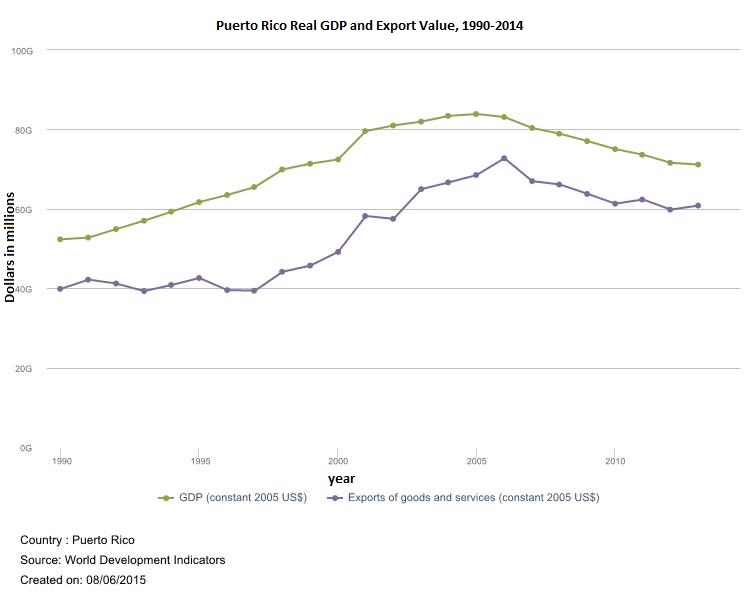
In 2006, Internal Revenue Service Code Section 936, which offered generous advantages to American companies operating in Puerto Rico, finally expired after a gradual phase-out. After the expiration of this tax subsidy, the Puerto Rican economy entered a recessionfrom which it has not yet emerged. As the chart below shows, the decline in real (adjusted for inflation) Gross Domestic Product coincides with a decline in real export value. Export value peaked in 2006, and declined along with the total output of the Puerto Rican economy following the end of the business tax credit.MyChart (Puerto Rico)

Manufacturing firms were major beneficiaries of the Section 936 tax credit. Its elimination and the loss of manufacture-for-export directly impacted the Puerto Rican economy and contributed to the severity of the ongoing debt crisis.

The decline in economic output makes it nearly impossible for the territorial government to keep up with ever-growing debt payments.  Attempts at fiscal austerity only contribute to the economic decline. Even with an automatic increase in Social Security, Medicaid, and other transfer payments from Washington, local austerity is particularly undesirable in an economy featuring the high levels of government employment seen in Puerto Rico.

Energy

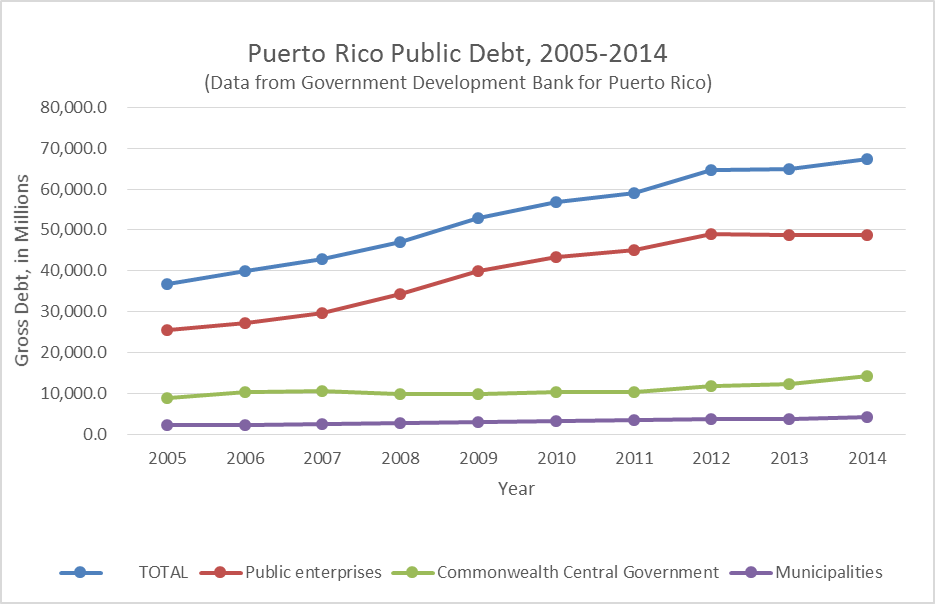
The single largest component of Puerto Rico’s total debt of approximately $72 billion belongs to the island’s inefficient utilities and other public enterprises, shown in red in the chart below.

Puerto Rico Debt Graph

As the central government and local municipalities have seen debt loads grow slowly from a low baseline, Puerto Rico’s public enterprises have piled up liabilities that comprise almost 70% of the territory’s debt.


Hacking for Inside Traders

High Tech and the Financial Markets

Keri Geiger writes: Exposing a new front in cybercrime, U.S. authorities broke up an alleged insider trading ring that relied on computer hackers to pilfer corporate press announcements and then profited by trading on the sensitive information before it became public.

The suspected hackers, who are thought to be in Ukraine, allegedly infiltrated the computer servers of PRNewswire Association LLC, Marketwired and Business Wire, a unit of Warren Buffett’s Berkshire Hathaway Inc., over a five-year period.

They siphoned more than 150,000 press releases including corporate data on earnings that could be used to anticipate stock market moves and make profitable trades, the U.S. said. The hackers passed the information to associates in America and Ukraine, who allegedly used it to buy and sell shares of dozens of companies, including Panera Bread Co., Boeing Co., Hewlett-Packard Co., Caterpillar Inc. and Oracle Corp., through retail brokerage accounts.

Prosecutors said the men targeted more than 100 companies and made “approximately 1,000 inside the window trades.” Money was then shifted offshore through Estonian banks, according to one of two federal indictments unsealed Tuesday.


The arrests and dual indictments in Brooklyn and New Jersey are a significant victory for the Federal Bureau of Investigation and prosecutors, who have been struggling to halt an increasing number of computer incursions that have publicly shaken Target Corp., Sony Corp. and JPMorgan Chase & Co., among other big companies.

With defendants spanning two countries, it’s not yet clear who masterminded the idea to hack the firms and trade off the information.

The only professional U.S. trader arrested was Vitaly Korchevsky, described by the authorities as the linchpin of the markets strategy, having run a mutual fund and worked on Wall Street before starting his own hedge fund.

The announcement, which sat in the wire’s server for less than 24 hours, was scooped up by the hackers and passed to the traders, according to the government. In this short window, they allegedly bought $8.3 million in Caterpillar stock and options. The announcement was then released publicly before the markets opened on Jan. 26..

They appear to have little or no financial credentials or obvious experience as traders. They work in real estate and construction and operate a myriad of LLCs that appear to be covers for their trading operations, according to public records.

Three of the defendants appear to be related: Igor, Arcadiy and Pavel Dubovoy. Arkadiy and Igor, who are father and son, currently live in Georgia, while Pavel is thought by the government to be in Ukraine.


MAIN-Computer-hacking (1)


Entrepreneur Alert: Classic Cars in Cuba

As Cubans head out to the beach to escape the summer heat of crowded cities, many are making the drive in relics from another era.

Tens of thousands of vintage American cars remain scattered throughout the country, manufactured before the revolution and subsequent US embargo in 1960. In the summers and at classic car shows, the old American models end up on display.

With no automobile imports coming in, the cars are preserved by Cuban mechanics and improvised fixes by the owners themselves.

Some Cubans have already started renting these cars to tourists who love them.

Classic Cars in Cuba

Portugal’s Austerity

Sara Miller Llana writes:  At the height of Portugal’s economic crisis, Fernando Fernandes was forced to close seven of the 10 clothing stores he spent his life building  – working so hard he missed the birth of his first son.  But when he found out he lost nearly half of his life savings last year, after Banco Espirito Santo collapsed, he took to the streets.


Yet when Mr. Fernandes casts his ballot on Oct. 4 in Portugal’s general election, he’ll have no anti-austerity, anti-EU party to register his frustration. A competitive one doesn’t exist.

Portugal is held up as the poster child of austerity that works, having successfully exited its bailout program last year. Exports are rising and the economy expanding. Most notable, from the vantage of Brussels at least, it does not have a firebrand party like Syriza from Greece or Podemos in Spain attempting to redraw the political map.


Domestic politics is central to why Portugal is a political outlier in the region. While the Socialists were in power when the country needed to be bailed out, the then-prime minister resigned and the conservatives won the snap election, without needing the center-left in a coalition.

Portugal also has a strong Communist party, which wins roughly 10 percent of the vote and leaves less space for a populist left.

The leftist parties that have sought to emulate Syriza or Podemos are bitterly divided, leaving none with power to harness change. The group LIVRE is polling at about 3 percent and the older Left Bloc at 5 percen

Still, the lack of vocal populism does not equate with lack of frustration in Portugal.

Many young people have responded to the crisis by leaving Portugal. Many of them listened to their prime minister when he said the best response to high youth unemployment was for the young to emigrate.

“They prefer to emigrate rather than make a revolution,” says Pedro Figueiredo, another tour founder.

Even the youths who have stayed local, however, seem resigned to the fact that their politics isn’t going to shift the status quo.

That is a sentiment that is even stronger among older groups, says Mr. Villaverde Cabral. And if the response of youths has been to flee, the response among those who stay in the country’s aging society has been to refuse to vote. “They’d rather abstain than create a new left-wing party,” he says.

Part of the reason is a temperament that is not like that of many countries in southern Europe.  Portugal lacks the sort of internal regional divides that characterize Spain, and didn’t have a 20th century civil war like Spain and Greece. And while Portugal did have a dictatorship, it was not as bloody as those in Spain and Greece. The country even strikes less than its counterparts, says Costa Pinto, which he sees as a symptom of a much less active civil society.

106816_600


China Devalues Yuan

The Rocky Road to Globalization

China’s 2.0 percent devaluation of the yuan on Tuesday pushed the U.S. dollar higher and hit equity markets worldwide as it raised the prospect of a new round of currency wars and fed worries about slowing Chinese economic growth.

Stocks fell in Asia, Europe and the Americas, as investors worried about the implications of a move designed to support China’s slowing economy and exports.

What is good for growth in China is unfortunately bad for everybody else.  The Dow Jones industrial average .DJI fell 137.33 points, or 0.78 percent, to 17,477.84, the S&P 500 .SPX lost 11.74 points, or 0.56 percent, to 2,092.44 and the NasdaqComposite .IXIC dropped 20.10 points, or 0.39 percent, to 5,081.70.

The devaluation especially hit the stock prices companies exposed to China, with shares of U.S. heavy equipment maker Caterpillar (CAT.N) losing 2.3 percent and Germany’s Volkswagen (VOWG.DE) dropping 4.6 percent.

European shares fell. The pan-European FTSEurofirst 300 index .FTEU3 was down 1 percent, led lower by car makers and luxury goods companies, whose products have just got more expensive for Chinese consumers.

China’s move, which the central bank described as a “one-off depreciation” based on a new way of managing the exchange rate that better reflected market forces, triggered the yuan’s biggest fall since 1994, pushing it to its weakest against the U.S. dollar in almost three years.

In a potentially worrisome sign, China’s offshore yuan, a more liquid instrument traded out of Hong Kong, fell 2.9 percent, exceeding the fall in the onshore yuan. It suggests more possible losses for the onshore currency, as the Hong Kong-traded yuan tends to act as a precursor to the onshore.

China Devalues Yuan


Robots in Retail?

The Future of Work

Virginia Postrel writes:  To see why robots aren’t going to wipe out everyone’s job anytime soon, look no further than the annoyed and bewildered customers confronting store self-checkout units squawking, “Unexpected item in bagging area” and “Help is on the way.”

Self-service checkout scanners are now standard at most U.S. supermarket and mass-merchandise chains. That might seem great for customers in a hurry. After all, in a June poll, half of U.S. adults picked slow checkout speeds and long lines as the most frustrating thing about shopping in brick-and-mortar stores. A whopping 88 percent would like checkout to be faster, the Harris poll for Digimarc Corp. found.  

But three-quarters of respondents also said they sometimes avoid self-service — most often because of technical problems. (Those over 65 were more likely to say they simply prefer cashiers.) Nobody wants to listen to an endless loop of electronic reprimands while watching other shoppers move smoothly through the human-staffed queue.

Even people who’ve mastered the machines often find themselves waiting behind customers who aren’t so adept. “If the self-checkout is empty, I always head for it,” says one friend. “But for some reason, whenever I get behind someone it seems to take forever, much longer than waiting behind someone at the cash register. I don’t know if they are refinancing their mortgage or buying groceries, so I just get in line at the cash register.”

Self-service is a handy option, but few shoppers want to rely on it. And most people who use self-scanners limit them to small orders.

That in part reflects the tiny space most stores allocate to their self-service bagging areas. But it also suggests two other costs that illuminate consumer thinking about the transaction. s social among us — that seems more justified when spread over many items.

To justify upgrades, self-scanner companies are working to address shoppers’ technical gripes. Market leader NCR, which accounted for 64 percent of new shipments in 2014, has shrunk its machines to double the space in the bagging area. It has also shortened the tedious process of paging through screens to find produce codes — a deterrent to many grocery shoppers. New NCR software first shows customers the top-selling fruits and vegetables in the store that day or, if they’ve swiped a frequent shopper card, their own most common purchases.

And scanning a bottle of wine no longer brings the process to an abrupt halt while you wait for a clerk half your age to check your driver’s license. The system simply alerts an employee as scanning continues. “A lot of times they can look over and see that you’re obviously old enough and not have to come over to check your ID,” said Dusty Lutz, general manager of NCR’s retail self-service solution, in an interview.

Eventually, such innovations will smooth the technical glitches that now make self-checkout irritating. (ATMs weren’t always so problem-free either.) But by the time supermarkets and drugstores roll out the glitch-free self-scanners, cutting human staff to a bare minimum may seem like retail suicide.

The only reason to go shopping is the social and aesthetic experience. Stores will have to treat employees as long-term assets who create specific value for customers rather than expenses to handle routine transactions. Technology will serve as a complement to, rather than a substitute for, staff. Already RSR’s annual survey finds that the most successful retailers are investing more in hiring and training. But, said Rosenblum, “they’re still struggling” with a century-old business model that assumes a low-paid, transient workforce of interchangeable clerks. Basic tools, such as wi-fi that employees can use to answer questions, are still scarce.

The job-displacing robots won’t be at the supermarket checkout but hidden in Amazon warehouses. Even graceful technology, however, can’t satisfy every consumer desire. Some researchers speculate that loneliness, rather than technophobia, may be one reason that older customers prefer cashiers to self-checkout. For people who live or work alone, interacting with cashiers may provide one of the day’s few in-person conversations. “Since I try to always get the same clerk, it’s like seeing a friend,” says one extroverted pal who works from home. “A friend who knows the codes for fruit and vegetables.”

Can Robots Replace the Trader Joe's Experience?

Closing in on Greek Deal

The Rocky Road to Globalization:  Holding Greece in the Group

The European Commission said a technical agreement had been reached with Greece, which now requires political approval. The Greek government is hoping to push a new €86bn (£60bn) three-year agreement through parliament later this week.

A deal is needed to keep the country in the eurozone and avert bankruptcy.

The country needs a deal by 20 August, when it has a debt repayment of about €3bn to make to the European Central Bank.


A Greek official said earlier that Greece agreed the function of a new independent privatisation fund, and how non-performing bank loans will be administered.

Both issues had been key sticking points in negotiations.

“Finally, we have white smoke,” the official said.

Deregulation of the natural gas market, another sticking point, was also agreed.

But Finnish Finance Minister Alexander Stubb sounded a cautious note, saying more work needed to be done with the details to finalise the agreement.

The Eurogroup of eurozone finance ministers is to meet on Friday to discuss approval of the deal, Spanish Prime Minister Mariano Rajoy said.

His centre-right People’s Party, which has a majority in the Spanish parliament, will be asking other parties to vote in favour of the agreement, he added.

Greek Deal

Taking Advantage of Oil Prices

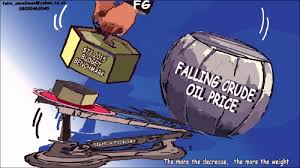
Jeffrey Frankel writes:   World oil prices, which have been highly volatile during the last decade, have fallen more than 50% over the past year. The economic effects have been negative overall for oil-exporting countries, and positive for oil-importing countries.

The answer is that countries should seek to do both: Lower the price paid to oil producers and raise the price paid by oil consumers, by cutting subsidies for oil and refined products or raising taxes on them.

Consider this: America’s roads and bridges are crumbling, and the national transportation infrastructure requires investment and maintenance. And yet the US Congress shamefully continues to evade its responsibility to fund the Federal Highway Trust Fund and put it on a sound long-term basis, owing to disagreement over how to pay for it. The obvious solution, which economists have long advocated, is an increase in America’s gasoline taxes. The federal gas tax has been stuck at 18.4 cents a gallon since 1993, the lowest among advanced countries. And yet, on July 30, Congress adopted only a three-month stopgap measure, kicking the gas can down the road for the 35th time since 2009.

Fossil-fuel pricing is a striking exception to the general rule that if the government has only one policy instrument, it can achieve only one policy objective. High oil consumption also leaves a country vulnerable to oil-market disruptions arising, for example, from instability in the Middle East. If gas taxes are high and consumption is low, as in Europe, fluctuations in the world price of oil have a smaller effect domestically.

The conventional wisdom is that it is politically impossible in the US to increase the gas tax. But other countries have political constraints, too. Indeed, some developing-country governments have faced civil unrest, even coups, over fuel taxes or subsidies. Yet Egypt, Ghana, India, Indonesia, Malaysia, Mexico, Morocco, and the United Arab Emirates have all reduced or abolished various fuel subsidies in the last year.

Besides raising taxes on fuel consumption, the US should also stop some of its subsidies for oil production.

For the US and other advanced countries, it is also a good time for reform from a macroeconomic standpoint. In the past, countries had to worry that a rising fuel tax could become built into uncomfortably high inflation rates. Currently, however, central bankers are not worried about inflation, except in the sense that they want it to be a little higher.

The US Congress will have to come back to highway funding in September. If other countries have found that what was politically impossible has suddenly turned out to be possible, why not the US?

Price of Crude

Can Greece be Weaned?

Dambisa Moya writes:   The ongoing Greek debt saga is tragic for many reasons, not least among them the fact that the country’s relationship with its creditors is reminiscent of that between the developing world and the aid industry. Indeed, the succession of bailouts for Greece embodies many of the same pathologies that for decades have pervaded the development agenda – including long-term political consequences that both the financial markets and the Greek people have thus far failed to grasp.

As in the case of other aid programs, the equivalent of hundreds of billions of dollars has been transferred from richer economies to a much poorer one, with negative, if unintended, consequences. The rescue program designed to keep Greece from crashing out of the eurozone has raised the country’s debt-to-GDP ratio from 130% at the start of the crisis in 2009 to more than 170% today, with the International Monetary Fund predicting that the debt burden could reach 200% of GDP in the next two years. This out-of-control debt spiral threatens to flatten the country’s growth trajectory and worsen employment prospects.

Like other aid recipients, Greece has become locked in a codependent relationship with its creditors, which are providing assistance in the form of de facto debt relief through subsidized loans and deferred interest payments. No reasonable person expects Greece ever to be able to pay off its debts, but the country has become trapped in a seemingly endless cycle of payments and bailouts – making it dependent on its donors for its very survival.

The country’s creditors, for their part, have an incentive to protect the euro and limit the geopolitical risk of a Greek exit from the eurozone. As a result, even when Greece fails to comply with its creditors’ demands – for, say, tax hikes or pension reforms – it continues to receive assistance with few penalties. Perversely, the worse the country performs economically, the more aid it receives.

The long-term consequences of this cycle of dependence could be serious. As long as Greece’s finances are propped up by international creditors, the country’s policymakers will be able to abdicate their responsibility to manage the provision of public goods like education, health care, national security, and infrastructure. They will also face few incentives to put in place a properly functioning system to collect taxes.

Dependence on aid undermines the implicit contract between citizens and their government, according to which politicians must keep taxpayers satisfied in order to stay in office. With foreign infusions of cash easing the need for tax revenues, politicians are likely to spend more time courting donors than caring for their constituents.

The weakened connection between public services and taxes not only makes it easier for officials to cling to power, but also increases the scope for corruption and inefficiency. Indeed, based on the experience of aid-recipient economies in the emerging world, the Greek people may find it increasingly difficult to hold their government accountable or penalize officials for misbehavior or corruption.

So far, the Greek crisis has been treated as a recurring emergency, rather than the structural problem that it is. And yet, as long as the country remains locked in a cycle of codependence with its creditors, the state of perpetual crisis is likely to persist.

Effective aid programs have almost always been temporary in nature, working – as was the case with the Marshall Plan – through short, sharp, finite interventions. Open-ended commitments, like aid flows to poor developing countries, have had only limited success, at best. As long as Greeks view assistance as guaranteed, they will have little incentive to put their country on a path toward self-sufficiency. Whatever the way forward for Greece, if there is to be any hope of progress, the assistance provided by the European Union and the IMF must come to be regarded as temporary.

Cutting the umbilical cord in a relationship of aid dependency is never easy, and there is no reason to expect that it will be any different with Greece. Phasing out transfers, even in a considered and systematic way, works only when the recipient is determined to put in place the measures necessary to survive without assistance. There are few signs that Greece is ready to walk on its own, and as long as the aid continues to flow, that is unlikely to change. In this sense, markets should view the Greek situation as an equilibrium, not a transition.
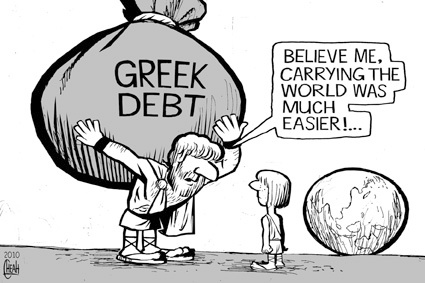
Greek Debt Relief

Good US/India Relations

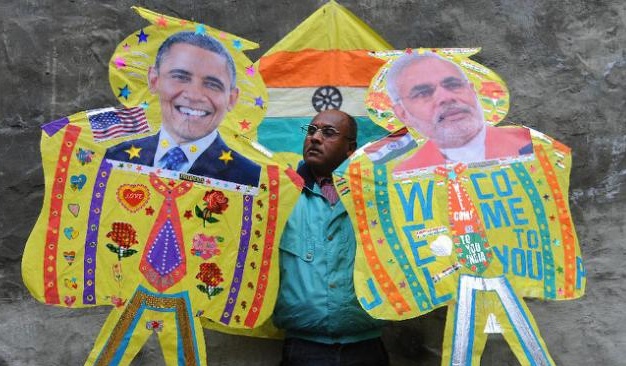
A sign of US-India relations?

Ahead of the 69th Independence Day celebrations, innumerable kites with photographs of Prime Minister Narendra Modi and US President Barack Obama will dot the city skyline.

US and India