Saudia Arabia Struggles with Oil

Nafeesa Syeed and Rinat Gaynullin writSaudi Arabia is burning through foreign reserves at a record pace as the largesse of the new king and regional turmoil ratchet up pressure on public finances already hurt by the oil price slump.

The kingdom spent $36 billion of the central bank’s net foreign assets — about 5 percent of the total — in February and March, the biggest two-month drop on record, data released this week show. The fall was in part due to King Salman’s order to give government employees and pensioners a two-month bonus after he ascended to the throne of the world’s biggest oil exporter in January.

The early months of Salman’s rule also saw a sharpening of the country’s rivalry with Iran — most strikingly over the Saudi-led air offensive in Yemen — and mounting security threats at home, challenges that had already led to a surge in military spending in 2014. The 48 percent drop in oil prices last year has prompted the government to use reserves and borrow from domestic banks to maintain spending on wages and investments.

The task of balancing Saudi Arabia’s economic and regional policies is increasingly falling to a new generation of princes, including the king’s son, Prince Mohammed Bin Salman. The prince, who was made second-in-line to the throne on Wednesday, heads a newly-created economic council and, as defense minister, is instrumental in the bombing campaign against Houthi rebels and their allies in Yemen.

The budget deficit is expected  to widen to 14.5 percent of gross domestic product this year, compared with a gap of 1.9 percent in 2014. The king’s handouts are likely to boost domestic consumption, supporting non-oil economic growth, she said.

Saudi Arabia accumulated tens of billions of dollars in reserves amid high oil prices. King Salman’s predecessor King Abdullah increased social and infrastructure spending after the 2011 revolts toppled rulers elsewhere in the region.
Military Spending

Military spending had increased well before the kingdom gathered a coalition of mainly Sunni-led countries behind its Yemen campaign. The “big $10-$15 billion” procurement deals have already been signed for the next three years, Michael Stephens, head of the Royal United Services Institute in Qatar, said by phone.

Saudi Arabia’s desire to play a larger role in the region means it’s likely to continue spending, Ibrahim Sharqieh Frehat, a professor of conflict resolution at Georgetown University in Qatar, said by phone.

The kingdom became the largest buyer of defense equipment last year, surpassing India, with inbound shipments jumping 54 percent.

“We are going to see this policy continuing and being reinforced,” which sits “neatly with the vision of the king of taking a regional leadership role,” said Frehat.
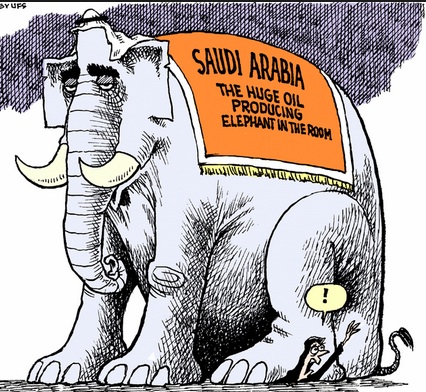

Saudi Arabia Needs Money

Putting the Community Back in Banking

Victoria McCrane writes: Hundreds of community bankers in Washington, DC this week will be raising concerns with lawmakers about the stalled nomination of one of their own to fill an open seat on the Federal Reserve’s seven-member board of governors.

Nearly 1,000 small bankers are in town for a policy summit hosted by the Independent Community Bankers of America, a trade group, and will be meeting with members of Congress and regulators to press policy priorities, including the pending nomination of former Bank of Hawaii chief executive Allan Landon to fill one of two empty seats on the Fed board.

Senate Banking Chairman Richard Shelby (R., Ala.), whose panel must consider Mr. Landon’s nomination before it can get a full vote on the Senate floor, said he told the White House a couple of weeks ago he won’t schedule a hearing for Mr. Landon until the president nominates a candidate for the other open seat at the Fed.

“We’ll see if they come up with two, and we’ll see what we can do,” Mr. Shelby said Tuesday. “They’ve got another opening. You know, they’ve never been in a hurry,” he said of the administration’s speed on filling open Fed seats.

The delay does not appear fueled by any GOP objections to Mr. Landon himself. Republicans as well as Democrats had been pushing the White House to embrace a candidate with community banking experience and none has publicly raised any complaints about Mr. Landon’s background.

“As is standard when we have vacant positions, the White House is conducting a comprehensive search for experienced and highly qualified individuals,” a White House spokeswoman said about the other vacant Fed governor slot. “When we are prepared to make an announcement, we will do so.”

Mr. Shelby noted that Mr. Obama also has failed to nominate a vice chairman of supervision at the Fed, a new role created by the 2010 Dodd-Frank law to oversee the central bank’s significant regulatory powers. “We’ve asked them about [that vacancy] over and over. They ought to think about that too,” Mr. Shelby said.

ICBA is now pressing the White House to produce another Fed nominee as well as pushing the issue on Capitol Hill.

Community bankers lobbied for years to get someone who understands their point of view onto the Fed board, and enlisted the help of several members of Congress to press the White House. President Barack Obama’s nomination of Mr. Landon in January was seen as a major victory for small bankers.

Entrepreneur Alert: New Price Control Technique from US Govt.

The Army announced it had chosen Harris and Thales to make its Rifleman Radio, the 21st century walkie-talkie that links foot troops into the Army’s command network.

Thales and Harris will split the next five years of Full Rate Production. It won’t be a 50:50 split, but rather an ongoing competition: Assuming that both Thales and Harris pass Army testing, the service will then buy radios in lots, with both companies competing to offer the lowest price. The Army will ultimately buy more than 150,000 FRP Rifleman Radios, but after five years, there’ll be a new competition, so Thales and Harris hardly have a perpetual lock on the program.

The award marks a historic shift in how the military buys radios — a shift that may be replicated in other areas. General Dynamics is a classic defense contractor: Its divisions build everything from nuclear powered submaines to armored ground vehicles, but it builds them all for the armed forces. Harris just builds radios, but it builds them for everybody: the police and the general public.

As Moore’s Law races ahead, high-tech has become a commodity, and with Rifleman Radio, the Army is buying it as such. Modern digital, software-defined radios are essentially computers that communicate wirelessly — something the civilian IT world builds far better than most traditional defense contractors. So instead of developing military-specific systems like JTRS, only to have the commercial sector lap the Pentagon procurement process and render the military tech obsolete on arrival, the Army is buying the radios as Non-Developmental Items (NDIs).

The crucial question is whether the military can replicate this model and take better advantage of competition and commerce innovation.  The  Defense Secretary went to SIliocn Valley to find out.

 Radios?

Accessing Information: War by Any Name?

Robert Hackett writes:  A report out of Arlington, Va.-based cyber security firm Lookingglass reveals a cyber campaign, allegedly Russian, waged against Ukrainian targets, such as the government, law enforcement, and military. The purpose of the state-sponsored espionage has apparently been to gather intelligence on its adversary, bolstering Russian war efforts.

The researchers dubbed the campaign “Operation Armageddon”. “For the most part the technologies were not advanced,” says Jason Lewis, chief collection and intelligence office at Lookingglass. “It’s not super sophisticated, but it’s certainly persistent.”

Lookingglass researchers worked with neither Ukraine nor Russia in its investigation, sourcing its materials rather from proprietary methods and through sites like VirusTotal, a public database where people can upload and scan files for known viruses.

Often, the researchers found, the hackers stole documents relevant to the outside conflict from victims’ machines, and then used those files to compromise future targets.

Once Ukraine’s interim President announced the start of an “anti-terrorist operation” against pro-Russian separatists in mid-April 2014, the conflict’s cyber activities significantly increased. From this point onwards, waves of cyber attacks from the Russians directly correlated with the timing of military events and were geared towards gathering intelligence to empower themselves on the physical battlefield – a digital method of espionage in its truest of forms.

The Lookingglass researchers, convinced that Russia is the culprit, agree with the Security Service of Ukraine (SBU) that the Russian Federal Security Service (FSB, descendant of the KGB) is to blame. (SBU, too, has called out FSB as being responsible for recent phishing attacks.) “We’re highly confident that the claims the SBU made are accurate,” Lewis says. “We didn’t find any evidence to the contrary to dispute those claims.”

That nation states are using cyber attacks to achieve geopolitical ends should come as no surprise.

Last year, CrowdStrike associated Chinese cyber espionage campaigns with China’s movement into disputed territory in the South Pacific as well as with an ISIS-led takeover of an Iraqi oil refinery. The security firm FireEye FEYE -1.07% found state actors using attack methods similar to those outlined above to target rebel forces during conflict in Syria. The security firm Cylance recently implicated Iran as having probed critical U.S. energy infrastructure, just prior to nuclear negotiations. And then, of course, there are the claims about Sony Pictures Entertainment and North Korea.

Espionage and cyber attacks can give countries that engage in the practice an upper hand in international affairs. “Nation states need to be able to asses how seriously people will take their threats and what they’ll do as result of a threat,” says Adam Meyers, vice president of intelligence at the security firm CrowdStrike, presenting a rationale for digital incursions. “It puts them in a better position to make a credible threat if they know what the response is going to be.”

Indeed, recent reports suggest that Russian spies have penetrated deep inside Ukraine’s intelligence apparatus.

Hacking as War?

Match.com for Jobs?

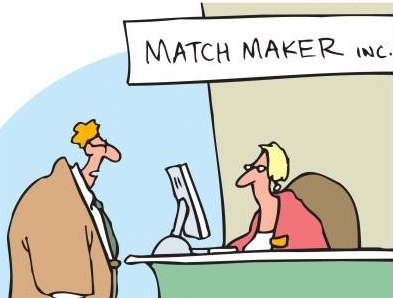
Should Match.com be brought into the workforce and match employees with jobs?  The US Secretary of Labor, Thomas Perez, thinks this would be a good idea.

Labor Secretary Thomas Perez wants the Obama administration to be the economic version of a dating website. “Match.com: Our goal is to match jobseekers who want to punch their way to the middle class with businesses,” Perez said Wednesday at a speech in Washington. He added that U.S. officials need to “step up our game” and reevaluate the old models that ushered young people into the economy.

“We’ve got to get rid of the old models of train-and-pray where you train people for jobs and pray people will find them for those jobs,” Perez said at the forum, hosted by the center-left think tank Third Way. “If people aren’t hiring widget makers — we shouldn’t train people to be widget workers.”

Match.com for Jobs

Fiorina Throws Her Hat in the Presidential Ring

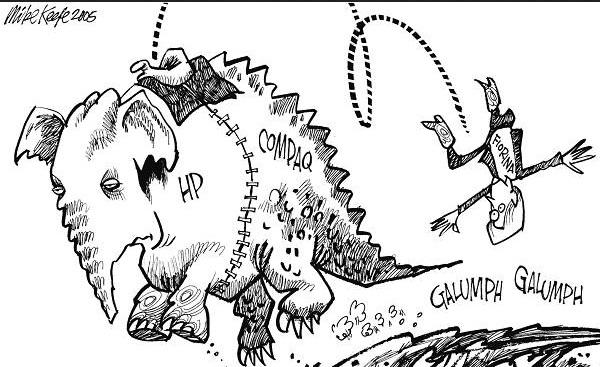
Kevin Cirilli writes:  Carly Fiorina’s political future depends on whether she can defend her record as CEO of Hewlett-Packard.

Fiorina said members of her own board leaked confidential information to the media to undermine her decisions, though she stopped short of alleging outright sexism. She was the first female CEO of a Fortune 20 company.

“Men understand other men’s need for respect, but they don’t always understand women’s need for respect,” Fiorina said. “The situation that transpired in the boardroom was all about certain board members wanting to protect their position when they felt threatened, because their behavior was against the code of conduct, and they knew that I as a leader would not tolerate that conduct.”

When asked again if she thought underlying sexism contributed to her firing, she said, “There’s no question that women in positions of authority are scrutinized differently, criticized differently and characterized different.”

Following her departure, she said HP officials monitored her phone calls to see if she had been the one leaking the negative information.

“Set aside the legality for a moment — that is a terrible practice for a board to engage in, and it’s evidence of their dysfunction,” she said.

Both critics and supporters portray her as a determined leader. She was ousted, detractors say, partly because of declining stock price and a controversial merger with Compaq that butted heads with HP’s founders’ vision for the future.

Still, she said President George W. Bush called to offer her a job in his administration the day after she was fired, though she declined to say which one.

Another phone call she received was from the late Apple CEO Steve Jobs. She said he urged her to take her time and not do anything for at least six months. She said Jobs told her HP would “regret” firing her one day.

Fiorina is hardly a presidential front-runner. But as the only likely female Republican presidential candidate, she has an important place in the field.

She is often mentioned as a potential vice presidential pick to the eventual Republican nominee. And her supporters praise her fiery speeches that frequently take on Hillary Clinton, the Democratic front-runner.

But her business record has resurfaced as she’s stepped back into the media limelight. Earlier this month, MSNBC’s “Morning Joe” co-host Mika Brzezinski confronted Fiorina about her business record during a contentious appearance.  Fiorina said she made tough choices that were best for the company.

Carly Fiorina and HP

Abe Pitches TPP

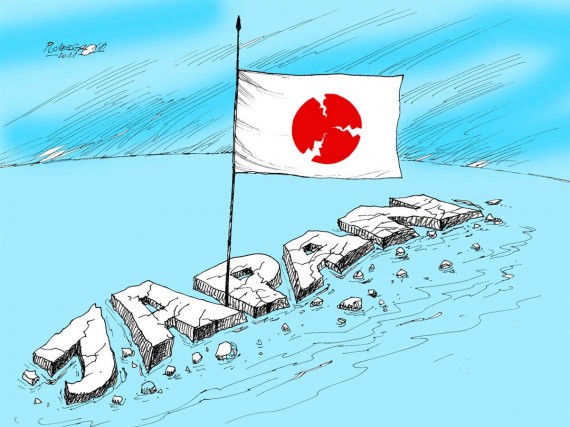
John Hudson writes:  Japanese Prime Minister Shinzo Abe made his most high-profile pitch yet for a trans-Pacific trade pact that has divided U.S. lawmakers and turned liberal Democrats against the White House over concerns about job losses and wage stagnation.

Abe said the Trans-Pacific Partnership, a trade proposal that would lower tariffs and harmonize regulations across 12 Pacific Rim countries, would strengthen the Japanese and American economies while bringing competing nations in line with an array of labor and environmental standards — a claim many Democrats view with skepticism.

“The U.S. and Japan must take the lead,” said Abe, the first Japanese leader to address both houses of Congress since World War II. “We must take the lead to build a market that is fair, dynamic, sustainable, and is also free from the arbitrary intentions of any nation.”

Abe painted a picture of Japan as the rule-abiding, democratic partner for the U.S. in forging standards for trade in Asia. Abe’s description casts Japan as the Asian country with the same economic values as the U.S., as opposed to China, though Abe mentioned Asia’s biggest economy only in passing. Advocates of the trade deal argue that the U.S. and Japan need to write the rules for business in Asia, lest Beijing do it for them.

Both Abe and President Barack Obama have touted their progress on the Trans-Pacific Partnership (TPP) during the Japanese leader’s visit to Washington. But no breakthroughs have been announced on the significant sticking points that still exist in the negotiations, namely agriculture and automobiles.

The trade agreement, along with another European trade pact, are both part of the Obama administration’s ambitious agenda to lower barriers for U.S. companies abroad and increase exports.

TPP still faces stiff opposition both in Japan and the U.S. Many Americans associate trade pacts with job losses that happened across the country as globalization spurred outsourcing by many U.S. companies in the 1980s and 1990s.

In addition to convincing the public in America and Japan, Obama and Abe must also persuade their local industries and legislators.

A group of Democrats accused Tokyo of manipulating the yen to boost exports — a claim that is disputed by economists but has nevertheless galvanized Democrats skeptical of global trade.

While avoiding the issue of currency manipulation entirely, Abe did seek to allay concerns that a TPP deal would spawn a race to the bottom among competing Pacific Rim countries.

The Republican 2016 presidential contenders have been broadly supportive of the trade deal, as have most Republicans, but the issue has been tricky for Democratic frontrunner Hillary Clinton, whose liberal base is more skeptical of free trade. As Secretary of State, Clinton called the TPP the “gold standard” in efforts to expand free and fair trade, but in recent days, she’s been increasingly noncommittal.

But first things first: Obama and Abe still need to solve lingering trade issues between the two countries, particularly respect to rice and automobiles.

Japan and US


Migration of Illegal Minors to US Slowing

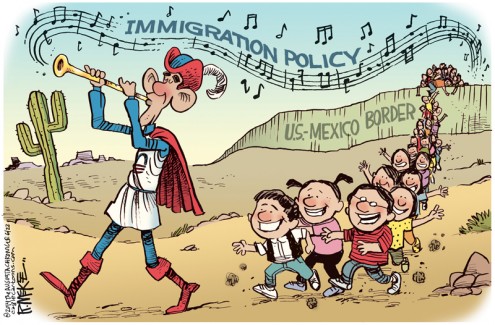
The Mexican government has been deporting illegal immigrants from Central America.  This concerted effort has in turn slowed down the migration of illegal minors across the US-Mexican border.

Those actions clearly have not halted migration. But the increasing difficulty of the trek — combined with high temperatures, the brisk pace of the deportation of Central Americans and a public-relations campaign warning people that they will not get visas in the US — is among the factors that may explain why fewer migrants are now crossing into the southwestern United States, with a particular decrease in the number of children traveling alone or with a relative.

Last month, 3,141 children traveling without a parent were apprehended at the United States-Mexico border, a 70 percent decrease from June.

Events this week in Baltimore show clearly that the US is not able to take care of its own young people, much less those of other countries. Slowing the Illegal Immigration of Minors to the US

Slowig Illegal Immigration of Minors

Upping Equity Requirements for Banks?

SImon Johnson writes: The main financial risk facing the United States today looks very similar to what caused so much trouble in 2007-2008: big banks with too much debt and too little equity capital on their balance sheets. Uneven global regulations, not to mention regulators who fall asleep at the wheel, compound this structural vulnerability.

All booms are different, but every major financial crisis has at its heart the same issue: major banks get into trouble and teeter on the brink of collapse.

The most important question to ask of any financial system is how much loss-absorbing equity major banks have on their balance sheets. When a company suffers losses, its shareholder equity falls in value, and less equity means that the company is more likely to default on its debts.

The capital ratios most frequently highlighted by banks and officials are misleading, because they include items – such as goodwill and deferred tax assets – that are incapable of absorbing losses. We need to look instead at tangible equity relative to tangible assets. And we should also be very careful about the accounting used for derivatives.

Thomas Hoenig, vice chairman of the Federal Deposit Insurance Corporation, publishes his own calculation of capital levels at the world’s largest banks, and these data are now available through the end of 2014. The most leveraged big US bank, Morgan Stanley, has less than 4% equity, meaning that 96% of its balance sheet is some form of debt. The average for big US banks is just under 5% equity.

This is more – but not much more – capital than some troubled banks had in the run-up to the financial crisis in 2008. Citigroup, for example, had no more than 4.3% equity, according to Hoenig’s calculation, in November 2008. At the end of 2012, when Hoenig started to publish his US GAAP-IFRS adjustment, the average for the largest US banks was roughly 4% equity. It is possible to argue that this key measure is moving in the right direction, but the pace of improvement is glacial at best.

More important, 5% equity is unlikely to be enough to absorb the kinds of losses that a highly volatile world will throw up.

The most dangerous shocks may be those that originate with the big banks themselves. The latest significant development to surface is what Better Markets, a pro-reform group that has put out a helpful fact sheet, calls “de facto guaranteed foreign subsidiaries” that trade derivatives – a murky phenomenon that likely involves all the big players. The trick here is that a de jure guaranteed foreign subsidiary of a US bank would have to comply with many US rules, including those governing conduct, transparency, and clearing (how the derivatives are actually traded). A foreign subsidiary that is supposedly independent is exempt from those rules.

The main reason why such loopholes are left open is that regulators choose not to close them. Sometimes this may be due to lack of information or awareness. But, in many cases, the regulators actually believe that there is nothing wrong with the behavior in question – either because they have been persuaded by lobbyists or because they themselves used to work in the industry (or could go work there soon.)

Sound familiar?

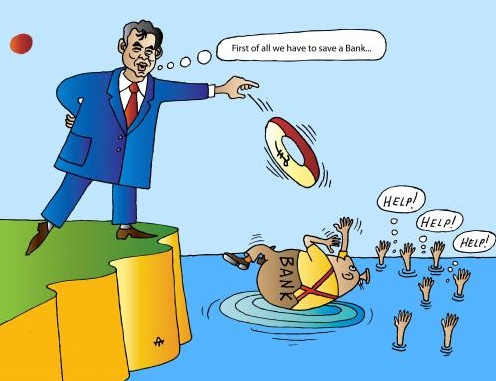
Saving Banks?

AIIB Connects with the World, US Excepted

Andrew Sheng writes: Despite official American and Japanese opposition, 57 countries have opted to be among the founding members of the China-led Asian Infrastructure Investment Bank (AIIB). Regardless of what naysayers believe, this remarkable turn of events can only benefit global economic governance.

According to former US Treasury Secretary Larry Summers, the AIIB’s establishment “may be remembered as the moment the United States lost its role as the underwriter of the global economic system.”

Who is right will depend largely on the decisions that the AIIB’s top shareholders make regarding its operating structure. So far, the AIIB has not sought to amend the principle that the largest contributor to a multilateral organization gets the largest say in running it.

This implies a larger global leadership role for China. Massive debts have lately undermined the ability of the US – not to mention Europe and Japan – to continue making such large contributions to hte IMF.  Fortunately, China is willing and able to fill the gap.

China has a 3.8% voting share in the IMF and World Bank, even though it accounts for more than 12% of world GDP.

The AIIB has its own objectives, which do not align precisely with those of, say, the World Bank. Specifically, the bank is a critical element of China’s “one belt, one road” strategy, which encompasses two initiatives: the overland Silk Road Economic Belt, connecting China to Europe, and the 21st Century Maritime Silk Road, linking China to Southeast Asia, the Middle East, and Europe.

Connectivity is vital to economic growth. Over the last three decades, the construction of roads, railways, ports, airports, and telecommunications systems in China has fostered trade, attracted investment, and, by linking the country’s land-locked western and southern provinces to its more prosperous coastal areas, helped to reduce regional disparities.

China’s Silk Road initiative, which aims to boost prosperity among China’s trading partners largely through infrastructure investment, is a logical next step – one on which China is spending significantly.t.

Given massive global demand for infrastructure finance – which, according to ADB estimates, will amount to $8 trillion in Asia alone over the next decade – the AIIB should not be considered a threat to the World Bank, the ADB, or other multilateral lenders.

The AIIB’s operations will most likely resemble those of the World Bank in the 1960s, when engineers with hands-on development experience dominated the staff and could design lending conditions that worked for borrowers.

The acid test of the AIIB’s effectiveness will be its governance model. One failing of the Bretton Wood institutions is their full-time shareholder boards of directors, which tend to undermine effectiveness by micro-managing and often requesting conflicting lending conditions.

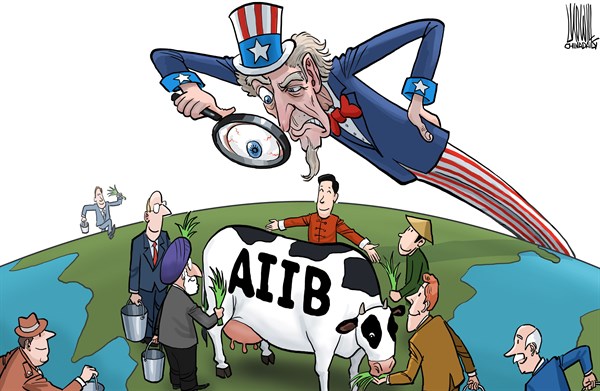
US and AIIB

Even if the AIIB does not deliver as promised, its establishment is an important reminder that in a fast-changing world, economic governance cannot remain stagnant. If Western leaders really do believe in innovation, competition, and meritocracy, they should welcome the AIIB.