Wall Street’s Stringer?

Matt Levine points out how politics works US style.  Particularly in New York, the traditional home of US finance:

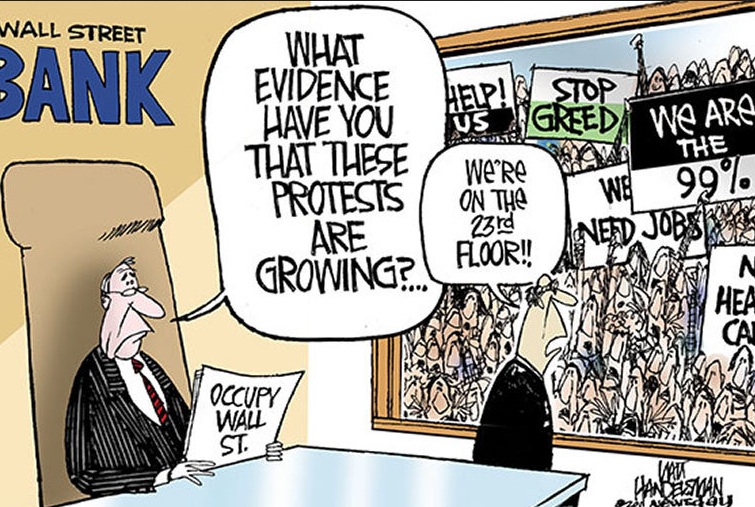
Remember how New York City Comptroller Scott Stringer was shocked to find out that New York’s pension funds pay investment management fees to “Wall Street”? Which includes paying a few basis points to traditional stock and bond managers, and one or two hundred basis points to “alternatives” (private equity, real estate, etc.) managers?

Stringer was pushing Albany lawmakers to pass a bill that would have allowed an additional 10 percent of the city’s $160 billion pension system — or $16 billion — to be invested in alternatives. Assuming the industry standard 2 percent management fee on such investments, that shift could have generated more than $300 million in new Wall Street fees every year.

Stringer championed the bill following a 2013 election campaign that saw him benefit from an influx of campaign contributions from financial executives after former Wall Street prosecutor (and former governor) Eliot Spitzer jumped into the race for comptroller. During the campaign, Stringer declared that he wanted the city to consider moving more pension money out of low-risk bonds and into Wall Street firms. Upon taking office in 2014, he argued that the existing law prohibiting more than a quarter of the city’s pension fund from being invested in alternatives was too restrictive.
Wall Street Fees

US Regulators Spoofed?

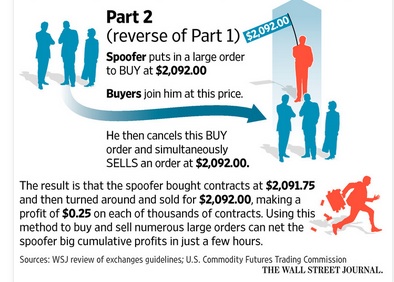
John Cochrane writes in his Grumpy Economist blog: Just when you thought financial regulation couldn’t get more expansive and incoherent, our Justice Department comes in to defend morons’ right to herd.  Mr. Navinder Singh Sarao is now under arrest, fighting extradition to the US, and his business ruined, for “spoofing” during the flash crash.

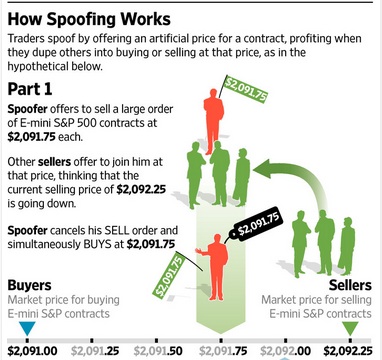
What is that? The Journal’s beautiful graph at left explains.Spoofing 1Spoofing 2
The obvious question: Who are these traders who respond to spoofing orders by placing their own orders? Why is it a crucial goal of law and public policy to prevent Mr. Sarao from plucking their pockets? Is “herding trader” or “momentum trader” or “badly programmed high-speed trading program” or just simple “moron in the market” now a protected minority?

Why is Mr. Sarao being prosecuted and not all the people who wrote badly programmed algorithms that were so easily spoofed? If this caused the flash crash (how, not explained in the article) are they not equally at fault?

I don’t mean by this a defense of the crazy stuff going on in high speed trading.  I think one second batch auctions are a much better market structure.  But the whole high speed trading thing is largely a response to SEC regulations in the first place, the order routing regulation, discrete tick size regulation, and strict time precedence regulation. A fact which will probably not enter at Mr. Sarao’s trial (he doesn’t seem to have billions for a settlement) and will give him little comfort in jail.

And maybe, just maybe, there is something more coherent here than the Journal lets on. I’ll keep reading hoping to find it and welcome comments who can.

A larger thought. We still really want to rely on regulators to spot all the problems of finance and keep us safe from more crashes?

How to Address Currency Manipulation?

Kemal Davis writes: It is impossible to deny that trade and exchange rates are closely linked. But does that mean that international trade agreements should include provisions governing national policies that affect currency values?

Some economists certainly think so. Simon Johnson, for example, recently argued that mega-regional agreements like the Trans-Pacific Partnership should be used to discourage countries from intervening in the currency market to prevent exchange-rate appreciation;

As it stands, the relevant international institutions — the World Trade Organization and the International Monetary Fund — are not organized to respond effectively to possible currency manipulation on their own. Incorporating macroeconomic policies affecting exchange rates into trade negotiations would require either that the WTO acquire the technical capacity (and mandate) to analyze and adjudicate relevant national policies or that the IMF join the dispute-settlement mechanisms that accompany trade treaties.

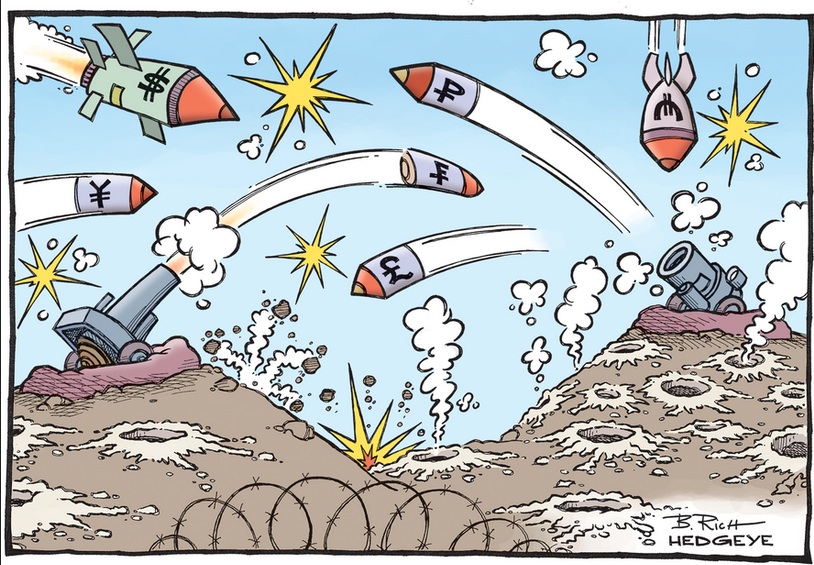
The most direct method is purchases of foreign assets. But, in a world of large short-term capital flows, central-banks’ policy interest rates – or even just announcements about likely future rates — also have a major impact. Moreover, quantitative easing affects exchange rates and trade, even if central banks purchase only domestic assets, as demonstrated by recent movements in the exchange rates of the dollar, the euro, and the yen.

Consider the problem that would be posed by the eurozone.  Most eurozone countries have lately been forced to tighten fiscal policy, thereby reducing or eliminating their current-account deficits.  As a result, the total eurozone trade surplus is now massive. Because individual eurozone members have no monetary-policy tools at their disposal, the only way that Germany can reduce its surplus while remaining in the eurozone is to conduct expansionary fiscal policy. The economist Stefan Kawalec has explicitly referred to the current policy mix in the eurozone as “currency manipulation.”

None of this means that macroeconomic policies that affect exchange rates are not problematic. They are. But trade negotiations are not the right forum for discussing the causes and consequences of current-account imbalances.

A better approach would include strengthening the IMF’s multilateral surveillance role. Doing so would broaden discussions of macroeconomic policy to include employment issues — specifically, the potential impact of large foreign-trade surpluses on domestic jobs. And it would give trade negotiations a chance to succeed.

Currencies

Encouraging Girls to Enter the Technology Field

Angela Merkel celebrate International Girls in ICT Day in Berlin before she left for Brussels.

International Girls in ICT Day is an opportunity for girls and young women to see and experience ICTs in a new light encouraging them to consider a future in technology. To date, over 111,000 girls and young women have taken part in more than 3,500 events held in 140 countries around the world.  Ghana, Lebanon, Brazil, et cetera!

The Girls in ICT initiative of the International Telecommunication Union (ITU) is a global effort to raise awareness on empowering and encouraging girls and young women to consider studies and careers in ICTs. The initiative is committed to celebrate and commemorate the International Girls in ICT Day on the fourth Thursday of every April as established by the ITU membership.

The Girls in ICT Portal is a tool for girls and young women to get an insight into the ICT sector as well as for partners to understand the importance of the International Girls in ICT Day, developed by the Digital Inclusion programme of ITU Telecommunication Development Bureau.

Girls in Tech

Ten Sustainable Companies for Earth Day

Andrew Winston writes in the Harvard Business Review:   The NGO Ceres has gotten an impressive array of companies to sign onto the Climate Declaration, which states that climate change is both a threat and a major economic opportunity. But this year, a smaller Ceres group, BICEP, which is calling for more aggressive policies like a tax on carbon, added some very mainstream companies such as General Mills, Kellogg’s, and Nestle (perhaps not coincidentally, General Mills announced early this year that its earnings were reduced by extreme weather).

In the wonky, trendy vocabulary of working together, “collaboration” isn’t exciting enough without the now-hot modifier of “pre-competitive” (meaning: stuff fierce rivals can do collectively that doesn’t diminish their ability to compete). Walmart and Target demonstrated how this works by convening a Personal Care Products Sustainability Summit. All the major players in the personal care product value chain — the giants of consumer products, chemicals, and fragrances — were there (as was I). The general topic was how this group could reduce the physical and chemical impacts of all those gels and liquids we use on our bodies, and the group will continue to work together and convene to tackle thorny issues in the value chain.  Sustainability

Sustainability

Can Policy Change on High Speed Trading?

Everett Rosenfeld writes:  A UK trader is charged for manipulation contributing to 2010 flash crash.

A high-frequency futures trader has been charged with illegally manipulating the stock market, contributing to the May 2010 “flash crash,” according to documents unsealed Tuesday.

The US Justice Department charged the United Kingdom’s Navinder Singh Sarao with wire fraud, 10 counts of commodities fraud, 10 counts of commodities manipulation and one count of spoofing (which is when a trader places a bid or offer with the intent to cancel before execution).

Sarao was arrested Tuesday in the U.K., and the U.S. is requesting his extradition, the DOJ said. The charges were filed in a federal complaint in February, but were unsealed Tuesday following the arrest.

The Commodity Futures Trading Commission also filed parallel civil charges against Sarao on Tuesday, calling him a “very significant player in the market.”

The CFTC alleged that Sarao was believed to have profited by about $40 million for his scheme. U.S. authorities have frozen nearly $7 million worth of his assets and accounts, Aitan Goelman, CFTC director of enforcement.


Spoofing

What Happens When the Government and Silicon Valley Team Up on Security?

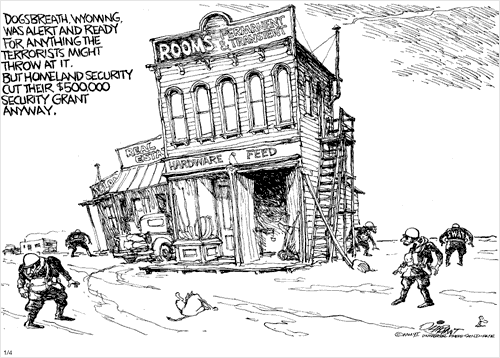
Shane Harris writes: The Department of Homeland Security is finalizing plans to open a “satellite office” in Silicon Valley that will work with tech companies to improve cyber security and recruit people to work for the government, Security Secretary Jeh Johnson announced Tuesday.”We want to strengthen critical relationships in Silicon Valley and ensure that the government and the private sector benefit from each other’s research and development,” Johnson said in a keynote speech to the RSA Conference, a major annual gathering in San Francisco of cyber security companies, hackers, journalists, and government officials. “And we want to convince some of the talented workforce here in Silicon Valley to come to Washington.”Relations between the technology industry and the U.S. government have been strained in the past two years following revelations by Edward Snowden of global surveillance, particularly by the National Security Agency. U.S. tech giants have accused the government of pushing them to weaken security and of spying aggressively on their customers. In response, some companies, most notably Apple, have stepped up the use of encryption to foil government snooping. At the same time he encouraged tech employees to “consider a tour of service for your country,” Johnson stepped back into the encryption debate. “Our inability to access encrypted information poses public safety challenges. In fact, encryption is making it harder for your government to find criminal activity, and potential terrorist activity,” Johnson said. He asked companies to work with the government to find “a solution to this dilemma” that would “take full account of the privacy rights and expectations of the American public, the state of the technology, and the cybersecurity of American businesses.”

Homeland Security

Illegal Wildlife Traffic on eBay?

Ted Williams writes:   Illegal trade in imperiled wildlife is rampant, and attempted controls are few and largely ineffective. Log on to most any international internet store that deals in wildlife or wildlife parts, and you’ll find a charnel house of endangered and protected species hawked openly or under phony names and in violation of US law and international agreements.

The world’s largest online marketplace by far, eBay, is one of the few that makes a serious effort to control wildlife smuggling by deleting ads for illegal products — but only the few it notices or hears about. Chris Nagano of the US Fish and Wildlife Service’s Endangered Species Division is a trained lepidopterist. When I asked him if he sees any ads for illegal butterflies on eBay he replied: “There are a number of imperiled butterflies openly advertised on eBay, including some listed under the Endangered Species Act or protected under laws of countries they inhabit. Some of these species are sold to collectors for hundreds or even thousands of dollars.”

Ivory products are the most popular wildlife items on internet markets, despite a global ban on ivory sales imposed by the 180-nation Convention on International Trade in Endangered Species (CITES). The National Academy of Sciences, a body of scholars established by the US Congress, estimates that 100,000 elephants were killed by poachers between 2010 and 2012, mostly to sate ivory demand of China’s newly-moneyed middle class. At that unsustainable rate elephants are likely to be extinct in the wild within two decades.  Illegal eBay Wildlife Sales

Illegal Butterfly Sales

EU Takes on Gazprom?

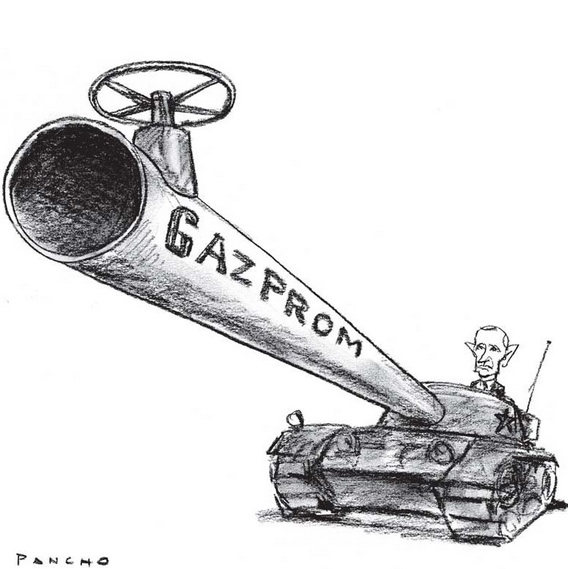
Keith Johnson writes:  European Union competition officials will likely throw the book at Russian energy giant Gazprom on Wednesday, flexing Brussels’s strongest muscle and potentially reshaping an energy sector that has worked largely to Moscow’s advantage since the 1970s.

EU Competition Commissioner Margrethe Vestager is expected to charge Gazprom with a bevy of anti-competitive practices, including denying pipeline access to other energy suppliers and charging discriminatory prices to certain customers.

This threatens to further ratchet up tensions between Brussels and Moscow that have been severely strained over the Ukraine crisis.

The EU case takes aim at three pillars of Gazprom’s longtime business model in the European market, the Russian firm’s biggest outlet for natural gas. At issue are Russian restrictions on the free flow of gas between European countries; limits on third-party access to gas pipelines; and the linkage of gas prices to crude oil prices, which EU officials argue has led to discriminatory pricing. All three practices under investigation potentially undermine Europe’s energy security. If they can be resolved either through negotiations with Gazprom or in the courts, it would help create a genuinely unified European energy market better able to withstand supply shocks.  EU Tightens Screws on Gazprom

Gazprom?


Renzi: End Slave Driving and Set up Immigration Centers in Africa

Dan Bilefsky writes: Prime Minister Matteo Renzi of Italy has issued a plea for collective action, and he alluded to a call for the creation of centers in Africa that would process asylum applications in a bid to spare many the perilous sea crossing to Europe.

Italy has become the main target of a wave of migrants trying to cross the Mediterranean Sea on often unseaworthy vessels such as the ship that capsized off the coast of Libya over the weekend, killing as many as 900 people.

Mr. Renzi called for the European Union to have a more coordinated strategy, including expanding search-and-rescue patrols and taking action against smugglers in Libya and elsewhere, whom he referred to as “21st-century slave drivers.”

He also evoked an idea that has previously circulated in Brussels: the establishment of migration centers in African countries, in cooperation with the United Nations, so that would-be migrants could apply for asylum in the European Union from their home countries rather than set off on potentially deadly journeys in search of refuge in Europe.On Thursday, European leaders are expected to discuss proposals to double the size of search-and-rescue operations in the Mediterranean; increase the budget for Frontex, the European Union’s border agency; improve cooperation between the police across the bloc; and intensify the battle against smugglers and human traffickers.

European Union officials said on Wednesday that the current budget for the bloc’s border protection operation, known as Triton, was about 3 million euros, or $3.2 million, a month, and that the operation’s resources included two aircraft, two helicopters, six coastal patrol vessels and about 65 officers. Even doubling that would probably not be enough to deal with the scale of the migration crisis, analysts said.

The number of people who have died in the Mediterranean Sea this year is thought to have already reached 1,727 migrants, according to the International Organization for Migration — more than 30 times last year’s death toll.

However, efforts to forge a common and robust European approach to immigration have faced several challenges in recent years, including weak political will at a time when budgets are stretched and far-right parties that have gained in popularity across the Continent by tapping into resentment against immigrants.

The efforts to forge a new European strategy on immigration have also been stymied by the fact that migration policy in the 28-member union is mostly the preserve of national governments rather than Brussels.