US and the Artic Council

Baffin Island in Canada’s far north is the site for a biennial summit meeting of the Artic Council

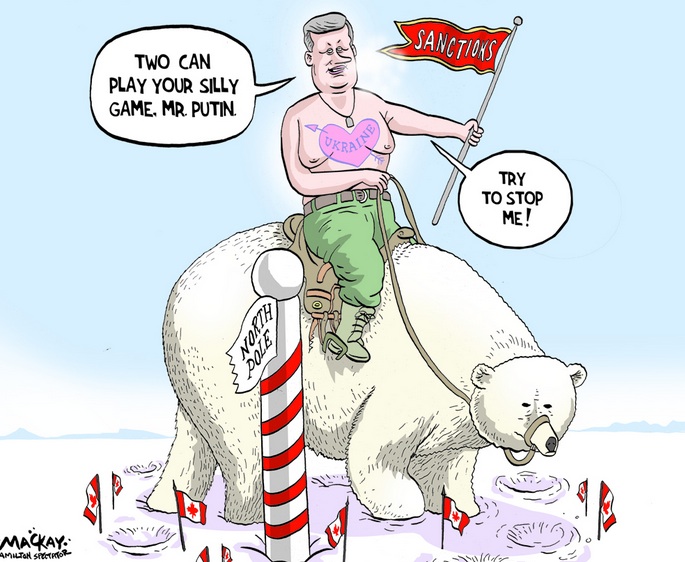
Russia’s involvement in Ukraine  has resulted in sanctions and travel bans on dozens of officials and a prohibition of the sale of American technology and services to help Russia tap its potentially enormous energy resources in the Arctic.

President Vladimir V. Putin views those as hostile acts.   “There is a pushing of the envelope here,” said Senator Lisa Murkowski, Republican of Alaska, who attended the meeting of the Artic Council as part of an American delegation led by Secretary of State John Kerry.

“The Arctic should be this zone of peace,” Ms. Murkowski said during a recent speech at the Center for Strategic and International Studies in Washington, alluding to the council’s founding purpose. “I absolutely believe that, adhere to it, but I also recognize that within a zone of peace, there is respect that you show for one another.”

The Arctic Council — made up of Canada, Denmark, Finland, Iceland, Norway, Russia, Sweden and the United States, as well as observer nations and organizations — was created in 1996 as a diplomatic forum to address issues that arose from the increased activity in the region.

The council was never intended to be a forum for debating military and security matters, and until recently, it appeared to be immune to broader political differences.

At the council’s meeting in Nuuk, Greenland, in 2011, the members adopted their first legally binding agreement to coordinate search-and-rescue operations over 13 million square miles of ocean.

At this year’s meeting, the nations agreed to discuss how to reduce the amount of methane and black carbon emitted by burning wood or fuels in the Arctic.

Russia’s military activity in the Arctic and its vast territorial claim to waters there highlight the strategic priority that Mr. Putin has given to the region. The intensifying competition over natural resources has increased the possibility of confrontation.

The spat over the Russian excursion to the North Pole centered on the delegation’s layover in the Svalbard archipelago, Norwegian territory about 500 miles north of the mainland that, under a 1920 treaty, grants commercial and residential rights to other countries, including Russia.

The United States has taken over the chairmanship of the council from Canada, allowing it to set the organization’s agenda for the next two years until the next summit meeting, to be held in Alaska.

In his remarks on Friday, US Secretary of State Kerry outlined what he called an ambitious set of goals, focused on ocean safety and security, economic development and, in particular, several steps to address climate change as part of President Obama’s push for stronger international action.
Artic Counctil

Equity Boom in China?

Angus Nicholson writes:   In 1987, a young man quit his job at the Hebei Oil Pipeline Bureau and went to seek his fortune in the nascent private property market of Hainan province’s Special Economic Zone. He was Pan Shiyi, now chairman of SOHO China, and one of China’s first private property developers. But he also experienced modern China’s first big real estate bust, when Hainan property prices crashed back to reality prices following a 1992 bull market inspired by Deng Xiaoping’s Southern Tour promoting his ‘reform and opening up’ policy platform.

Hainan is again at the forefront of a Chinese property slowdown.

Hainan may be an extreme case, but China’s property market will not return to its glory days of unrestrained growth.

The March figures from China’s National Bureau of Statistics (NBS) suggests that China’s property market slowdown will continue through 2015.

Construction starts that saw the most dramatic drop. Starts have dropped to their lowest level since October 2009, just before the Chinese government’s enormous 2009 stimulus package. This points to where the property slowdown is being felt most acutely, in new investment. Developers are now far less willing to invest in new projects and believe the market environment has shifted dramatically.Yu Liang president of major Chinese property developer Vanke Group, states that while government policies will help support the market, he is not expecting a major rebound. Yu thinks we have seen the end of the ‘Golden Age’ of the Chinese property market.

As if in unison, as the property market began its outright decline in the second half of 2014, China’s equity market sparked into life.

While the Chinese government does not control China’s stock markets, they are highly driven by policy changes. The share of bank financing in China’s financial sector and the associated concentration of risk has been a major concern for Chinese policymakers. The need to diversify risk across the financial system has driven the Chinese government’s support of corporations pursuing direct financing through China’s financial markets.

What the Chinese government really has little influence over is Chinese investors’ hunger for capital growth. With limited avenues for investment, Chinese investors often pile into asset classes all at once.

New brokerage account registrations and margin financing have exploded.

These are figures that would strike fear into the hearts of most central banks. But the People’s Bank of China (PBOC) is already battling on a number of fronts. The slowing economy, steady capital outflows and the disinflationary trend has tightened domestic liquidity.

This has lead the PBOC to begin, in the words of ANZ’s Liu Ligang, ‘an aggressive easing cycle’ with the weekend announcement of a 100 basis point cut to banks’ reserve requirement ratio (RRR).

How the government manages the equity market boom without precipitating a dramatic crash will be one of the most important stories for China in 2015. In the current environment one can sympathise with investors like Pan Shiyi who are diversifying into overseas assets.

China's Equity Market?

No Plan B for Greece?

Slovenian finance chief Dusan Mramor led the calls at a meeting of the bloc’s 19 finance chiefs on Friday to consider a “plan B” to mitigate the fallout if negotiations with Greece fail.

As Greece struggles to pay pensions and salaries, its government has failed to present a plan to revamp its economy that passes muster with euro-area officials who are withholding further aid.

In February, finance ministers gave the Greek government until the end of June to complete the deal and said they expected a list of reforms by the end of April.

“Some countries have said, because of their concern on the lack of progress and the attitude on the Greek side, ‘if it continues like this, we will really get into trouble,’” Dutch Finance Minister Jeroen Dijsselbloem said “In that context plan B has been mentioned.”

Still, ministers were left frustrated that European Economic Commissioner Pierre Moscovici clamped down on discussions of a backup plan. They went on to air their concerns without him, one of the people said.

Finance chiefs aren’t saying in public that they’re contemplating alternative outcomes because that would send the message to markets that it’s game over, the person said.

“The central scenario is that in the Greece case we’re going to reach an agreement,” Spanish Economy Minister Luis de Guindos told reporters on Saturday. “That’s the only one that we’re considering.”

Varoufakis, who was attacked by his colleagues for his handling of the negotiations, joined Moscovici’s effort to prevent others in the group taking precautions in case the talks fail.

While finance ministers’ immediate concern is how to keep Greece in the euro area, if talks over refinancing break down, failure to prepare for a Greek default also risks reawakening the contagion threat that shook the bloc during the darkest days of the debt crisis.

Technical inspectors assessing the needs of Greece’s economy on behalf of the EU and International Monetary Fund told Friday’s meeting that they need to have better access to officials with political responsibility in Athens in order to speed up the process, according to de Guindos.

The dilemma for finance ministers is that just raising the prospect of a plan B risks making it a self-fulfilling prophecy.

Grexit?

Reform in China?

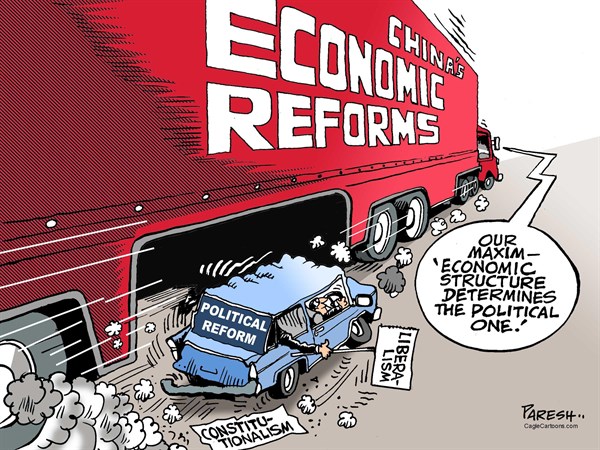
A scholar based in China writes:  Since the start of its post-Mao reforms in the late 1970s, the communist regime in China has repeatedly defied predictions of its impending demise. The key to its success lies in what one might call “authoritarian adaptation”—the use of policy reforms to substitute for fundamental institutional change. Under Deng Xiaoping, this meant reforming agriculture and unleashing entrepreneurship. Under Jiang Zemin, it meant officially enshrining a market economy, reforming state-owned enterprises, and joining the World Trade Organization. Under Hu Jintao and Wen Jiabao, it meant reforming social security. Many expect yet another round of sweeping reforms under Xi Jinping—but they may be disappointed.

The need for further reforms still exists, due to widespread corruption, rising inequality, slowing growth, and environmental problems. But the era of authoritarian adaptation is reaching its end, because there is not much potential for further evolution within China’s current authoritarian framework. A self-strengthening equilibrium of stagnation is being formed, which will be hard to break without some major economic, social, or international shock.

One reason for the loss of steam is that most easy reforms have already been launched. Revamping agriculture, encouraging entrepreneurship, promoting trade, tweaking social security—all these have created new benefits and beneficiaries while imposing few costs on established interests. What is left are the harder changes, such as removing state monop­olies in critical sectors of the economy, privatizing land, giving the National People’s Congress power over fiscal issues, and establishing an independent court system. Moving forward with these could begin to threaten the hold of the Chinese Communist Party on power, something that the regime is unwilling to tolerate.

Reform in China


Another reason for the loss of steam is the formation of an increasingly strong antireform bloc. Few want to reverse the reforms that have already taken place, since these have grown the pie dramatically. But many in the bureaucracy and the elite more generally would be happy with the perpetuation of the status quo, because partial reform is the best friend of crony capitalism.

China and the US in the Global Economy?

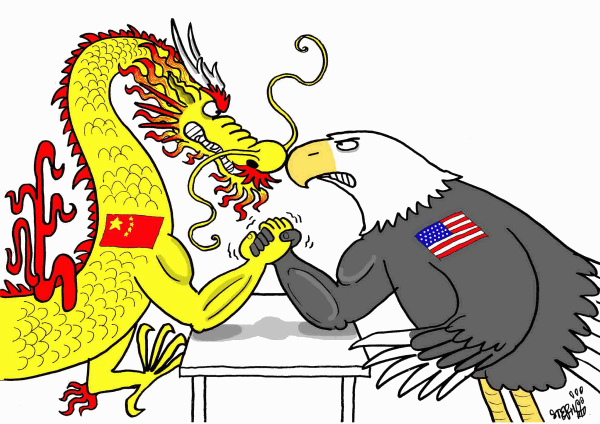
Jeffrey Frankel writes: China and the United States seem to regard Asia-Pacific relations similarly: as a zero-sum game. Are countries signing up for China’s Asian Infrastructure Bank or America’s Trans-Pacific Partnership?  Will China be welcomed, or humiliatingly rebuffed, in its effort to persuade the International Monetary Fund to include the renminbi in its unit of account, Special Drawing Rights (SDR)? Is the US still the world’s largest economy, or did China surpass it in 2014?

However tempting it may be to focus on such questions, they are the wrong way to think about the global economy. There is no reason why some countries should not join both China’s AIIB and America’s TPP, or why overlapping memberships should not expand over time – or, indeed, why the hostesses should not eventually attend each other’s parties.

There is nothing wrong with joining the AIIB. Asia needs more help with infrastructure investment than the World Bank and the Asian Development Bank can provide; China can play a useful leadership role; and the participation of countries with high governance standards can help prevent the cronyism, corruption, and environmental damage to which large-scale infrastructure projects are prone.

Likewise, the TPP negotiations are sometimes characterized as a US attempt to isolate China. But, given the Asia-Pacific region’s high trade volumes, and its dense set of trading arrangements running in every direction, no one, including China, is about to be isolated.

Exchange rates are another area where zero-sum thinking prevails.

Every five years, the IMF reconsiders its composition, which currently is defined in terms of the dollar, euro, yen, and pound.  A misplaced focus on country rankings can do real damage.

Such is the case with the stalled IMF quota reform, an issue where the rankings in fact are of some importance, but not in a zero-sum way. quota shares, implying greater financial contributions and greater voting weights.

Thirty years ago, the West wanted nothing more than for China to become a capitalist economy. It has done so, with spectacular success. The rules of the game now require that China be given a bigger share in the governance of international institutions.

China and the US

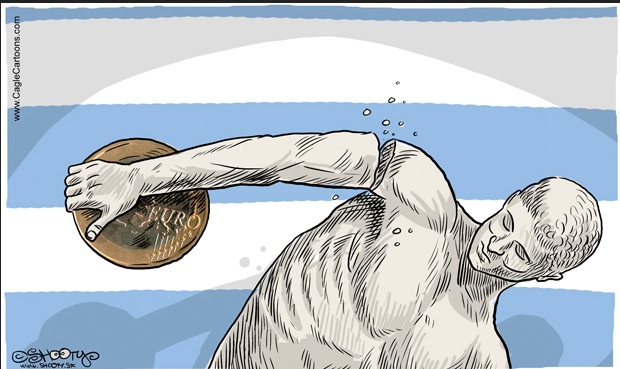
Greece: Coming to Terms?

Yanis Varoufakis writes:  Three months of negotiations between the Greek government and our European and international partners have brought about much convergence on the steps needed to overcome years of economic crisis and to bring about sustained recovery in Greece. But they have not yet produced a deal. Why? What steps are needed to produce a viable, mutually agreed reform agenda?

We and our partners already agree on much. Greece’s tax system needs to be revamped, and the revenue authorities must be freed from political and corporate influence. The pension system is ailing. The economy’s credit circuits are broken. The labor market has been devastated by the crisis and is deeply segmented, with productivity growth stalled. Public administration is in urgent need of modernization, and public resources must be used more efficiently. Overwhelming obstacles block the formation of new companies. Competition in product markets is far too circumscribed. And inequality has reached outrageous levels, preventing society from uniting behind essential reforms.

Beginning with fiscal consolidation, the issue at hand concerns the method. The “troika” institutions (the European Commission, the European Central Bank, and the International Monetary Fund) have, over the years, placed Greece in an austerity trap.

When fiscal consolidation turns on a predetermined debt ratio to be achieved at a predetermined point in the future, the primary surpluses needed to hit those targets are such that the effect on the private sector undermines the assumed growth rates and thus derails the planned fiscal path. Indeed, this is precisely why previous fiscal-consolidation plans for Greece missed their targets so spectacularly.

Our government’s position is that backward induction should be ditched. If this means that the debt-to-GDP ratio will be higher than 120% in 2020, we devise smart ways to rationalize, re-profile, or restructure the debt – keeping in mind the aim of maximizing the effective present value that will be returned to Greece’s creditors.

Besides convincing the troika that our debt sustainability analysis should avoid the austerity trap, we must overcome the second hurdle: the “reform trap.”  The previous reform program was founded on internal devaluation, wage and pension cuts, loss of labor protections, and price-maximizing privatization of public assets.

Our government believes that this program has failed, leaving the population weary of reform. The best evidence of this failure is that, despite a huge drop in wages and costs, export growth has been flat.

Additional wage cuts will not help export-oriented companies, which are mired in a credit crunch. And further cuts in pensions will not address the true causes of the pension system’s troubles (low employment and vast undeclared labor). Such measures will merely cause further damage to Greece’s already-stressed social fabric, rendering it incapable of providing the support that our reform agenda desperately needs.

The current disagreements with our partners are not unbridgeable. Our government is eager to rationalize the pension system (for example, by limiting early retirement), proceed with partial privatization of public assets, address the non-performing loans that are clogging the economy’s credit circuits, create a fully independent tax commission, and boost entrepreneurship. The differences that remain concern how we understand the relationships between the various reforms and the macro environment.

None of this means that common ground cannot be achieved immediately.

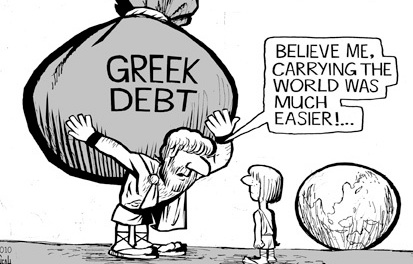
Greek Debt

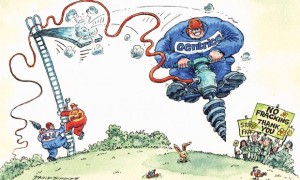
Shale Productions Costs Plummet

The cost to drill and complete a well is obviously the most critical cost category from the prospective of operator’s economics. This capital expenditure is incurred upfront whereas operating cash flows from the well are received over a long period of time and are heavily discounted as a result. The undiscounted upfront cost therefore has a strong effect on the IRR and is “grandfathered” (locked in) in the event the cycle turns and commodity prices improve.

The Upstream industry’s success in achieving fast cost cuts is evidenced by the recent reports by oilfield service providers according to which the recent drop in both activity levels and margins for Lower 48 is unprecedented in its speed. These are comments that came from both Schlumberger and Halliburton in the service majors’ conference calls in the past several days. Pricing for tubular goods and completion services were among the first to roll over as these, as well as certain other, oil service categories traditionally have weak contract and price protection. Premium rigs, on the other hand, had very strong dayrate and utilization protection under contracts going into 2015. As a result, cost reductions to E&P operators will continue to be realized on the drilling side as rig contracts roll over to lower dayrates. The same is true about the remaining service contracts on the completion side.

While these very deep cost reductions for the E&P sector are unlikely to be sustained in the long run, the very favorable cost environment may last, possibly through the end of 2016. Even if drilling activity begins to gradually pick up again towards the end of this year, it will take time for the service industry to restructure its capacity, without which pricing power will be weak. In the most immediate term, the vector of the cost change should remain in favor of E&P operators, until the pricing for services reaches its cyclical bottom, most likely in Q3 2015.

It should be noted that the service industry is also taking radical steps to respond to the macro challenge and has announced very deep layoffs and operating base consolidations in the U.S. As a harbinger of retirements of older, less efficient equipment, Helmerich & Payne recognized a loss in this morning’s quarterly report on the decommissioning of its 17 SCR FlexRigs.

The need to re-hire personnel and re-establish regional operational presence may again become a bottleneck and source of increasing costs for the industry as a whole, should the cycle turn around again.

Shale Oil Production

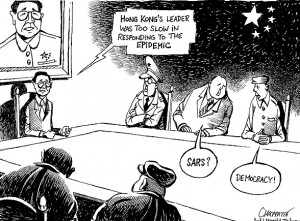
HSBC to Hong Kong?

HSBC proclaims that the world is its oyster.

HSBC Holdings Plc, less than two weeks before Britain’s general election, said it’s reviewing whether to move its headquarters out of the country because of rising tax and regulatory costs.

A move to Hong Kong, viewed by analysts as the bank’s most likely destination should it relocate, would unpick a structure that’s existed since the Hongkong and Shanghai Banking Corp. acquired Britain’s Midland Bank Plc in 1992. A transfer should cost no more than $1.5 billion because HSBC still has a base in the former British colony, said Chirantan Barua, an analyst at Sanford C. Bernstein Ltd. in London.

“The work is underway,” Chairman Douglas Flint told shareholders at the bank’s annual meeting in London on Friday. “The question is a complex one and it is too soon to say how long this will take or what the conclusion will be.”

 Flint has been under pressure from investors to consider moving from the U.K., where a levy imposed on banks’ global balance sheets following the financial crisis cost HSBC 750 million pounds ($1.1 billion) last year, more than any other lender. Europe accounts for less than a quarter of profit at the bank, which operates in more than 70 nations.

“They may not like the U.K., but I’m not sure there’s exactly going to be a raft of people queuing up to have them” because of the size of HSBC’s $2.6 trillion balance sheet, said Edward Firth, head of European bank research at Macquarie Group Ltd. in London. “Hong Kong is the only serious possibility.”

In a statement, the Hong Kong Monetary Authority noted what it called HSBC’s “deep historical links” and said it would take a “positive attitude” should the lender decide to move.

Finance Director Iain Mackay said in an interview: HSBC won’t just look at Hong Kong, but other countries with a strong regulatory framework including Canada, the U.S., China, Australia, Singapore, France and Germany.

HSBC also said it’s concerned about Britain’s potential exit from the European Union.

Standard Chartered, another British bank that like HSBC makes most of its profit in Asia, is also being urged by investors to relocate because of the cost of being in London. The U.K. levy cost Standard Chartered $366 million last year, accounting for about 9 percent of its $4.2 billion of pretax profit.

Hong Preferred Home for Bankers?


Family Businesses Deserve Attention

Report from the Economist:  Family companies are much more than just half-formed public companies. They are a category of companies in their own right. They have unique advantages in the form of long-term thinking and concentrated ownership. They have unique disadvantages in the form of succession problems and family feuds. And they have unique ways of dealing with these problems. Given the sheer number of family companies of all sizes, and their economic importance, they deserve a lot more attention, in particular from three groups of people: business analysts, professional managers and theorists of the firm.

Business analysts would do well to add some new tools to standbys such as company prospectuses and analysts’ reports. They might read more novels—say Jane Austen’s “Pride and Prejudice” for its observations on the marriage market and Thomas Mann’s “Buddenbrooks” for its insights into the fading of the entrepreneurial spirit across the generations. They should also follow the gossip columns.  A bad marriage can doom a business empire.

They should certainly keep an eye on problems of succession. A huge transfer of corporate wealth and power is currently taking place in two parts of the world—Asia and the Middle East—which have little experience of such things. The fate of two of the world’s biggest companies, Samsung and Hutchison Whampoa, is being shaped by family succession.

Business analysts like to argue that conglomerates will become less prevalent as markets develop, but conglomerates are also driven by families’ desire to provide opportunities for their offspring.  LVMH has managed to buy a number of family-owned luxury companies because they are much happier selling to another family firm than to an anonymous public company. Estée Lauder is pursuing a similar strategy in buying up family-owned beauty companies.


A consulting trio argues that public companies have a lot of important lessons to learn from family companies, from the value of long-term thinking to the virtues of frugality. They commended family companies on their ability to develop a cadre of loyal staff. Nestlé, a Swiss food company, slightly underperforms its big competitors in good times but outperforms them in bad. Essilor, a global leader in optical lenses, is obsessed with cost, keeps its debt low and has little staff turnover.

The more companies compete to sell “meaning” as well as mere products, the better family companies will do.

The most intriguing challenge posed by the enduring success of the family company is to one of the building blocks of modern economics: the theory of the firm.

Put companies and families together, and you have a uniquely potent combination

The prevalence of family companies in so much of the world suggests that theorists of the firm need to think more in terms of groups of firms rather than just individual firms.

Inheritance and ownership bring with them a whole collection of problems that are every bit as tricky as agency and transaction costs. Heirs frequently quarrel about their inheritance, and some owners behave less responsibly than others.

The company is one of the most powerful instruments ever produced by human beings; it allows investors and workers to pool their resources to serve the needs of strangers to mutual benefit.  Families with names like Rothschild and Baring played a starring role in creating modern capitalism. Families with names like Godrej and Lee will play a starring role in re-creating it in a more global age.

Family Businesses

US Economic Dominance and the AIIB

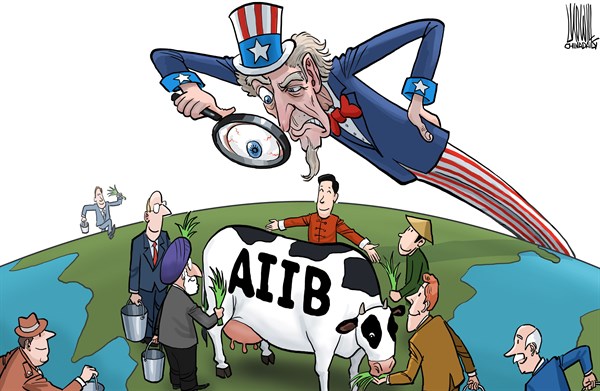
Mark Fleming-Williams writes:  Former U.S. Treasury Secretary Lawrence Summers wrote on April 5 that this month may be remembered as the moment the United States lost its role as the underwriter of the global economic system. His comments refer to the circumstances surrounding China’s launch of a new venture, the Asia Infrastructure Investment Bank, (AIIB).  Wary of China’s growing ambitions and influence, the United States had advised its allies not to join the institution, but many signed up anyway. The debacle was undoubtedly embarrassing for Washington, but even so, Summers’ prophecy is a bit premature at this stage.  US Economic Dominance

US and AIIB